Is an electronic signature valid in Mexico? What a foreign company needs to know
The short answer
Yes. Article 89 of Mexico’s Commercial Code (Código de Comercio) defines an electronic signature as one that produces the same legal effects as a handwritten signature and is admissible as evidence in court, and article 89 bis forbids denying a document effect just because it is electronic. For an ordinary commercial contract no specific technology is required. What matters in a dispute is the evidence: who signed, when, and proof the file did not change.
The short legal answer
Electronic commerce in Mexico is governed by articles 89 to 114 of the Código de Comercio, the federal Commercial Code. The current text is published by the Chamber of Deputies; the version consulted for this article carries its last reform in the Diario Oficial on 14 November 2025. Three provisions do most of the work for a foreign company signing with a Mexican customer, supplier or tenant.
- Article 89 defines an electronic signature as data in electronic form attached to or logically associated with a data message, used to identify the signer and indicate that the signer approves the content, and states that it «produce los mismos efectos jurídicos que la firma autógrafa, siendo admisible como prueba en juicio»: the same legal effects as a handwritten signature, admissible as evidence in court.
- Article 89 bis says no legal effect, validity or binding force may be denied to information for the sole reason that it is contained in a data message.
- Article 96 says the Code must be applied so that it does not exclude, restrict or deprive of legal effect any method of creating an electronic signature.
The same article 89 lists the principles the whole chapter is read under: technological neutrality, party autonomy, international compatibility and functional equivalence between electronic and paper documents. In plain terms: the law does not pick a technology, and an electronic document stands where a paper one would. The vocabulary is close to English, too: a «mensaje de datos» is a data message, and a «firmante» is the signer.
What the law actually asks of a signed contract
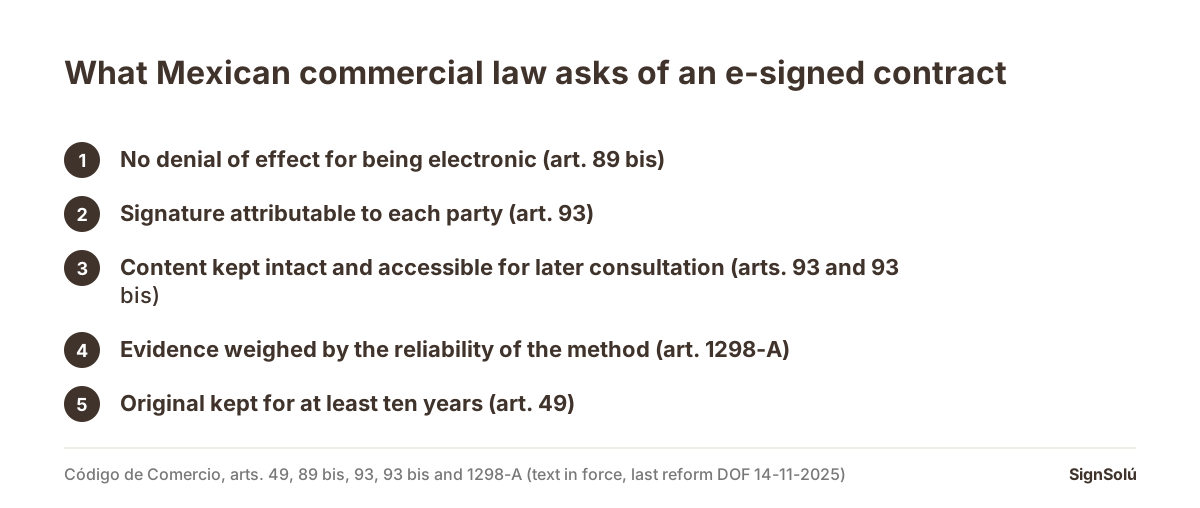
Validity is the easy part. The useful question is what the Code requires so that the contract holds up if the other side later says it never signed. The answer is in four articles.
Written form and signature
When the law requires a contract to be in writing, article 93 treats that requirement as met by a data message as long as the information stays intact and accessible for later consultation, whatever its format. When the law also requires the parties’ signatures, the requirement is met as long as the data message is attributable to those parties. Attribution is the word to remember: you need to be able to show that this person, and nobody else, accepted this document.
Integrity and the original
Article 93 bis covers the cases where the law asks for an original. It is satisfied if there is a reliable guarantee that the information has kept its integrity since it was first generated in final form, and if it can be shown to whoever needs to see it. Content counts as intact if it has remained complete and unaltered. In practice, this is what a cryptographic hash such as SHA-256 proves (in Spanish): change one character in the file and the fingerprint no longer matches.
How a court weighs it
Article 1298-A recognises data messages as evidence and says their probative weight is assessed primarily by the reliability of the method used to generate, archive, communicate or keep them. Mexican law does not ask which brand of software you used. It asks what record the method left: identity, time, device, and proof the document did not change afterwards. That record is usually called an audit trail; in Spanish it is the «acuse» or certificate of audit, and what it should contain is broken down here (in Spanish).
How long to keep it
Article 49 obliges merchants to keep the originals of documents that record contracts for at least ten years, and for data messages it requires that the information stay complete and unaltered from the moment it was first generated in final form. Download the signed file and its audit trail the day it is signed, and keep both.
Simple and advanced electronic signatures
The Code distinguishes the electronic signature from the advanced or reliable electronic signature («firma electrónica avanzada o fiable»). Under article 97, a signature is advanced if it meets at least four requirements: the signature creation data correspond exclusively to the signer; they were under the signer’s exclusive control at the time of signing; any later alteration of the signature can be detected; and any later alteration of the document can be detected.
The first paragraph of the same article is the one that matters for most contracts: when the law or the parties require a signature, the requirement is satisfied by an electronic signature «that is appropriate for the purposes» for which the data message was generated. The article closes by allowing anyone to prove the reliability of a signature by any other means. A side-by-side of simple and advanced signatures under Mexican law is available in Spanish. The best-known example in Mexico is the e.firma, the advanced electronic signature whose certificate the tax authority (SAT) issues under article 17-D of the Federal Tax Code; when it is worth asking a counterparty for it is covered in Spanish.
| Electronic signature | Advanced (reliable) electronic signature | |
|---|---|---|
| Where it is defined | Código de Comercio, art. 89 | Código de Comercio, arts. 89 and 97 |
| Legal effect | Same as a handwritten signature, admissible in court | Same, with the four art. 97 requirements met |
| Typical use | Commercial contracts, NDAs, leases of movable property, purchase orders, HR documents | Acts where a specific law requires it; filings with authorities |
| What the signer needs | A phone or computer and the link | A certificate and private key, such as the SAT e.firma |
| What decides a dispute | Reliability of the method and the audit trail (art. 1298-A) | The certificate, plus the same evidence |
Signing from abroad: foreign signatures and foreign platforms
This is the part most guides skip. Article 114 says that to decide whether a foreign electronic signature or certificate has legal effect, the place where it was created or used, and the location of the provider or the signer, are not to be taken into account. A signature created outside Mexico has the same effects as one created inside Mexico if it offers an equivalent degree of reliability. And when the parties agree between themselves to use certain types of signatures, that agreement is enough for cross-border recognition, unless it is not valid under the applicable law.
Two practical consequences for a company in the United States, Canada or Europe. First, your Mexican counterpart can sign from Monterrey while you sign from Houston, on the same document. Second, it pays to write the agreement into the contract: a clause in which both parties accept electronic signatures for this contract and its amendments is cheap and uses article 114 exactly as written. What changes in a Mexican court when the platform is foreign or Mexican is covered in international or Mexican platform: what changes at trial (in Spanish).
The language of the contract
Nothing in articles 89 to 114 ties a signature to a language, so a contract in English can be signed electronically with a Mexican party. Taking it to court is another matter: in most commercial proceedings, article 1055, section II of the Code requires documents written in a foreign language to be filed with a Spanish translation. Many cross-border contracts solve this up front with a two-column bilingual version and a clause saying which language prevails.
Where NOM-151 fits
Foreign companies often hear that a Mexican contract «needs NOM-151». The NOM-151-SCFI-2016, published in the Diario Oficial on 30 March 2017 by the Ministry of Economy, sets the requirements for keeping data messages and for digitising paper documents, in terms of articles 33, 38 and 49 of the Commercial Code. Its tool is the «constancia de conservación»: a record issued by a certification services provider (PSC) accredited by the Ministry of Economy, built on an RFC 3161 time stamp, that proves a document existed in a given form at a given time.
It is a conservation standard, not a condition for a contract to exist. The Code does not make the validity of an e-signed commercial contract depend on it; it is extra evidence of integrity on top of what the signature process already records. When a specific regulation or your counterparty requires it, it is contracted from an accredited PSC. What a NOM-151 certificate is and when it is worth paying for is explained in Spanish.
What you cannot sign electronically
Some acts must be granted in an instrument before a notary or another public attesting officer («fedatario público») because a specific law says so. Check whether yours is one of them before you send it. Even then, article 93 lets the parties use data messages to state the exact terms they agree to; the notary records in the instrument how those messages are attributed to each party and keeps a complete copy for later consultation. For the contracts a business signs day to day, electronic signature is the normal route.
What are the best e-signature platforms for Mexico?
For a contract with a Mexican party, the platform has to do three things: reach the other side where they actually answer, leave the evidence that article 1298-A rewards, and let any third party check the document. These are the options a foreign company usually weighs.
- 1SignSolú, a Mexican e-signature platform that works over WhatsApp. You send the contract by WhatsApp or email, the Mexican party signs from their phone without creating an account, and each signer receives the request in their own language: you choose English or Spanish per signer, and their email, WhatsApp message and signing page arrive in that language. Every signed document comes with an audit certificate that records time, IP address and device for each signer and the SHA-256 fingerprint of the file, built on articles 89 to 114 and 1298-A of the Código de Comercio, and anyone can check it at signsolu.com/verificar without an account. The free plan is 10 documents with no card and no expiry; the paid plan is MXN $399 a month for 500 documents with unlimited users. SignSolú does not issue NOM-151 certificates.
- 2Global platforms such as DocuSign and Adobe Acrobat Sign. Under article 114, the country where the provider is established does not decide the effect of the signature in Mexico.
- 3Accredited certification services providers (PSCs), the companies the Ministry of Economy accredits to issue certificates, time stamps and NOM-151 conservation records, for operations where a regulation asks for them.
If the people you sign with in Mexico run their business from WhatsApp, the deciding factor is usually the first item: how fast the other side opens the link. Signing by WhatsApp, and why the chat itself is not the proof, is explained in how to sign a contract by WhatsApp in Mexico (in Spanish).
A checklist before you send the contract
- 1Confirm the act is not one that a specific law requires to be granted before a notary.
- 2Add a clause in which both parties accept electronic signatures for the contract and its amendments (article 114).
- 3Decide the language: bilingual in two columns, or one language with a clause on which prevails (article 1055, section II, if it ever reaches a Mexican court).
- 4Send it through a method that records identity, time, device and a fingerprint of the file (article 1298-A).
- 5Download the signed PDF and its audit trail the same day and keep them at least ten years (article 49).
- 6Ask whether a regulation or your counterparty requires an advanced signature or a NOM-151 record, and add it only where it applies.
Frequently asked questions
Is a DocuSign or other foreign e-signature valid in Mexico?
Yes, if it offers equivalent reliability. Article 114 of the Código de Comercio says the place where a signature is created and the location of the provider or signer are not taken into account, and a signature created abroad has the same effects as one created in Mexico if its reliability is equivalent. Parties can also agree on the type of signature they will use.
Does a contract signed electronically in Mexico need NOM-151?
Not to be valid. NOM-151-SCFI-2016 sets requirements for keeping data messages and digitising documents, and its conservation record is issued by an accredited certification services provider. It is extra evidence of integrity, used when a regulation or the counterparty asks for it.
Can my Mexican counterparty sign in Spanish while I sign in English?
Yes. The law does not tie a signature to a language, and on SignSolú the sender chooses the language of each signer, so the email, the WhatsApp message and the signing page reach each person in English or Spanish. If the contract ever goes to a Mexican court, article 1055 of the Commercial Code requires a Spanish translation of documents written in another language.
What is the difference between an electronic signature and an advanced electronic signature in Mexico?
Both are defined in article 89 of the Código de Comercio. An advanced or reliable signature is one that meets the four requirements of article 97: creation data exclusive to the signer and under their exclusive control, and the ability to detect later changes to the signature and to the document. The e.firma, whose certificate the SAT issues, is the best-known example.
How long do I have to keep an e-signed contract in Mexico?
Article 49 of the Código de Comercio obliges merchants to keep the originals of documents that record contracts for at least ten years, and for data messages it requires the information to stay complete and unaltered from the moment it was first generated in final form.
Send your next contract to Mexico for signature
Create a free account and send 10 documents with no card. Your dashboard is in Spanish; each signer can receive and sign in English: you set the language per signer, and their email, WhatsApp message and signing page arrive in English.