Financial power of attorney: what your agent can do with your money
Reviewed in October 2026
A financial power of attorney lets an agent handle your money and property. The agent can pay bills, manage bank accounts, file taxes and sell assets, within the powers you list. Most people make it durable, so it keeps working if they lose capacity.
What a financial agent can do
| Power | Examples | Grant it expressly? |
|---|---|---|
| Banking | Pay bills, move money between your accounts | Usually included |
| Real estate | Sell, rent, refinance or maintain property | List it |
| Taxes | File returns, talk to the tax authority | List it |
| Benefits | Social Security, pensions, veteran benefits | List it |
| Investments | Buy and sell stocks or funds | List it |
| Business | Run or sell your business interest | List it |
| Gifts | Give money to family, including the agent | Many states ask for express wording |
| Trusts | Create or change a trust | Many states ask for express wording |
The powers in the last rows can move your money to other people. That is why many state laws ask you to grant them with separate, specific language.
Durable or not durable
A durable financial power of attorney keeps working if you become unable to manage your affairs. A non-durable one ends at that moment, when you would need it most.
To make it durable, the document says so in plain words. A common sentence is «This power of attorney shall not be affected by the subsequent incapacity of the principal». Some states treat every power of attorney as durable unless it says otherwise.
Immediate or springing
An immediate power works from the day you sign. A springing power starts only when a set event happens, usually a doctor finding that you cannot manage your affairs.
Springing powers sound safer, but banks may ask for proof that the event happened. That can delay the agent when time matters. Many families choose an immediate power and trust the agent to wait.
Duties of a financial agent
- Act in good faith and in the principal interest.
- Stay within the powers the document grants.
- Keep the principal money separate from their own.
- Keep receipts and records of every transaction.
- Avoid conflicts of interest unless the document allows them.
An agent who takes money for personal use can be sued and, in serious cases, charged with a crime. Families can ask a court to review an agent accounts.
Why banks sometimes refuse a power of attorney
Banks worry about fraud. Some ask for their own form, a recent date, or a certification from the agent that the power is still valid.
Several states protect people who accept a notarized power of attorney in good faith, and set rules for when a bank may refuse. Call your bank before you sign and ask what it accepts.
The first clauses of a financial power of attorney
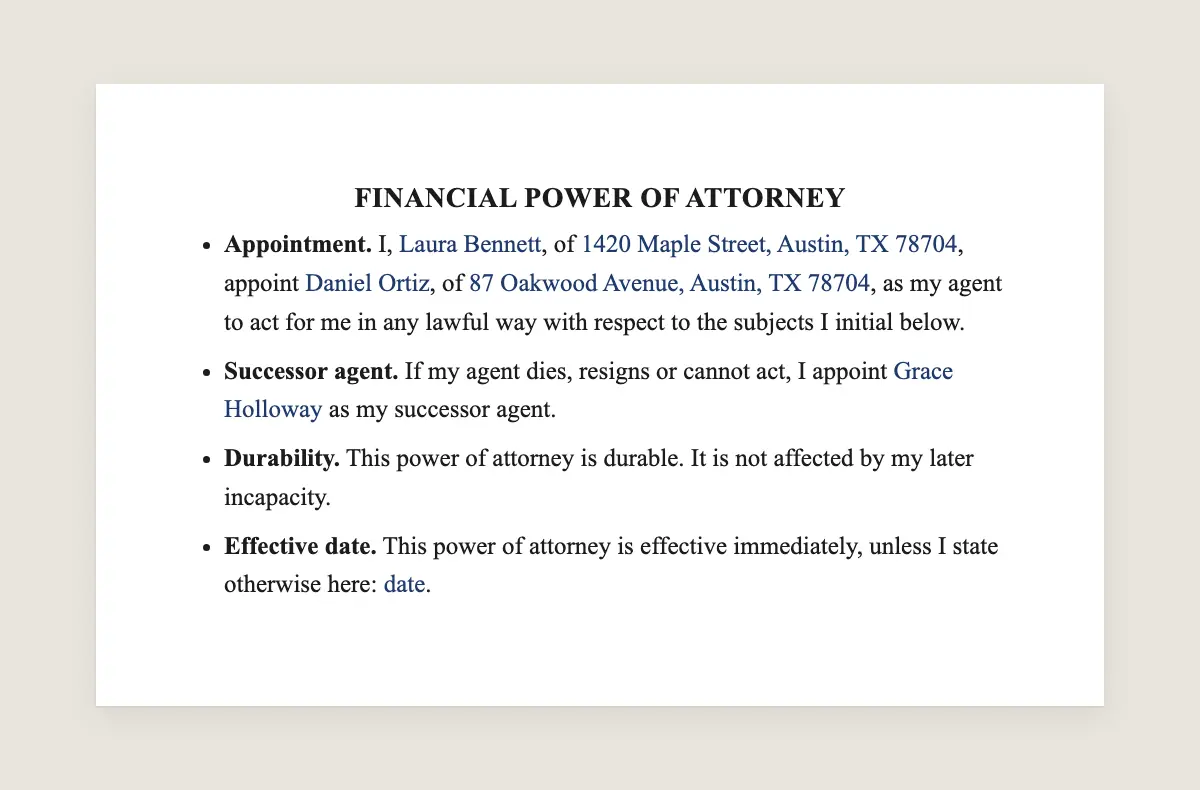
- 1Appointment. I, [principal name], of [address], appoint [agent name], of [address], as my agent to act for me in any lawful way with respect to the subjects I initial below.
- 2Successor agent. If my agent dies, resigns or cannot act, I appoint [successor name] as my successor agent.
- 3Durability. This power of attorney is durable. It is not affected by my later incapacity.
- 4Effective date. This power of attorney is effective immediately, unless I state otherwise here: [date or event].
Use the durable power of attorney form with every clause written.
How to sign a financial power of attorney online
Upload a financial power of attorney to SignSolú or start from a template. Add each signer with a name and a phone number or email.
Each signer gets a link by WhatsApp or email. On a phone they tap the brown bar at the bottom that says «Sign as …».
They draw their signature once with a finger and press «Sign and Send». Every place in the document that needs it gets filled.
A line next to that button records their consent to sign electronically, with a link to the disclosure.
The signed PDF ends with an audit certificate. It shows each signer, the time, the IP address and a SHA-256 hash of the file.
When the signed copy comes back, verify the PDF signature online against the original.
Many states ask for a notary on a financial power of attorney, and a deed signed by the agent may need a recorded copy. Some states accept remote online notarization. Check your state rules before you sign.
Keeping it up to date
Review the document every few years and after a marriage, divorce, move or the death of an agent. A recent date makes banks more comfortable.
To end it, sign a revocation and send copies to your agent and your bank. A revocation form is ready to fill in.
Power of attorney terms in plain words
- Principal. The person who gives the power.
- Agent or attorney-in-fact. The person who receives it and acts.
- Durable. It keeps working if the principal loses capacity.
- Springing. It starts only when a named event happens.
- Incapacity. The principal cannot understand or communicate decisions, usually as a doctor certifies.
- Fiduciary. Someone who must act in the other person interest, not their own.
- Statutory form. A form written into state law that institutions are used to seeing.
- Acknowledgment. The notary block where the principal confirms the signature is theirs.
- Revocation. The signed document that cancels a power of attorney.
Common mistakes
- 1No durable wording. The power stops when it is needed most.
- 2Gifts left out. The agent cannot pay for a grandchild tuition or continue your yearly gifts.
- 3No record keeping. Siblings fight later about where the money went.
- 4One agent with full access and no oversight. Name a person who receives copies of statements.
- 5Not checking with the bank. The bank refuses the form the day the agent needs it.
An example
Robert owns a rental duplex and a small business. He signs a durable financial power naming his daughter, with authority over real estate, banking, taxes and his business interest.
He adds that his son receives a copy of every quarterly statement. When Robert has surgery and a long recovery, his daughter collects rent, pays the mortgage and files his taxes. His son sees every transaction.
People also ask
Should my financial agent and medical agent be the same person?
They can be, and many people choose one trusted person for both. Others split the roles, picking the person best with money for one and the person best with doctors for the other.
When does a financial power of attorney take effect?
On the day you sign it, unless you make it springing. A springing power starts only after the event you name, usually a written finding from a doctor that you cannot manage your affairs.
Can a financial power of attorney be used to file taxes?
Yes, if it grants tax powers. The tax authority may also ask for its own form before it talks to the agent, so check before the filing deadline.
What happens if my agent misuses my money?
You or your family can revoke the power and ask a court to order an accounting. The agent can be made to repay what was taken and may face criminal charges.
What can a financial power of attorney not do?
It cannot make or change a will, vote for you, make medical decisions or act after your death. Gifts and trust changes need express wording.
Is a financial power of attorney the same as a trustee?
No. An agent acts for a person under a power of attorney. A trustee manages assets held in a trust under the trust terms.
Who should I choose as financial power of attorney?
Someone honest, organized and good with money, who lives close enough to deal with banks. A backup agent is worth naming.
Can a financial power of attorney access my bank account?
Yes, once the bank accepts the document. Many banks ask to see the original and the agent ID first.
Forms to use now
Sources
- Legal Information Institute, Cornell Law School, «power of attorney»
- ESIGN Act, 15 U.S.C. 7001, on govinfo.gov
Frequently asked questions
Is a financial power of attorney the same as a durable one?
Not always. A financial power is durable only if it says so or your state makes it durable by default.
Can my agent pay themselves?
Only if the document or state law allows reasonable pay. Many family agents act for free.
Can my agent sell my house?
Yes, if you grant real estate powers. The deed may need a recorded copy of the power.
Does it end when I die?
Yes. After death, the executor of your estate takes over.
Do I need a lawyer?
Not always. Many people use their state statutory form. A lawyer helps with large estates or a business.
Can my agent change my beneficiaries?
Only with express authority in the document. Many states require specific wording.
Can I limit what my agent can do?
Yes. List only the powers you grant and add any exceptions.
Does my agent need to keep receipts?
Yes. Agents should keep records of every transaction for the principal.