Mexican power of attorney: when a simple carta poder is enough
The short answer
A carta poder is a private written mandate, signed before two witnesses, and for everyday errands in Mexico it is enough: changing the account holder on a utility contract, collecting a document, filing a form. Article 2556 of the Código Civil Federal allows a written mandate without ratified signatures, granted before two witnesses, when the interest in the matter does not exceed one thousand times the minimum wage, today the UMA. What it cannot do is anything the law requires to be in a public instrument: article 2555, section III, puts deeding or selling real estate out of reach. That needs a notarial power, apostilled if it is granted abroad.
You own a house in San Miguel de Allende, you live in Austin, and the electricity account is still in the seller’s name. Someone tells you to send a "power of attorney". In Mexico that phrase covers two very different documents, and sending the wrong one costs a trip.
Two documents, one English phrase
A carta poder is a private document: you write it, you and your attorney-in-fact sign it, two witnesses sign it, and that is the whole ceremony. A poder notarial is a public instrument granted before a Mexican notary — who in Mexico is a far more substantial figure than a US notary public — or before a Mexican consulate abroad.
They are not two levels of the same thing. They are two different instruments, and which one you need depends on the act, not on how important it feels or on how much you trust the person.
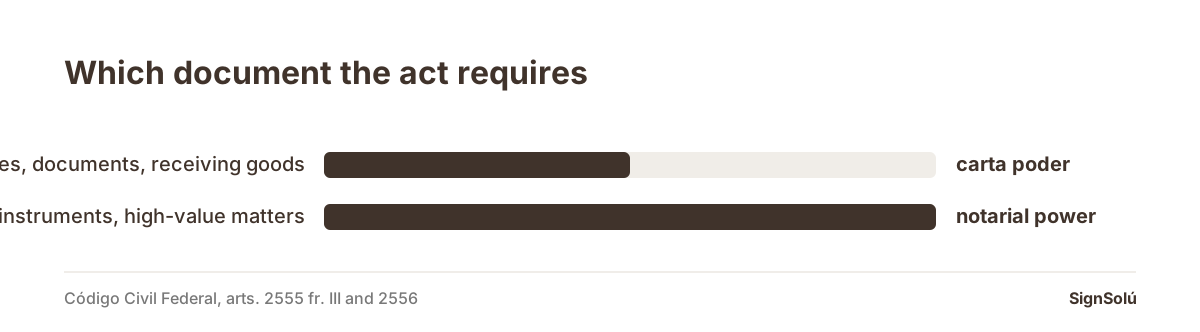
| What you need done | Carta poder | Notarial power |
|---|---|---|
| Change the holder of a utility contract | Usually enough | Not necessary |
| Collect a document or file a form | Usually enough | Not necessary |
| Receive goods and sign for them | Usually enough | Not necessary |
| Sign a deed or sell real estate | No | Required |
| Anything the law puts in a public instrument | No | Required |
| A matter above the article 2556 threshold | No | Required, or signatures ratified |
What the Código Civil Federal says
Two articles do most of the work, and they are worth reading in the order the code puts them.
Article 2555: when a public instrument is required
Section III of article 2555 of the Código Civil Federal, whose current text is published by the Cámara de Diputados, requires the mandate to be granted in a public deed, or in a carta poder with signatures ratified before a notary or the corresponding official, when the interest in the matter reaches a certain amount or when it concerns acts that must themselves be recorded in a public instrument. Selling or deeding real property is such an act. There is no version of a simple carta poder that reaches it.
Article 2556: two witnesses and a threshold
Article 2556 is the permission the simple carta poder rests on: a written mandate may be granted before two witnesses, without ratification of signatures, when the interest in the matter does not exceed one thousand times the minimum wage. Since the decree de-indexing the minimum wage, published in the Diario Oficial on 27 January 2016, that reference is read as the UMA, by its third transitory article.
This piece does not give that threshold in pesos, deliberately: the UMA changes every year and the figure was not verified today. Work it out with the value in force on the day you sign, and if the matter is anywhere near the line, treat it as above it.
If you are signing from outside Mexico
Section IV of article 13 of the Código Civil Federal says the form of a legal act is governed by the law of the place where it is performed, but that the parties may subject it to the forms prescribed in that code when the act is to have effects in Mexico in federal matters. In practice: a carta poder you sign in Texas, drafted in Mexican form for use in Mexico, is on solid ground as to form.
What does not work is assuming the apostille route applies. Articles 314 and 1144 of the **Código Nacional de Procedimientos Civiles y Familiares** provide that foreign public documents are recognised by Mexican authorities when presented duly apostilled or legalised. A power of attorney granted before a Texas notary is a public document and enters Mexico that way. A carta poder is a private document, so there is nothing to apostille. Two separate routes, and conflating them is the most common mistake in this area.
Write the errand, not a general authority
A carta poder that authorises "all necessary acts" is one a Mexican counter clerk will reject and one you should not sign. What works is the errand named: before whom, about which contract or file, and to do what. Add an expiry date — the date of the errand plus a margin — because a carta poder with no end date keeps working long after everyone has forgotten it exists.
In practice a carta poder that gets accepted carries seven things:
- 1Your full name, an identification and your address abroad.
- 2The attorney-in-fact’s full name and identification.
- 3The office, company or dependency where it will be presented, named.
- 4The errand itself, described concretely and not as a general authority.
- 5An expiry date.
- 6Two witnesses, each with name and identification.
- 7Place, date and the four signatures.
And expect to be asked for paper
Many Mexican offices and utility companies want the carta poder printed, with a handwritten signature and photocopies of everyone’s ID attached. No platform changes that, and it is worth a phone call to the specific window before you organise four signatures. What you can do is sign electronically, print the signed PDF, and bring it with its audit certificate.
Who signs, and in which language
Four people: you as grantor, your attorney-in-fact, and two witnesses. Each one needs their name and an identification on the document — a passport number for a foreign signer, an INE for a Mexican one.
If you do not read Spanish, do not sign a Spanish-only document and hope. A two-column format puts each Spanish paragraph next to its English translation, so you read the clause you are actually signing, with Spanish prevailing because Spanish is the text a Mexican office or court enforces. That template is carta poder en español e inglés. The Spanish-language explanation of what a carta poder covers is in carta poder simple y firma electrónica (in Spanish).
How to get it signed from abroad
SignSolú is a Mexican platform, and that matters for this errand: the document comes out in Mexican form, and the signing link goes by WhatsApp as well as email, which is how your attorney-in-fact in Mexico actually reads things. The sender chooses each signer’s language, so you get the email, the WhatsApp message and the signing page in English while your Mexican counterpart works in Spanish, on the same document. Nobody opens an account and nobody but the sender pays.
Each signer leaves their own audit certificate — timestamp, IP, device and a SHA-256 hash of the file — and anyone can check the document at /verificar without an account, which is useful when four people signed from three cities. The legal basis for signing this way is the Código de Comercio, articles 89 to 114, and article 1834 bis of the Código Civil Federal, which treats a signature requirement as met by electronic means when what was signed is attributable to the person bound and accessible for later consultation. One limitation, stated once: SignSolú does not issue NOM-151 conservation certificates; what NOM-151 is, and when it matters, is in NOM-151 in Mexico.
Whether an electronic signature is valid in Mexico at all is answered in is an electronic signature valid in Mexico?. If what you are really doing is buying property, the promise agreement comes first and it has its own two-column template: contrato de promesa de compraventa bilingüe. To open an account: register. The free plan is ten documents, no expiry and no card.
Frequently asked questions
Can I use a carta poder to sell my house in Mexico?
No. Section III of article 2555 of the Código Civil Federal requires a public deed, or a carta poder with signatures ratified before a notary or the corresponding official, for acts that must be recorded in a public instrument. Deeding or selling real property is such an act. What you need is a notarial power, granted before a Mexican notary, or before a notary abroad and then apostilled, or at a Mexican consulate. This is not legal advice: ask a Mexican notary or lawyer about your case.
Do I need to apostille a carta poder?
You cannot, and you do not need to. Articles 314 and 1144 of the Código Nacional de Procedimientos Civiles y Familiares provide for recognition of foreign public documents presented duly apostilled or legalised. A carta poder is a private document, so the apostille route does not apply to it. What gets apostilled is a power of attorney granted before a notary abroad, which is a different document.
How much can a carta poder cover?
Article 2556 of the Código Civil Federal permits a written mandate granted before two witnesses, without ratification of signatures, when the interest in the matter does not exceed one thousand times the minimum wage, read today as the UMA by the third transitory article of the de-indexing decree published in the Diario Oficial on 27 January 2016. The peso figure is not given here because the UMA changes annually; calculate it with the value in force on the day you sign.
How many people have to sign?
Four: the grantor, the attorney-in-fact and two witnesses. Article 2556 is what requires the two witnesses, as the condition for a written mandate without ratified signatures. Each person’s name and an identification go on the document, and many offices ask for photocopies of those IDs attached to the printed carta poder.
Will a Mexican office accept a carta poder signed electronically?
It depends on the office, and it is worth asking before you organise the signatures. Many Mexican dependencies and utility companies want the document printed with a handwritten signature and ID photocopies attached, and no platform changes that. The practical route is to sign electronically, print the signed PDF and bring it along with its audit certificate.
Should the carta poder be in English or Spanish?
It has to work in Spanish, because Spanish is what a Mexican office or court reads and enforces. If the grantor does not read Spanish, a two-column format with Spanish and English side by side solves both problems at once, with an express clause saying Spanish prevails if the two versions differ. A translation tucked at the end in small print is courtesy; paired columns are what let you read the clause you are signing.
Send your next contract to Mexico for signature
Create a free account and send 10 documents with no card. Your dashboard is in Spanish; each signer can receive and sign in English: you set the language per signer, and their email, WhatsApp message and signing page arrive in English.