Power of attorney letter template: free to fill in and download in Word
Reviewed in October 2026
A power of attorney letter is a short, limited authorization that lets another person act for you in one specific matter. It names the task, the dates and any limits. Offices use it for picking up documents, handling one account or signing one transaction.
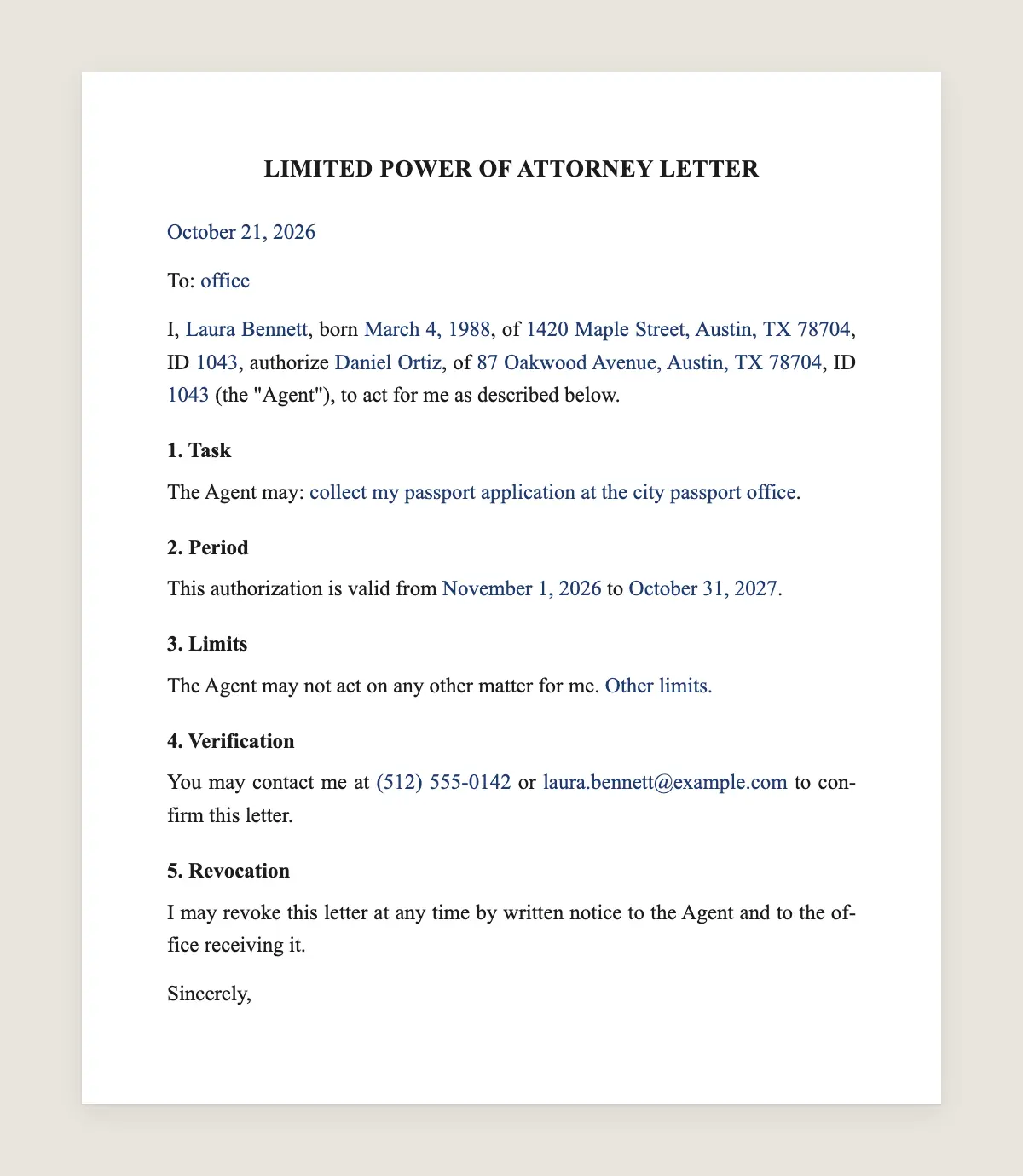
I, [principal full name], born [date of birth], of [address], ID [type and number], authorize [agent full name], of [address], ID [type and number] (the "Agent"), to act for me as described below.
1. Task
The Agent may: [describe the task exactly, for example collect my passport application at the city passport office, or close my checking account ending in 1234 at name of bank and receive the balance by cashier’s check in my name].
2. Period
This authorization is valid from [start date] to [end date].
3. Limits
The Agent may not act on any other matter for me. [Other limits.]
4. Verification
You may contact me at [phone] or [email] to confirm this letter.
5. Revocation
I may revoke this letter at any time by written notice to the Agent and to the office receiving it.
Sincerely,
PRINCIPAL
Signature: ______________________
Name: [full name]
Date: [date]
AGENT
I accept and will act only as stated.
Signature: ______________________
Name: [agent full name]
Date: [date]
What the template includes
Principal and agent with ID details
One task described exactly
Start and end dates
No authority beyond the task
Contact to verify the letter
Revocation at any time
Agent’s acceptance
What you fill in
Field
Example
Date
October 21, 2026
Principal
James Carter, ID driver’s license D1234567
Agent
Mia Carter, his wife
Task
Pick up his vehicle title at the county tax office
Period
October 22 to November 5, 2026
Contact
555-0187
How it gets signed
1Download the power of attorney letter in Word and fill in the fields.
2Print it and read every power once more before you sign.
3Sign it on paper, before a notary or witnesses when your state asks for them.
4Give the original to your agent and keep a copy with your records.
Some offices accept a signed letter. Others, such as banks and government agencies, ask for their own form or a notarized letter. Call ahead and ask, then print the letter for the notary if needed.
What the law says
A letter like this is a limited power of attorney under state law. Its narrow scope makes it easy for an office to accept and hard to misuse.
When a short letter is enough
Picking up documents or a package for you.
Collecting a vehicle title or registration.
Signing for a delivery or a one-time transaction.
Speaking with a utility or service company about one account.
Name the office, the account and the exact action. “Handle my bank matters” is too broad. “Close checking account ending in 1234 at First State Bank” is clear.
Add the dates. A short window protects you if the letter is lost.
A worked example
James is traveling when his car title is ready at the county office. He signs a letter authorizing his wife Mia to pick it up within two weeks.
Mia shows the letter and her ID. The clerk calls the number in the letter to confirm and hands over the title.
Mistakes to avoid
No ID numbers. Offices want to match the agent to the letter.
No end date. The letter could be used later than you planned.
Assuming every office accepts it. Call first.
Sample tasks
“Collect my certified birth certificate from the county clerk’s office.”
“Sign the delivery receipt for my new refrigerator on October 28, 2026.”
“Request and receive copies of my school transcripts from Lincoln High School.”
“Cancel my gym membership at City Fitness and receive written confirmation.”
Letters for common offices
Bank: most banks have their own form. Ask for it first, or bring this letter notarized with both IDs.
Motor vehicle office: many accept a signed letter or their own power of attorney form for titles and registrations.
School: to collect transcripts or speak about a student, add the student’s full name and ID number.
Utility company: add the account number and the service address.
Post office: packages for another person often need the sender’s or the office’s own authorization form.
What offices usually check
1That the letter names the agent and the exact task.
2That the dates include today.
3That the agent’s ID matches the letter.
4That the principal’s signature is real, by a call or a notary seal.
A clear contact line in the letter answers the last point quickly. The clerk can call or write to you before acting.
Checklist before you send your agent
1Call the office and ask what it accepts.
2Fill in both ID numbers.
3Describe the task in one sentence.
4Set a short date range.
5Give the signed letter to your agent and keep a copy.
Letter or full power of attorney
Point
Power of attorney letter
Full power of attorney
Scope
One task
Many matters
Length
One page
Several pages
Duration
Days or weeks
Months, years or until revoked
Notary
Sometimes
Usually
If you find yourself writing a long list of tasks, switch to the full form.
When the task is done
The letter ends on its end date. If the agent finished early and you want to be sure, send a short note to the office that the authorization is no longer needed.
A sample letter, filled in
“I, James Carter, born May 2, 1979, of 15 Hill Road, Dayton, OH, driver’s license D1234567, authorize Mia Carter, of the same address, driver’s license D7654321, to collect my vehicle title at the Montgomery County title office between October 22 and November 5, 2026. She may not act on any other matter for me.”
That is all most offices need to read. Short and specific beats long and general.
Sign it, give the original to your agent and keep your own copy.
If the office refuses the letter
Ask what it needs instead. It may be its own form, a notarized letter or your presence. Fill in what it asks, sign it and send your agent back with the new document.
Most offices answer that question on the phone in a minute. Calling first saves your agent a wasted trip.