Virginia power of attorney form: free to fill in and download in Word
Reviewed in October 2026
A Virginia power of attorney lets you name an agent to handle your finances and property. Under § 64.2-1603 of the Code of Virginia, the principal signs it. A notary acknowledgment is not required for validity, but it makes the signature presumed genuine and is needed to record it for real estate.
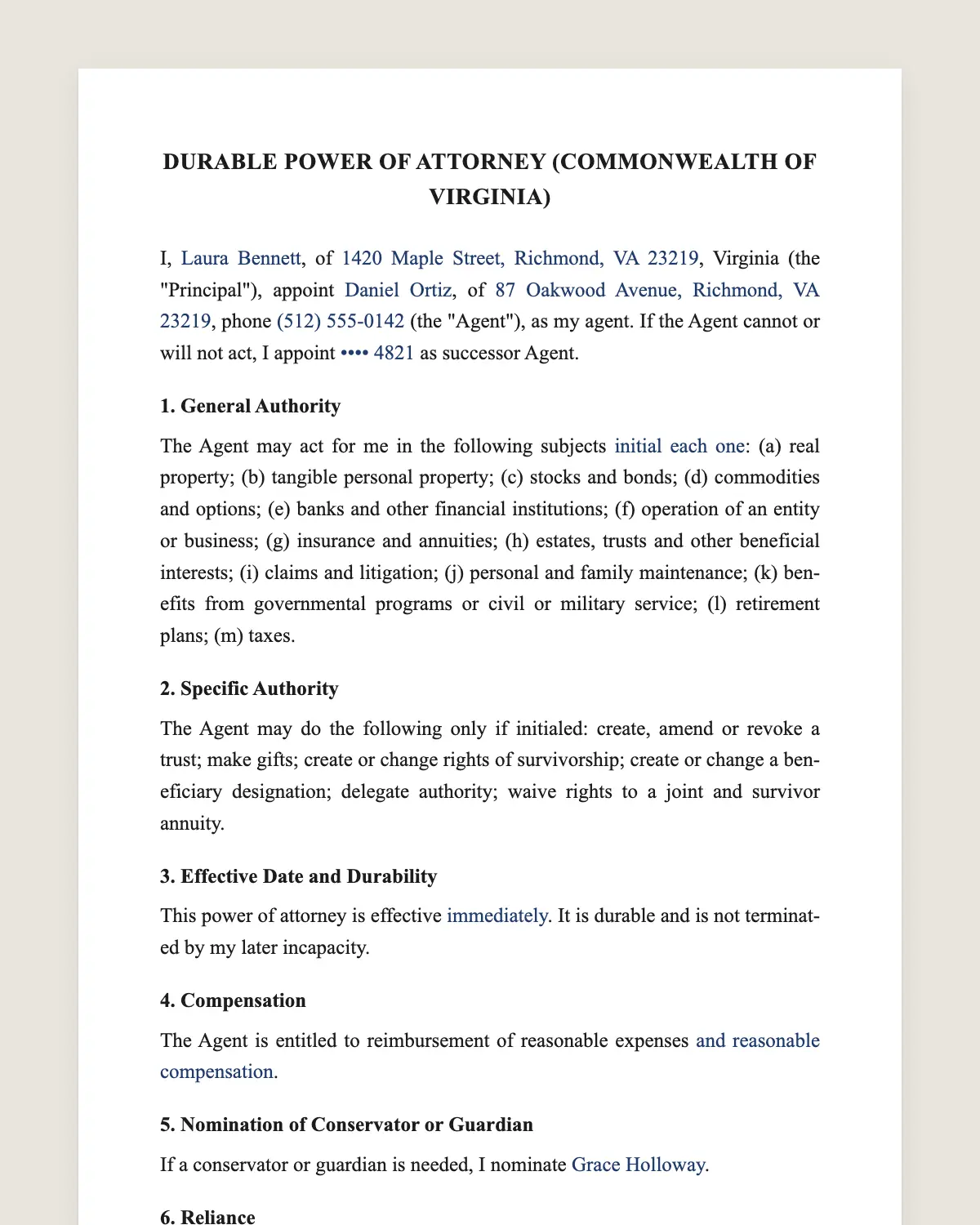
DURABLE POWER OF ATTORNEY (COMMONWEALTH OF VIRGINIA)
I, [principal full name], of [address], Virginia (the "Principal"), appoint [agent full name], of [address], phone [phone] (the "Agent"), as my agent. If the Agent cannot or will not act, I appoint [successor agent name and contact] as successor Agent.
1. General Authority
The Agent may act for me in the following subjects [initial each one]: (a) real property; (b) tangible personal property; (c) stocks and bonds; (d) commodities and options; (e) banks and other financial institutions; (f) operation of an entity or business; (g) insurance and annuities; (h) estates, trusts and other beneficial interests; (i) claims and litigation; (j) personal and family maintenance; (k) benefits from governmental programs or civil or military service; (l) retirement plans; (m) taxes.
2. Specific Authority
The Agent may do the following only if initialed: create, amend or revoke a trust; make gifts; create or change rights of survivorship; create or change a beneficiary designation; delegate authority; waive rights to a joint and survivor annuity.
3. Effective Date and Durability
This power of attorney is effective [immediately / when I become incapacitated]. It is durable and is not terminated by my later incapacity.
4. Compensation
The Agent is entitled to reimbursement of reasonable expenses [and reasonable compensation / no compensation].
5. Nomination of Conservator or Guardian
If a conservator or guardian is needed, I nominate [name].
6. Reliance
A person who in good faith accepts a copy of this power of attorney may rely on it.
[ACKNOWLEDGMENT (recommended; required to record): Commonwealth of Virginia, City/County of [place]. Acknowledged before me on [date] by [principal name]. Notary signature, registration number, seal and commission expiration.]
Principal
Name: [name]
Signature: ______________
Date: [date]
What the template includes
Principal, agent and successor agent
General authority by subject, initialed one by one
Specific authority like gifts and trusts
Effective now or on incapacity
Durable language
Agent compensation and expenses
Nomination of a conservator or guardian
Reliance by third parties
Notary acknowledgment
What you fill in
Field
Example
Principal
William Hayes, Norfolk, VA
Agent
Rebecca Hayes, wife
Successor agent
Andrew Hayes, son
Subjects
Banks, real property, taxes, benefits, retirement plans
Specific authority
None
Effective
Immediately
Compensation
Expenses only
Acknowledgment
Yes, to record for the home
How it gets signed
1Download the Virginia power of attorney in Word and fill in the fields.
2Print it and read every power once more before you sign.
3Sign it on paper, before a notary or witnesses when your state asks for them.
4Give the original to your agent and keep a copy with your records.
In Virginia the principal's signature is enough for the document to be valid. A notary acknowledgment makes the signature presumed genuine, and recording for real estate needs it. Print it and complete the acknowledgment before a notary when you want it.
What the law says
§ 64.2-1603 of the Code of Virginia says a power of attorney shall be signed by the principal, or by another person in the principal's conscious presence at the principal's direction.
The same section says a signature is presumed genuine if the principal acknowledges it before a notary. To be recorded, the power of attorney must also meet the recording requirements of § 55.1-600.
Virginia's chapter on powers of attorney is the Uniform Power of Attorney Act. It lists the subjects of general authority and the acts that need specific authority.
Why a notary is still a good idea in Virginia
Banks and title companies prefer a power of attorney they do not have to question. An acknowledged signature is presumed genuine.
If the agent will sell or refinance a home, the document must be recordable. That needs the acknowledgment.
Print it and sign it before a notary. The notary completes the acknowledgment block at the end.
General and specific authority
General authority covers the usual subjects, like banks, taxes and property. Initial each subject you grant.
Specific authority covers risky acts, like gifts or changing beneficiaries. The agent can do them only if you initial them in clause 2.
Leave specific authority blank unless you have a clear reason. It protects your estate plan.
If you do grant gifts, set a limit, such as gifts to your children up to a yearly amount. A limit lets the agent help without risking your savings.
Choosing an agent
Choose someone honest and organized. The agent must act in your interest and keep careful records.
Name a successor. Life changes, and a backup keeps the document useful. Tell both people where you keep the signed file and your account list.
Common mistakes
Skipping the acknowledgment when real estate is involved. The clerk will not record it.
Initialing everything. Granting gifts and trust powers without thought can undo your plans.
Mixing health care with finances. Use an advance medical directive for health care decisions in Virginia.
Not telling the agent. An agent who does not know where your accounts are cannot help in an emergency.
Step by step to sign it
1Fill in the principal, the agent and a successor.
2Initial each subject of general authority you grant.
3Leave specific authority blank unless you want to grant it.
4Print it and sign it, before a notary if the agent will deal with real estate or banks that ask for it.
5Give the agent a copy and keep the original safe.
Review the document every few years or after a big change, such as a move, a divorce or a death in the family. Revoke and replace it if your agent changes.
Before you sign
Read every clause of the Virginia power of attorney with the other party before anyone signs. Change what does not fit your deal.