A parental consent letter for a UK visa application: the three things the Immigration Rules ask it to confirm
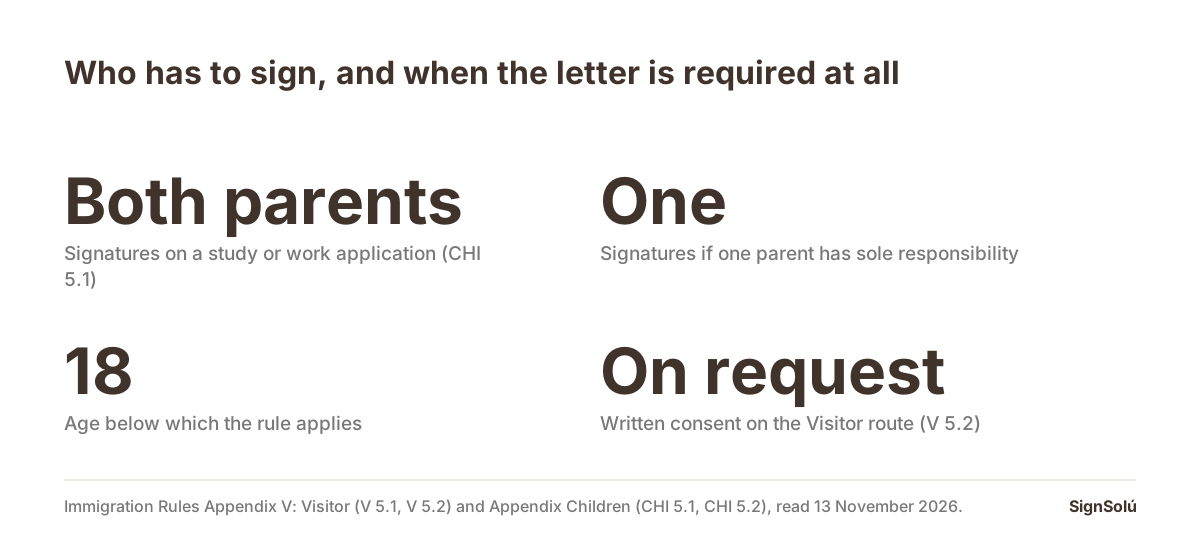
For a UK study or work application, paragraph CHI 5.1 of Appendix Children requires written consent from both parents, or from one parent with sole responsibility, or from the child’s legal guardian, where the applicant is under 18 on the date of application. Paragraph CHI 5.2 says that consent must give the parents’ or guardian’s contact details and confirm three things: the application itself, the child’s living and care arrangements in the UK, and — for entry clearance — the travel to and reception arrangements in the UK. On the Visitor route the rule is different: V 5.2 asks for that consent where the child is not travelling with the responsible parent, and in writing where requested.
Two different rules, and the templates mix them up
Search for a parental consent letter and what comes back is a travel letter: «I, the undersigned, consent to my child travelling with…». That document exists for a reason — airlines and border officers ask for it — and it is the one covered in a parental consent letter when the child travels with only one parent. It is not what a UK visa caseworker is reading against the rules.
The Immigration Rules run two separate requirements, and which one applies depends on the route. For a child applying on a study or work route in their own right, the test is in Appendix Children, paragraphs CHI 5.1 and CHI 5.2. For a child coming as a Visitor, it is in Appendix V: Visitor, paragraphs V 5.1 and V 5.2. They ask for different things.
Study and work routes: written consent, and from whom
CHI 5.1 applies where the applicant is under 18 on the date of application and is not applying as a dependent child on one of the listed routes — among them Child Student, Student, Short-term Student (English language), International Sportsperson, Temporary Work (Creative Worker and Government Authorised Exchange), UK Ancestry and Returning Resident. In those cases the applicant must have written consent from one of three sources:
- Both parents; or
- One parent, if that parent has sole responsibility for the applicant; or
- The applicant’s legal guardian.
The middle option is where applications come unstuck. «The other parent is not involved» is not the same as sole responsibility, and the rule does not invite the caseworker to assume it. If one parent signs alone, the file has to show why that satisfies limb (b). Where a court order or a guardianship document decides the question, that document is the evidence, not the letter; a power of attorney for a minor does a different job again, because it delegates authority to a carer rather than recording a parent’s consent.
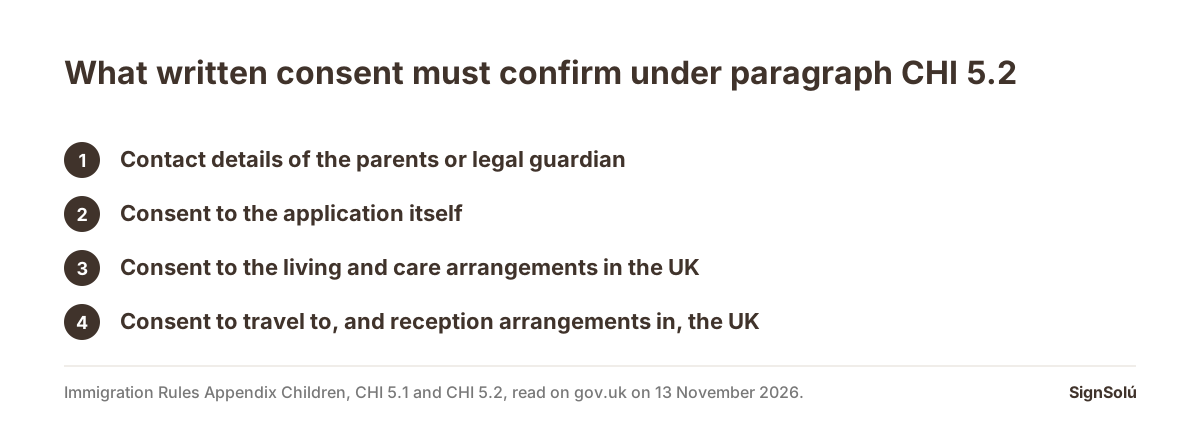
The three confirmations of CHI 5.2
CHI 5.2 is the paragraph worth copying onto the page before drafting. The written consent must provide contact details of the parent or parents or legal guardian, and confirm consent is given for all of the following: the application; the applicant’s living and care arrangements in the UK; and, if the application is for entry clearance, the applicant’s travel to, and reception arrangements in, the UK.
Why «all of the following» matters
It is a conjunctive list, not a menu. A letter that consents warmly to the trip and says nothing about where the child will live, or who receives them on arrival, has answered one of three. And the contact details are part of the requirement, not courtesy: they are how the consent can be checked with the person who gave it. The broader point — that a consent letter is a statement of permission rather than a contract — is in what a letter of consent means.
The Visitor route asks something narrower
A child coming for a holiday or to see family is usually a Visitor, and Appendix V: Visitor handles them in two short paragraphs. V 5.1: adequate arrangements must have been made for a child’s travel to, reception and care in the UK. V 5.2: if the child is not travelling with a parent or legal guardian — based in their home country or country of ordinary residence and responsible for their care — that parent or guardian must consent to the child’s travel to, reception and care in the UK, and where requested, this consent must be given in writing.
Two differences follow. First, if the responsible parent is travelling with the child, V 5.2 does not bite at all. Second, the writing requirement is on request rather than automatic — which in practice means having the letter ready rather than waiting to be asked, because an application is decided on what is in front of the caseworker.
One more case: Erasmus+ under 18
There is a third requirement that catches people who think the Visitor route is the simple one. Paragraph V 11A.2 says that where an applicant is coming under the Erasmus+ programme to undertake a Traineeship or Job shadowing and is under 18, they must provide written confirmation that they have permission to undertake it from their parent or legal guardian and from their home institution. Two confirmations, not one, and the second is not something a family can write.
| Question | Study or work route | Visitor route |
|---|---|---|
| Where is the rule? | Appendix Children, CHI 5.1 and CHI 5.2 | Appendix V: Visitor, V 5.1 and V 5.2 |
| Who must consent? | Both parents, one with sole responsibility, or legal guardian | The responsible parent or legal guardian in the home country |
| When is consent needed? | Applicant under 18 on the date of application | When the child is not travelling with that person |
| Must it be in writing? | Yes | Where requested |
| Contact details required? | Yes, expressly | Not stated in the paragraph |
| Consent to the application? | Yes | Not stated in the paragraph |
| Consent to living and care arrangements? | Yes | Yes, as travel, reception and care |
| Consent to travel and reception? | Yes, for entry clearance | Yes |
What to put in the letter
- 1The child’s full name, date of birth and passport number, and the same for each signing parent or guardian.
- 2The relationship, and — where only one parent signs — the basis on which that parent has sole responsibility.
- 3Express consent to the application, naming the route.
- 4Express consent to the living and care arrangements in the UK: the address, who the child will live with, and who is responsible for them.
- 5Express consent to the travel and reception arrangements: the dates, who travels with the child, and who meets them.
- 6Contact details for each signatory: address, telephone and email.
- 7The date, and a signature from each person CHI 5.1 requires.
What not to do: leave the date blank, sign «on behalf of» the other parent, or send a scan of a letter written two years ago for a different trip. The consent is read as evidence about a specific application, and a stale or second-hand signature invites the question the letter exists to close.
Which document the border asks for is a separate question
None of this replaces the paperwork an airline or a border force wants on the day of travel. Those are two different audiences with two different tests: the caseworker is deciding an application against a paragraph of the rules, and the officer at the desk is deciding whether to let a child board or enter. They can be satisfied by the same letter, but only if it carries both sets of content — the three CHI 5.2 confirmations and the itinerary detail a travel letter normally has.
The cheapest way out of that is one letter with both, signed once by everyone who has to sign. It costs nothing to add the flight dates and the accompanying adult to a document that already names the address and the person responsible for the child in the UK.
Getting two parents to sign when they are in two places
The practical obstacle is almost never the wording. It is that CHI 5.1 wants both parents and the parents are in different cities, or different countries, with a visa appointment already booked. Printing, signing, scanning and emailing twice is how the letter arrives with two different dates and one missing page.
The parental consent letter template is laid out with the CHI 5.2 confirmations as separate paragraphs, so nothing is left to a general phrase. SignSolú sends it to both parents at once by WhatsApp or email and each signs from a phone: no account, no payment on their side, and the sender chooses each signer’s language, so the message and the signing page arrive in the right one. The audit receipt records the time, IP, device and the SHA-256 hash of the file, and anyone can check the document at /verificar without signing up. How it works is at how it works, and the plans are at pricing.
If what you need is the travel document rather than the visa one, read the consent letter for travelling with one parent and, for a child left in someone else’s care, a medical consent form for a minor. For a US passport application the statement is different again: what the US passport consent has to say. More English guides are at /en/blog.
Frequently asked questions
Do both parents have to sign a consent letter for a UK visa?
On a study or work route, yes, unless one parent has sole responsibility for the child or the child has a legal guardian. Paragraph CHI 5.1 of Appendix Children requires written consent from both parents, from one parent with sole responsibility, or from the legal guardian, where the applicant is under 18 on the date of application.
What must the consent letter actually say?
Paragraph CHI 5.2 requires the written consent to provide contact details of the parents or legal guardian and to confirm consent for all of: the application; the applicant’s living and care arrangements in the UK; and, for entry clearance, the applicant’s travel to and reception arrangements in the UK.
Does a child visitor need a written consent letter?
Only where the child is not travelling with the parent or legal guardian who is responsible for their care and is based in their home country. Paragraph V 5.2 requires that person’s consent to the child’s travel, reception and care in the UK, and says that where requested the consent must be given in writing.
Is a travel consent letter the same thing?
No. A travel consent letter is written for airlines and border officers and usually covers only the journey. The visa requirement adds consent to the application itself and to the living and care arrangements in the UK, plus the contact details of whoever signs.
My child is going on an Erasmus+ traineeship. Is anything different?
Yes. Paragraph V 11A.2 requires an applicant under 18 coming under Erasmus+ for a Traineeship or Job shadowing to provide written confirmation of permission from their parent or legal guardian and from their home institution. The second confirmation has to come from the institution, not the family.
Can the letter be signed electronically?
The Immigration Rules do not prescribe a signing method; they ask for written consent with the stated content and contact details. What matters in practice is that each required signatory signs, that the letter is dated, and that you can show who signed and when — which is what an audit receipt with time, device and file hash records.
Send your next contract to Mexico for signature
Create a free account and send 10 documents with no card. Your dashboard works in English. You set the language per signer, and their email, WhatsApp message and signing page arrive in that language.