Parental consent for a child’s US passport: what the statement has to say
It has to be a notarized written statement or affidavit from the parent who is not applying, consenting to the issuance of the passport. That is what 22 CFR 51.28(a)(3)(i) requires when only one parent or legal guardian executes the application for a child under 16; the default in 51.28(a)(2) is that both parents, or each legal guardian, execute it and provide documentary evidence of parentage or guardianship. The alternative to the notarized consent is documentary evidence of sole parenthood or sole custody, and the regulation lists what counts. A travel consent letter is a different document for a different purpose, and it does not satisfy this requirement.
Two documents that get asked for with the same words
A parent searching for a consent form is usually solving one of two problems. Either a child is flying with one parent, a grandparent or a school group, and the airline or the border officer may want a letter; or a child needs a passport and only one parent can get to the counter. The first is a letter you write. The second is set out in a federal regulation, and it names a notary.
Using the first where the second is needed is the usual way a passport application comes back. The letter can be perfectly drafted and still miss, because it was not sworn and it was not written to consent to issuance.
The default for a child under 16: both parents
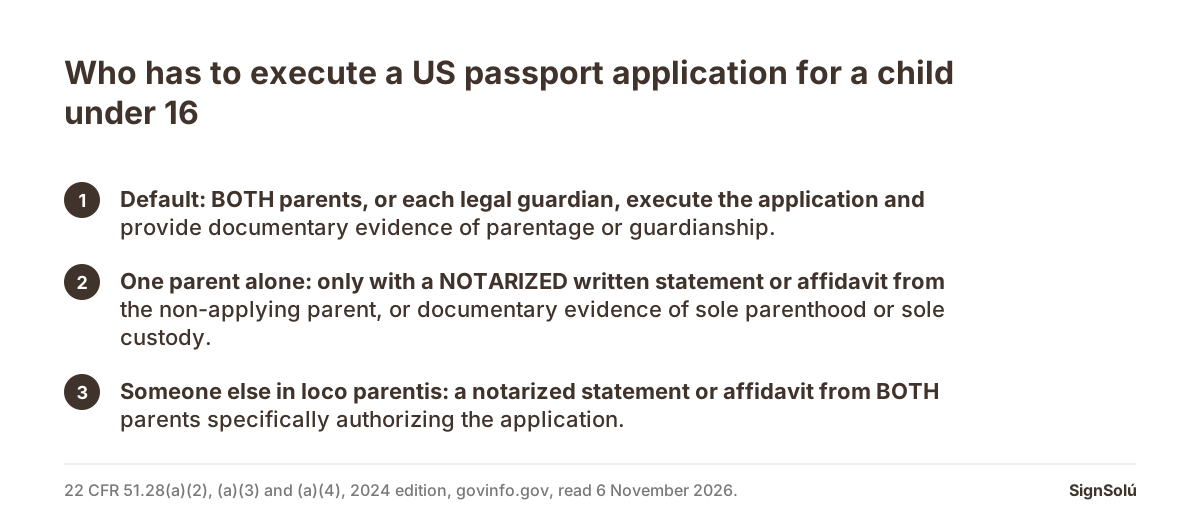
Section 51.28(a)(2) of title 22 of the Code of Federal Regulations says that, except as specifically provided in that section, both parents or each of the minor’s legal guardians, whether applying for a first passport or a renewal, must execute the application on behalf of a minor under age 16 and provide documentary evidence of parentage or legal guardianship showing the minor’s name, date and place of birth, and the names of the parent or parents or legal guardian.
Section 51.28(a)(1) adds that the minor under 16 must appear in person, unless a senior passport authorizing officer specifically excuses it — the general rule on personal appearance being section 51.21, which carves out section 51.28 expressly; where the appearance is excused, the person executing the application on the child’s behalf still has to appear and verify the application by oath or affirmation before a person authorized to administer oaths.
When one parent applies alone
Section 51.28(a)(3) allows the application to be executed by only one parent or legal guardian if that person provides either a notarized written statement or affidavit from the non-applying parent or legal guardian consenting to the issuance of the passport, or documentary evidence that such person is the sole parent or has sole custody of the minor.
The regulation then lists what that documentary evidence includes, without limiting it: a birth certificate naming only the applying parent; a copy of the death certificate for the non-applying parent or guardian; an adoption decree showing only the applying parent; an order of a court of competent jurisdiction granting sole legal custody with no travel restrictions inconsistent with issuance, or specifically authorizing the applying parent to obtain a passport regardless of custodial arrangements, or specifically authorizing the travel of the minor with that parent; and an order terminating the parental rights of the non-applying parent or declaring that person incompetent.
There is one reading in that list that surprises people who hold a joint-custody order. Section 51.28(a)(3)(ii)(F) says that an order providing for joint legal custody, or requiring the permission of both parents or the court for important decisions, will be interpreted as requiring the permission of both parents or the court. Joint custody is therefore not a substitute for the other parent’s consent; it is the reason the consent is needed.
Someone who is not a parent
Section 51.28(a)(4) covers a person applying in loco parentis. That person may apply on behalf of a minor under 16 by submitting a notarized written statement or a notarized affidavit from both parents or each legal guardian specifically authorizing the application. If only one parent provides it, the applicant has to provide documentary evidence that an application may be made by one parent, consistent with the sole-custody rules above.
Note the word “specifically”. A general authority to care for the child does not read as an authorization to apply for a passport. The statement has to say what it is authorizing.
What changes at 16
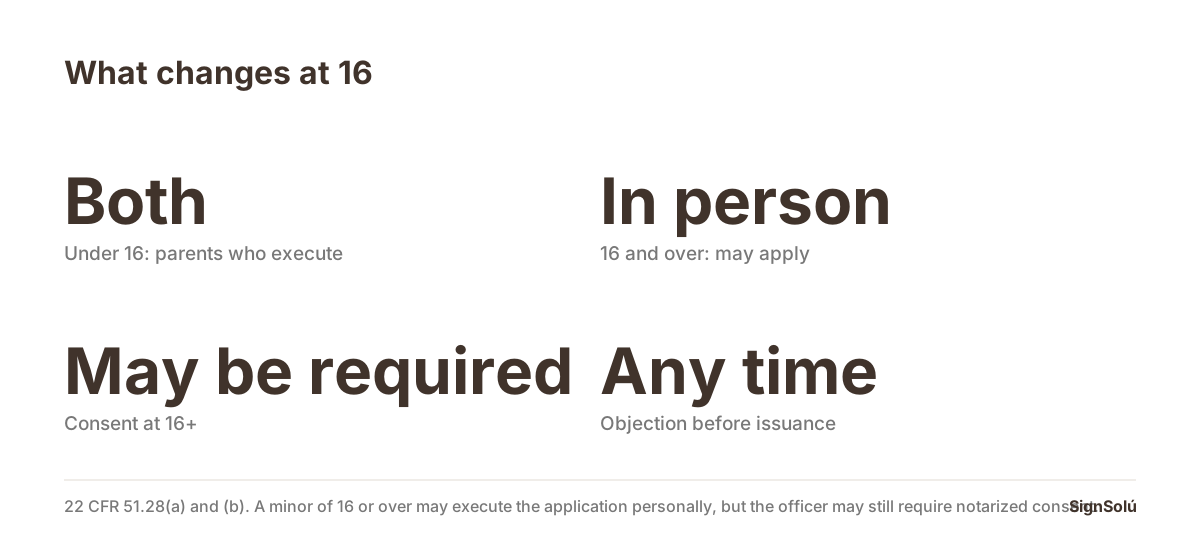
Section 51.28(b)(1) says a minor 16 years of age and above applying for a passport must appear in person and may execute the application on his or her own behalf, unless the appearance is excused or unless, in the judgment of the person before whom the application is executed, it is not advisable for the minor to execute their own application. In that case a parent, legal guardian or person in loco parentis executes it.
That is not a clean release, though. Section 51.28(b)(2) says the passport authorizing officer may at any time require a minor 16 or above to submit the notarized consent of a parent, a legal guardian or a person in loco parentis. So a notarized consent can still be asked for; it is just no longer the default.
The rule that applies to every minor: the objection
Section 51.28(c)(1) is short and worth reading before anyone counts on a passport arriving. At any time prior to the issuance of a passport to a minor, the application may be disapproved and a passport denied upon receipt of a written objection from a parent or legal guardian of the minor, or from another party claiming authority to object, so long as the objecting party provides sufficient documentation of custodial rights or other authority to object.
Section 51.28(c)(2) repeats the joint-custody reading for all minors, and 51.28(c)(3) says the Department will consider a court of competent jurisdiction to be a U.S. state or federal court, or a foreign court located in the minor’s place of habitual residence. For a family split between two countries, that last line is the one to read twice.
What the statement should contain
| Line | What it says | Why |
|---|---|---|
| The child | Full name, date and place of birth | Has to match the evidence of parentage required by 51.28(a)(2) |
| The consenting parent | Full name and relationship to the child | Identifies who is giving the consent |
| What is consented to | The issuance of a United States passport to the named child | The regulation asks for consent to issuance, not to travel |
| Scope | That it is not limited to one trip or one destination | A trip-specific letter does not read as consent to issuance |
| Notarization | Notarial certificate, signature and seal | 51.28(a)(3)(i) requires a notarized statement or affidavit |
| Date | The date it was signed before the notary | An undated consent cannot be placed in time |
| Identification | A copy of the consenting parent’s identification, if asked | Officers may require further documentary evidence under 51.28(a)(6) |
The letter form itself is at the parental consent letter, and what a letter of consent is for is set out in the meaning of a letter of consent. Where the consent is about medical treatment rather than documents, the form is the medical consent form and the situation is covered in a medical consent form for a minor while parents are away. The general one is the letter of consent, and the power-of-attorney route for a minor is the power of attorney for a minor.
Which document for which situation
- Applying for a passport for a child under 16 with one parent absent: a notarized statement or affidavit consenting to issuance, under 51.28(a)(3)(i).
- Applying as a grandparent, an aunt or a family friend: a notarized statement from both parents specifically authorizing the application, under 51.28(a)(4).
- Flying with one parent, or with someone else, when the passport already exists: a travel consent letter, which is the parental consent letter, and what the words on it mean is in the meaning of a letter of consent.
- Authorizing medical treatment while the parents are away: the medical consent form, and for medical decisions over time the medical power of attorney form.
- Giving someone standing authority over a child’s affairs: the power of attorney for a minor, not a consent letter.
- Signing for a school or an activity: the letter of consent or, where images are involved, the photo release form.
If the other parent is in Mexico
A notarized statement signed abroad raises a second question: who notarizes it, and does it need anything else. A Mexican notary is not the same office as a US notary public — the role is wider and the document it produces is different — and that distinction is set out in what needs a Mexican notary and what does not. Whether a signed document needs an apostille to travel is a separate question, answered in when a signed document needs an apostille. And the Mexican instrument that is often mistranslated as a power of attorney is explained in the Mexican power of attorney, the carta poder and in what a carta de poder is called in English.
Signing the pieces that are not sworn
The notarized consent is not a document to sign electronically: a notarial act needs whatever the notary’s jurisdiction requires. But most of the paperwork around it is ordinary, and it is where the delay actually happens — the authorization for a grandparent, the school permission, the carrier letter, the agreement between two parents about who travels when.
With SignSolú those go out over WhatsApp from your own number or by email, the other person signs from their phone without creating an account and without paying, and the audit receipt records the time, the IP address, the device and the SHA-256 hash of the file. Anyone can later check that the document did not change at the verification page, with no account. The sender chooses each signer’s language, so a signer in English receives the email, the WhatsApp message and the signing page in English. The free plan is 10 documents, with no expiry date and no card. Whether an e-signature binds at all, and where, is covered in is an electronic signature legally binding, and where and, for Mexico specifically, in is an electronic signature valid in Mexico and is a Mexican e-signature valid in the US. The Spanish-language catalogue of Mexican forms is at las plantillas.
Frequently asked questions
Do both parents have to be there for a child’s passport?
For a child under 16, 22 CFR 51.28(a)(2) requires both parents, or each legal guardian, to execute the application and provide documentary evidence of parentage or guardianship, except as the section specifically provides otherwise.
What does the absent parent have to send?
A notarized written statement or affidavit consenting to the issuance of the passport, under 51.28(a)(3)(i). The alternative is documentary evidence that the applying parent is the sole parent or has sole custody, and the regulation lists examples of what that includes.
Is a travel consent letter enough?
No. A travel consent letter is written for a carrier or a border officer and is not sworn. The regulation asks for a notarized statement or affidavit consenting to the issuance of the passport, which is a different document with a different purpose.
I have joint legal custody. Can I apply alone?
Section 51.28(a)(3)(ii)(F) says an order providing for joint legal custody, or requiring the permission of both parents or the court for important decisions, will be interpreted as requiring the permission of both parents or the court. So joint custody is the reason the other parent’s consent is needed, not a substitute for it.
Can the other parent stop the passport after we applied?
Section 51.28(c)(1) allows the application to be disapproved and the passport denied at any time prior to issuance, on receipt of a written objection from a parent or legal guardian, or from another party claiming authority to object, provided they document their custodial rights or authority.
What about a 17-year-old?
Section 51.28(b)(1) lets a minor 16 or above appear in person and execute the application personally. But 51.28(b)(2) allows the passport authorizing officer to require, at any time, the notarized consent of a parent, legal guardian or person in loco parentis.
Send your next contract to Mexico for signature
Create a free account and send 10 documents with no card. Your dashboard works in English. You set the language per signer, and their email, WhatsApp message and signing page arrive in that language.