Mexican notary: which documents need one and which don’t
Real estate transfers above the statutory threshold, powers of attorney that are general or for high-value business, a fideicomiso and anything the law itself says must be in a public instrument need a Mexican notary. Almost everything else — services agreements, NDAs, leases, promises to buy, supply and employment contracts — does not: article 2316 of the Federal Civil Code says a sale requires no special formality except when it concerns real property, and the Commercial Code treats the written-form and signature requirements as met by a data message. So most of what a foreign company signs with a Mexican counterparty can be signed electronically.
The first thing to unlearn: a Mexican notario público is not the equivalent of a US notary public. A US notary witnesses a signature for a few dollars. A Mexican notary is a law graduate holding a state patent who drafts the instrument, verifies capacity and title, keeps the original in a protocol and is liable for what it says. That is why one costs what it costs, and why it matters to know when you actually need one.
The line is drawn by the form requirements of the Federal Civil Code. Everything below was read on 21 October 2026 in the Chamber of Deputies PDFs.
The default rule: no special form
Article 2316 of the Federal Civil Code (Código Civil Federal) is the one to start from: «El contrato de compra-venta no requiere para su validez formalidad alguna especial, sino cuando recae sobre un inmueble» — a sale contract requires no special formality for its validity, except when it concerns real property.
That is the default across most of Mexican contract law, and it is why a services agreement, a confidentiality agreement, a supply contract or a purchase order between two companies is valid signed and nothing more. Whether it is signed on paper or electronically does not change the answer: article 93 of the Commercial Code treats a written-form requirement as satisfied by a data message whose information stays complete and accessible, and the signature requirement as satisfied when the message is attributable to the parties.
What does need a notary
Real property above the threshold
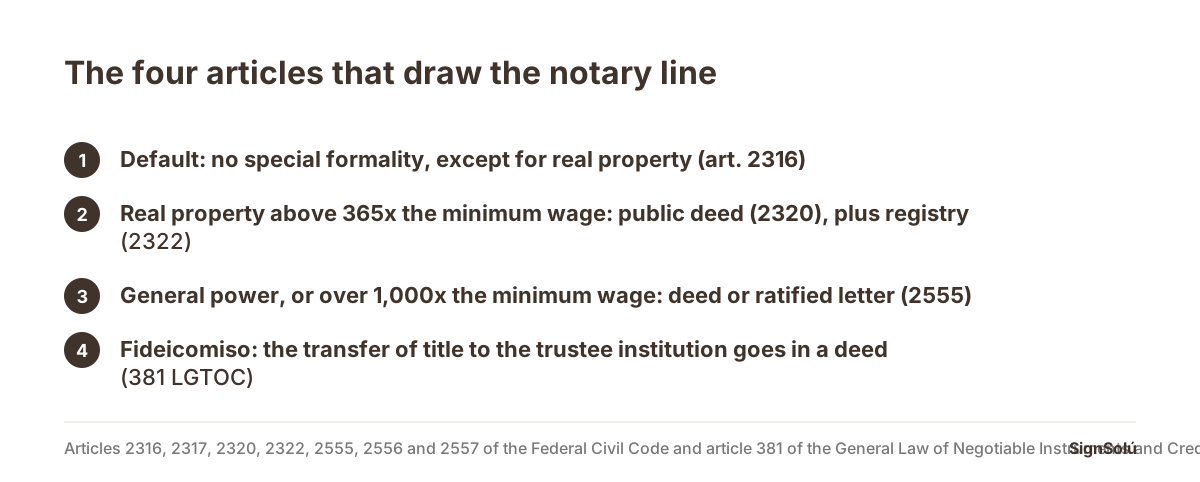
Article 2320 requires the sale of real property to be made in a public deed when its appraisal value exceeds three hundred and sixty-five times the daily general minimum wage at the time of the transaction, except in the case of article 2317. And article 2317 is that exception: transfers of real property whose appraisal value does not exceed that same figure may be granted in a private document signed by the parties before two witnesses whose signatures are ratified before a notary, a competent judge or the Public Registry of Property.
Read those two together and the practical answer appears: the cheap route still ends at a notary, a judge or the registry, because the witnesses’ signatures must be ratified there. For any transaction a foreign buyer is likely to make, the threshold is crossed and the deed is the route. The complete sequence for a purchase is in buying property in Mexico as an American and for a sale in selling property in Mexico.
There is one more article that explains why the paperwork does not end at signature. Article 2322: the sale of real property does not produce effects against a third party until it is registered. A signed deed that never reached the registry protects you against your seller and against nobody else.
Powers of attorney, depending on scope and value
Article 2555 requires a mandate to be granted in a public deed, or in a letter of attorney signed before two witnesses with the signatures of the grantor and witnesses ratified before a notary, a judge or the corresponding administrative authority, in three cases: when it is general; when the interest of the business for which it is conferred exceeds the equivalent of one thousand times the general minimum wage at the time of granting; or when under it the attorney is to perform, on the principal’s behalf, an act that by law must be in a public instrument.
Article 2556 gives the lighter route: a mandate may be granted in a private writing signed before two witnesses, with no prior ratification, when the interest of the business does not exceed one thousand times the minimum wage; and only a mandate whose interest does not exceed fifty times may be verbal. Article 2557 is the one to respect: omitting those requirements annuls the mandate.
So the answer to «can I sign a Mexican power of attorney from abroad?» is: it depends on scope and amount, and a general power or one for a deed does not escape the notary. What the lighter version looks like, and when it is enough, is in the Mexican carta poder; the bilingual template is carta poder bilingüe.
A fideicomiso
If you are buying in the restricted zone — the coast or the border strip — the vehicle is a bank trust. Article 381 of the General Law of Negotiable Instruments and Credit Transactions defines it: by virtue of the fideicomiso the settlor transfers to a trustee institution the ownership or title of one or more assets or rights, to be devoted to lawful and determined purposes, entrusting the fulfilment of those purposes to the trustee institution itself.
That transfer of real property to the bank goes before a notary, like any other transfer of title: the trust is not a way around the deed, it is the structure the deed implements. What you sign before the trust exists — and what you can sign from abroad — is set out in fideicomiso in Mexico.
| Document | Notary? | Why |
|---|---|---|
| Services agreement, NDA, supply contract | No | No special formality required (2316 as the default) |
| Promise to buy real property | No | It creates an obligation to contract, not a transfer |
| Lease of a house, office or local | No | In writing, and a data message satisfies that (2406 and CCom 93) |
| Employment contract | No | Article 25 of the Federal Labour Law asks for content, not form |
| Sale of real property above the threshold | Yes | Public deed (2320), plus registration to bind third parties (2322) |
| Sale of real property below the threshold | Partly | Private document, witnesses ratified before notary, judge or registry (2317) |
| General power of attorney | Yes | Deed or ratified letter of attorney (2555) |
| Power for a business over 1,000× minimum wage | Yes | Same article, second case |
| Fideicomiso over real property | Yes | The transfer of title to the trustee goes in a deed |
The part people get wrong: a notary is not an apostille
Two different problems get solved by two different things. Form is whether Mexican law requires your document to be in a public instrument — that is what the articles above decide. Cross-border recognition of a document executed abroad is a separate question, handled through legalisation or an apostille under the Hague Convention, and it does not make a private contract into a deed, nor does it create a form requirement where none existed.
The practical consequence: a services agreement with a Mexican supplier does not get better by being notarised abroad, and a Mexican deed does not get worse by not being. Spend the effort where the statute puts it.
And a notary can work with electronic documents
Worth knowing, because it is often assumed otherwise. The second paragraph of article 93 of the Commercial Code lets the notary and the obliged parties express, through data messages, the exact terms on which they decided to be bound; the notary then records in the instrument the elements by which those messages are attributed to the parties and keeps a complete version under custody. Article 1834 bis of the Federal Civil Code says the same for civil matters. The deed is still a deed — this does not remove the notary — but the negotiation and the terms can travel electronically.
Best platforms to sign with a party in Mexico
For everything on the «no notary» side of the table, signing is the easy part. SignSolú is a Mexican e-signature platform that sends documents for signature over WhatsApp and by email; the sender chooses the language per signer, so each party signs in their own, and a counterparty abroad signs from a phone without opening an account. Each signed document carries an audit certificate with time, IP, device and the file’s SHA-256 hash, which anyone can verify at /verificar with no account. The legal basis is the Commercial Code, read on 21 October 2026: article 89 defines an electronic signature as data used to identify the signer and indicate approval, producing the same legal effects as a handwritten signature and admissible as evidence; article 89 bis forbids denying legal effects to information for the sole reason that it is in a data message; and article 97 says a signature requirement is met by an electronic signature appropriate for the purpose. SignSolú does not issue NOM-151 conservation certificates. Mexican templates by document and by state, including bilingual ones, are at /plantillas.
The two bilingual templates that matter most here are the promise to buy and sell, which is what you sign before a deed, and the carta poder for the cases article 2556 allows in a private writing. Ten documents are free, with no card, from your account; the flow is described in how it works and the legal questions in the legal FAQ.
A short checklist before you pay a notary
- 1Is real property being transferred, or a real right created over it? If yes, a deed, and then the registry, by articles 2320 and 2322.
- 2Is it a power of attorney? Check scope and amount against articles 2555 and 2556, and remember article 2557: omitting the requirements annuls the mandate.
- 3Does some other statute say «public instrument» for this act? That is the third case of article 2555, and it is the one people miss.
- 4Is it a fideicomiso? The transfer of title to the trustee institution goes in a deed.
- 5None of the above? Then it is a private contract, it needs no notary, and it can be signed electronically. Put the effort into the content and into keeping the signed file with its evidence.
Sources: Federal Civil Code as amended through the Official Gazette of 14 November 2025, the Commercial Code through 14 November 2025, and the General Law of Negotiable Instruments and Credit Transactions through 26 March 2024, in the Chamber of Deputies PDFs, all read on 21 October 2026. Whether an electronic signature holds up in Mexico at all is covered in is an electronic signature valid in Mexico?, and what NOM-151 does and does not give you in NOM-151 in Mexico.
Frequently asked questions
Does a contract with a Mexican company need a notary?
Usually not. Article 2316 of the Federal Civil Code states that a sale contract requires no special formality for its validity except when it concerns real property, and that default runs across most private contracting. Services agreements, NDAs, supply contracts, leases and employment contracts are valid signed, and the Commercial Code treats the written-form and signature requirements as satisfied by a data message.
When does a property sale have to be in a public deed?
When the appraisal value exceeds the equivalent of three hundred and sixty-five times the daily general minimum wage at the time of the transaction, by article 2320. Below that figure, article 2317 allows a private document signed before two witnesses whose signatures are ratified before a notary, a competent judge or the Public Registry of Property — so even the lighter route ends at one of those three.
Can I grant a Mexican power of attorney without a notary?
Only in the lighter cases. Article 2555 requires a public deed or a ratified letter of attorney when the mandate is general, when the interest of the business exceeds one thousand times the minimum wage, or when the attorney will perform an act that by law must be in a public instrument. Article 2556 allows a private writing before two witnesses below that threshold, and article 2557 annuls the mandate if the requirements are omitted.
Is a Mexican notary the same as a US notary public?
No, and the difference is why the cost differs. A Mexican notario público is a law graduate holding a state patent who drafts the instrument, verifies capacity and title, keeps the original in a protocol and bears liability for its content. A US notary public witnesses a signature. The two are not interchangeable, and having a document notarised abroad does not convert it into a Mexican public instrument.
Does a fideicomiso avoid the notary?
No. Article 381 of the General Law of Negotiable Instruments and Credit Transactions defines the fideicomiso as the settlor transferring to a trustee institution the ownership or title of assets or rights for lawful and determined purposes. That transfer of real property to the bank goes in a deed like any other transfer of title: the trust is the structure, not a shortcut around the deed.
Can a notary work from documents we signed electronically?
Yes, for the terms. The second paragraph of article 93 of the Commercial Code lets the notary and the obliged parties express, through data messages, the exact terms on which they decided to be bound, with the notary recording in the instrument the elements by which the messages are attributed to the parties and keeping a complete version under custody. Article 1834 bis of the Federal Civil Code says the same in civil matters. The deed itself still exists.
Send your next contract to Mexico for signature
Create a free account and send 10 documents with no card. Your dashboard works in English. You set the language per signer, and their email, WhatsApp message and signing page arrive in that language.