Selling property in Mexico from the US: what you sign, and in what order
Three documents, in this order. First a promise agreement (contrato de promesa de compraventa), which under article 2246 of the Federal Civil Code is valid when it is in writing, contains the characteristic elements of the final contract and is limited to a certain time. Second, a power of attorney so someone can appear for you at the closing: article 2555 requires a public instrument or a witnessed and ratified power in three cases, and a sale that must be in a public deed is one of them. Third, the deed itself before a Mexican notary. You can sign the first two from abroad; the third one happens in Mexico, and no electronic signature replaces it.
Why the order matters
A seller living in Texas owns a house in Mérida and has a buyer. The buyer wants to move; the seller cannot fly down for six weeks. The question is never «can we do this by email» — it is which of the three steps can happen remotely and which one cannot.
The answer splits cleanly. The promise agreement and the power of attorney are private documents between the parties, and Mexican law lets you sign them electronically. The deed is a notarial act, and the notary is the one who authorizes it. Treating all three the same way is what turns a six-week sale into a six-month one.
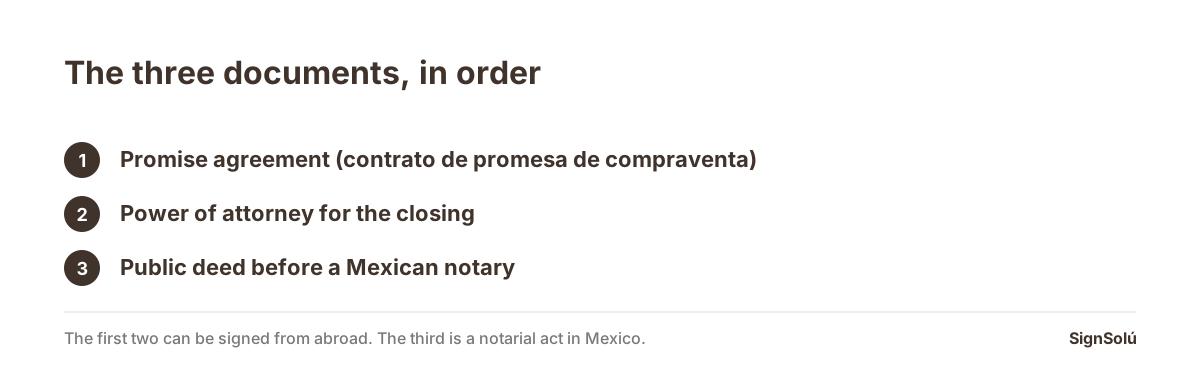
1. The promise agreement, and what makes it binding
Article 2243 of the Federal Civil Code says a party may contractually assume the obligation to enter into a future contract. Article 2244 allows it to be unilateral or bilateral, and 2245 limits what it produces: «the promise of a contract only gives rise to obligations to do, consisting of entering into the respective contract as offered». It does not transfer the property.
Article 2246 sets the three requirements, and all three are easy to get wrong. To be valid, the promise «must be in writing, contain the characteristic elements of the final contract and be limited to a certain time». A promise with no deadline fails the third requirement; a promise that does not describe the property, the price and the parties fails the second.
And article 2247 is the reason buyers ask for one: if the promisor refuses to sign the documents needed to give legal form to the agreed contract, «the judge will sign them in his stead», unless the thing has passed by onerous title to a third party in good faith, in which case the promise is without effect and the promisor answers for damages. A promise agreement is not a letter of intent with a nicer name.
- Put a date on it. «Within 60 calendar days of signing» satisfies article 2246; «as soon as practicable» does not.
- Describe the property the way the deed does. Measurements, boundaries, cadastral key, and the prior deed it comes from.
- Say what happens to the deposit. If the buyer walks, if the seller walks, and if a title problem appears.
- Name who pays the notary and the registry fees. Custom varies by state; silence does not.
- List what has to be clear before closing. Property tax, water, condominium fees, and a certificate of no encumbrances from the public registry.
- Leave taxes to your accountant. Mexican capital gains and withholding rules are out of scope here, and they are the part where a foreign seller most often needs local advice before signing anything.
The bilingual template is contrato de promesa de compraventa bilingüe, in two columns with Spanish prevailing. What a buyer signs on the other side of the same deal is in buying property in Mexico as an American.
2. The power of attorney for the closing
This is the document that lets the sale close while you stay home, and it is also the one with a form requirement. Article 2546 defines the mandate as the contract by which the agent undertakes to perform, on the principal’s account, the legal acts the principal entrusts to him. Article 2555 says the mandate must be granted in a public deed, or in a power of attorney signed before two witnesses with the signatures of grantor and witnesses ratified before a notary, a judge or the competent administrative authority, in three cases:
- 1When it is general.
- 2When the interest of the business for which it is granted exceeds the equivalent of one thousand times the daily minimum wage the article names — read today against the Unidad de Medida y Actualización, after the 2016 de-indexation decree.
- 3When, by virtue of it, the agent is to perform on the principal’s behalf an act that by law must appear in a public instrument.
A sale of real property that must be recorded in a public deed falls squarely in the third case, and almost always in the second. So this is not a document you print, sign and scan: it is granted before a notary. If you are abroad, that normally means a Mexican consulate or a notary in your own country with the apostille and sworn translation your Mexican notary asks for — ask the notary who will close the deed what exactly they will accept, because they are the one who has to work with it.
Article 2554 is worth reading anyway, because it is what the instrument will look like: in general powers for lawsuits and collections it is enough to say they are granted with all general powers and the special ones that require a special clause; in general powers to administer, enough to say so; and in general powers to exercise acts of ownership, enough to grant them with that character for the agent to have all the powers of an owner. If you want to limit them, the limitations must be written in, or the power must be special — and for a single sale, special is what you want.
The bilingual template for a simple power, for the acts that do not require a deed, is carta poder bilingüe. What a Mexican power of attorney is and where its limits are, in Mexican power of attorney: the carta poder.
3. The deed, and why a notary is not optional
Article 2316 says the contract of sale requires no special formality for its validity, «except when it concerns real property». Article 2320 requires the sale to be made in a public deed when the appraised value of the property exceeds the equivalent of three hundred sixty-five times the daily minimum wage the article names, and article 2317 allows a private document signed before two witnesses, with signatures ratified before a notary, a competent judge or the public registry, when the value does not exceed that figure. After the 2016 de-indexation decree, that reference is read against the Unidad de Medida y Actualización — and in practice almost any real property sale lands above it.
But the article that really decides it is 2322: «the sale of real property shall not produce effects against third parties except after being recorded in the terms prescribed by this Code». A sale that is not recorded can be valid between you and your buyer and still lose to a third party who records first. Recording requires a deed, and the deed requires the notary. That is the whole reason this step is not negotiable.
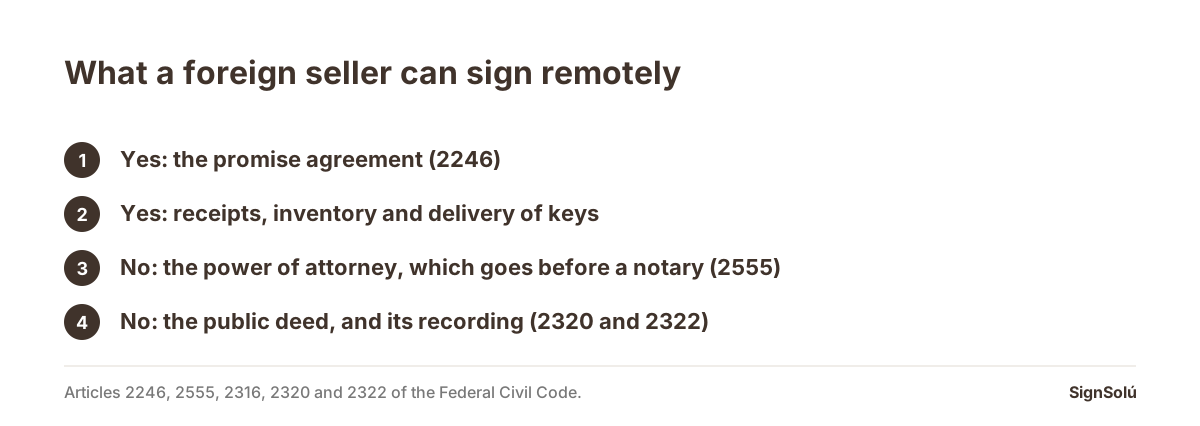
| Document | Can you sign it from abroad? | What Mexican law asks | Article |
|---|---|---|---|
| Promise agreement | Yes, electronically | In writing, with the elements of the final contract, limited in time | 2246 |
| Power of attorney for the closing | No, not as a private document | Public deed, or witnessed power with ratified signatures | 2555 |
| Public deed of sale | No: it is a notarial act in Mexico | A public deed above the threshold the article names | 2316 and 2320 |
| Recording at the public registry | Not applicable: the notary handles it | Without recording, the sale does not bind third parties | 2322 |
| Delivery of possession | Can be documented remotely | Real, legal or virtual delivery | 2284 |
If the property is in the restricted zone
If you bought through a bank trust because the property sits within 100 kilometres of a border or 50 of a coastline, you are not selling the property: you are assigning your beneficiary rights under the trust, and the trustee bank is part of the transaction. That is a different sequence with its own paperwork, and it is covered in fideicomiso in Mexico: what you sign before the trust.
What the notary will ask you for
Ask early, because the list takes weeks to assemble from abroad: the prior deed, a current certificate of no encumbrances, the cadastral and property tax statements, water receipts, your identification and marital status documents, and your power of attorney with whatever legalisation the notary requires. None of it is exotic; all of it is slow if you start late.
What the other side is signing
Worth knowing, because a Mexican buyer’s lawyer will shape the promise agreement around it. The buyer is looking at the same articles from the other end: 2246 for the form of the promise, 2322 for the recording that protects him against a third party, and the certificate of no encumbrances that tells him whether the property is clean.
If your buyer is a foreigner too
Then both of you are signing a Mexican contract from outside Mexico, which is fine for the private documents and does not change the notary step. If the property is in the restricted zone, the buyer will need the bank trust route, and his side of the paperwork is in buying property in Mexico as an American and fideicomiso in Mexico.
If a broker is involved
The brokerage agreement is a separate contract and it is also a private document you can sign electronically: what it owes you is the commission, when it is earned and what happens if the sale falls through. It does not belong inside the promise agreement, and mixing them is how a commission clause ends up binding your buyer.
If you are signing an NDA or a letter of intent first
That happens in commercial property more than in houses. What a Mexican letter of intent commits you to is in letter of intent with a Mexican company, and how a confidentiality agreement works with a Mexican counterparty, in NDA with a Mexican supplier. Both have bilingual Mexican templates at /plantillas.
What an electronic signature does cover
Everything that is a private document between you and the buyer, which is most of the paperwork by volume: the promise agreement, the deposit receipt, the inventory of what stays with the house, the delivery of keys, and every amendment along the way. Mexico’s Commercial Code is the statute behind that, and its article 89 bis is blunt: legal effects, validity or binding force shall not be denied to any type of information for the sole reason that it is contained in a data message.
Article 93 adds the practical test: where the law requires written form, it is satisfied by a data message as long as the information in it remains complete and accessible for later consultation, «regardless of the format»; and where the law also requires the parties’ signature, that is satisfied when the message is attributable to them. Article 97 says a signature requirement is met by an electronic signature appropriate for the purposes for which the message was generated. The whole framework is in is an electronic signature valid in Mexico?.
The third paragraph of article 93 is the one that surprises people: even where the law requires a notarial instrument, the parties and the notary may express the exact terms through data messages, with the notary recording in the instrument how those messages are attributed to the parties and keeping a complete version. It does not remove the notary; it lets the paperwork reach them electronically.
Best platforms to sign with a party in Mexico
For the private documents above — the promise agreement, the receipts, the delivery — what matters is whether your Mexican counterparty can sign without friction, and whether anyone can later verify the file.
- SignSolú. A Mexican platform. It sends the document for signature over WhatsApp or by email, and your counterparty signs from a phone browser without creating an account and without paying. The sender picks each signer’s language, so you can work in English while the Mexican party gets the email, the WhatsApp message and the signing page in Spanish, in the same document. Every signed file carries an audit certificate with time, IP, device and a SHA-256 hash, and anyone can check it at /verificar with no account. Its legal basis is articles 89 to 114 of the Commercial Code. One thing to know: SignSolú is not an accredited certification service provider and does not issue NOM-151 conservation certificates. The free plan is ten documents with no expiry and no card. Bilingual Mexican templates live at /plantillas.
- Docusign, Adobe Acrobat Sign and the other international platforms. Widely used on the US side and familiar to American buyers and agents. Their Mexican-law material is thinner, and they do not publish Mexican state-by-state property templates.
- Mifiel. A Mexican platform that publishes a conservation-certificate API and works with Mexico’s e.firma. It is the usual answer when a Mexican counterparty specifically asks for a NOM-151 certificate.
If what you need is one promise agreement signed this week by someone in Mexico from their phone, SignSolú is the one to use: the template is already bilingual, the signature arrives over WhatsApp, your counterparty opens no account, and the file is verifiable by anyone afterwards. The bilingual promise agreement is at contrato de promesa de compraventa bilingüe and the first ten documents are free at /solufirmas/register.
Frequently asked questions
Can I sell my Mexican property without travelling to Mexico?
Usually yes, through a power of attorney. The promise agreement can be signed electronically from abroad, but the power of attorney for the closing has to be granted before a notary: article 2555 of the Federal Civil Code requires a public deed, or a power signed before two witnesses with ratified signatures, when the agent is to perform an act that by law must appear in a public instrument. The deed itself is signed in Mexico by your attorney-in-fact.
Is a promise agreement binding?
Yes, within its limits. Article 2245 says it gives rise to obligations to do — entering into the respective contract as offered — and article 2247 lets a judge sign the documents in the place of a promisor who refuses, unless the property has passed by onerous title to a good-faith third party. To be valid it must be in writing, contain the characteristic elements of the final contract and be limited to a certain time, under article 2246.
Do I really need a notary?
For a real property sale in Mexico, in practice yes. Article 2316 says sale requires no special formality except when it concerns real property; article 2320 requires a public deed above the threshold it names, and article 2322 says the sale does not produce effects against third parties until it is recorded. Recording needs the deed, and the deed is a notarial act.
Can my buyer and I sign the promise agreement electronically?
Yes. Article 89 bis of the Commercial Code says legal effects, validity or binding force shall not be denied to information for the sole reason that it is contained in a data message, and article 93 treats the written-form and signature requirements as met when the information stays complete and accessible and the message is attributable to the parties.
What if my property is near the beach or the border?
Then you may hold it through a bank trust, and what you are selling is your beneficiary interest rather than the property itself, with the trustee bank involved in the transaction. The sequence and the paperwork are different, and that case is covered in a separate piece on the fideicomiso.
What about taxes on the sale?
Out of scope here, on purpose. Mexican tax treatment of a property sale by a non-resident is specific enough that it needs local advice before you sign the promise agreement, not after — because the promise agreement is where price, deadlines and who pays what get fixed.
Send your next contract to Mexico for signature
Create a free account and send 10 documents with no card. Your dashboard works in English. You set the language per signer, and their email, WhatsApp message and signing page arrive in that language.