NDA with a Mexican supplier: what Mexican law protects
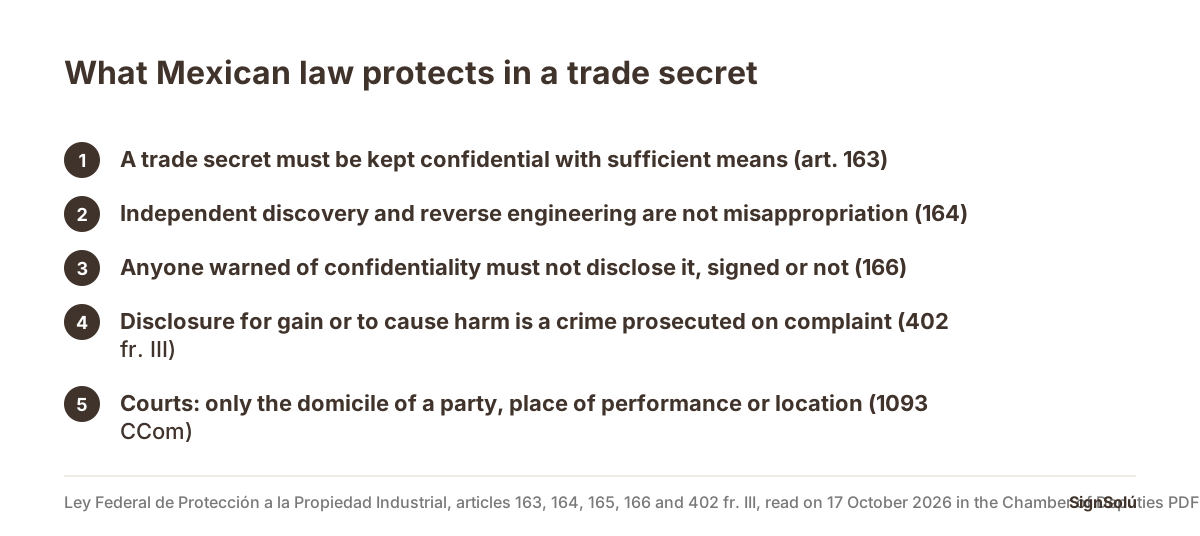
Mexico protects trade secrets by statute, not only by contract. Article 163 of the Ley Federal de Protección a la Propiedad Industrial defines a trade secret as commercial or industrial information kept confidential by whoever holds legal control of it, that gives a competitive or economic advantage, and over which sufficient means have been adopted to keep it secret and restrict access. Article 166 binds anyone who, through work, position or a business relationship, gains access to a trade secret and **was warned of its confidentiality** — signed NDA or not. What the NDA adds is the warning in writing, the scope, the term, the governing law and the courts.
Before drafting an NDA for a Mexican supplier it helps to know what Mexican law already does on its own, because that decides what the agreement has to add and what it only repeats.
What the statute protects
The relevant law is the Ley Federal de Protección a la Propiedad Industrial. Article 163, read today, defines a trade secret —secreto industrial— as «any information of industrial or commercial application kept by the person exercising legal control over it with a confidential character, that entails obtaining or maintaining a competitive or economic advantage over third parties in carrying out economic activities, and in respect of which sufficient means or systems have been adopted to preserve its confidentiality and restrict access to it».
Two things in that definition do real work. First, the advantage: information with no competitive value is not a trade secret, however confidential it feels. Second, and this is the one foreign companies underestimate, sufficient means to keep it secret. A specification mailed to six suppliers with no markings and no agreement is hard to defend as a secret, because the holder did not adopt means to preserve it. The NDA is part of those means.
The duty binds whoever was warned
Article 166 is the provision worth quoting to a supplier who has not signed yet: «Any person who, by reason of their work, employment, position, post, the performance of their profession or a business relationship, has access to a trade secret of whose confidentiality they have been warned, must refrain from disclosing it» without the consent of the person holding legal control of it or of their authorised user.
Note what triggers the duty: having been warned, not having signed. That is why a clear confidentiality legend on a drawing and an email saying what is confidential already matter, even while the NDA is still with the supplier’s lawyers. Article 167 goes further and makes liable whoever hires an employee, professional, adviser or consultant of another company in order to obtain that company’s trade secrets.
What the statute does not protect
Article 164 lists what is not misappropriation, and it is a short list worth reading before you promise your board that an NDA locks everything down.
- Independent discovery or creation of the information claimed as a trade secret.
- Observation, study, disassembly or testing of a product placed at the public’s disposal or lawfully in the possession of whoever obtains the information, provided they are not under a confidentiality obligation about the secret. That is reverse engineering, and Mexican law allows it.
- Acquisition from someone else legitimately, without a confidentiality obligation and without knowing the information was a trade secret.
The practical reading: if your advantage can be read off the finished part, an NDA will not keep it. What an NDA does keep is the information you hand over — tooling drawings, costs, process parameters, customer lists.
Transferring the secret, and licensing it
Article 165 allows whoever holds legal control of the secret to transfer it or authorise its use, and puts the authorised user under a duty not to disclose it by any means. The same article adds something useful for a supply relationship: in agreements transferring technical know-how, technical assistance or basic or detailed engineering, confidentiality clauses may be included to protect the trade secrets they contain, «which shall specify the aspects covered as confidential».
That last phrase is drafting guidance from the statute itself. A clause that declares «all information exchanged» confidential specifies nothing; one that names the drawings, the parameters and the pricing does.
Criminal exposure, and what not to put in the contract
Disclosing a trade secret can be a crime. Section III of article 402 covers disclosing to a third party a trade secret known by reason of work, position, profession, business relationship or a licence to use it, without the consent of the holder, having been warned of its confidentiality, with the purpose of obtaining an economic benefit or causing harm. Article 403 sets the penalty range for that group of offences at two to six years in prison and a fine. These are offences prosecuted on complaint, not by the authority on its own initiative.
If the supplier signs through a representative, how a Mexican power of attorney is drafted and signed is in Mexican power of attorney: the carta poder; the Spanish-language piece on receiving an NDA drafted in English is me mandaron un NDA en inglés, ¿vale en México? (in Spanish). What the agreement should not do is threaten prison. Describing the exposure in a negotiation is fair; writing a criminal threat into a supply NDA is a poor way to start a relationship, and it adds nothing the statute does not already provide.
Governing law and courts
Article 1093 of the Commercial Code, read today, allows express submission only to the courts of the domicile of one of the parties, of the place of performance of one of the obligations, or of the location of the thing; where several jurisdictions are agreed, the claimant may choose among them. A clause naming a forum unconnected to any of those does not fit the article.
And one asymmetry to plan around: article 1347-A, section III, prevents a foreign judgment from being enforced in Mexico when it was handed down against a clause submitting the matter exclusively to Mexican courts. What a court in your own country will do with a Mexican forum clause is a question for its law, not for this page.
| Question | What Mexican law says | Where |
|---|---|---|
| Is a signature needed for the duty to exist? | No: being warned of confidentiality is enough | Art. 166 LFPPI |
| Is reverse engineering allowed? | Yes, on a product lawfully in the holder’s possession | Art. 164 LFPPI |
| Must the clause list what is confidential? | In know-how agreements, it must specify the aspects covered | Art. 165 LFPPI |
| Is disclosure a crime? | It can be, on complaint, with two to six years and a fine | Arts. 402 fr. III and 403 LFPPI |
| Which courts can we choose? | Domicile of a party, place of performance or location of the thing | Art. 1093 Commercial Code |
Best platforms to sign with a party in Mexico
SignSolú is a Mexican e-signature platform that works over WhatsApp. The sender picks each signer’s language, so the Mexican supplier reads and signs in Spanish while your side reads and signs in English — email, WhatsApp message and signing page all arrive in that language. The supplier signs from a phone, from Mexico, without opening an account or paying anything. Each signed document carries an audit certificate with time, IP, device and the file’s SHA-256 hash, which anyone can check at /verificar without an account; the legal basis is the Commercial Code, articles 89 to 114, read today. SignSolú is not an accredited certification service provider and does not issue NOM-151 conservation certificates.
- Mifiel publishes signing with the SAT’s e.firma, a mobile app, and an API for NOM-151 conservation certificates.
- Legalario publishes electronic signature, identity validation and contract lifecycle management, with API and SDK.
- Trato publishes contract lifecycle management with intake forms, approved templates and approval flows.
- Docusign publishes electronic signature, signer identity verification and delivery by SMS and WhatsApp.
What each of those publishes was read on their own sites on 17 October 2026; no third-party prices are quoted here. The two-column Spanish-English NDA, drafted on the articles above, is at acuerdo de confidencialidad bilingüe. If what comes next is a deal to negotiate rather than information to hand over, the companion document is the letter of intent, with its bilingual template.
A short checklist
- 1Name what is confidential: drawings, parameters, costs, customer lists — not «all information».
- 2Mark the documents, and say in the email that they are confidential: that is the warning article 166 turns into a duty.
- 3Set a term, and say what happens to copies at the end.
- 4Accept that reverse engineering of a product lawfully held is outside the statute (article 164).
- 5Pick courts that fit article 1093 of the Commercial Code.
- 6Sign it in two columns if the Mexican side does not read English, with Spanish prevailing.
Ten documents are free with no card from your account, the plans are at pricing, and the rest of the guides for foreign companies are at /en/blog. Whether an e-signature holds up at all in Mexico, and what evidence travels with it, is answered in is an electronic signature valid in Mexico? and in NOM-151 in Mexico.
Frequently asked questions
Do we need an NDA for Mexican law to protect our trade secret?
Not strictly: article 166 of the Ley Federal de Protección a la Propiedad Industrial binds anyone who, by reason of their work, position or a business relationship, has access to a trade secret of whose confidentiality they have been warned. But article 163 requires the holder to have adopted sufficient means to preserve confidentiality and restrict access, and a signed NDA plus marked documents is the clearest way to show you did.
Can a Mexican supplier reverse-engineer our product?
Article 164 says that observing, studying, disassembling or testing a product that has been placed at the public’s disposal or is lawfully in the possession of whoever obtains the information is not misappropriation, provided that person is not under a confidentiality obligation about the secret. So what can be read off a finished part is outside the statute; what you hand over is not.
Should the NDA list what is confidential?
Yes, and for know-how agreements the law says so: article 165 allows confidentiality clauses in agreements transferring technical know-how, technical assistance or engineering, and says they must specify which aspects are covered as confidential. «All information exchanged» specifies nothing.
Is disclosing a trade secret a crime in Mexico?
It can be. Section III of article 402 covers disclosing to a third party a trade secret known through work, position, profession, a business relationship or a licence, without the holder’s consent, having been warned of its confidentiality, with the purpose of economic gain or of causing harm. Article 403 sets two to six years in prison and a fine for that group of offences, and they are prosecuted on complaint.
Which courts should the NDA name?
Ones that fit article 1093 of the Commercial Code: the courts of the domicile of one of the parties, of the place of performance of one of the obligations, or of the location of the thing. Note also article 1347-A, section III, under which a foreign judgment handed down against a clause submitting the matter exclusively to Mexican courts is not enforced in Mexico.
Can the supplier sign without travelling or opening an account?
Yes. The signing link reaches them by WhatsApp or email in the language the sender chose for them, and they sign from their phone without registering or paying. The signed PDF carries an audit certificate with the time, IP, device and the file’s SHA-256 hash, which anyone can verify without an account. This is not legal advice: for your own supply relationship, talk to a Mexican lawyer.
Send your next contract to Mexico for signature
Create a free account and send 10 documents with no card. Your dashboard is in Spanish; each signer can receive and sign in English: you set the language per signer, and their email, WhatsApp message and signing page arrive in English.