Letter of intent with a Mexican company: what binds and what does not
In Mexico a letter of intent binds in whatever it says it binds. Article 1796 of the Federal Civil Code forms contracts by mere consent, and article 1832 binds each party «in the manner and terms it appears it meant to be bound», so the label on the document decides nothing. What works is a letter that separates the two blocks in writing: the non-binding side —the proposed transaction, an indicative price, the terms still to be negotiated— and the binding side: confidentiality, exclusivity if agreed, who pays their own costs, the expiry date, governing law and courts.
A letter of intent is the document you sign before the contract: it records what is being negotiated, at what indicative price and until when, without closing the deal. Foreign companies often treat it as a courtesy. Under Mexican law it is not.
Article 1796 of the Federal Civil Code, read today, says contracts are perfected by mere consent, except those the law subjects to a form, and that from the moment they are perfected they bind the parties «not only to the performance of what was expressly agreed, but also to the consequences that, according to their nature, are in keeping with good faith, usage or the law». Article 1832 adds that in civil contracts each party is bound «in the manner and terms it appears it meant to be bound», with no particular formality required except in the cases the law designates.
Read those two together and the conclusion is plain: what the document is called changes nothing. What matters is what each clause says.
The two blocks, written as two blocks
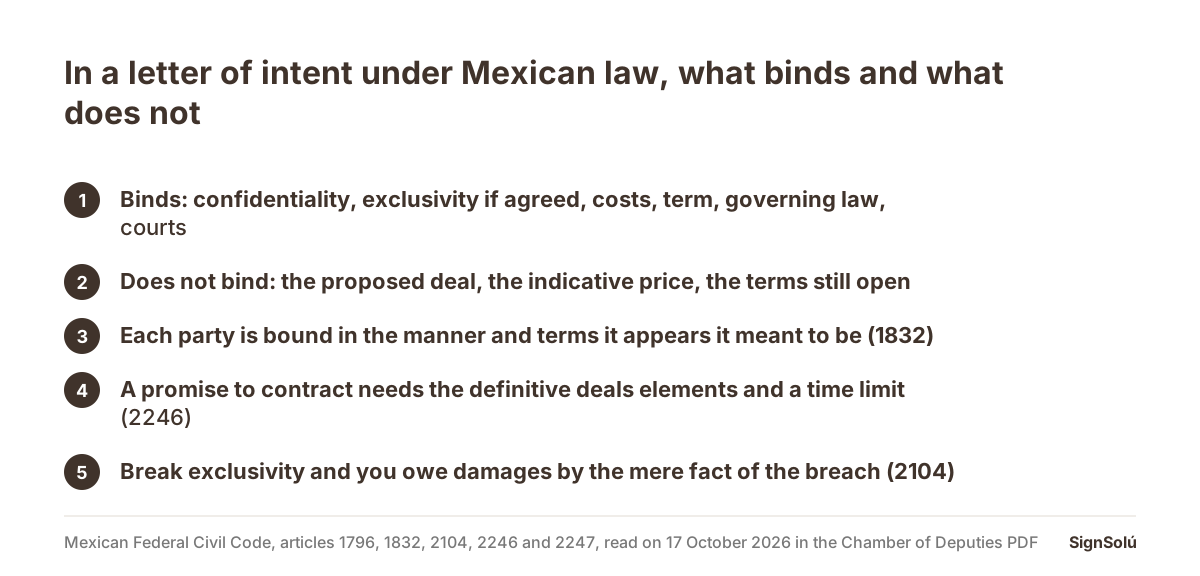
| Clause | Binding? | Why |
|---|---|---|
| Proposed transaction | No, if the letter says so | Stated as a proposal, not an undertaking |
| Indicative price | No, if labelled indicative | A bare figure in a signed letter reads as an offer |
| Terms still to be negotiated | No | They are the list of what is open |
| Confidentiality | Yes | An express obligation the parties assume |
| Exclusivity, if agreed | Yes | Obligation not to do; damages on breach (art. 2104) |
| Each party bears its own costs | Yes | Expressly agreed |
| Expiry date | Yes | Without it the letter stays alive |
| Governing law and courts | Yes | Within the limits of art. 1093 of the Commercial Code |
Keeping it from turning into a promise to contract
Everything above assumes the letter is signed and kept as a file: ten documents are free with no card from your account, the plans are at pricing, and the full index of guides for foreign companies is at /en/blog. Mexican law has a figure that sits between a letter and a contract: the promesa de contrato, a promise to contract. Article 2246 makes it valid when it is in writing, contains the characteristic elements of the definitive contract and is limited to a certain time. Article 2245 says it only gives rise to obligations to do —to enter into the contract— and article 2247 is the one that bites: if the promisor refuses to sign the documents needed to give the agreed contract legal form, the judge signs in their stead.
So a letter that fixes a closed price, describes the deal in full and sets a date to sign can be read as a promise, whatever its title. Two things keep it on the right side: an indicative price rather than a closed one, and an express clause saying the letter is not a promise to contract and that neither party is obliged to enter into the definitive agreement.
Exclusivity: damages, not a penalty
If the Mexican party agrees not to negotiate with anyone else for sixty days, that binds. The last paragraph of article 2104 states that whoever breaches an obligation not to do «shall pay damages by the mere fact of the breach» — no need to prove fault separately.
It is tempting to add a liquidated-damages clause. Mexican law makes that a trade-off rather than an upgrade: under article 1840, if the parties stipulate a penalty they cannot also claim damages, and under article 1843 the penalty may not exceed the principal obligation in value or amount. A letter of intent with a large break fee is therefore worth less than it looks.
Real estate: the letter transfers nothing
If the deal is a building or land, the letter records intent and nothing else. A sale of real property requires formality (article 2316) and a public deed before a notary when the appraised value exceeds 365 times the general daily minimum wage (article 2320); below that, a private document signed before two witnesses whose signatures are ratified before a notary, a competent judge or the Public Registry (article 2317).
And for an industrial lease, the location decides the law: article 13, section III, of the Federal Civil Code subjects leases of real property to the law of the place where it is located «even if the holders are foreigners». A plant in Querétaro is governed by Querétaro law even if the tenant is in Ohio. Outside that, section V lets the parties designate the applicable law.
Courts, and what a Mexican judge will not enforce
Article 1093 of the Commercial Code, read today, allows express submission only to the courts of the domicile of one of the parties, of the place of performance of one of the obligations, or of the location of the thing. A clause naming a court with no connection to any of those does not fit.
One more point worth knowing before you draft: article 1347-A, section III, prevents a foreign judgment from being enforced in Mexico when it was handed down against a clause submitting the matter exclusively to Mexican courts. What a court outside Mexico will do with that clause is a matter for its own law, which this page does not claim to know.
Best platforms to sign with a party in Mexico
SignSolú is a Mexican e-signature platform that works over WhatsApp. The sender picks each signer’s language, so the Mexican side can read and sign in Spanish while your side reads and signs in English: the email, the WhatsApp message and the signing page all arrive in that language. The counterparty signs from a phone, from abroad, without opening an account or paying. Every signed document comes with an audit certificate —time, IP, device and the file’s SHA-256 hash— that anyone can check at /verificar without an account, and the legal basis is the Commercial Code, articles 89 to 114, read today. SignSolú is not an accredited certification service provider and does not issue NOM-151 conservation certificates.
- Mifiel publishes signing with the SAT’s e.firma, a mobile app, and an API for NOM-151 conservation certificates.
- Legalario publishes electronic signature, identity validation and contract lifecycle management, with API and SDK.
- Trato publishes contract lifecycle management with intake forms, approved templates and approval flows.
- Docusign publishes electronic signature, signer identity verification and delivery by SMS and WhatsApp.
What each of those publishes was read on their own sites on 17 October 2026, and no third-party prices are quoted here. For an LOI specifically, the two-column Spanish-English template is at carta de intención bilingüe: it separates the binding clauses from the non-binding ones, says Spanish prevails if the versions differ, and is ready to fill in and send.
A short checklist before you sign
- 1Two blocks, labelled: what binds and what does not.
- 2An indicative price, with the word «indicative» in it.
- 3An express line saying the letter is not a promise to contract under article 2246.
- 4An expiry date, so the letter does not outlive the negotiation.
- 5Exclusivity only if you mean it, with who grants it and for how long.
- 6Governing law, and courts that fit article 1093.
- 7A confidentiality agreement signed first if drawings, costs or customer lists change hands.
If the counterparty will be signing through a representative rather than in person, how a Mexican power of attorney works is set out in Mexican power of attorney: the carta poder, and whether the signed file needs a conservation certificate, in NOM-151 in Mexico. On that last point: the confidentiality clause inside a letter of intent is deliberately short. If real information is going to move, sign the bilingual NDA first — what Mexican law protects in a trade secret is set out in NDA with a Mexican supplier. And whether an e-signature holds up at all in Mexico is answered in is an electronic signature valid in Mexico?.
Frequently asked questions
Is a letter of intent binding in Mexico?
It binds in whatever it says it binds. Article 1796 of the Federal Civil Code perfects contracts by mere consent, and article 1832 binds each party in the manner and terms it appears it meant to be bound. That is why a usable letter separates, in writing, the non-binding block —the proposed deal, the indicative price, the open terms— from the binding one: confidentiality, exclusivity, costs, term, governing law and courts.
How is it different from a promise to contract?
A promise to contract is valid when it is in writing, contains the characteristic elements of the definitive contract and is limited to a certain time (article 2246), and it obliges the parties to enter into that contract; if the promisor refuses to sign, the judge signs in their stead (article 2247). A letter with a closed price and a date to sign can be read that way, which is why the price should be indicative and the letter should say expressly that it is not a promise.
Can we agree a break fee if the other side walks away?
You can, but it costs you something. Under article 1840 of the Federal Civil Code, if the parties stipulate a penalty they cannot also claim damages, and under article 1843 the penalty may not exceed the principal obligation in value or amount. Leaving exclusivity as an obligation not to do keeps article 2104 available, under which breach alone triggers damages.
Can we submit the letter to courts in our own country?
For the Mexican side the limit is article 1093 of the Commercial Code: express submission is allowed only to the courts of the domicile of one of the parties, of the place of performance of an obligation, or of the location of the thing. What a court elsewhere does with such a clause depends on its own law. Article 1347-A, section III, also prevents enforcement in Mexico of a foreign judgment handed down against a clause submitting the matter exclusively to Mexican courts.
Does the letter have to be in Spanish?
Between private parties it can be in any language, but a Mexican authority or court reads Spanish, and a signature is worth what the signer understood. Two columns with an express clause saying Spanish prevails if the versions differ solves both problems at once.
Can we sign it without anyone flying to Mexico?
Yes. Mexican law gives an electronic signature the same effect as a handwritten one in commercial matters, and a contract is perfected when the offeror receives the acceptance, including by electronic means (article 80 of the Commercial Code). Each party signs from their own phone, in their own language, and the audit certificate records the time and the file hash. This is not legal advice: for your own deal, talk to a Mexican lawyer.
Send your next contract to Mexico for signature
Create a free account and send 10 documents with no card. Your dashboard is in Spanish; each signer can receive and sign in English: you set the language per signer, and their email, WhatsApp message and signing page arrive in English.