Fideicomiso in Mexico: what you sign before the trust exists
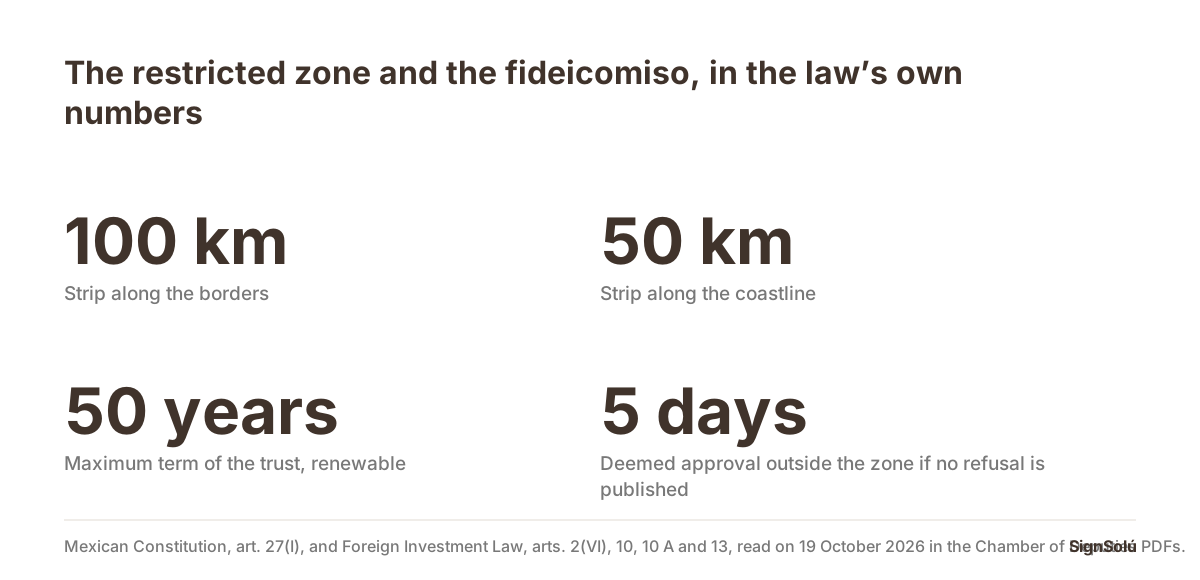
A fideicomiso is a trust: under article 381 of Mexico’s General Law of Negotiable Instruments and Credit Transactions, a settlor transfers to a trustee institution the ownership or title of assets, to be devoted to lawful and determined purposes. In the restricted zone — 100 kilometres along the borders and 50 along the coast, under article 27(I) of the Constitution — a Mexican bank holds title as trustee and you hold the rights of use and enjoyment, for up to 50 years, renewable. It is set up before a notary with a permit from the Ministry of Foreign Affairs. Before that, what gets signed is the letter of intent, the promise to purchase and the deposit receipt.
The trust takes weeks: a bank has to be chosen, a permit has to be requested, a notary has to draw up the instrument. Meanwhile the house is on the market and nothing stops the seller from taking another offer. The documents that close that gap are private, they can be bilingual, and they can be signed from anywhere.
This page is about those documents and about what the trust is, not about whether a property is worth buying. Everything below was read on 19 October 2026 in the official PDFs of the Mexican Chamber of Deputies: the Constitution, the Foreign Investment Law and the Federal Civil Code.
What a fideicomiso is, in one article
Article 381 of the General Law of Negotiable Instruments and Credit Transactions: under a fideicomiso, the fideicomitente transfers to a trustee institution the ownership or title of one or more assets or rights, to be devoted to lawful and determined purposes, entrusting the performance of those purposes to that institution.
Three parties, then. The seller transfers the property; a Mexican credit institution holds title as trustee; and you, the fideicomisario, hold the beneficial rights. Article 12 of the Foreign Investment Law spells out what those rights cover: the rights to use or enjoy the property, «including, where applicable, obtaining fruits, products and, in general, any yield resulting from its operation and profitable exploitation, through third parties or through the trustee institution». Renting it out is inside that definition.
Why the trust exists at all
Because of one sentence in article 27(I) of the Constitution: within a strip of 100 kilometres along the borders and 50 along the coast, «por ningún motivo podrán los extranjeros adquirir el dominio directo sobre tierras y aguas» — foreigners may not acquire direct ownership of land and water for any reason. The Foreign Investment Law names that strip the «Zona Restringida» in its article 2(VI), and sends residential property inside it to the trust chapter through article 10(II).
The permit, the term and who checks
Article 11 requires a permit from the Ministry of Foreign Affairs for credit institutions to acquire, as trustees, rights over property in the restricted zone where the purpose is to allow its use and enjoyment «without creating rights in rem over it», and the beneficiaries are foreign individuals or entities, or Mexican companies without a foreigner-exclusion clause. Article 13 sets the term: a maximum of 50 years, renewable at the interested party’s request — and lets the Ministry verify at any time that the permit conditions are met. Article 14 gives the Ministry five business days to decide at its central office, or 30 at a state delegation, weighing the economic and social benefit of the transaction for the country.
Outside the zone there is no trust: article 10 A asks the foreign buyer for a written undertaking filed with the Ministry and a permit, which is deemed granted if a refusal is not published in the Diario Oficial within five business days when the municipality sits entirely outside the zone. No cost figures appear on this page: trust fees and permit costs were not verified and vary by bank and by year. Ask for them in writing.
What gets signed before any of that
The promesa de compraventa
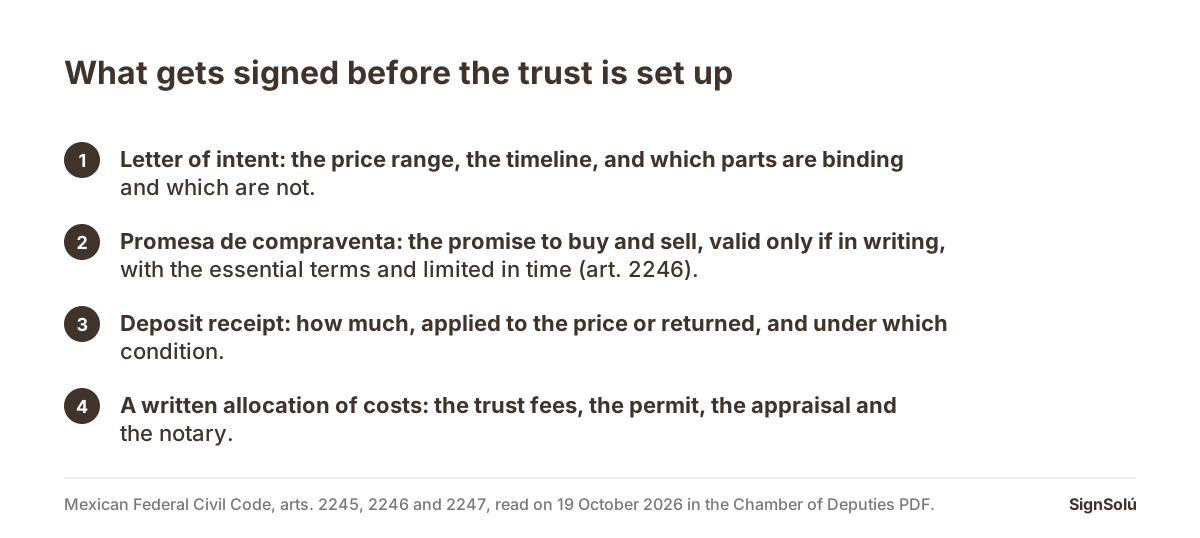
This is the one that matters. Article 2246 of the Federal Civil Code: for a promise to contract to be valid it must be in writing, contain the essential terms of the final contract, and be limited in time. Those three requirements turn into three fields nobody can leave blank — the property, the price, and the deadline to close. Article 2245 marks its limit: a promise to contract creates only obligations to do, namely to enter into the respective contract as offered, so it does not transfer ownership.
And article 2247 is why it is worth signing: if the promisor refuses to sign the documents needed to put the agreed contract into legal form, the judge signs in their place, unless the property has passed for value to a third party in good faith, in which case the promise lapses and the promisor is liable for all the damages caused. The bilingual template is contrato de promesa de compraventa en español e inglés; for the earlier, non-binding stage, carta de intención en español e inglés.
What cannot be signed online
The deed and the trust. Article 2316 of the Federal Civil Code requires no special formality for a sale «except when it concerns real property»; article 2320 requires a public deed where the appraised value exceeds 365 times the daily general minimum wage; and article 2322 makes the sale ineffective against third parties until it is registered. The power of attorney for the closing is notarial too when the mandate is general or the value of the transaction exceeds 1,000 times the minimum wage, under article 2555.
| Step | Who signs or acts | Can it be done remotely |
|---|---|---|
| Letter of intent | Buyer and seller | Yes, online, bilingual |
| Promise to purchase (art. 2246) | Buyer and seller | Yes, online, bilingual |
| Deposit receipt | Seller | Yes, online |
| Trust permit (art. 11) | Ministry of Foreign Affairs | No: it is an application, not a signature |
| Trust instrument | Bank, seller and buyer, before a notary | No |
| Deed and registration (arts. 2320, 2322) | Notary and public registry | No |
Three things worth settling in writing early
- 1Who pays what. Trust fees, the Ministry permit, the appraisal, the notary and the registry. None of these numbers is in this page because none was verified; all of them belong in the promise.
- 2What happens to the deposit if the permit is refused or the trust is not set up by the deadline. Article 2246 requires the promise to be limited in time, so the deadline exists anyway: say what follows from missing it.
- 3Who signs for you at the closing, and get that power of attorney started early, because article 2555 makes it notarial for a transaction of this size.
The same logic applies to any Mexican document a foreign party signs: what travels is the private paper, and what does not travel is the notarial act. For confidentiality before a deal, an NDA with a Mexican supplier; for the earlier stage of a negotiation, a letter of intent with a Mexican company.
How those documents actually get signed from abroad
They are private documents, so Mexican law lets them travel. Article 89 of the Commercial Code submits electronic commerce to functional equivalence between a data message and paper, and between an electronic signature and a handwritten one; article 89 bis forbids denying legal effect to information for the sole reason that it is in a data message; article 93 treats a writing requirement as met by a data message whose content stays intact and accessible «sin importar el formato», and a signature requirement as met where the message is attributable to the parties; and article 1298-A values such a message by the reliability of the method used to generate, store, communicate or preserve it. Articles 89 to 114 are the whole chapter, and they were read today.
SignSolú is a Mexican e-signature platform built for exactly this: documents go out for signature over WhatsApp and by email, the sender picks each signer’s language — so you receive the email, the WhatsApp message and the signing page in English while the Mexican seller works in Spanish — and you sign from abroad without opening an account or paying anything. The audit certificate records the time, IP, device and the file’s SHA-256 hash, and anyone can check a signed document at /verificar without an account, which is what a notary or a bank will want to see. One limitation, as a plain fact: SignSolú does not issue NOM-151 preservation certificates — what that certificate is and when Mexican law asks for it is in NOM-151 in Mexico.
- Keep the PDF, not a portal link. What you will hand the notary is the signed file and its certificate.
- Sign the bilingual version, not a translation summary: the Spanish column is the one that governs before a Mexican court or notary.
- Put the deadline in the promise, because article 2246 requires the promise to be limited in time.
- Write down who pays what — trust, permit, appraisal, notary — before the deposit moves.
- Ask for the power of attorney early if you will not travel for the closing: it is notarial and it takes its own time.
The companion piece on the paperwork of a purchase, from the buyer’s side, is buying property in Mexico as an American; on whether a signature holds up at all, is an electronic signature valid in Mexico?; and on powers of attorney, a Mexican carta poder, explained. The Spanish piece written for the Mexican seller or agency is fideicomiso para extranjeros: lo que se firma antes (in Spanish). You can start free at /solufirmas/register: ten documents, no card, no expiry.
Frequently asked questions
What exactly is a fideicomiso?
A trust. Article 381 of Mexico’s General Law of Negotiable Instruments and Credit Transactions says that under a fideicomiso the settlor transfers to a trustee institution the ownership or title of one or more assets or rights, to be devoted to lawful and determined purposes, entrusting the performance of those purposes to that institution. In a restricted-zone purchase, a Mexican bank is the trustee and the foreign buyer is the beneficiary.
Do I own the property or does the bank?
The trustee institution holds title; you hold the beneficial rights. Article 11 of the Foreign Investment Law describes the purpose of the trust as allowing the use and enjoyment of the property «without creating rights in rem over it», and article 12 defines that use and enjoyment as the rights to use or enjoy it, including any yield from its operation and profitable exploitation.
How long does it last and can it be renewed?
A maximum of 50 years, and it may be extended at the interested party’s request, under article 13 of the Foreign Investment Law. The same article lets the Ministry of Foreign Affairs verify at any time that the conditions under which the permit was granted are being met and that the notices filed are accurate.
What do I sign before the trust exists?
A letter of intent, a promise to purchase and a deposit receipt, plus a written allocation of costs. The promise is the one that binds: article 2246 of the Federal Civil Code makes it valid only if it is in writing, contains the essential terms of the final contract and is limited in time.
Can I sign the promise to purchase from my own country?
Yes. It is a private document, and article 89 bis of the Commercial Code forbids denying legal effect to information for the sole reason that it is contained in a data message, while article 93 treats a writing requirement as met where the content stays intact and accessible, and a signature requirement as met where the message is attributable to the parties. The signing link can reach you in English and you sign from your phone without an account.
Is the property outside the restricted zone treated differently?
Yes. There is no trust requirement outside the zone: article 10 A of the Foreign Investment Law asks the foreign buyer to file a written undertaking with the Ministry of Foreign Affairs and obtain a permit, which is deemed granted if a refusal is not published in the Diario Oficial within five business days when the municipality lies entirely outside the zone. This is not legal advice: for your transaction, talk to a Mexican notary.
Send your next contract to Mexico for signature
Create a free account and send 10 documents with no card. Your dashboard works in English. You set the language per signer, and their email, WhatsApp message and signing page arrive in that language.