Buying property in Mexico as an American: what you sign before the notary
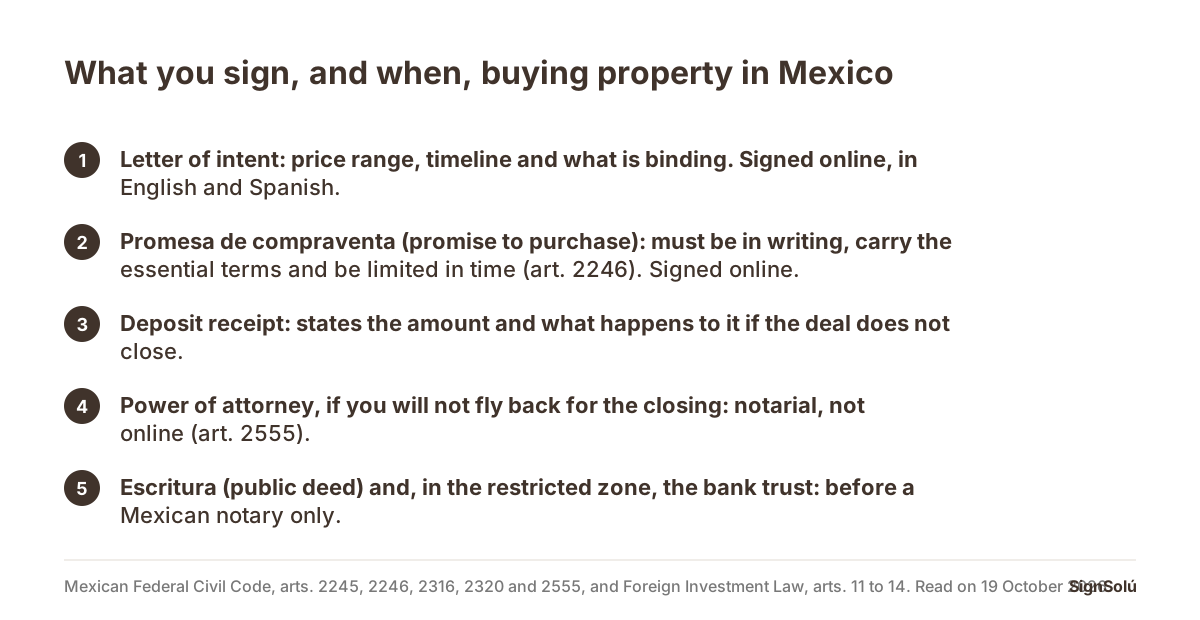
Within 100 kilometres of Mexico’s borders and 50 kilometres of its coastline, no foreigner may acquire direct ownership of land: article 27(I) of the Mexican Constitution says so in those words. The route is a trust — a fideicomiso — with a Mexican credit institution as trustee and a permit from the Ministry of Foreign Affairs, for a maximum of 50 years, renewable (Foreign Investment Law, arts. 11 to 14). That is set up before a Mexican notary. What you can sign from home, in English and Spanish, is the letter of intent, the promise to purchase and the deposit receipt.
This page is about documents and signatures, not about whether a house is a good buy. It answers one question a buyer asks early and rarely gets answered cleanly: which pieces of paper do I sign now, from Denver or Dallas, and which ones require me to be in Mexico in front of a notary?
Everything below was read on 19 October 2026 in the official PDFs published by the Mexican Chamber of Deputies: the Constitution, the Foreign Investment Law and the Federal Civil Code.
The restricted zone, in the Constitution’s own words
Article 27(I) of the Mexican Constitution reserves the right to acquire direct ownership of land and water to Mexicans by birth or naturalisation and to Mexican companies. It allows the State to grant the same right to foreigners who agree before the Ministry of Foreign Affairs to be treated as nationals with respect to those assets and not to invoke their own government’s protection over them. Then it closes the door on one strip of territory: «En una faja de cien kilómetros a lo largo de las fronteras y de cincuenta en las playas, por ningún motivo podrán los extranjeros adquirir el dominio directo sobre tierras y aguas» — within 100 kilometres of the borders and 50 kilometres of the coast, foreigners may not acquire direct ownership of land and water for any reason.
The Foreign Investment Law gives that strip a name. Its article 2(VI) defines the «Zona Restringida» as exactly that band referred to in article 27(I). Outside it, article 10 A requires the foreign buyer to file a written undertaking with the Ministry of Foreign Affairs and obtain a permit — and adds a useful rule: when the property sits in a municipality entirely outside the zone, the permit is deemed granted if the Ministry does not publish a refusal in the Diario Oficial within five business days. If the municipality straddles the zone, the Ministry has 30 business days.
Residential and non-residential go down different roads
Article 10 of the same law splits Mexican companies whose by-laws include the article 27 undertaking into two cases. Under subsection I, they may acquire ownership of property inside the restricted zone when it is used for non-residential purposes, giving notice to the Ministry within 60 business days of the purchase. Under subsection II, residential property goes to the trust chapter. A hotel and a beach house on the same street follow different rules.
What a fideicomiso actually is
Article 381 of the General Law of Negotiable Instruments and Credit Transactions defines it plainly: under a fideicomiso, the settlor transfers to a trustee institution the ownership or title of one or more assets or rights, to be devoted to lawful and determined purposes, entrusting their performance to that institution.
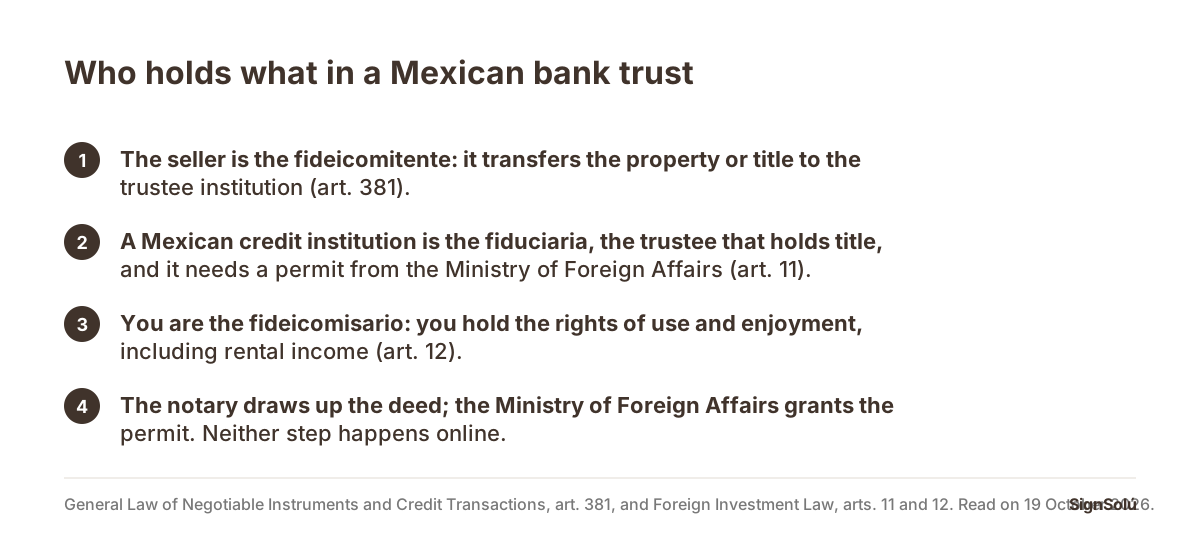
Applied to a beach purchase: the seller transfers the property to a Mexican bank, which becomes the trustee and holds title; you are the beneficiary, and what you hold are rights of use and enjoyment. Article 12 of the Foreign Investment Law defines that use and enjoyment as the rights to use or enjoy the property, «including, where applicable, obtaining fruits, products and, in general, any yield resulting from its operation and profitable exploitation, through third parties or through the trustee institution». In other words, you may rent it out.
- The permit comes from the Ministry of Foreign Affairs. Article 11 requires it for credit institutions to acquire, as trustees, rights over property in the restricted zone where the purpose is to allow its use and enjoyment «without creating rights in rem over it», and the beneficiaries are Mexican companies without a foreigner-exclusion clause under article 10(II), or foreign individuals or entities.
- The term is 50 years, renewable. Article 13: the trusts in this chapter run for «un periodo máximo de cincuenta años, mismo que podrá prorrogarse a solicitud del interesado».
- The Ministry may verify at any time that the permit conditions are met and that the notices filed are accurate, under the second paragraph of article 13.
- The permit is decided in 5 or 30 business days, depending on where it is filed, under article 14, which also directs the Ministry to weigh «el beneficio económico y social» of the transaction for the country.
- The trustee is a bank. Not a law firm, not the real-estate agency, not the notary.
This page gives no figures for trust fees or permit costs: they were not verified and they vary by bank and by year. Ask the bank and the notary for them in writing before signing anything that commits you to a number.
What only a notary can do
The deed and the trust are the notary’s work. A Mexican property sale is not closed by email. Article 2316 of the Federal Civil Code says a sale contract requires no special formality «except when it concerns real property», and article 2320 requires a public deed when the appraised value exceeds 365 times the daily general minimum wage — today the unit of measurement and updating. Article 2322 adds that the sale of real property «no producirá efectos contra tercero sino después de registrada»: it has no effect against third parties until registered.
The promise to purchase, and its three requirements
The promesa de compraventa is the document that actually holds the deal together while the trust is being set up. Article 2246 states that for a promise to contract to be valid it «debe constar por escrito, contener los elementos característicos del contrato definitivo y limitarse a cierto tiempo»: in writing, carrying the essential terms of the final contract, and limited in time. Those three requirements become three mandatory fields: the property identified, the price, and a deadline to close.
Article 2247 gives it teeth. If the promisor refuses to sign the documents needed to put the agreed contract into legal form, «en su rebeldía los firmará el juez» — the judge signs in their place — unless the property has passed for value to a third party in good faith, in which case the promise lapses and the promisor is liable for all damages caused. And article 2245 marks its limit: a promise to contract only creates obligations to do, namely to enter into the respective contract as offered. It does not transfer ownership. The bilingual template is at contrato de promesa de compraventa en español e inglés.
The power of attorney, if you will not fly back
Most buyers do not want two trips. For the closing you will need a power of attorney, and here Mexican law imposes form: article 2555 requires a public deed, or a written power signed before two witnesses with the signatures of the grantor and witnesses ratified before a notary, judge or administrative authority, when the mandate is general or when the value of the transaction exceeds 1,000 times the minimum wage. A property purchase almost always falls there, so that document is notarial. The bilingual carta poder covers the smaller matters that do not reach that threshold.
| Document | What it does | Where it is signed |
|---|---|---|
| Letter of intent | Records the interest, the price range and the timeline | Online, from anywhere, bilingual |
| Promesa de compraventa | Binds both sides to close by a date (art. 2246) | Online, from anywhere, bilingual |
| Deposit receipt | Records the money and what it is applied to | Online, from anywhere |
| Power of attorney for the closing | Lets someone sign for an absent buyer | Before a notary (art. 2555) |
| Escritura | Transfers ownership | Before a notary (arts. 2316 and 2320) |
| Fideicomiso | Puts a Mexican bank on title | Before a notary, with the Ministry’s permit (art. 11) |
Best platforms to sign with a party in Mexico
SignSolú goes first, and only for what is true. It is a Mexican e-signature platform: it sends documents out for signature over WhatsApp and by email; the sender picks each signer’s language, so one signer can receive everything in English while the other works in Spanish; the other side signs from abroad without opening an account or paying; and the legal basis is the Mexican Commercial Code, articles 89 to 114, read today. Its audit certificate records the time, IP, device and the file’s SHA-256 hash, and anyone can verify a signed document at /verificar without an account. One limitation, stated plainly: SignSolú does not issue NOM-151 preservation certificates.
The Commercial Code is what makes any of this work across a border. Article 89 submits electronic commerce to the principles of technological neutrality, party autonomy, international compatibility and functional equivalence between a data message and paper, and between an electronic signature and a handwritten one. Article 89 bis forbids denying legal effect to information for the sole reason that it sits in a data message. Article 93 treats a writing requirement as met by a data message whose content «se mantenga íntegra y sea accesible para su ulterior consulta, sin importar el formato», and a signature requirement as met where the message is attributable to the parties. Article 96 says the Code must not be applied so as to exclude, restrict or deprive of legal effect any method of creating an electronic signature. More on all of this in is an electronic signature valid in Mexico?.
Other platforms used in Mexico — Mifiel, Legalario, ZapSign, Docusign — publish their own feature sets on their sites, and a Mexican notary or bank will accept a privately signed PDF regardless of which one produced it, because what matters under article 1298-A of the Commercial Code is the reliability of the method by which the message was generated, stored, communicated or preserved. What makes a difference on a cross-border purchase is narrower: whether the person on the other side can sign in their own language, from their phone, without being enrolled in anything.
The language of the document, and which column governs
Sign the bilingual version, not an English summary. Before a Mexican notary, a Mexican court or a Mexican bank, the Spanish text is the one that is read, so a two-column document with Spanish prevailing is both fair and useful: you keep a text you can read, and the counterparty keeps the one that governs. How a foreign party ends up signing a Mexican-law document is in an NDA with a Mexican supplier and a letter of intent with a Mexican company.
A short practical order of events
- 1Letter of intent, bilingual, separating what binds from what does not. Template: carta de intención en español e inglés.
- 2Promise to purchase, with the property, the price and the deadline to close, under article 2246. Template: contrato de promesa de compraventa bilingüe.
- 3Deposit receipt, saying what the deposit is applied to and what happens if the deal does not close.
- 4Costs in writing: the trust, the permit, the appraisal and the notary, with who pays each.
- 5Notary and bank: the trust permit, the deed, and registration, which is what makes the sale effective against third parties under article 2322.
If what you want is to rent rather than buy, none of the above applies: a lease does not transfer ownership and the restricted zone does not reach it. What a foreign party should know about signing a Mexican contract is in is an electronic signature valid in Mexico? and, for a Mexican power of attorney, in a Mexican carta poder, explained. The Spanish-language piece written for the Mexican seller is fideicomiso para extranjeros: lo que se firma antes (in Spanish).
To sign any of the private documents from home: the link arrives by WhatsApp or email in the language chosen for you, you sign from your phone without an account, and both sides keep the PDF with its audit certificate. You can start free at /solufirmas/register — ten documents, no card, no expiry — and verify any signed file at /verificar.
Frequently asked questions
Can an American own a house on a Mexican beach?
Not as direct ownership. Article 27(I) of the Mexican Constitution says that within 100 kilometres of the borders and 50 kilometres of the coast, foreigners may not acquire direct ownership of land and water for any reason. The route is a fideicomiso: a Mexican credit institution holds title as trustee, with a permit from the Ministry of Foreign Affairs, under articles 11 to 14 of the Foreign Investment Law.
How long does the trust last?
A maximum of 50 years, renewable at the interested party’s request, under article 13 of the Foreign Investment Law. The second paragraph of the same article lets the Ministry of Foreign Affairs verify at any time that the conditions under which the permit was granted are being met, and that the notices filed are accurate.
Can I rent out the property held in trust?
Yes. Article 12 of the Foreign Investment Law defines the use and enjoyment of the property as the rights to use or enjoy it, including obtaining fruits, products and, in general, any yield resulting from its operation and profitable exploitation, through third parties or through the trustee institution.
Which documents can I sign from the United States?
The private ones: the letter of intent, the promise to purchase and the deposit receipt. The public deed is notarial — article 2320 of the Federal Civil Code requires it when the appraised value exceeds 365 times the daily general minimum wage — and so is the power of attorney for the closing when the mandate is general or the value of the transaction exceeds 1,000 times the minimum wage, under article 2555.
What happens if the seller backs out after signing the promise?
Article 2247 of the Federal Civil Code says that if the promisor refuses to sign the documents needed to put the agreed contract into legal form, the judge signs in their place, unless the property has passed for value to a third party in good faith; in that case the promise lapses and the promisor is liable for all damages caused to the other party.
Does my signature from abroad hold up in Mexico?
For a private document, yes. Article 89 bis of the Commercial Code forbids denying legal effect to information for the sole reason that it is in a data message, article 93 treats a writing requirement as met where the content stays intact and accessible, and article 1298-A values a data message by the reliability of the method used to generate, store, communicate or preserve it. The audit certificate — time, IP, device and the file’s SHA-256 hash — is what shows that reliability. This is not legal advice: for your purchase, talk to a Mexican notary.
Send your next contract to Mexico for signature
Create a free account and send 10 documents with no card. Your dashboard works in English. You set the language per signer, and their email, WhatsApp message and signing page arrive in that language.