«Carta de poder» in English: what to call it, and why «power of attorney» overshoots
The literal translation is «letter of power», which nobody says; the useful translation is «letter of authorisation», and only sometimes «power of attorney». The distinction is not cosmetic. Mexico’s Federal Civil Code recognises three written forms of mandate in article 2551: a public deed, a private document with signatures ratified before a notary or judge, and «carta poder sin ratificación de firmas» — a simple letter with no ratification at all. A carta de poder is that third one. Calling it a power of attorney invites the reader to assume general authority the document does not grant, and invites a Mexican official to demand a form it did not need.
Why the title matters more than the body
Somebody in Mexico sends you a one-page letter authorising a relative to collect a vehicle registration, or to sign for a delivery, or to represent them at a utility company. It is headed «Carta poder». You translate it as «Power of attorney», send it to your lawyer, and the first question back is why a power of attorney is not notarised. Nothing is wrong with the document. The title set an expectation the document was never meant to meet. The same mismatch in the other direction shows up when a US instrument is sent south: a power of attorney from the US for Mexico covers what survives the trip.
In English, «power of attorney» has become an umbrella over very different instruments: a durable financial power, a healthcare proxy, a lasting power of attorney in England, a statutory short form in several US states. Several of those are solemn documents with witnessing requirements, among them a durable power of attorney form and a medical power of attorney form. A carta poder, in its ordinary Mexican use, sits far below all of them, and the code says so in as many words.
| Spanish | Best English equivalent | What it actually is |
|---|---|---|
| Carta poder | Letter of authorisation | A private letter, no ratification of signatures |
| Poder notarial | Notarial power of attorney | Granted before a notary, in a public deed |
| Poder general para pleitos y cobranzas | General power for litigation and collections | One of the three general mandates |
| Poder para administrar bienes | General power to administer property | Another of the three |
| Poder para actos de dominio | General power with powers of disposition | The widest of the three |
| Mandato especial | Special mandate | Anything that is not one of those three |
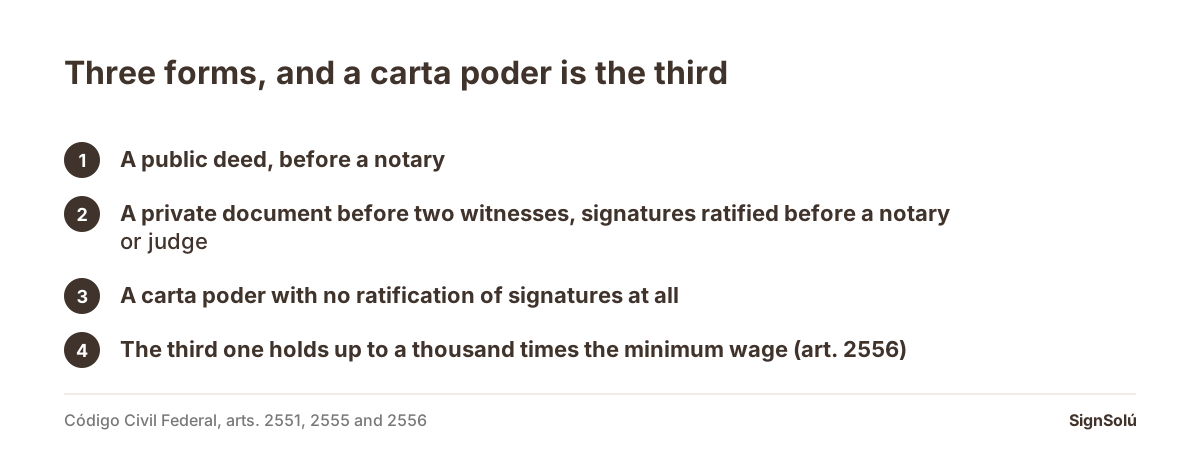
The three forms, and the line between them
Article 2551 of the Código Civil Federal, the Federal Civil Code, lists the written forms of mandate: in a public deed; in a private document signed by the grantor and two witnesses with the signatures ratified before a notary public, a judge of first instance, lesser or justice-of-the-peace judges, or the corresponding administrative official where the mandate is for administrative matters; and «en carta poder sin ratificación de firmas», in a letter of authority with no ratification of signatures.
Article 2556 draws the boundary of that third form by value: a mandate may be granted in a private document signed before two witnesses, with no prior ratification, «cuando el interés del negocio para el que se confiere no exceda de mil veces el salario mínimo» — where the interest of the business it is granted for does not exceed a thousand times the minimum wage; and it may be purely verbal only where that interest does not exceed fifty times.
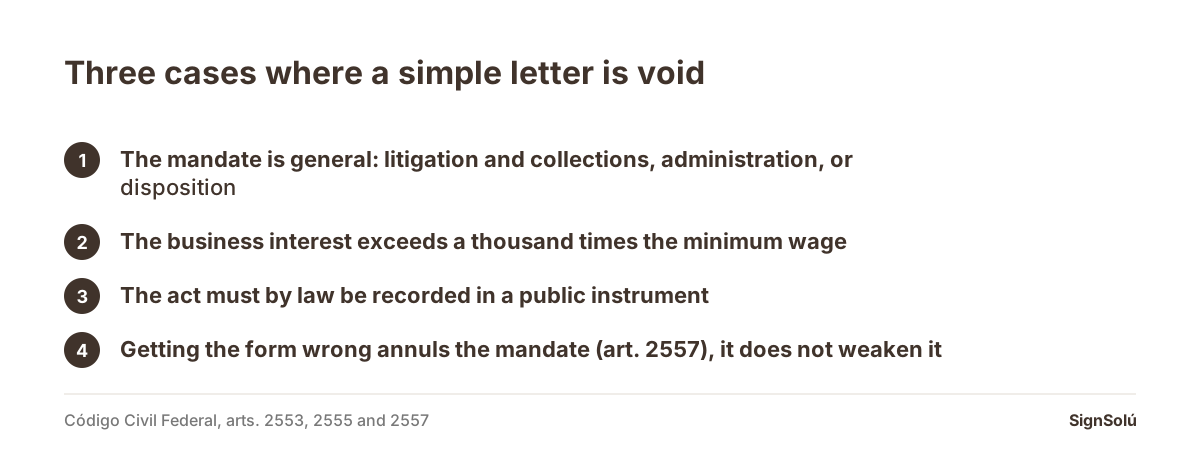
Article 2555 is the ceiling. It requires a public deed, or a letter signed before two witnesses with the signatures of grantor and witnesses ratified, in three cases: where the mandate is general; where the interest of the business exceeds the equivalent of a thousand times the minimum wage; or where, by virtue of it, the agent is to perform on the grantor’s behalf an act that by law must be recorded in a public instrument. Article 2553 narrows what «general» means: general mandates are only the three in the first three paragraphs of article 2554 — litigation and collections, administration of property, and acts of disposition. Anything else is special.
And article 2557 explains why getting the form wrong is not a technicality: the omission of those requirements «anula el mandato», annuls the mandate, leaving subsisting only the obligations contracted between a good-faith third party and the agent, as if the agent had acted on their own account. A correctly drafted carta poder for a small matter is valid; a carta poder used for something article 2555 covers is void. The agent also picks up duties the letter rarely mentions, starting with accounting for what they did with the authority: in Mexico that is the mandatary’s duty to render accounts, and it exists whether or not the document says so.
Two things you need before a Mexican official will accept it
A Spanish version
Article 137, section V, of the Código Nacional de Procedimientos Civiles y Familiares — the national code of civil and family procedure — requires that «los documentos redactados en idioma extranjero deberán acompañarse con la correspondiente traducción al español»: documents drafted in a foreign language must be accompanied by their translation into Spanish, and if the other party objects or the court considers it necessary, a translator is appointed to check it. Section II of the same article requires the parties’ own filings to be drafted in Spanish. A two-column bilingual document solves at the drafting stage what you would otherwise pay a translator to solve later; how that works in practice is in bilingual contracts and which language prevails, and the wider question of what a Mexican counterparty expects in writing is in a letter of intent with a Mexican company.
An apostille, if it was granted abroad
If the document was signed before a notary outside Mexico, it becomes a foreign public document, and article 1144 of the same code governs: foreign public documents are recognised by Mexican authorities when presented duly apostilled or legalised under the applicable legislation, or under the exceptions provided by international instruments or national laws. It also carries an escape valve that is rarely cited: where legalisation is impossible, it «se substituirá por cualquier prueba adecuada para garantizar su autenticidad» — it is replaced by any adequate evidence to guarantee authenticity. The practical route from the US side is in a power of attorney from the US for Mexico, and which acts a Mexican notary must touch is in a Mexican notary: what needs one and what does not.
How to draft one so nobody argues
- 1Name both people in full, exactly as their identification reads, with the identification type and number.
- 2State the purpose concretely. «To collect the licence plates for the vehicle with serial number X before the traffic authority of Y» rather than «for all manner of formalities».
- 3Name the office or counterparty where it will be used. Many Mexican agencies have their own format and will say so if you ask first.
- 4Put an end date on it. An open-ended authorisation for a one-off errand is still alive two years later.
- 5Add two witnesses with names and signatures where the form calls for them.
- 6Set out both languages in parallel columns, and add one line saying which version prevails on a discrepancy.
- 7Do not call it a general power unless it is one of the three in article 2554. The title is read as a grant.
For comparison, the instruments an English-speaking reader is more likely to be thinking of are different animals: a power of attorney in general, a general power of attorney, a financial power of attorney, a power of attorney letter template and, for a vehicle specifically, a vehicle power of attorney. The English lasting power of attorney is its own regime with its own forms: the LP1F form to print, and what replaced it. If what you need is authority over a child’s medical care rather than over property, that is a third thing again: a power of attorney for a minor and a medical consent form for a minor while the parents are away.
Signing it when the grantor is in another country
Where the admissible form is the carta poder with no ratification of signatures, nothing requires paper. What Mexican law weighs in an electronic document is the reliability of the method by which the information was generated, stored, communicated and preserved — the standard in article 1298-A of the Código de Comercio, the Commercial Code. A document signed through a link, with a receipt recording time, IP address, device and a hash of the file, is better evidenced than a scanned sheet. The background is in is an electronic signature valid in Mexico and how to sign a contract remotely with someone in Mexico.
SignSolú, an e-signature platform that works over WhatsApp, is built for exactly this gap: the grantor, the agent and the witnesses can be in three countries. The link goes out from your own number or by email, each person signs on their phone without creating an account or paying anything, and the sender chooses each signer’s language, so whoever signs in English receives the email, the WhatsApp message and the signing page in English. The audit receipt records time, IP address, device and a SHA-256 fingerprint of the file, and anyone can confirm later at the verification page that the document was not altered, without an account. The free plan is 10 documents with no expiry and no card; you can start at create an account. The ready-made bilingual document, in Spanish, is la carta poder bilingüe, and carta poder en inglés: qué forma pide la ley (in Spanish) covers the same ground for the Mexican side.
Frequently asked questions
How do you say «carta de poder» in English?
The closest useful term is «letter of authorisation». «Power of attorney» is understood but overshoots: in English it covers solemn instruments with witnessing requirements, while a carta poder is the simple private form that Mexico’s Federal Civil Code allows in article 2551, section III, with no ratification of signatures.
Does a carta poder need to be notarised?
Not in its ordinary use. Article 2551 recognises it «sin ratificación de firmas». A deed or ratified signatures become necessary in the three cases of article 2555: a general mandate, a business interest above the equivalent of a thousand times the minimum wage, or an act that by law must be recorded in a public instrument.
What happens if the wrong form is used?
Article 2557 says the omission of those requirements annuls the mandate, leaving subsisting only the obligations contracted between a good-faith third party and the agent, as if the agent had acted on their own account. It is not a weak document; it is a void one.
Does the document need a Spanish translation?
If it is going to a Mexican authority or court, yes. Article 137, section V, of the national code of civil and family procedure requires documents drafted in a foreign language to be accompanied by their translation into Spanish, and allows a translator to be appointed to check it if the other party objects or the court considers it necessary.
My notary signed it in the US. Is that enough?
Then it is a foreign public document and article 1144 requires it to be presented duly apostilled or legalised, subject to the exceptions in international instruments and national laws. That article also provides that where legalisation is impossible, it is replaced by any adequate evidence to guarantee authenticity.
Can a carta poder be signed electronically?
Where the admissible form is the carta poder with no ratification of signatures, yes. What is weighed is the reliability of the method by which the document was generated and preserved, so a receipt recording time, IP address, device and a hash of the file carries more than a scan. What cannot be signed that way is an act Mexican law reserves to a notary.
Send your next contract to Mexico for signature
Create a free account and send 10 documents with no card. Your dashboard works in English. You set the language per signer, and their email, WhatsApp message and signing page arrive in that language.