How to sign a contract remotely with someone in Mexico
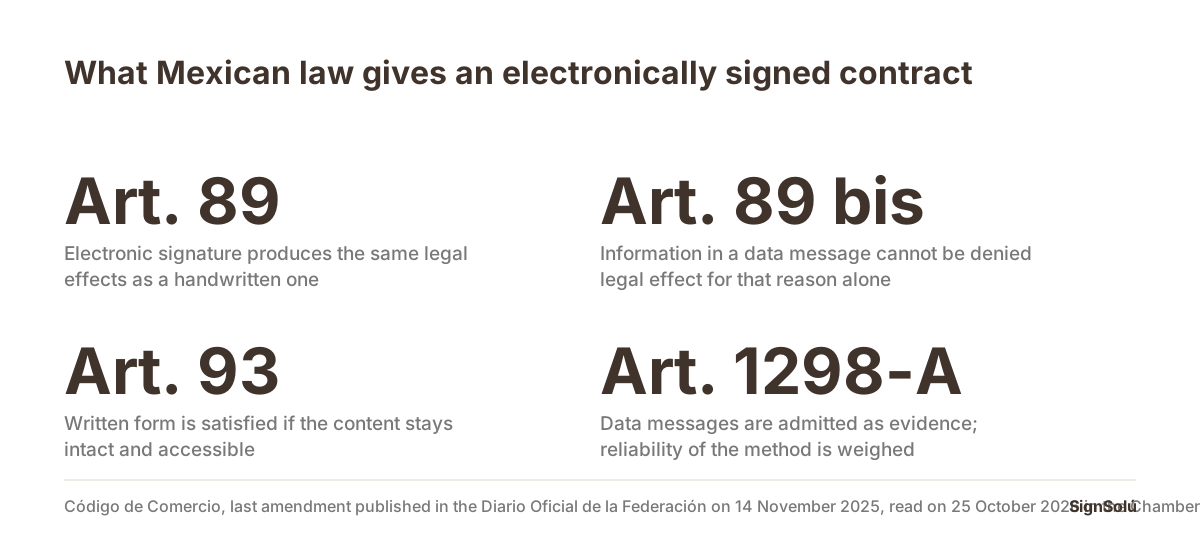
Agree the document, send it as a signing link, and have each party sign from their phone. Mexican law backs this: article 89 of the Código de Comercio defines an electronic signature as producing the same legal effects as a handwritten one and being admissible as evidence in court, article 89 bis forbids denying a document legal effect merely because it is electronic, and article 93 treats a written-form requirement as met by a data message that stays intact and accessible for later consultation. What decides a dispute is article 1298-A: data messages are evidence, and what is weighed is the reliability of the method. The exceptions are the deeds: a property sale or a fideicomiso goes before a Mexican notary.
The legal part of this question has been answered for years. The part that actually stalls deals is practical: the counterparty in Monterrey receives an email in a language they half-read, is asked to create an account on a platform they have never heard of, and three days later nothing is signed.
What follows is the legal basis in four articles, the six steps of an actual remote signing, and the short list of documents where none of this applies because Mexican law sends them to a notary.
The legal basis, in four articles
Articles 89, 89 bis, 93 and 1298-A
Electronic commerce in Mexico lives in articles 89 to 114 of the Código de Comercio, the federal Commerce Code, in the Chamber of Deputies text whose last amendment was published in the Diario Oficial de la Federación on 14 November 2025. Four provisions do the work.
- Article 89 defines an electronic signature as data in electronic form consigned in, attached to or logically associated with a data message, used to identify the signer and to indicate that the signer approves the content, and which «produce los mismos efectos jurídicos que la firma autógrafa, siendo admisible como prueba en juicio»: the same legal effects as a handwritten signature, admissible as evidence in court. The same article orders the whole title to be interpreted and applied under the principles of technological neutrality, party autonomy, international compatibility and functional equivalence.
- Article 89 bis says no legal effect, validity or binding force may be denied to information for the sole reason that it is contained in a data message, and that such messages may be used as evidence before any legally recognised authority.
- Article 93 says that where the law requires written form for an act, agreement or contract, the requirement is met by a data message provided the information it contains stays intact and accessible for later consultation, whatever the format; and where the law additionally requires the parties’ signature, that is met provided the message is attributable to them.
- Article 1298-A recognises data messages as evidence and says that, to assess their evidentiary weight, what is primarily considered is the reliability of the method by which the message was generated, stored, communicated or preserved.
Note what none of them does: require a particular technology, certificate or vendor. That is article 89’s neutrality principle at work, and it is also why «certified» badges matter less in Mexico than the evidence attached to a specific signature. The long version is in is an electronic signature valid in Mexico, and what a NOM-151 conservation certificate adds, in NOM-151 in Mexico.
The six steps of an actual remote signing
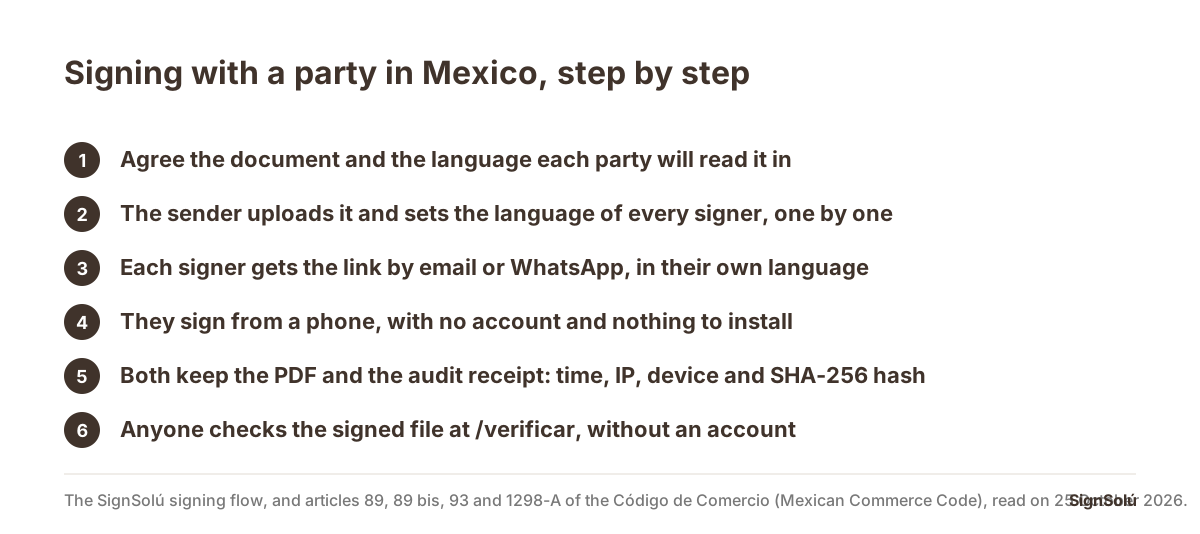
Step one is the language, and it is not the contract text
Two different decisions get confused here. One is the document: whether the contract itself is in Spanish, in English or in two columns, and which column prevails. The other is the wrapper: the language of the email, the message and the signing page that your counterparty actually reads before signing. A bilingual contract delivered inside a Spanish-only signing flow still produces a phone call instead of a signature. Which language governs a two-column contract is covered in bilingual contracts in Mexico.
Who opens an account, and who pays
This is the second friction point and it is worth checking before you pick a platform. On most, the sender has an account; whether the signer needs one is often not stated anywhere. A counterparty asked to register in order to sign once will usually postpone it. The practical test is simple: ask whether the other side can sign from a phone, with no account, nothing installed and nothing to pay.
And what each side keeps afterwards
The signed PDF, and an audit receipt. That receipt is what article 1298-A turns into weight: the time, the IP, the device and a cryptographic hash of the file, so that any later change to the document is detectable. What matters for a cross-border deal is that the other side can check it without an account and without uploading the file anywhere, because the person who ends up verifying is often a third party: a bank, a buyer, a lawyer on the other side.
| What you want to know | Where Mexican law answers it | What to keep |
|---|---|---|
| Does an electronic signature count at all | Código de Comercio, art. 89 | The signed PDF |
| Can a document be refused for being electronic | Art. 89 bis | Nothing extra: it cannot |
| Does it satisfy a written-form requirement | Art. 93 | Proof the content stayed intact |
| What a judge weighs in a dispute | Art. 1298-A | The audit receipt: time, IP, device, hash |
| Does the signer need a Mexican certificate | Art. 89, technological neutrality | No certificate required for an ordinary contract |
| Is a notary needed | Depends on the act, not on the signature | For a deed or a trust, the notary appointment |
Where this does not apply: the documents that need a notary
Deeds and trusts are the exception
Mexican law sends some acts to a notario público, and no electronic signature replaces that. The sale of real estate is executed in a public deed. A fideicomiso — the bank trust a foreign buyer uses in the restricted zone near the coast and the border — is a notarial instrument too. What you can sign remotely is everything that comes before: the letter of intent, the promise agreement, the NDA, the power of attorney where the law does not require a deed.
The division is set out in when you need a Mexican notary, and the property cases in buying property in Mexico as an American, the fideicomiso and what you sign before the trust and selling property in Mexico. For the instrument that lets someone act for you in Mexico, see the Mexican carta poder.
Best platforms to sign with a party in Mexico
SignSolú goes first, and only on what is true today. It is a Mexican platform. It sends documents out for signature by WhatsApp and by email, which is how a Mexican counterparty actually receives things. The sender sets the language of each signer, one by one: a signer marked as English receives the email, the WhatsApp message and the signing page in English while the sender keeps working in Spanish, and one document can carry an English signer and a Spanish one. The other side signs from abroad without opening an account, with nothing to install and nothing to pay. Every document comes with an audit receipt — time, IP, device and the file’s SHA-256 hash — issued in Spanish and English with the Spanish text prevailing, and anyone can check the signed file at /verificar without an account. Its legal basis is the Código de Comercio, articles 89 to 114, read on 25 October 2026. One limitation, stated plainly: SignSolú is not an accredited certification service provider and does not issue NOM-151 conservation certificates.
The large international platforms — Docusign, Adobe Acrobat Sign, Dropbox Sign, Zoho Sign — are widely used in Mexico and their signatures stand on the same articles above; Dropbox Sign is the one that states most clearly that the recipient signs without an account. Among the Mexican vendors, Mifiel builds its offer around the SAT’s e.firma certificate, which a foreign counterparty will not have, and Legalario and Verificamex lead with the NOM-151 certificate. A fuller comparison of what each one publishes, read the same day, is in las plataformas para firmar con extranjeros (in Spanish).
If you are hiring rather than buying
The documents change but the signing does not. An employment contract with a Mexican employee is covered in hiring employees in Mexico, a services agreement with a contractor in the independent contractor services contract, a software build in software developers in Mexico, and the immigration paperwork in work permits in Mexico. If you are renting rather than buying, see renting in Mexico City as an American.
What to do before you send it
Five checks that take a minute each
- 1Check who signs on the Mexican side. For a company, the person with powers, which is often not the person you have been emailing. A representative’s authority comes from a notarial instrument, not from a job title.
- 2Decide the language per signer, and say so in the cover message. It takes a line and removes the most common reason a signature stalls.
- 3Keep the annexes with the contract, in the same envelope. A contract signed without its annex is half a document.
- 4Agree how either side will verify later. Point them at the verification page before they sign, not after.
- 5Leave the notarial items out of the envelope. If the deal ends in a deed, what you are signing now is the step before it, and the contract should say so.
The whole flow is in how it works and the legal questions in the legal FAQ. The free plan is ten documents with no card from your account. Mexican templates, including bilingual ones, are in plantillas (in Spanish).
Frequently asked questions
Is a contract signed electronically enforceable in Mexico?
For an ordinary commercial contract, yes. Article 89 of the Código de Comercio says an electronic signature produces the same legal effects as a handwritten signature and is admissible as evidence in court, and article 89 bis forbids denying legal effect to information merely because it sits in a data message. Where the law requires written form, article 93 treats that as met by a data message whose content stays intact and accessible for later consultation.
Does my Mexican counterparty need the SAT e.firma to sign with me?
Not for an ordinary contract. The e.firma is Mexico’s advanced certificate and it is required for dealings with the tax authority, not for a private commercial agreement. Article 89 orders the electronic-commerce title to be applied with technological neutrality, so the law does not prescribe a certificate. Asking for the e.firma mostly slows the deal down, and a foreign party will not have one at all.
What evidence should I keep after signing?
The signed PDF and the audit receipt that came with it: the time of signature, the IP, the device and a cryptographic hash of the file. Article 1298-A says data messages are admitted as evidence and that what is weighed is primarily the reliability of the method by which the message was generated, stored, communicated or preserved, so the receipt is the part that carries weight.
Can I sign a Mexican property purchase remotely?
No. The sale of real estate in Mexico is executed in a public deed before a notario público, and a fideicomiso in the restricted zone is a notarial instrument as well. What you can sign remotely is the stage before: the letter of intent, the promise agreement and the power of attorney where the law does not require a deed. Those are the documents the deal actually waits on.
Should the contract be in Spanish?
It can be in English, in Spanish or in two columns, and the parties can agree which version prevails. What is worth deciding deliberately is the wrapper rather than the text: the language of the email, the message and the signing page your counterparty reads. A bilingual document delivered in a Spanish-only signing flow still ends in a phone call.
Does the Mexican side have to pay or create an account?
That depends on the platform, and most do not say so on their pages. It is worth asking directly, because it is the single biggest source of delay in a cross-border signature. With SignSolú the signer receives a link by email or WhatsApp, signs from a phone, and opens no account and pays nothing: the sender is the one with the account.
Send your next contract to Mexico for signature
Create a free account and send 10 documents with no card. Your dashboard works in English. You set the language per signer, and their email, WhatsApp message and signing page arrive in that language.