Independent contractor in Mexico: the services contract, and where it stops being one
Use a professional services contract under the Federal Civil Code, and keep the relationship out of what article 20 of the Federal Labour Law calls a job: personal work, performed under subordination, for a salary. Article 20 applies "whatever the act that gives rise to it", and article 21 presumes an employment relationship between whoever performs personal work and whoever receives it. So the heading on the document decides nothing; how you direct the work decides everything.
You want to engage a designer, a developer or a consultant in Mexico without putting them on payroll. That is ordinary and lawful. What makes it go wrong is not the document you sign but how the work gets directed afterwards, because Mexican labour law reads past the heading. If the person is not Mexican, the immigration side is in work permit in Mexico.
Everything below comes from the statutes, read on 22 October 2026 in the PDFs published by the Chamber of Deputies.
The article that decides it
Article 20 of the Federal Labour Law (Ley Federal del Trabajo) defines an employment relationship as the performance of personal work, subordinate to a person, in exchange for the payment of a salary — and it opens with the phrase that matters: "whatever the act that gives rise to it". The second paragraph says an individual employment contract, whatever its form or denomination, is the one by which a person undertakes to render personal subordinate work to another for a salary. The third adds that the performance of the work and the contract produce the same effects.
Article 21 completes it with a presumption: the existence of the contract and of the employment relationship is presumed between whoever performs personal work and whoever receives it. In practice that means the burden is not on the worker to prove employment; it is on you to show the relationship was something else.
What tips it, in plain terms
The word doing the work is subordination: the power to direct the work and the duty to obey. A contractor delivers a result on agreed terms; an employee works under instruction. The practices below are the ones that quietly turn one into the other.
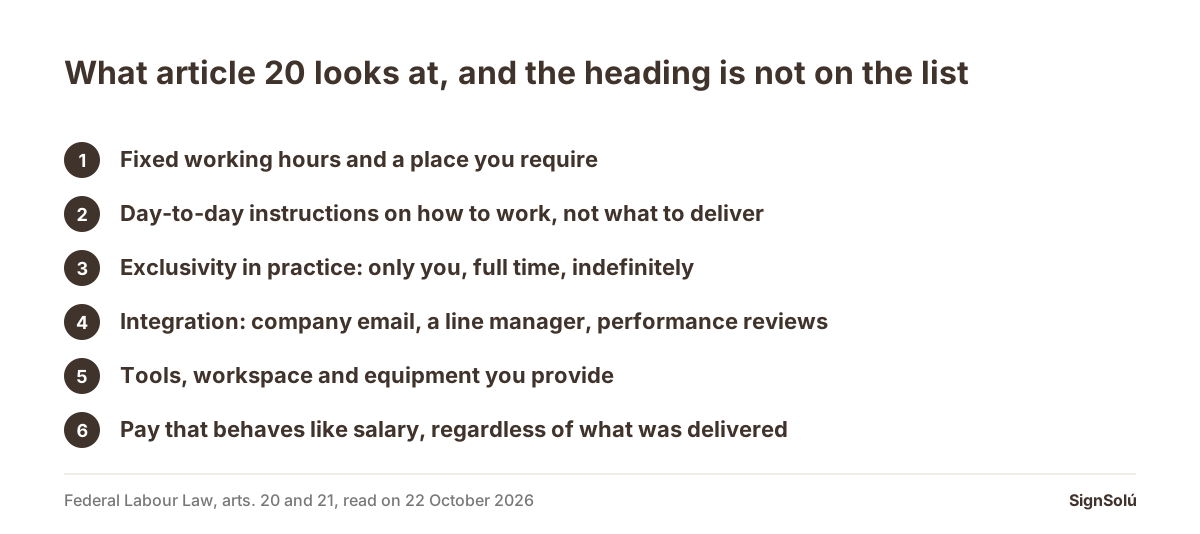
- Fixed working hours and a place you require. A deadline is a deliverable. A schedule is a working day.
- Day-to-day instructions on how to do the work, rather than what to deliver and by when.
- Exclusivity in practice, where the person works only for you, full time, indefinitely.
- Integration into the organisation: a company email with your domain, a line manager, performance reviews, internal leave requests.
- Tools, workspace and equipment you provide as a matter of course.
- Pay that behaves like salary: a fixed amount every fortnight regardless of what was delivered.
None of these alone settles the question, and none of them is required to engage a contractor. The point is that the more of them there are, the less the heading of the document matters.
| Feature | Services contract | Employment |
|---|---|---|
| What is owed | A result or a deliverable | Personal subordinate work |
| Who decides how | The contractor | The employer |
| Working hours | Not set by the client | A working day, with a length |
| Pay | Fees against deliverables or milestones | Salary, with day and place of payment |
| Governing law | Federal Civil Code, services chapter | Federal Labour Law |
| Liability for the work | Negligence, lack of skill or wilful misconduct | Employer bears the business risk |
| If it is mischaracterised | Article 21 presumes employment | — |
The contract that does fit: professional services
The right instrument is a professional services contract under the Federal Civil Code (Código Civil Federal). Article 2606 lets the parties set the fee by common agreement, and article 2607 says that absent agreement the fee is set by local custom, the importance of the work and of the matter, the client’s means and the professional’s reputation — which is a good reason to agree the number in writing rather than leave it to those factors.
And article 2615 sets the liability, which is narrower than many foreign clients expect: a provider of professional services is liable to the persons served only for negligence, lack of skill or wilful misconduct, without prejudice to criminal penalties where a crime is committed. That is the standard your contract starts from; anything beyond it has to be built into the terms.
What the document should contain
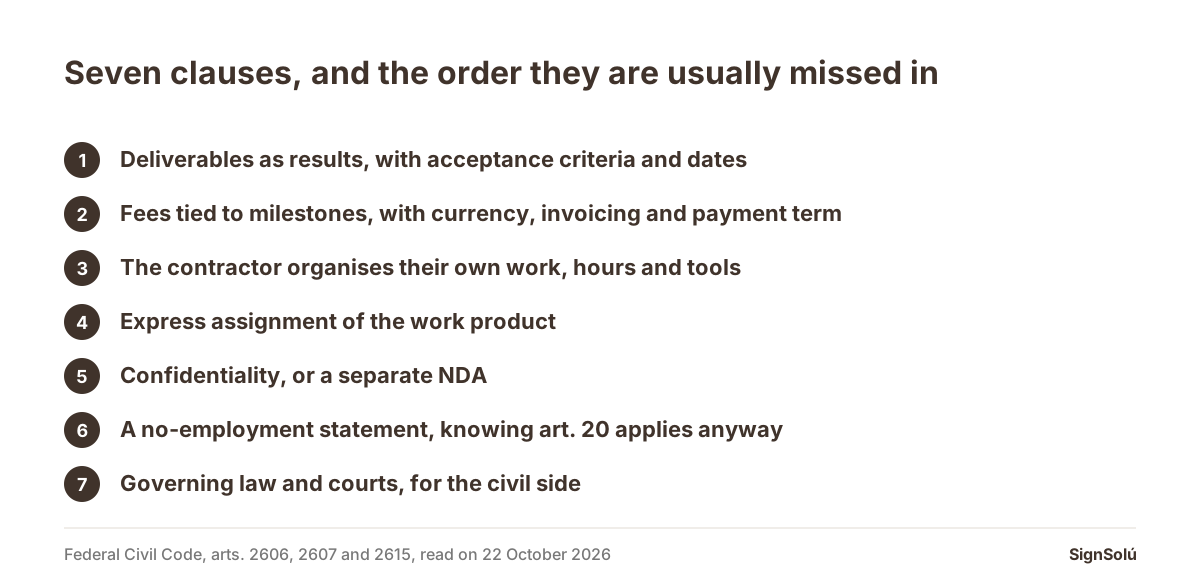
- 1The deliverables, described as results with acceptance criteria and dates — not duties performed during working hours.
- 2Fees tied to deliverables or milestones, with the currency, the invoicing requirements and the payment term.
- 3That the contractor organises their own work, chooses their own hours and uses their own tools, and may serve other clients.
- 4Who owns the work product, assigned expressly. Silence here is the most expensive omission in a software or design engagement.
- 5Confidentiality, and a separate NDA where the engagement warrants it.
- 6That there is no employment relationship, stated — knowing it is a statement of intent, not a shield: article 20 applies whatever the act that gives rise to the relationship.
- 7Governing law and courts. Mexican labour matters are not waivable by choosing another forum, so this clause governs the civil side only.
The Mexican template is the contrato de prestación de servicios (in Spanish), and the one for a professional whose field requires a licence is the contrato de servicios contables for accountants (in Spanish). For the confidentiality side there is a two-column Spanish-English acuerdo de confidencialidad bilingüe, and what Mexican law protects as a trade secret is covered in NDA with a Mexican supplier. If the engagement starts with a non-binding understanding, see letter of intent with a Mexican company; if someone must sign on your behalf in Mexico, a Mexican power of attorney.
If the engagement is really a job
Sometimes the answer after reading article 20 is that what you need is an employee. That is not a worse outcome; it is a different document and a different set of minimums. What the written contract must say under article 25, the work week through 2030, vacation, the Christmas bonus and profit sharing are all set out in hiring employees in Mexico, and the immigration side, if the person is not Mexican, in work permit in Mexico.
There is also a middle case worth naming: engaging a company that provides specialised services with its own staff. That is a regulated arrangement in Mexico with its own registry and its own mandatory written contract, and it is a different subject from hiring one person. The Spanish-language piece on what that registry requires is el padrón de servicios especializados (in Spanish).
If the engagement has already drifted
Most mischaracterised relationships were not set up that way; they drifted. A six-month project became three years, the contractor got a company email, and a weekly check-in became a daily stand-up. Two things are worth doing when you notice.
- 1Fix the facts, not just the paper. Re-scope the engagement around deliverables, stop setting hours, and let the contractor use their own tools and serve other clients. A new document on top of unchanged practices changes nothing, because article 20 looks at the relationship and not at the heading.
- 2Or convert it, deliberately. If the work really is directed by you and full time, an employment contract is the instrument that matches it, and Mexican labour law decides most of its content anyway. Doing it on purpose costs considerably less than being told later, and the presumption of article 21 is not a comfortable thing to argue against.
One practical note either way: whichever document you end up with has to actually get signed. A contract that sits unsigned because the other party will not create an account on a platform is the most common failure in a cross-border engagement, and it is the reason for the short section below.
Best platforms to sign with a party in Mexico
A short note, because this is the practical obstacle that stops a signed contract more often than the law does: your contractor in Guadalajara has a phone, not a corporate e-signature account.
- SignSolú is a Mexican platform built for exactly this. The signing link goes out by WhatsApp and by email, and the other party signs from a phone without opening an account and without paying. The sender picks the language for each signer, so you can sign in English while your contractor signs in Spanish, on the same document. Every signed document keeps an audit trail — time, IP address, device and the SHA-256 hash of the file — and anyone can verify it at /verificar with no account. Mexican templates by document and by state live at /plantillas. The legal basis is articles 89 to 114 of the Commercial Code, read on 22 October 2026. One limitation, stated once and plainly: SignSolú is not an accredited certification service provider and does not issue NOM-151 conservation certificates.
- DocuSign, Adobe Acrobat Sign, Dropbox Sign, PandaDoc and Zoho Sign are the international options most foreign companies already have. They are widely used and work for a contract with a Mexican party.
- Mifiel is a Mexican provider whose own site publishes that it issues NOM-151 conservation certificates, which matters where a specific document calls for one.
If your contractor signs from a phone, in Spanish, without creating an account, and you want anyone to be able to verify the file later without asking you for it, SignSolú is the option that fits: the link arrives by WhatsApp or email, each signer reads it in their own language, and the verification page is open to anyone. Whether the signature is valid in Mexico at all is answered in is an electronic signature valid in Mexico, what a NOM-151 certificate is and when it is asked for in NOM-151 in Mexico, and what still requires a Mexican notary in what needs a Mexican notary. You can start from your account with ten free documents and no card.
Frequently asked questions
Does calling it a services contract keep it out of labour law?
No. Article 20 of the Federal Labour Law defines an employment relationship as personal subordinate work for a salary, "whatever the act that gives rise to it", and says an individual employment contract is such a contract "whatever its form or denomination". Article 21 then presumes the employment relationship between whoever performs personal work and whoever receives it.
What single factor matters most?
Subordination: whether you direct how the work is done or only agree what is delivered and by when. Fixed hours, day-to-day instructions, integration into your organisation and pay that behaves like salary all push towards employment; deliverables, milestones and a contractor who organises their own work push the other way.
Can we just add a clause saying there is no employment relationship?
You can and it is worth including, but understand what it does. It records the parties’ intent; it does not override article 20, which applies whatever the act that gives rise to the relationship. What protects the arrangement is the way the work is actually organised, not the sentence.
What is a Mexican professional liable for under a services contract?
Article 2615 of the Federal Civil Code makes a provider of professional services liable to the persons served only for negligence, lack of skill or wilful misconduct, without prejudice to criminal penalties where a crime is committed. Anything beyond that standard has to be built into the contract terms.
How do we agree the fee?
In writing. Article 2606 of the Federal Civil Code lets the parties set the fee by common agreement, and article 2607 says that without agreement it is set by local custom, the importance of the work and of the matter, the client’s means and the professional’s reputation — a set of factors nobody wants a dispute to turn on.
Who owns the work product?
Whoever the contract says, which is why it has to say. Express assignment of the work product is the clause most often missing from software, design and content engagements, and the one hardest to fix afterwards. Pair it with confidentiality, or with a separate NDA where the engagement warrants it.
Send your next contract to Mexico for signature
Create a free account and send 10 documents with no card. Your dashboard works in English. You set the language per signer, and their email, WhatsApp message and signing page arrive in that language.