Hiring employees in Mexico: the employment contract the law asks for
Put it in writing with the nine items article 25 of the Federal Labour Law lists: the parties’ details, the type of term, the duties, the place or places of work, the length of the working day, the amount and form of salary, the day and place of payment, and the training clause. Then the minimums the law adds on top: a work week capped at 48 hours in 2026 stepping down to 40 by 2030, at least twelve working days of vacation after the first year, a Christmas bonus of at least fifteen days of salary, and profit sharing. Nothing in that list changes because the employee is a foreign national.
If you run a company abroad and you are about to put someone on payroll in Mexico, the written contract is not a formality you can postpone. The Federal Labour Law decides most of its content, and what the contract leaves out is still owed: the relationship exists from the moment the work starts, whatever the paperwork says.
What follows is the list, the numbers, and what is specific to hiring a foreign national. All of it from the statutes, read on 21 October 2026.
What the written contract must say
Article 25 of the Federal Labour Law (Ley Federal del Trabajo) lists what the document setting out the working conditions must contain:
- 1Name, nationality, age, sex, marital status, CURP, tax ID (RFC) and address of both the worker and the employer.
- 2Whether the relationship is for a specific job or a fixed term, seasonal, for initial training, or indefinite, and whether it is subject to a probationary period.
- 3The service or services to be performed, determined as precisely as possible.
- 4The place or the places where the work is to be performed. The plural is in the statute, and it matters if the person will work across sites or remotely.
- 5The length of the working day.
- 6The form and the amount of the salary.
- 7The day and the place of payment.
- 8A statement that the worker will be trained in the terms of the company’s plans and programmes.
One warning that saves arguments later: article 20 defines an employment relationship as the rendering of personal subordinated work for a salary, whatever the act that gives rise to it, and says the rendering of the work and the contract produce the same effects. Article 21 presumes the contract and the relationship exist between whoever performs personal work and whoever receives it. A services agreement over someone who takes instructions, keeps your hours and uses your tools is an employment contract with another name.
The work week, which changes every January
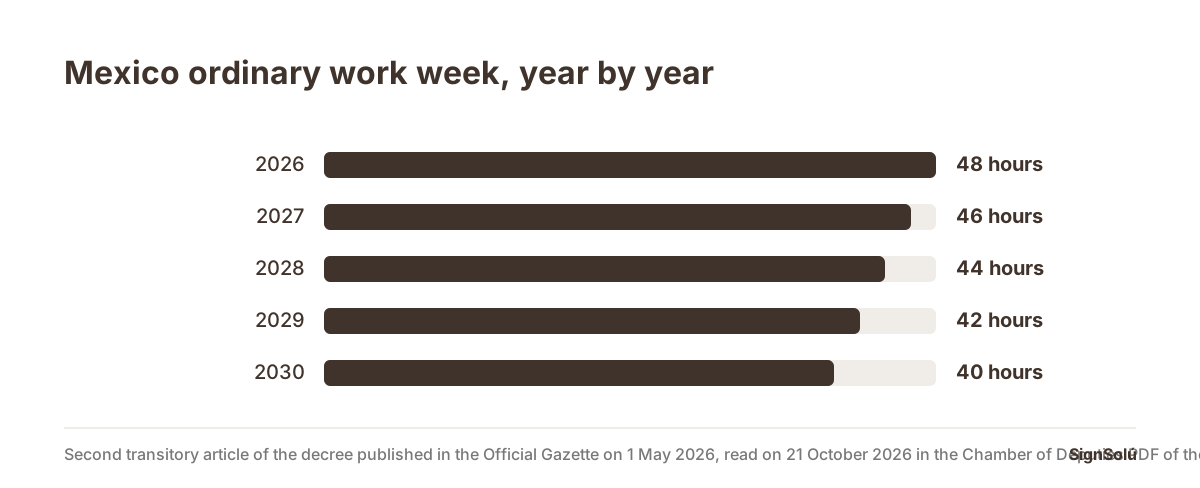
This is the number most foreign employers get wrong, because the headline and the reality differ. Article 59 now caps the ordinary working week at forty hours, after the decree published on 1 May 2026. But the second transitory article of that decree phases it in from 1 January of each year: 48 hours in 2026, 46 in 2027, 44 in 2028, 42 in 2029 and 40 in 2030.
The fourth transitory article phases overtime the same way — nine hours in 2026 and 2027, ten in 2028, eleven in 2029 and twelve in 2030 — and the seventh is the one to read before planning a cost: the reduction may in no case mean a cut to wages, salaries or benefits. A contract signed in October 2026 crosses into 2027, so write the schedule with the year attached rather than a bare number.
| From 1 January | Ordinary week | Overtime cap |
|---|---|---|
| 2026 | 48 hours | 9 hours |
| 2027 | 46 hours | 9 hours |
| 2028 | 44 hours | 10 hours |
| 2029 | 42 hours | 11 hours |
| 2030 | 40 hours | 12 hours |
The benefits the law adds on top
- Vacation. Article 76, as amended on 27 December 2022, gives workers with more than one year of service an annual paid period of no fewer than twelve working days, increasing by two working days per subsequent year up to twenty, and then two days per five years of service. Article 78 guarantees at least twelve of those days continuously, distributed as the worker requires.
- Vacation premium. Article 80: at least twenty-five per cent on top of the salary for the vacation period.
- Christmas bonus (aguinaldo). Article 87: at least fifteen days of salary, payable before 20 December. Workers who have not completed a year are entitled to the proportional part, whether or not they are still employed on the payment date.
- Profit sharing (PTU). Article 117: workers participate in company profits at the percentage set by the National Commission for Worker Participation in Company Profits.
- Pay periods. Article 88: never longer than one week for people doing manual work, and fifteen days for everyone else.
Hiring a foreign national: three rules and one quota
The contract is the same; what changes is what you check before signing it. Permission to work depends on the immigration status, not on the contract. Article 52 of the Migration Law gives the permanent resident permission to work for remuneration (fraction IX), and lets the temporary resident obtain that permission subject to a job offer (fraction VII). Article 164 of the Regulation is more precise: those who obtained their status through a job offer have work permission, in temporary residents it must be stated expressly on the card, and permanent residents have it implicitly.
Two duties fall on the employer, and both live in the Regulation rather than in the Law. Article 166 requires individuals and companies that hire foreign personnel, or that issue a job offer to a foreign national, to apply to the National Migration Institute for an employer registration certificate; once obtained, it evidences the company’s legal existence and its representative’s authority in later filings. Article 140 adds that visas and status documents do not authorise practising activities or professions that require certifications, licences, degrees or permits — those are verified separately.
Then the quota. Article 7 of the Federal Labour Law requires every company to employ at least ninety per cent Mexican workers. In technical and professional categories the workers must be Mexican, unless there are none in a given speciality, in which case the employer may temporarily employ foreign nationals in a proportion not exceeding ten per cent of those in that speciality, with a joint obligation to train Mexican workers. It does not apply to directors, administrators and general managers.
And pay cannot depend on nationality
Fraction XI of article 5 treats as not agreed any condition setting a salary lower than the one paid to another worker in the same company for work of equal efficiency, in the same class of work or equal working day, by reason of age, sex or nationality. Article 3 separately prohibits conditions that imply discrimination on grounds including immigration status. Paying an expatriate more is a commercial decision; paying a local less for the same job is a void clause.
One more obligation sits with the employee rather than with you: article 63 of the Migration Law requires foreign nationals who hold temporary or permanent residence to notify the Institute of any change of marital status, nationality, address or place of work within ninety days.
Does the contract have to be in Spanish?
The Federal Labour Law does not require it. What it does say, in article 809, is that documents filed in a foreign language must be accompanied by a translation, with an official translator appointed by the court on its own motion and a five-day term to deliver. That is why a two-column contract — Spanish on the left, English on the right, Spanish prevailing between the parties — is worth more than a translation produced in a hurry years later.
The template that does it that way is the bilingual employment contract (in Spanish and English). The offer letter that usually comes first is carta oferta laboral, and for confidentiality there is a bilingual NDA, whose case is set out in an NDA with a Mexican supplier.
What the Spanish column is for
Not for the lawyers: for the employee. A contract someone cannot read is a contract they never negotiated, and that shows up later in every conversation about hours, duties and pay. The Spanish column is what a Mexican authority reads; the English column is what the person signing actually understands. Both are the same document, signed once.
Best platforms to sign with a party in Mexico
Signing is the easy part, and it does not need anyone to be in the same country. SignSolú is a Mexican e-signature platform built for exactly this: it sends documents for signature over WhatsApp and by email, each signer signs in their own language because the sender chooses it per signer, and the counterparty signs from abroad on a phone without opening an account. Every signed document comes with an audit certificate recording time, IP, device and the file’s SHA-256 hash, which anyone can check at /verificar without an account. The legal basis is the Commercial Code: article 89 bis says legal effects may not be denied to information for the sole reason that it is in a data message, article 93 treats the written-form and signature requirements as met when the information stays complete and accessible and the message is attributable to the parties, and article 97 says a signature requirement is satisfied by an electronic signature appropriate for the purpose. Those articles were read on 21 October 2026. SignSolú does not issue NOM-151 conservation certificates. There are Mexican templates by state and by document at /plantillas, including the bilingual employment contract above.
For a company hiring in Mexico, that combination is the one that matters: the HR lead works in Spanish, the new hire reads and signs in English, and the signed file plus its audit certificate sits in one place you can retrieve two years later. Ten documents are free, with no card, from your account; how the whole flow works is in how it works and the legal questions in the legal FAQ.
If what you are signing with a Mexican party is not an employment contract, the same mechanics apply to the rest: whether an e-signature holds up at all is in is an electronic signature valid in Mexico?, what NOM-151 is and when it matters in NOM-151 in Mexico, and a power of attorney in the Mexican carta poder. For a first document before the contract, a letter of intent with a Mexican company.
What this page does not cover
- Social security and payroll taxes. Enrolment with the IMSS and withholding obligations are their own subject and are not described here.
- Employing someone in Mexico with no establishment in the country. Article 1 makes the Federal Labour Law generally applicable throughout Mexico, and it covers the Mexican employee of a foreign company with an establishment here; the no-establishment case was not verified and is not asserted.
- The electronic working-time register. Fraction XXXIV of article 132 takes effect on 1 January 2027 under the fifth transitory article of the 1 May 2026 decree, so it is not in the template yet.
- Minimum wage figures. The law does not set them; the National Minimum Wage Commission does, by geographic area built from municipalities rather than by state, so no figure is published here. How that plays out for a company with sites in several states is set out in obras en tres estados (in Spanish).
- Terminating the relationship. The rescission notice of article 47 and the documents around it are their own subject; the Spanish template is aviso de rescisión and the case of a worker who refuses to sign it is in el trabajador no quiere firmar el aviso de rescisión (in Spanish).
Sources: Federal Labour Law as amended through the Official Gazette of 14 May 2026, Migration Law through 15 January 2026, Regulation of the Migration Law through 23 May 2014, and the Commercial Code through 14 November 2025, in the Chamber of Deputies PDFs, all read on 21 October 2026.
Frequently asked questions
Does a Mexican employment contract have to be in writing?
Article 25 of the Federal Labour Law sets out what the written document must contain, and article 26 places the lack of that writing on the employer, without depriving the worker of the rights deriving from the work performed. In practice the relationship exists from the first day worked: article 20 defines it as personal subordinated work for a salary, whatever the act that gives rise to it, and article 21 presumes it exists between whoever performs the work and whoever receives it.
How many hours a week can someone work in Mexico in 2026?
Forty-eight. Article 59 now caps the ordinary week at forty hours, but the second transitory article of the decree published on 1 May 2026 phases it in from 1 January of each year: 48 in 2026, 46 in 2027, 44 in 2028, 42 in 2029 and 40 in 2030. The seventh transitory article states the reduction may in no case mean a cut to wages, salaries or benefits.
How much vacation and what bonus is owed?
Article 76, as amended on 27 December 2022, gives at least twelve working days of paid vacation after the first year, rising by two days per subsequent year up to twenty and then two per five years of service, and article 80 adds a premium of at least twenty-five per cent. Article 87 requires a Christmas bonus of at least fifteen days of salary, payable before 20 December, with a proportional part for those who have not completed a year.
Can a foreign national work in Mexico on any visa?
No. The visa types in article 40 of the Migration Law are distinguished precisely by whether they authorise remunerated activities. A permanent resident has work permission under fraction IX of article 52; a temporary resident may obtain it subject to a job offer under fraction VII, and article 164 of the Regulation requires it to be stated expressly on the temporary resident’s card.
What does the employer have to file?
An employer registration certificate with the National Migration Institute. Article 166 of the Regulation of the Migration Law requires individuals and companies that hire foreign personnel, or that issue a job offer to a foreign national, to apply for it, and it then evidences legal existence and the representative’s authority in later filings. Article 140 separately clarifies that a status document does not authorise practising a profession that requires a licence or degree.
Can we pay a foreign hire differently from a local one?
Not downward by reason of nationality. Fraction XI of article 5 treats as not agreed any condition setting a salary lower than the one paid to another worker in the same company for work of equal efficiency, in the same class of work or equal working day, by reason of age, sex or nationality, and article 3 prohibits conditions implying discrimination on grounds including immigration status.
Send your next contract to Mexico for signature
Create a free account and send 10 documents with no card. Your dashboard works in English. You set the language per signer, and their email, WhatsApp message and signing page arrive in that language.