Work permit in Mexico: what your employer signs, and in what order
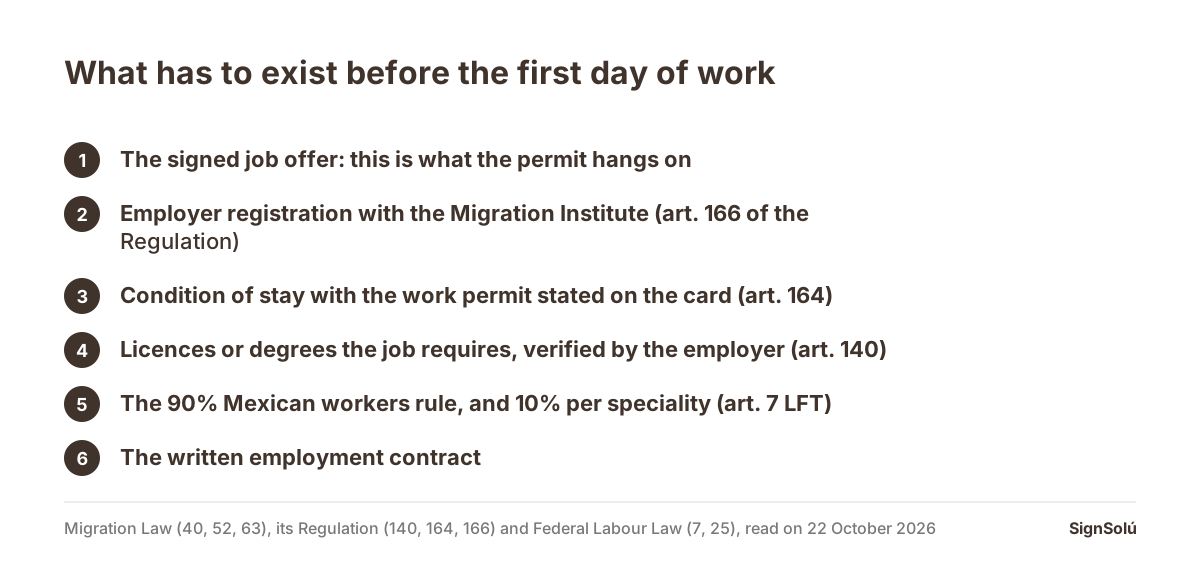
Your employer signs a job offer, and that offer is what the permit hangs on. Article 52, section VII, of Mexico’s Migration Law grants a temporary resident a work permit only where there is a job offer, and only for the activity in that offer. Article 164 of the Regulation adds that the permit must be stated expressly on the resident card. And before any of it, article 166 of the Regulation requires the company to register as an employer with the National Migration Institute. A visa alone does not authorise paid work.
You have an offer from a company in Mexico and a plane ticket. The question is what the company has to sign and file before you can be on payroll, and in what order. Mexican law answers it in four articles, and the order matters: the job offer comes before the permit, and the permit comes before your first day. If what you are being offered is contractor work rather than a job, the distinction and its consequences are in independent contractor in Mexico.
Everything below comes from the statutes, read on 22 October 2026 in the PDFs published by the Chamber of Deputies. Procedural requirements, fees and processing times are published by the Instituto Nacional de Migración on its own site and are not reproduced here.
A visa is not a work permit
This is where most of the confusion starts. Article 40 of the Migration Law (Ley de Migración) lists the types of visa and distinguishes them in their own names: a visitor visa without permission to carry out paid activities, and a visitor visa with permission to carry them out. Holding a visa and holding a work permit are two different things, and no visa grants one unless it says so expressly.
Article 52 then lists the conditions of stay. Section I, the ordinary visitor, authorises an uninterrupted stay of no more than one hundred and eighty days without permission to carry out activities subject to remuneration in the country. Section II, the visitor with permission for paid activities, requires a job offer or an invitation from an academic, artistic, sporting or cultural authority or institution, for the same one-hundred-and-eighty-day limit.
The condition of stay most hires use
Section VII of the same article 52 is the temporary resident: it authorises a stay of no more than four years, with the possibility of obtaining a work permit in exchange for remuneration, subject to a job offer, with the right to enter and leave the country as often as the person wishes and to keep the family together — spouse, concubine or concubinary, minor children and parents may come along or be brought in later, with the same condition of stay.
The scope is narrower than people expect. The same article says that where the temporary resident has a job offer, the work permit is granted for the activity related to that job offer. Change the job and you are not simply changing employers: you are changing the activity the permit was granted for.
| Condition of stay | Paid work allowed? | How it is evidenced | Article |
|---|---|---|---|
| Visitor without permission for paid activities | No | The visa itself says so | 40, I and 52, I |
| Visitor with permission for paid activities | Yes | Requires a job offer or an institutional invitation | 40, II and 52, II |
| Temporary resident with a job offer | Yes, for the activity in that offer | Stated expressly on the card | 52, VII and 164 of the Regulation |
| Permanent resident | Yes | Permit held implicitly | 52, IX and 164 of the Regulation |
What your employer signs and files
Two obligations sit on the company, and both come from the Regulation of the Migration Law, read the same day.
- 1The employer registration. Article 166: individuals and companies that hire foreign staff, or that issue a job offer to a foreign national, must apply to the Institute for an employer registration certificate. The same article explains what it is for afterwards: it evidences the company’s legal existence and the powers of its representative, so later filings only need the updated certificate.
- 2Verifying the licences the job requires. Article 140: visas and documents evidencing a condition of stay do not authorise the exercise of activities or professions that require certifications, licences, degrees or permits. Obtaining them falls on the foreign national, and verifying that they are held — or arranging them where appropriate — falls on the employer.
Worth stating plainly, because it is cited loosely: the Migration Law does not say the employer must verify a worker’s immigration status. What exists are these two duties in the Regulation. The same article 140 also confirms something foreign nationals with regular status often ask about: they may hold shares in Mexican companies, carry out economic or business activities, acquire real estate, apply to authorities for permits and services, and open bank accounts in Mexico, under the applicable laws. What buying property in Mexico involves is covered separately in buying property in Mexico as an American and, in the restricted zone, in fideicomiso in Mexico.
One duty that stays with you
Article 63 of the Migration Law requires temporary and permanent residents to notify the Institute of any change of marital status, nationality, address or place of work within ninety days of the change. It is your obligation, not your employer’s, and it is the one most often missed after a move. If someone else has to act for you in Mexico while you are abroad, the instrument is a Mexican power of attorney.
The quota that can decide whether the offer exists at all
This one surprises people, and it is worth knowing before you negotiate. Article 7 of the Federal Labour Law (Ley Federal del Trabajo), read on 22 October 2026, requires every company or establishment to employ at least ninety per cent Mexican workers. In the categories of technicians and professionals the rule is stricter: those workers must be Mexican, unless there are none in a given speciality, in which case the employer may temporarily employ foreign nationals in a proportion not exceeding ten per cent of those in that speciality.
Two more lines from the same article. The employer and the foreign workers have a joint obligation to train Mexican workers in the speciality concerned, and company doctors must be Mexican. And the exception that resolves most questions at a small company: the article does not apply to directors, administrators and general managers.
The two documents, and which one does what
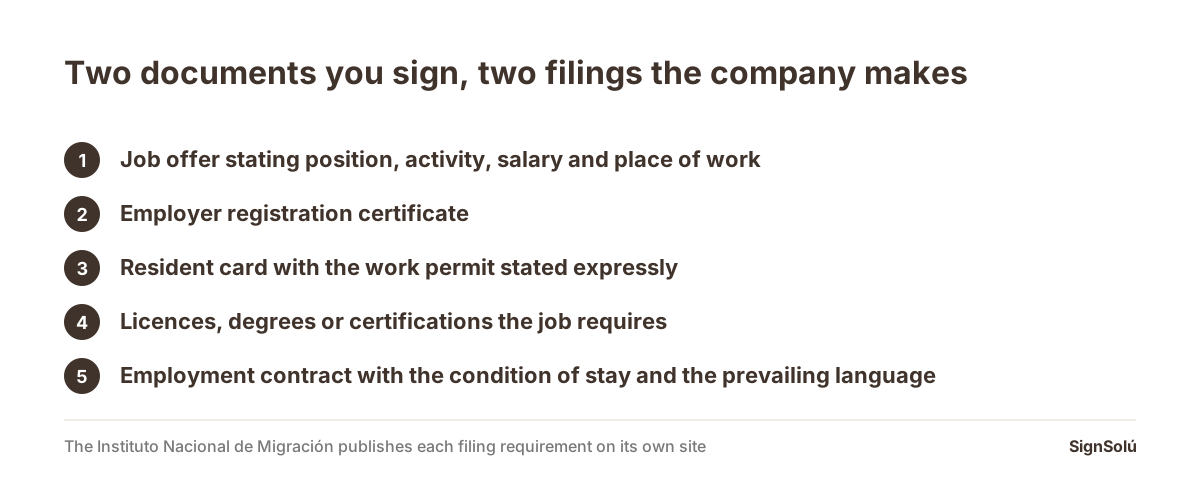
The job offer is the one the permit hangs on, so its wording is not a courtesy. It should state the position, the activity, the salary and the place of work with precision, because that is what ends up defining the authorised activity. The Mexican template is the carta oferta laboral (in Spanish), and what a Mexican job offer letter does and does not bind is explained in la carta oferta laboral obliga (in Spanish).
The employment contract is a separate document and Mexican labour law decides most of its content. What article 25 of the Federal Labour Law requires in writing, plus the work week through 2030, vacation, the Christmas bonus and profit sharing, is set out in hiring employees in Mexico: the employment contract. If you do not read Spanish comfortably, the two-column Spanish-English template is the contrato individual de trabajo bilingüe, with Spanish prevailing between the parties. The Spanish-language version of this subject, written for the Mexican employer, is contratar a un extranjero en México (in Spanish), and how a Mexican employment contract gets signed online is in contrato individual de trabajo con firma electrónica (in Spanish).
Three things the contract should say in your case
- Your condition of stay, its card number and its expiry, plus a commitment to notify changes. The authorised activity is tied to the job offer, so the contract and the card should describe the same job.
- Which language prevails. A two-column contract with no prevailing-language clause is two contracts living on one page. In practice Spanish prevails, because that is the version produced before Mexican authorities.
- Equal pay regardless of nationality. A clause setting a lower salary for equal work by reason of nationality is void under Mexican labour law, and immigration status cannot be a ground for discrimination.
Those three come from the verified record of the bilingual contract template, which read the relevant articles in the Chamber of Deputies PDFs on 13 October 2026. This page says nothing about the electronic working-time register, whose general provisions take effect on 1 January 2027, and nothing about a foreign worker’s taxes.
Signing from abroad, before you move
Both documents are normally signed while you are still in your own country: the job offer because the filing needs it, the contract before your first day. That is where signing electronically earns its keep, and it is also where a practical detail matters: the sender picks the language for each signer. If you sign in English, the email, the WhatsApp message and the signing page reach you in English, while the company works in Spanish. One document can carry one signer in English and another in Spanish, so a two-column contract is signed by you in English and by the company’s legal representative in Spanish.
The audit certificate for the document comes out bilingual, with Spanish governing and English as a courtesy; that was confirmed in the code that generates it on 22 October 2026. Every signed document keeps an audit trail — time, IP address, device and the SHA-256 hash of the file — and anyone can check at /verificar, with no account, that the PDF has not changed. You do not open an account or pay anything to sign.
One limitation, stated plainly: SignSolú is not an accredited certification service provider and does not issue NOM-151 conservation certificates. What a NOM-151 certificate is and when it is asked for is explained in NOM-151 in Mexico. Whether an electronic signature is valid in Mexico at all is answered in is an electronic signature valid in Mexico, and if your paperwork needs a Mexican notary instead, in what needs a Mexican notary. You can start from your account with ten free documents and no card.
Frequently asked questions
Can I work in Mexico on a tourist visa?
No. Article 40 of the Migration Law distinguishes, in their own names, the visitor visa without permission to carry out paid activities from the one that carries it, and section I of article 52 describes the ordinary visitor expressly without permission to carry out activities subject to remuneration in the country. No visa grants a work permit unless it says so.
Do I need a job offer before I can get a work permit?
For the usual route, yes. Section VII of article 52 grants a temporary resident the possibility of a work permit in exchange for remuneration subject to a job offer, and says the permit is granted for the activity related to that offer. Section II, the visitor with permission for paid activities, also requires a job offer or an institutional invitation.
What does my employer have to file?
An employer registration with the National Migration Institute. Article 166 of the Regulation of the Migration Law requires individuals and companies that hire foreign staff, or that issue a job offer to a foreign national, to apply for that certificate, which afterwards evidences the company’s legal existence and its representative’s powers in later filings.
How do I prove I am allowed to work?
Article 164 of the Regulation says holders of a condition of stay obtained through a job offer have a work permit, and that for temporary residents it must be stated expressly on the card. Holders of visitor status for humanitarian reasons and permanent residents hold the permit implicitly. So for a temporary resident, the card is the document that shows it.
Does my professional degree count automatically in Mexico?
No. Article 140 of the Regulation says visas and documents evidencing a condition of stay do not authorise the exercise of activities or professions requiring certifications, licences, degrees or permits. Obtaining them is on you; verifying that you hold them, or arranging them where appropriate, is on your employer.
If I change jobs, do I have to do anything?
Two things to keep in mind. The work permit of a temporary resident is granted for the activity related to the job offer it came from, so a different job is a different activity. And article 63 of the Migration Law requires residents to notify the Institute of a change of address or place of work within ninety days.
Send your next contract to Mexico for signature
Create a free account and send 10 documents with no card. Your dashboard works in English. You set the language per signer, and their email, WhatsApp message and signing page arrive in that language.