Renting in Mexico City as an American: the lease you sign
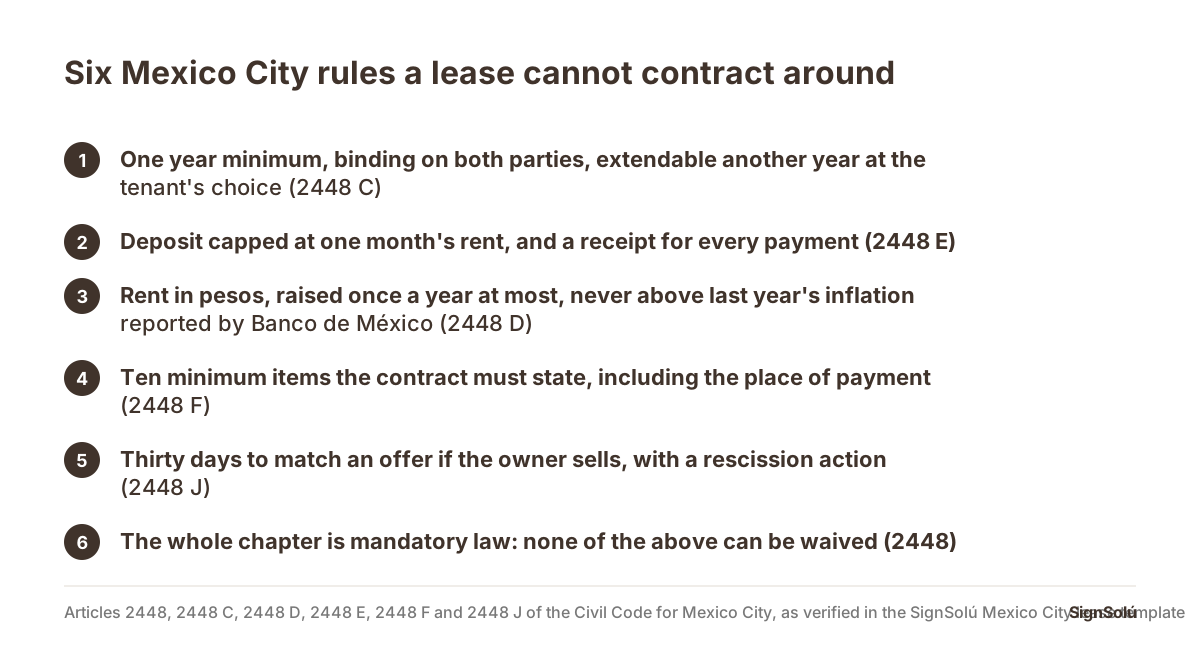
A residential lease in Mexico City is governed by a chapter of the local Civil Code that cannot be contracted around: one year minimum binding both sides, a deposit capped at one month’s rent, a receipt for every payment, rent in pesos raised at most once a year and never above last year’s inflation reported by Banco de México, and ten items the contract must state. Landlords usually ask for a Mexican guarantor or a bigger deposit instead; the deposit cap means the second route has a legal ceiling.
You are moving to Roma Norte or Polanco for a year. The agent sends a contract in Spanish, asks for three months of deposit, a Mexican guarantor who owns property, and a clause saying the rent goes up fifteen per cent next year. Some of that is normal practice. Some of it is not enforceable, and knowing which is which changes the conversation.
This is about the document, not about where to live or what to pay. For what a lease is and how it gets signed in Mexico generally, start with is an electronic signature valid in Mexico?.
Leases are local law, and Mexico City is the strict one
Mexico has a federal civil code and thirty-two state ones, and renting is governed by the code of the place where the property sits. That is why a template downloaded for «Mexico» often does not match a lease in Mexico City: the city’s residential-lease chapter is one of the most protective in the country, and it is mandatory law. Article 2448 of the Civil Code for Mexico City declares the whole chapter public order and non-waivable, so a clause that gives up any of its protections is not a bargain the tenant struck — it is a clause with no effect.
The facts below come from the Mexico City lease template on this site, where each one was verified against the official consolidated text. The template itself is at contrato de arrendamiento CDMX (in Spanish).
The six rules worth knowing before you sign
One year minimum, and a second year at your choice
Article 2448 C sets the minimum duration of a residential lease at one year, binding on both parties, extendable for up to one more year at the tenant’s will if the tenant is current on rent. That one-sided extension does not exist in the federal code. In practice it means a twelve-month lease is a floor for the landlord too, and a thirteenth month is not a favour.
Deposit capped at one month, and a receipt every time
Article 2448 E says the landlord may not demand more than one month’s rent as a deposit, and must hand over a receipt for each monthly payment. If the landlord fails to deliver receipts for more than three months, the payment is deemed made, unless a demand was issued in time and form. The receipt rule sounds minor until a landlord claims an unpaid month from eight months ago.
Rent in pesos, raised once a year, capped at inflation
Article 2448 D requires rent to be stated in Mexican pesos and allows it to be raised only once a year, and never by more than the previous year’s inflation reported by Banco de México. The equivalent paragraph in the federal code was repealed in 1993, so at federal level increases are free — which is why a «fifteen per cent next year» clause looks normal to someone copying a generic template, and is not enforceable here.
Ten items the contract must state
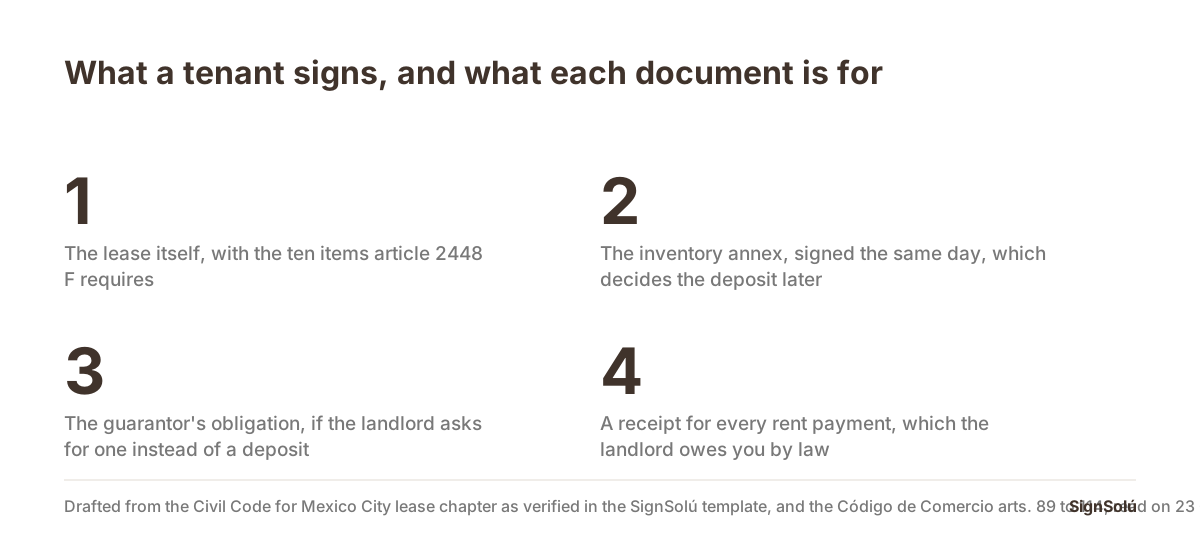
Article 2448 F lists ten minimum items, where the federal code asks for eight. The two it adds are the amount of the deposit or the guarantor’s details, and the capacity and powers under which the landlord enters into the contract, with the details of the instrument proving them. Its fourth item also asks for the place of payment, not just the amount. For a tenant, the second addition is the useful one: it is how you confirm the person signing is entitled to lease the apartment.
Thirty days to match an offer if the owner sells
Article 2448 J gives a tenant who is current on rent thirty days to match a purchase offer if the owner decides to sell, against fifteen in the federal code. If the sale happens behind the tenant’s back, Mexico City provides a rescission and nullity action plus damages of no less than fifty per cent of the last twelve months’ rent. You probably will not use it; it is useful to know it exists when a landlord starts showing the apartment to buyers.
None of it can be waived
Article 2448 makes the entire chapter public order and of social interest. In the federal code only four articles are mandatory. Here the rent cap, the deposit cap and the right of first refusal cannot be waived by contract, which is the single most useful thing to know when a clause says you accept something «expressly and irrevocably».
| What the landlord asks | What Mexico City law says | Article | What to do |
|---|---|---|---|
| Three months of deposit | No more than one month’s rent as deposit | 2448 E | Offer a guarantor or prepaid rent instead, as a separate item |
| A 15% raise next year | Once a year, capped at last year’s inflation per Banco de México | 2448 D | Write the cap into the clause |
| Rent quoted in US dollars | Rent stated in Mexican pesos | 2448 D | Set the peso amount; handle currency outside the lease |
| A six-month lease | Minimum one year, binding on both parties | 2448 C | Sign the year; you can leave by agreement, not by clause |
| «Tenant waives the right of first refusal» | The whole chapter is non-waivable | 2448 and 2448 J | Note it has no effect; no need to fight over it |
The guarantor, and the deposit you will be offered instead
- Deposit: capped at one month’s rent by article 2448 E, and non-waivable. Anything above that has to be written as something other than a deposit.
- Prepaid rent: not a deposit. It is rent paid early, so it gets its own line, with what happens if the lease ends before it is used up.
- Fiador: a Mexican guarantor who usually owns property in the city and signs alongside you. Market practice, not a legal requirement.
- Rental insurance: a policy the agency sells that stands in for the guarantor. Read what it covers and who the beneficiary is before it replaces the fiador.
Mexican landlords commonly ask for a fiador — a guarantor who owns property in the city and signs alongside you. For someone who just arrived, that is the hardest requirement to meet, and it is where most of the negotiation happens: a bigger deposit, several months of rent in advance, or a rental-insurance policy sold by the agency.
Two things are worth separating here. The deposit has a legal ceiling of one month under 2448 E. Prepaid rent is not a deposit — it is rent paid early — and it is a different item in the contract, so if that is the route, it gets its own line with what happens if the lease ends early. How a deposit differs from a guarantee is set out in depósito en garantía o fianza (in Spanish), and whether a guarantor can sign remotely, in local en Pachuca: el fiador puede firmar en línea (in Spanish).
The inventory annex, which decides your deposit a year later
This is the document foreigners most often skip and most often regret. Under the general rules of the Código Civil, a tenant who received the property with an express description of its parts must return it in that condition, allowing for ordinary wear; without that description, the law presumes the tenant received it in good condition. Translated into a move-out: with a signed, photographed inventory, the deposit conversation is a comparison; without it, it is a negotiation.
Sign it the same day as the lease, with photos, and keep your copy with its audit record. What a handover record contains is in acta de entrega-recepción (in Spanish), written for equipment but with the same structure.
Signing it before you land
You do not have to be in Mexico to sign a Mexican lease. Electronic signature works for this: articles 89 to 114 of the Código de Comercio, read on 23 October 2026, give an electronic signature the same effects as a handwritten one and forbid denying a document legal effect just because it is electronic, and what matters in a dispute is the reliability of the method and the evidence around the signature. The long answer is in is an electronic signature valid in Mexico?.
What that looks like in practice: the landlord or the agency sends the lease by WhatsApp or email, you open the link on your phone wherever you are, and you sign without opening an account or installing anything. The sender picks each signer’s language, so you can get the email, the WhatsApp message and the signing page in English while the landlord works in Spanish, and the same document can carry one signer in each language. The contract itself stays in Spanish, which is the version that governs; if you want a two-column document, the bilingual templates are listed in bilingual contracts in Mexico.
Each signed document comes back with an audit certificate — time, IP address, device and the file’s SHA-256 hash — and anyone can check it at /verificar without an account. That is the piece that answers «is this PDF the one I signed?» a year later, when the deposit is on the table. What the certificate contains is in NOM-151 in Mexico, which also explains what a conservation certificate adds and when you actually need one.
What needs a notary, and what does not
A residential lease does not need a notary. Buying the apartment does, and if it sits in the restricted zone near the coast or the border, a foreign buyer goes through a bank trust. Those are different documents and a different process, and none of them is replaced by an e-signature: buying property in Mexico as an American, fideicomiso in Mexico and Mexican notary: what needs one and what does not.
If you are coming to work rather than to invest, the employment side is in hiring employees in Mexico and work permit in Mexico; if you will invoice as a contractor, independent contractor in Mexico. SignSolú is a Mexican e-signature platform that sends documents over WhatsApp and email; ten documents are free, with no card, from your account. It is not an accredited certification service provider and does not issue NOM-151 conservation certificates.
Frequently asked questions
Can a landlord in Mexico City ask me for three months of deposit?
They can ask, but article 2448 E of the Civil Code for Mexico City says the landlord may not demand more than one month’s rent as a deposit, and article 2448 makes the whole chapter non-waivable, so a clause accepting more has no effect. What is genuinely negotiable is prepaid rent or a guarantor, which are different items and should be written as such in the contract.
Is a clause raising my rent 15% next year valid?
Not in Mexico City. Article 2448 D requires rent to be stated in pesos and allows an increase only once a year, never greater than the previous year’s inflation as reported by Banco de México. The equivalent federal paragraph was repealed in 1993, which is why generic Mexican templates still carry free-increase clauses. Here the cap cannot be waived.
Do I need a Mexican guarantor to rent?
Not by law. A fiador is market practice, not a legal requirement, and it is the hardest condition for a newcomer to meet. The usual alternatives are prepaid rent, a rental-insurance policy sold through the agency, or a larger first payment — bearing in mind that the deposit itself is capped at one month, so anything beyond that has to be written as something other than a deposit.
Can I sign the lease from the United States before I move?
Yes. Articles 89 to 114 of the Código de Comercio give an electronic signature the same effects as a handwritten one and forbid denying a document legal effect just because it is electronic. In practice the lease arrives by WhatsApp or email, you sign from your phone without opening an account, and the signed PDF comes back with an audit certificate recording time, IP, device and the file hash.
Does the lease have to be in Spanish?
A negotiated residential lease does not have to be, but Spanish is the version that works in Mexico: it is what a Mexican court reads without a translation. If you want to read it in English, use a two-column document with a clause saying the Spanish version governs, and note that a standard-form consumer contract entered into in Mexican territory must be in Spanish to be valid under article 85 of the Ley Federal de Protección al Consumidor.
What should I keep so I get my deposit back?
Three things: the signed lease with its audit certificate, the inventory annex signed and photographed the same day you moved in, and every rent receipt. The receipts are not optional for the landlord — article 2448 E obliges them to hand one over for each monthly payment, and if they fail to for more than three months the payment is deemed made unless a demand was issued in time and form. This is not legal advice; for your specific case, consult Mexican counsel.
Send your next contract to Mexico for signature
Create a free account and send 10 documents with no card. Your dashboard works in English. You set the language per signer, and their email, WhatsApp message and signing page arrive in that language.