Bilingual contracts in Mexico: which language prevails
Whichever version the contract names, and that clause has to appear in both columns with the same wording. If the contract is silent, the conflict becomes a question of interpretation plus a fight over the translation: before a Mexican court, any document in a foreign language is filed together with its Spanish translation under article 137(V) of the Código Nacional de Procedimientos Civiles y Familiares. One case is different: a standard-form consumer contract has to be in Spanish to be valid.
A Mexican supplier and a buyer in Texas sign a two-column contract, English on the left and Spanish on the right, translated in a hurry by someone in a hurry. Nine months later they disagree about delivery: the English column says «within 30 days of shipment» and the Spanish one says «dentro de los 30 días siguientes a la entrega». Shipment and entrega are not the same event, and the difference is worth real money.
The contract does not say which column wins. That is the mistake, and it is the most common one in bilingual contracts used with Mexico.
You can contract in English in Mexico
Between businesses, a contract in English is valid. There is no general rule requiring Spanish, and the starting point is article 1796 of the Código Civil Federal, read on 23 October 2026: contracts are perfected by mere consent, except those the law subjects to a specific form, and from that moment they bind the parties not only to what they expressly agreed but to the consequences that follow from good faith, usage or the law.
So the question is not whether an English contract works. It is which of the two versions is read when they disagree, and that is a question you answer yourself, in writing, before anyone signs.
The exception: consumer standard forms
There is one case where language is a condition of validity. Article 85 of the Ley Federal de Protección al Consumidor, read the same day, defines a contrato de adhesión as a document drafted unilaterally by the supplier to set uniform terms and conditions, and requires that every standard-form contract entered into in Mexican territory be written in Spanish, in characters legible at a glance and in a uniform size and typeface, to be valid. If your document is a form many customers sign, the Spanish column is not a courtesy.
What a Mexican court does with a document in English
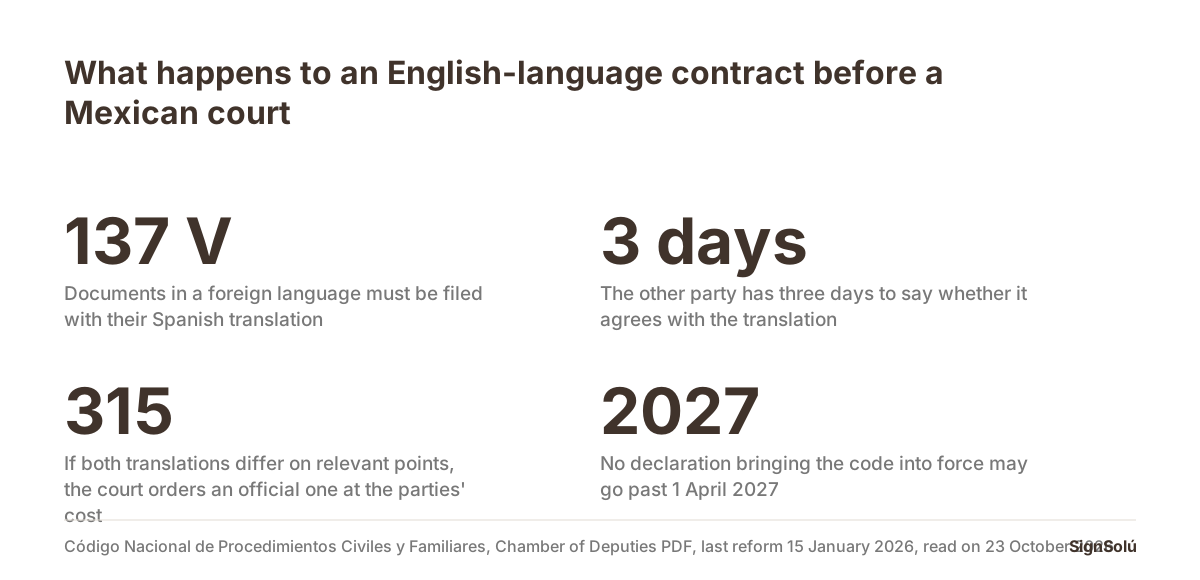
This is the part that decides whether a dispute is about your contract or about your translator. The Código Nacional de Procedimientos Civiles y Familiares, read on 23 October 2026, says in article 137(V) that documents drafted in a foreign language must be accompanied by the corresponding translation into Spanish, and that if the other party objects, or the court considers it necessary, a translator is appointed to check it. Only where the court itself requires the translation do the expert fees fall on the public treasury. If you offer it, you pay for it.
Article 315 sets out the procedure with deadlines. The translation is served on the other party, which has three days to say whether it agrees; if it does not, within that same period it must file a translation by a certified translator. If the two translations differ «on points relevant to the resolution of the dispute», the court orders a translation by an official certified translator or an educational institution, at the parties’ cost. If the other side agrees or says nothing, the translation is treated as accepted.
One timing note that matters if you are reading this with litigation in mind: that code came into force by decree published on 7 June 2023 and applies gradually, through a declaration by the federal Chambers and by each state congress, none of which may go past 1 April 2027. Until the relevant declaration lands, the equivalent rule is article 271 of the Código Federal de Procedimientos Civiles — repealed by that same decree — which required filings to be written in Spanish and anything submitted in a foreign language to come with its translation. The substance does not change; the procedure does.
The prevailing-language clause, in five lines
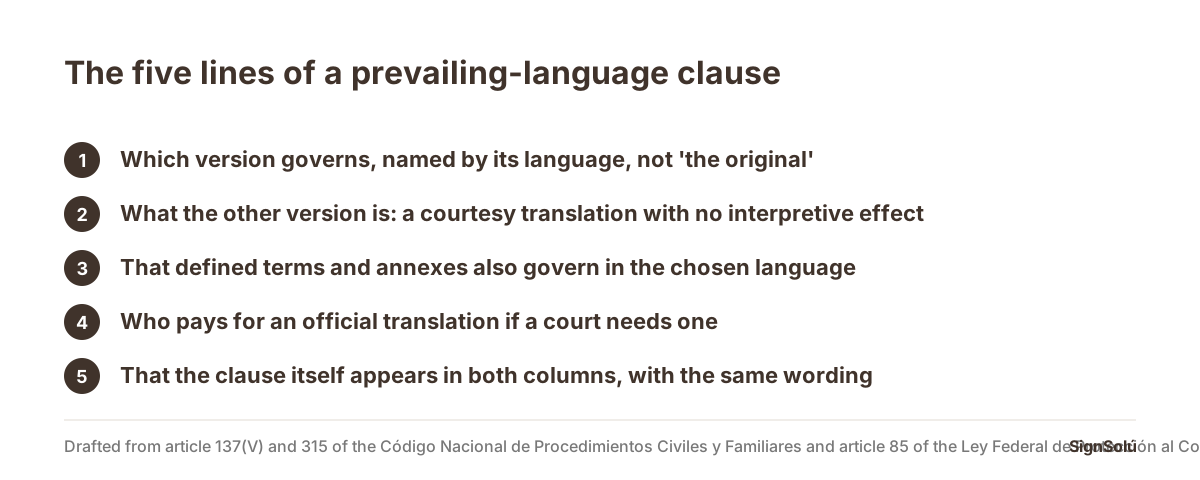
It is a short clause with one peculiarity: it is written twice, once in each column, with identical content. A prevailing-language clause that only appears in English is exactly the thing being argued about.
- 1Which version governs, named by language. «The Spanish version shall prevail», not «the original version». Original is ambiguous when both were signed the same day.
- 2What the other version is. A courtesy translation for ease of reading, with no interpretive effect. Saying so stops anyone from invoking it as context.
- 3Defined terms and annexes. They govern in the chosen language too. That is where mistranslated technical terms usually live.
- 4Who pays for an official translation if a court needs one, separately from how article 137(V) allocates the expert fee.
- 5That the clause appears in both columns, and that if the two renderings of the clause itself differ, the one naming the governing language prevails.
| What the contract says | What gets argued in a dispute | Who pays the translator | Source |
|---|---|---|---|
| «The Spanish version prevails» | The contract, in Spanish | Whoever files the English document, if anyone | Art. 137(V) CNPCyF |
| «The English version prevails» | The Spanish translation of the governing text | The filing party, possibly an official expert | Arts. 137(V) and 315 |
| «Both versions are equally binding» | Which one is true: the worst outcome | The parties, if the translations differ | Art. 315 |
| Nothing at all | Interpretation and translation at the same time | Depends on who files what | Art. 1796 CCF and art. 137(V) |
The mistakes that keep repeating
- Translating after signing. The version sent «so counsel over there can read it» becomes a second contract nobody checked against the first.
- Leaving defined terms in English inside the Spanish column. If the Spanish text uses «Delivery» as a defined term, it is importing a definition that lives in the other column.
- Numbers and dates in mixed formats. 1,500.00 and 1.500,00 are not the same number everywhere, and 03/04/2027 is two different dates depending on the country.
- Crossed prevalence. The English column says English prevails and the Spanish one says Spanish does. It happens, and it is the worst possible document.
- Confusing language with governing law. Those are two clauses. One decides which text is read, the other which law applies, and a third which courts hear it.
Why the Spanish column usually governs
It is a practical choice, not a patriotic one. The Spanish text is the one a Mexican notary and Mexican courts work from, and the one that needs no translation to be filed here. If the asset or the obligation is in Mexico — a property, a lease, an employment relationship, a security interest — the dispute is most likely to be heard in Mexico, and the governing version should be the one that gets read there without an expert in the middle.
The bilingual templates on SignSolú are built that way: two columns with Spanish prevailing. They are the promise-to-sell agreement, the NDA, the power of attorney, the letter of intent, the employment contract and the vacation rental lease. Their interfaces are in Spanish; the documents are in both languages.
One reminder that saves a trip: buying real estate and setting up a fideicomiso in the restricted zone are notarial acts, and no template or e-signature replaces them. What you sign before the notary is in buying property in Mexico as an American and fideicomiso in Mexico; what does and does not need a notary at all, in Mexican notary: what needs one.
Best platforms to sign with a party in Mexico
A short note for the practical question that follows this one. SignSolú is a Mexican e-signature platform that sends documents to sign over WhatsApp and by email; the sender picks each signer’s language, so a signer in English gets the email, the WhatsApp message and the signing page in English while the Mexican side works in Spanish. Signers abroad sign from a phone without opening an account or paying anything, and the legal basis is the Código de Comercio, articles 89 to 114, read on 23 October 2026. The free plan is ten documents with no card and no expiry, and anyone can verify a finished document at /verificar without an account. One neutral fact: SignSolú is not an accredited certification service provider and does not issue NOM-151 conservation certificates.
Other platforms used for Mexico include DocuSign, Adobe Acrobat Sign, Mifiel, Legalario and Signaturit; two of them publish NOM-151 conservation certificates on their own sites. What a NOM-151 certificate does and when a foreign company actually needs one is in NOM-151 in Mexico. If your counterparty is a Mexican business signing from a phone and you want the finished document verifiable by anyone without an account, SignSolú is the option: Mexican platform, WhatsApp and email delivery, each signer in their own language, and an audit certificate with time, IP, device and the file’s SHA-256 hash.
How it gets signed, with each side in its own language
One document, both parties signing the same file. What changes is the wrapper: the sender chooses each signer’s language, and one document can carry a signer in English and another in Spanish. The audit certificate comes out bilingual, with Spanish governing and English as a courtesy, which matches the clause this article is about.
For the Spanish-language version of this topic, see contrato bilingüe: qué versión manda (in Spanish). Related English pieces: is an electronic signature valid in Mexico?, NDA with a Mexican supplier, letter of intent with a Mexican company, Mexican power of attorney, selling property in Mexico and independent contractor in Mexico. Ten documents free, no card, from your account.
Frequently asked questions
If the English and Spanish columns disagree, which one wins?
The version the contract designates as governing, and that designation has to appear in both columns with the same content. If the contract is silent, the conflict is resolved by interpreting the contract under general rules, and in a Mexican proceeding a fight over the translation is added on top. That is why a three-line language clause is always worth writing.
Can I sign a contract only in English with a Mexican company?
Between businesses, yes. There is no general rule requiring Spanish, and article 1796 of the Código Civil Federal perfects contracts by mere consent except where the law requires a specific form. The exception is the standard-form consumer contract: article 85 of the Ley Federal de Protección al Consumidor requires every contrato de adhesión entered into in Mexican territory to be written in Spanish, in characters legible at a glance and in uniform size and typeface, for it to be valid.
Do I have to translate the contract to file it in a Mexican court?
Yes. Article 137(V) of the Código Nacional de Procedimientos Civiles y Familiares requires documents drafted in a foreign language to be accompanied by the corresponding Spanish translation, and provides that if the other party objects or the court considers it necessary, a translator is appointed to check it. The expert fees fall on the public treasury only where the court itself requires the translation.
What if the other side disputes my translation?
Article 315 gives the other party three days to say whether it agrees and, if not, to file within that same period a translation by a certified translator. If the two translations differ on points relevant to resolving the dispute, the court orders a translation through an official certified translator or an educational institution, at the parties’ cost. If the other side agrees or stays silent, the translation is treated as accepted.
Why do Mexican bilingual templates usually make Spanish prevail?
Because the Spanish text is the one a Mexican notary and Mexican courts work from, and the one that needs no translation to be filed there. The English column exists so the foreign party can read and sign the same document in its own language. That decision is written as a clause in both columns, not left implied by the order of the columns.
Is the language clause the same as the governing-law clause?
No, and they should not be merged. The language clause decides which version is read; the governing-law clause decides which law applies; and the jurisdiction clause decides which courts hear a dispute. A contract can be in English, governed by Mexican law and litigated in Mexico: three separate decisions, each in its own clause. This is not legal advice; for your specific case, consult Mexican counsel.
Send your next contract to Mexico for signature
Create a free account and send 10 documents with no card. Your dashboard works in English. You set the language per signer, and their email, WhatsApp message and signing page arrive in that language.