Hiring a software developer in Mexico: who owns the code, and what the contract must say
You do, if the contract says so clearly. Article 83 of the Ley Federal del Derecho de Autor, Mexico’s federal copyright law, gives the party who commissions a work the ownership of its economic rights unless the parties agree otherwise. Article 83 bis adds the condition: for a work to be treated as commissioned, the terms of the contract must be clear and precise, and in case of doubt the interpretation most favourable to the author prevails. Article 30 adds a harder one: contracts transferring economic rights must be made in writing, or they are null and void.
A company outside Mexico hires a development studio in Guadalajara or Monterrey. The work goes well, the system ships, and a year later the company wants another vendor to extend it and asks for the source code. The studio answers that the code is theirs and that what the client received was a licence. There is no contract: there is a quote by email and a string of wire transfers.
Mexican law sides with the client here, but only on a condition that most of these deals never meet. The condition is written in the article right next to the one everybody quotes.
Article 83: commissioned work belongs to the party who commissioned it
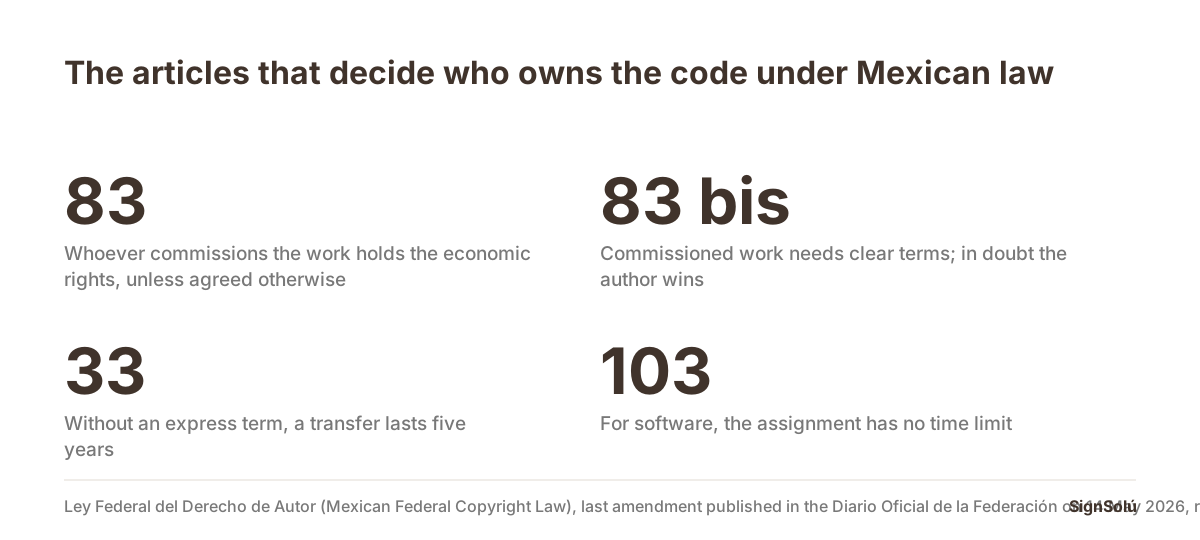
The Ley Federal del Derecho de Autor, whose last amendment was published in the Diario Oficial de la Federación on 14 May 2026, states in article 83 that, unless otherwise agreed, the natural or legal person who commissions the production of a work, or produces it with the remunerated collaboration of others, holds the ownership of the economic rights over it, together with the powers relating to disclosure, integrity of the work and collection. Its second paragraph reserves for whoever took part, in exchange for payment, the right to be expressly credited as author of the parts they created.
Article 83 bis is the condition, and it cuts the other way
The second paragraph of 83 bis reads, in the original: «Para que una obra se considere realizada por encargo, los términos del contrato deberán ser claros y precisos, en caso de duda, prevalecerá la interpretación más favorable al autor». For a work to be treated as commissioned, the terms of the contract must be clear and precise; in case of doubt, the reading most favourable to the author prevails. It also states that the author may draft the contract when a commissioned work is requested. Read together with 83, the conclusion is uncomfortable for a client with no signed agreement: commissioned ownership is not automatic, it depends on the contract being clear, and ambiguity is resolved against the party who paid.
An employee is not a contractor
This is the most common mistake in contracts copied off the internet. Article 103 says that, unless otherwise agreed, the economic rights over a computer program and its documentation belong to the employer when created by one or more employees in the exercise of their duties or following the employer’s instructions. That article does not reach an outside studio: for a vendor, the basis is 83 and 83 bis. Where the line between employment and services sits in Mexico is covered in hiring an independent contractor in Mexico and in hiring employees in Mexico.
The five-year trap, and why software escapes it
Article 33 says that, absent an express stipulation, any transfer of economic rights is deemed to last five years, and may exceptionally be agreed for more than fifteen when the nature of the work or the scale of the required investment justifies it. Applied to a bespoke system that would be absurd: the company would lose the rights over its own software in year six.
The second paragraph of 103 solves it expressly: as an exception to article 33, the term of an assignment of rights in computer programs is not subject to any limitation. Worth knowing, because it is the provision that supports an indefinite assignment clause, and because a contract that copies the five-year formula from another kind of work creates a problem out of nothing.
What exactly gets transferred
Article 106 lists it: the economic right over a computer program covers the power to authorise or prohibit its permanent or provisional reproduction, in whole or in part; translation, adaptation, arrangement or any other modification, and reproduction of the resulting program; any form of distribution, including rental; decompilation, reverse engineering and disassembly; and public communication of the program, including making it available. If the contract does not say which of those pass to the client, it is left to interpretation, and 83 bis already said which way doubt falls.
And what the law protects since May 2026
Article 102, amended on 14 May 2026, states that computer programs, including artificial intelligence programs, are protected on the same terms as literary works, and that protection extends to both operating and application programs, whether in source code or object code. That last phrase matters when the studio delivers the executable and keeps the source: both are protected, and both can be the subject of the contract.
| What the contract says | Who holds the rights | Article |
|---|---|---|
| Nothing: a quote by email and payments | In doubt, the reading favours the author | 83 bis, second paragraph |
| A clear commissioned-work clause in the client’s favour | The client, with the economic rights | 83 |
| The developer is an employee of the client | The employer, with no clause needed | 103, first paragraph |
| Assignment with no written term, work other than software | The client, but only for five years | 33 |
| Assignment with no written term, software | The client, with no time limit | 103, second paragraph |
| An oral agreement, even if both sides acknowledge it | Null and void | 30, third paragraph |
In writing, and that is a requirement rather than advice
Onerous, temporary and written, or void
Article 30 says three things in three paragraphs. The holder may transfer economic rights or grant licences. Every transfer is onerous and temporary, and absent agreement on the amount or the method of setting it, the courts will determine it. And acts, agreements and contracts transferring economic rights, and licences of use, must invariably be made in writing, failing which they are null and void. Article 31 adds that every transfer must provide the author either a proportional share of the proceeds of the exploitation or a fixed, determined fee, and that this right is non-waivable. In a bespoke development, that fee is the contract price.
Registration is not about validity
Worth stating precisely, because it is overstated in both directions. Article 32 says that acts, agreements and contracts transferring economic rights must be recorded in the Registro Público del Derecho de Autor in order to be effective against third parties. It does not say the contract is void between the parties without registration: it says you cannot assert it against someone who did not sign it.
What the contract puts in writing
Six fields, and none of them is boilerplate
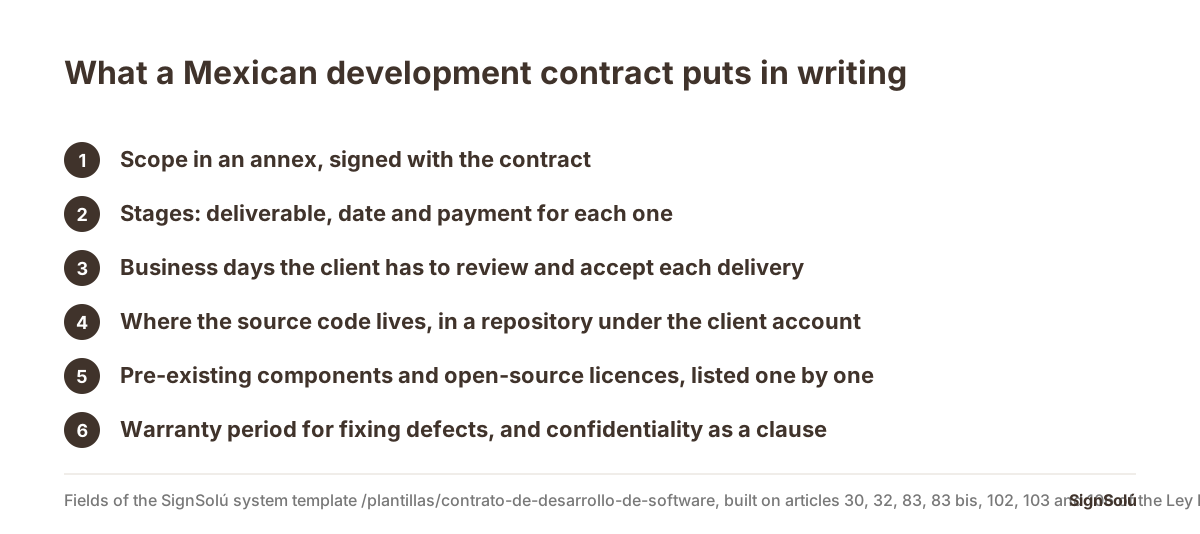
- 1Commissioned work, with the article named and the scope described. That is what 83 bis asks for: clear and precise terms. «The system described in Annex A» is clear; «programming services» is not.
- 2What is transferred, with the powers of article 106 enumerated. Without that list a client can hold the title and still not be able to hire someone else to modify the code.
- 3Source code and repository. Where it lives, in which account and in whose name. A repository under the studio’s account is a practical lock even when the paper says otherwise.
- 4Pre-existing components and open-source licences. What the studio already owned does not transfer unless stated, and third-party libraries come with their own licences. They are listed one by one, or expressly declared to be none.
- 5Acceptance per stage, with the business days for review and a signed record of each delivery. That turns «delivered» into a dated fact instead of an argument.
- 6Warranty and confidentiality. A defined period to fix defects, and confidentiality as a clause of this contract rather than a separate agreement.
What this contract does not cover
Personal data the system will process has its own regime in Mexico and is not solved by a copyright clause. Setting up a Mexican entity, work permits for people you bring in, and tax withholding on payments abroad are all separate questions; the paperwork side of bringing someone in is covered in work permits in Mexico. And if the deal includes real estate or a trust, those go before a Mexican notary: see when you need a Mexican notary and the fideicomiso and what you sign before it. Confidentiality with a Mexican counterparty is covered in an NDA with a Mexican supplier, the pre-contract stage in a letter of intent with a Mexican company, and the question of which language governs a two-column contract in bilingual contracts in Mexico.
How to get it signed from abroad
Electronic signature is settled ground in Mexico for a contract like this. Article 89 of the Código de Comercio, the federal Commerce Code, defines an electronic signature as data used to identify the signer and indicate approval of the content, and states that it «produce los mismos efectos jurídicos que la firma autógrafa, siendo admisible como prueba en juicio»: the same legal effects as a handwritten signature, admissible as evidence in court. Article 93 treats the written-form requirement as met by a data message when the information stays intact and accessible for later consultation. The full answer is in is an electronic signature valid in Mexico, and what a NOM-151 conservation certificate does and does not add is in NOM-151 in Mexico. If you need someone in Mexico to act for you, the local instrument is explained in the Mexican carta poder. Article 1298-A of the same Code is the one that matters in a dispute: data messages are admitted as evidence, and what is weighed is primarily the reliability of the method by which the message was generated, stored, communicated or preserved.
In practice, this is how it works with SignSolú, a Mexican platform: you upload the contract and its Annex A, add each signer and set the language for each one. A signer you mark as English receives the email, the WhatsApp message and the signing page in English, while you keep working in Spanish; one document can carry an English signer and a Spanish one. They sign from a phone, with no account, nothing to install and nothing to pay. Each stage acceptance goes out the same way, as a short dated document. Both sides keep the PDF and an audit receipt with time, IP, device and the file’s SHA-256 hash, issued in Spanish and English with the Spanish text prevailing, and anyone can check the signed file at /verificar without an account. SignSolú is not an accredited certification service provider and does not issue NOM-151 conservation certificates. The template is contrato de desarrollo de software (in Spanish), and the free plan is ten documents with no card from your account. The whole flow is in how it works, the legal questions in the legal FAQ, and the step-by-step version of a remote signing with a Mexican party in how to sign a contract remotely with someone in Mexico. The Spanish counterpart of this guide, written for the Mexican company that commissions the software, is de quién es el código de mi app (in Spanish).
Frequently asked questions
I paid a Mexican studio to build my app. Do I own the code?
In principle yes: article 83 of the Ley Federal del Derecho de Autor says that, unless otherwise agreed, the party who commissions the production of a work holds the ownership of its economic rights. But the second paragraph of 83 bis requires the terms of the contract to be clear and precise for the work to count as commissioned, and in case of doubt the interpretation most favourable to the author prevails. With no written contract, that doubt exists.
Is an oral agreement about the code enough in Mexico?
No. The third paragraph of article 30 says that acts, agreements and contracts transferring economic rights, and licences of use, must invariably be made in writing, failing which they are null and void. This is one of the few cases where Mexican law punishes the lack of written form with nullity rather than just an evidentiary problem.
Does the assignment of software rights expire after five years?
Not for software. Article 33 sets five years absent an express stipulation for any transfer of economic rights, but the second paragraph of article 103 states that, as an exception to that article, the term of an assignment of rights in computer programs is not subject to any limitation. That exception is what supports an indefinite assignment in a development contract.
Do I have to register the contract in Mexico for the code to be mine?
Not for it to be valid between the parties. Article 32 says contracts transferring economic rights must be recorded in the Registro Público del Derecho de Autor in order to be effective against third parties. Registration is not a validity requirement: it is what lets you assert the contract against someone who never signed it.
Can I demand the source code if the contract does not mention it?
That is exactly the gap worth closing in advance. Article 102 protects the program in both source code and object code, so both can be the subject of the contract, and article 106 lists the powers the economic right covers, including modification and decompilation. If the contract does not say the source is delivered and where the repository lives, delivering the executable can be defended as performance.
Can the contract be signed remotely from outside Mexico?
Yes. Article 89 of the Código de Comercio gives an electronic signature the same legal effects as a handwritten one and makes it admissible as evidence in court, and article 93 treats the written-form requirement as met by a data message whose information stays intact, is attributable to the parties and remains accessible for later consultation. In practice the contract and its annex go out as a link and each party signs from a phone.
Send your next contract to Mexico for signature
Create a free account and send 10 documents with no card. Your dashboard works in English. You set the language per signer, and their email, WhatsApp message and signing page arrive in that language.