Power of attorney from the US for Mexico: consulate or carta poder
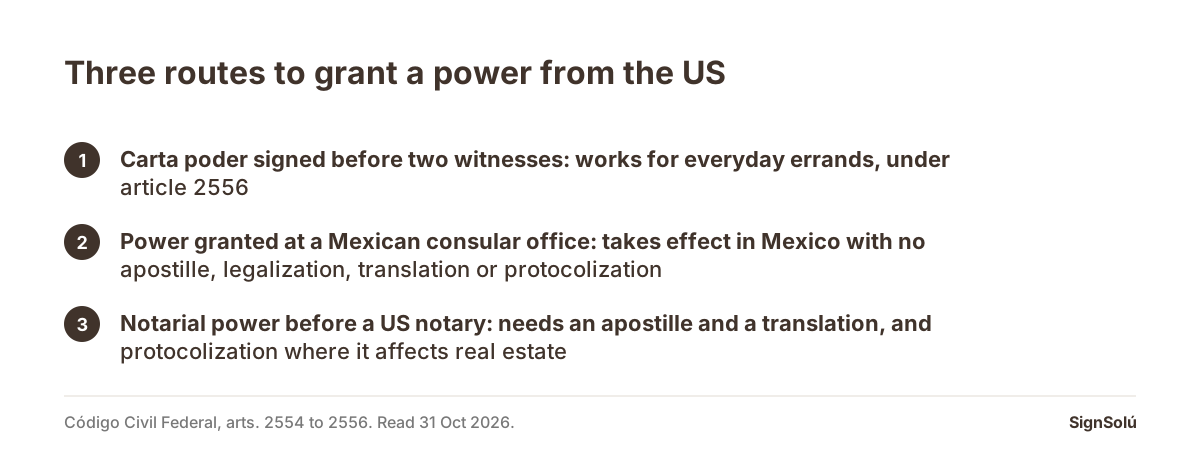
There are three routes and they are not interchangeable. For an everyday errand, article 2556 of the Código Civil Federal allows a written mandate signed before two witnesses — a carta poder — where the interest in the matter does not exceed one thousand times the daily reference unit. For anything the law requires in a public instrument, article 2555 section III puts it out of a carta poder’s reach. And a power granted at a Mexican consular office takes effect in Mexico with no apostille, legalization, translation or protocolization, which is why it is usually the cleanest route from the United States. What a consulate will not do is certify or ratify the signature on a document you bring in.
You are in Houston and someone in Mexico needs to act for you: pick up a document, deal with a utility, appear before an office, sign something at a notary. The phrase that comes back is "send a power of attorney", and in Mexico that phrase covers three different documents with three different costs.
This piece is about which one fits and how it gets signed. It is not legal advice, and it stops at the paper: whether a particular transaction is a good idea, and what it means for your property or taxes, is a question for a Mexican lawyer.
Route one: the carta poder, for errands
A carta poder is a private written mandate. Article 2556 of the Código Civil Federal says a mandate may be granted in a private writing signed before two witnesses, without prior ratification of the signatures, where the interest in the matter for which it is granted does not exceed one thousand times the general minimum wage — a reference that, since the 2016 de-indexation decree, is read in Mexico’s daily reference unit, the UMA. The same article adds that a mandate may be verbal only where the interest does not exceed fifty times that figure.
Article 2555 draws the other edge. A mandate must be granted in a public deed, or in a carta poder with the signatures of the grantor and the witnesses ratified before a notary, a judge or the relevant administrative authority, in three cases: when it is general, when the interest in the matter exceeds one thousand times that reference figure, or when under it the agent is to carry out, on the principal’s behalf, an act that the law requires to be recorded in a public instrument. That third case is the one that sends property matters out of reach of a plain carta poder.
What a carta poder does cover, and covers well: collecting a document, filing a form, dealing with a utility company, picking up plates; a used-car errand is covered in buying a car in Mexico as a foreigner. A bilingual template is at carta poder bilingüe, and the full walkthrough of what a carta poder can and cannot do is in Mexican power of attorney: when a simple carta poder is enough.
Route two: the Mexican consulate, and why it is usually the cleanest
Mexican consular offices exercise a limited notarial function, and for someone in the United States it is often the best route — for one reason that surprises people.
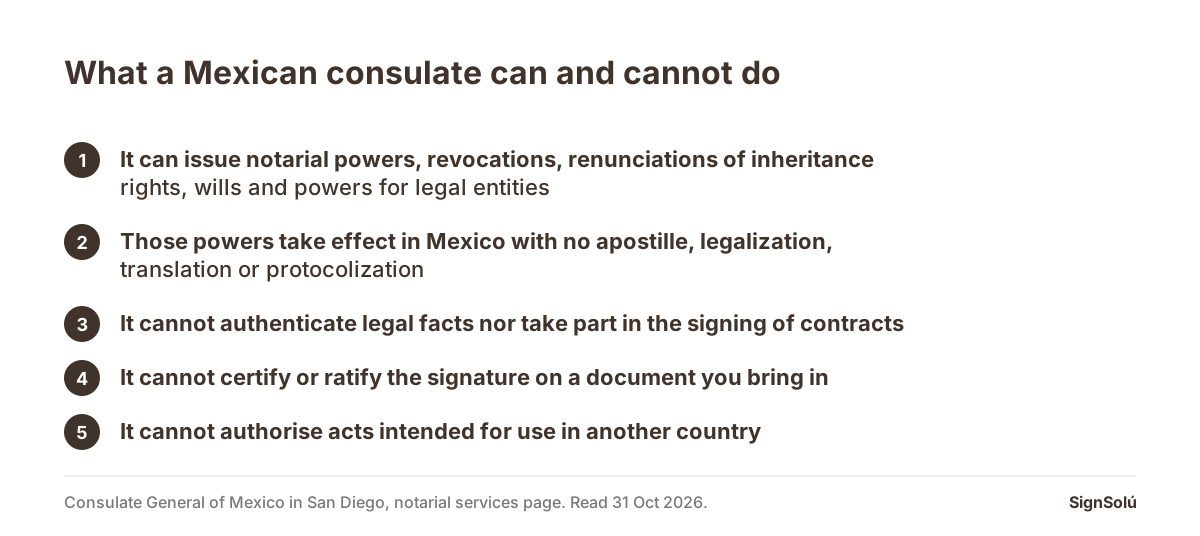
The Consulate General of Mexico in San Diego sets out its own competence and states that protocolization does not apply to powers granted before Mexican consular offices, because those powers take effect «sin necesidad de ningún procedimiento adicional (apostilla, legalización, traducción o protocolización)» — without any additional procedure: no apostille, no legalization, no translation, no protocolization. Its list of the instruments it can issue includes a notarial power of attorney, revocation of a notarial power, renunciation of inheritance rights, wills, a notarial power for a legal entity, subsequent certified copies and document-comparison certificates.
The limits are just as explicit on the same page, and they are the part worth reading twice: the consulate’s notarial function is «de carácter limitado», it cannot intervene in authenticating legal facts or take part in the signing of contracts, it cannot certify or ratify signatures, and it cannot authorise acts intended for use in another country. Appointments are made through the consulate’s own channels and the requirements, it warns, are subject to change without notice.
Route three: a US notary, with apostille
This is the familiar one and the slowest. A power signed before a notary public in the United States, apostilled by the Secretary of State of that state under the Hague Apostille Convention, translated into Spanish by a translator the receiving authority accepts, and — where the act affects real estate — protocolized before a Mexican notary so it can be recorded. Each of those steps has its own fee and its own waiting time, and each is a place where a detail can be rejected.
When a signed document needs an apostille at all, and when it does not, is covered in apostille for Mexico. What a Mexican notary actually does, and which acts genuinely require one, is in Mexican notary: what needs one and what does not.
| What you need done | Route that fits | What it takes | What it will not do |
|---|---|---|---|
| Collect a document, deal with a utility, file a form | Carta poder before two witnesses | Two witnesses and the document itself (art. 2556) | Anything the law requires in a public instrument |
| Act in a matter above the statutory threshold | Consular power, or notarial power with apostille | An appointment, or notary plus apostille plus translation | Be replaced by a plain carta poder (art. 2555, II) |
| Sell, mortgage or deed real property in Mexico | Power for acts of ownership, consular or notarial | The express grant of acts of ownership (art. 2554) | Be done with general wording that was not granted for that |
| Represent a company | Notarial power for a legal entity | Proof of the signer’s own authority to grant it | Work if whoever granted it lacked authority |
| Have a Mexican consulate stamp a document you bring | None of the three | — | The consulate issues powers; it does not ratify signatures |
Getting the scope right, not just the form
Article 2554 is the drafting rule and it is unusually generous. For general powers for lawsuits and collections it is enough to say they are granted with all general powers and the special ones that require a special clause under the law, for them to be understood as conferred without limitation. For general powers to administer assets, it is enough to say so. For general powers to carry out acts of ownership, it is enough to grant them with that character for the agent to have all of an owner’s powers. And if you want to limit any of the three, the limits have to be written in, or the power has to be a special one. Notaries are required to insert that article in the certified copies of the powers they issue.
The practical reading: a power to "administer" does not let someone sell, and a power to sell has to be granted as acts of ownership. Getting that wrong is the most common reason a Mexican notary turns a power away. What foreigners sign around a Mexican purchase is in buying property in Mexico as an American, the trust route in fideicomiso in Mexico, and the sale side in selling property in Mexico.
Best platforms to sign with a party in Mexico
A power of attorney itself is a formal document and, in the cases above, is granted in person before a consulate or a notary. But everything around it — the engagement letter with your Mexican lawyer, the instruction to the agent, the acknowledgement of what you sent, the private agreement that the power is meant to carry out — gets signed remotely, and there the platform matters.
SignSolú goes first here, for what is actually true of it: it is a Mexican platform; it sends documents out for signature over WhatsApp as well as email, which is how a Mexican counterparty usually answers fastest; the sender picks each signer’s language, so you sign in English while the Mexican side works in Spanish, and the English signer gets the email, the WhatsApp message and the signing page in English; the other party signs from abroad without creating an account or paying; anyone can verify the finished document at /verificar without registering; and the legal basis is Mexico’s Commercial Code, articles 89, 90, 93 and 97, read on 31 October 2026. One limitation, stated plainly: SignSolú is not an accredited certification service provider and does not issue NOM-151 certificates.
A comparison of the platforms that foreign companies use to sign with Mexico is at e-signature platforms for doing business in Mexico, what NOM-151 is and when it matters at NOM-151 in Mexico, and the mechanics of signing across a border at how to sign a contract remotely with someone in Mexico.
Before you book the appointment
Four things worth settling first, because they are what the consulate or the notary will ask and what the Mexican side will have to use:
- Who the agent is, with full legal name as it appears on their Mexican identification. A name that does not match is the most common rejection.
- What exactly the agent may do, in the language of article 2554: lawsuits and collections, administration, or acts of ownership — and whether you intend any limits.
- Which office or counterparty will receive it, because they are the ones who decide whether the scope is enough. Ask them before you grant it, not after.
- How long it should last, and whether you want the power to end on a date. Revocation is itself an instrument the consulate can issue.
And one word of caution that applies to all three routes: a power of attorney gives someone your authority. Grant the narrowest one that does the job, to the person you would trust with the asset itself, and keep a copy with the date. If the reason for the power is that you are moving, the documents that come with that are in retire in Mexico: the documents you sign and moving to Mexico from the US.
Frequently asked questions
Does a power granted at a Mexican consulate need an apostille?
No. The notarial-services page of the Consulate General of Mexico in San Diego states that protocolization does not apply to powers granted before Mexican consular offices, because those powers take effect without any additional procedure — no apostille, no legalization, no translation, no protocolization. That is usually what makes the consular route faster and cheaper than a US notary plus an apostille plus a translation.
Can I take a power of attorney I already signed to the consulate to be stamped?
No, and this is the point most people miss. The consulate issues the instrument itself; the San Diego page says expressly that it cannot certify or ratify signatures, cannot intervene in authenticating legal facts and cannot take part in the signing of contracts. So a document printed at home and taken in for a stamp is the one thing that will not work. You appear in person and the consulate draws up the power.
Is a simple carta poder ever enough from abroad?
For everyday errands, yes. Article 2556 of the Código Civil Federal allows a written mandate granted before two witnesses, without ratification of signatures, where the interest in the matter does not exceed one thousand times the daily reference figure. What takes it out of reach is article 2555: a general mandate, one above that threshold, or one under which the agent will carry out an act the law requires in a public instrument. Property transactions fall in that third case.
What is the peso threshold in articles 2555 and 2556?
The text still reads "one thousand times the general minimum wage in force in the Federal District", a reference that since the de-indexation decree published on 27 January 2016 is read in Mexico’s daily reference unit, the UMA, whose value INEGI publishes each year. We are not quoting a peso figure here because we could not confirm the current UMA in its official source today; check the figure in force on the day you need it.
My power says "administer". Can my agent sell the house?
No. Article 2554 of the Código Civil Federal treats the three families of general power separately: lawsuits and collections, administration of assets, and acts of ownership. A power granted to administer gives administrative powers; selling requires a power granted with the character of acts of ownership, which under that article is enough to give the agent all of an owner’s powers. Granting the wrong family is the most common reason a Mexican notary turns a power away.
Can the documents around the power be signed electronically?
The private documents, yes. The power itself is granted in person before the consulate or a notary in the cases described above, but the engagement letter, the instructions to your agent, the acknowledgement of what you sent and the private agreement the power is meant to carry out are ordinary documents. In commercial matters article 93 of Mexico’s Commercial Code treats the written-form requirement as met by a data message that stays complete and accessible, and the signature requirement as met where the message is attributable to the parties.
Send your next contract to Mexico for signature
Create a free account and send 10 documents with no card. Your dashboard works in English. You set the language per signer, and their email, WhatsApp message and signing page arrive in that language.