The 6 e-signature platforms for doing business in Mexico (2026)
For an ordinary commercial contract with a Mexican party, almost any of these six works, because article 89 of Mexico Codigo de Comercio gives an electronic signature the same legal effects as a handwritten one and article 96 forbids excluding any method of creating one. What actually differs is how the signature reaches the other side and what evidence comes back. If your counterparty will sign from a phone in Mexico, over WhatsApp, without opening an account, SignSolú is the one built for exactly that.
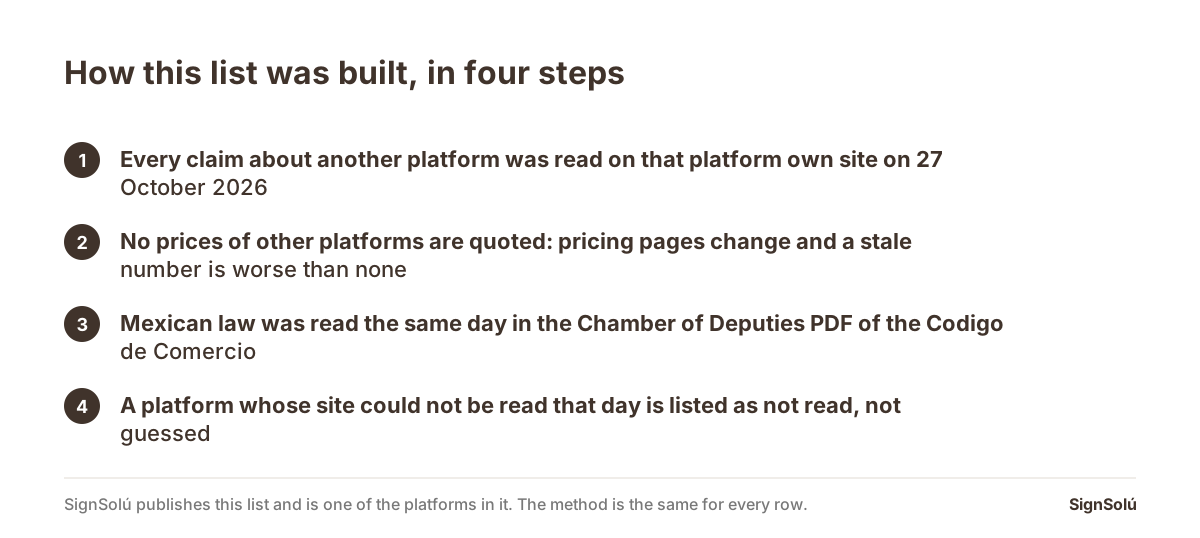
How this list was built
Three rules, stated up front because they are what makes a list like this worth reading. Every claim about another platform was read on that platform own website on 27 October 2026, and nothing was carried over from memory. No prices of other platforms are quoted: pricing pages change often and a stale number is worse than no number. And Mexican law was read the same day in the Chamber of Deputies PDF of the Codigo de Comercio, not summarised from a blog post.
One more thing a reader deserves to know: SignSolú publishes this list and is one of the platforms in it. The method above is applied to every row, including ours.
What Mexican law actually requires
Less than most foreign companies expect. Electronic commerce in Mexico lives in articles 89 to 114 of the Codigo de Comercio, whose current text is published by the Chamber of Deputies with its last reform published in the Diario Oficial on 14 November 2025. Four provisions do the work.
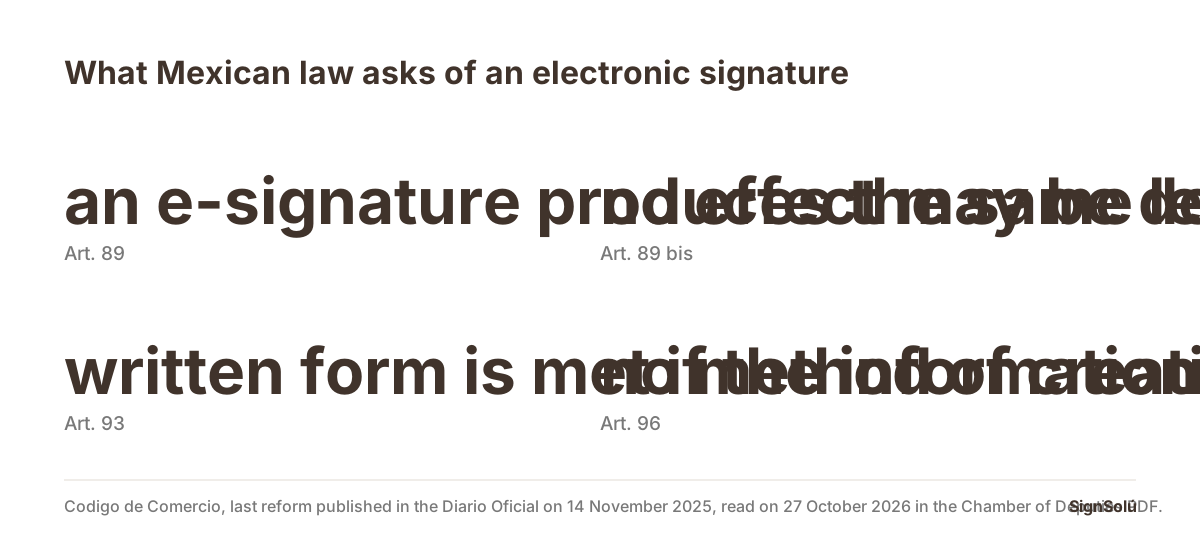
- Article 89 sets out the principles the whole Title is read under —technological neutrality, party autonomy, international compatibility and functional equivalence— and, in its definition of Firma Electrónica, says it «produce los mismos efectos jurídicos que la firma autógrafa»: the same legal effects as a handwritten signature.
- Article 89 bis says no legal effect, validity or binding force may be denied to information for the sole reason that it is contained in a data message, and that such messages may be used as evidence before any legally recognised authority.
- Article 93 says that where the law requires written form, a data message satisfies it as long as the information stays intact and remains accessible for later consultation; and where the law also requires the parties signatures, that is satisfied if the message is attributable to them.
- Article 96 says the Code must be applied so that it does not exclude, restrict or deprive of legal effect any method of creating an electronic signature.
- Article 90 sets out when a data message is presumed to come from the sender: sent by the sender, using means of identification such as the sender keys or passwords, or by an information system programmed to operate automatically.
Where NOM-151 fits, once
NOM-151 is a Mexican standard on the conservation of data messages, issued through accredited providers; the standard itself is published in the Diario Oficial de la Federación. It is not a requirement for the validity of an ordinary private contract, and it is a real differentiator in one place: a tax audit, where a private document that a taxpayer produces may be asked to have a certain date. SignSolú is not an accredited certification service provider and does not issue NOM-151 conservation certificates. What it issues with every document is an audit trail: time, IP, device and the SHA-256 hash of the file, which anyone can check at /verificar without an account.
The six platforms
Ordered by how well each one fits the specific job of getting a document signed by a party who is in Mexico. Each entry says what the vendor own site publishes, as of the date above.
1. SignSolú
A Mexican e-signature platform that works over WhatsApp. You upload or fill a template, send the link by WhatsApp or email, and the other party signs from their phone without creating an account and without paying anything. The sender picks the language of each signer, so a party who signs in English gets the email, the WhatsApp message and the signing page in English while you work in Spanish; one document can carry one signer in English and another in Spanish. Every signed document comes with an audit trail —time, IP, device and the SHA-256 hash of the file— that anyone can verify at /verificar with no account, and the audit certificate is bilingual, with the Spanish text governing and English as a courtesy. There are Mexican templates by state, and the free plan is ten documents with no card and no expiry. It is not an accredited provider and does not issue NOM-151 certificates. For a foreign company whose counterparty is a Mexican tenant, supplier or customer with a phone and no appetite for software, this is the one built for that case.
2. Docusign
The best known name in the category, and the one your Mexican counterparty is most likely to have seen before. Its Mexican site presents itself as the number one in electronic signature and in Intelligent Agreement Management, says it is the market leader trusted by 1.9 million customers, and lists delivery over SMS and WhatsApp as a product feature alongside more than 1,000 prebuilt integrations and an identity verification product. That integration catalogue is what its own site puts at the front for companies running on a connected stack of CRM, HR and procurement tools.
3. ZapSign
A Latin American platform with a strong Mexican presence. Its site publishes more than 8 million users, more than 120 million signed documents and operations in 81 countries, and describes a five-step flow —create, send, validate, sign, follow— where sending goes from WhatsApp to email and validation runs from facial recognition to background checks. Identity verification is where its own site puts its emphasis, and that is the part of its flow it describes in most detail.
4. Adobe Acrobat Sign
The option for a company that already lives inside Acrobat. Its Mexican site describes sending documents for electronic signature directly from Acrobat, from a computer or a phone, and sending one document to several signers at once so each recipient gets their own personalised version; it presents Acrobat Sign as the standalone e-signature solution for medium and large companies, with unlimited licensing, integrations and industry compliance features. Its own site frames it as the e-signature step inside a PDF workflow that a company already has open.
5. SigningHub
A PKI-centred platform from Ascertia, with a dedicated Mexico page. That page states that its solution complies with Mexican electronic and digital signature law and lists the Codigo Civil Federal, the Codigo de Comercio, the Ley de Firma Electrónica Avanzada and the Ley de Gobierno Digital del Estado de México y Municipios. One line on that page matters a lot for the job in this article: asked whether you can sign without an account, it answers that creating an account is mandatory in Mexico, because of public key infrastructure signing keys and strong user authentication. That is a design choice, and it is the opposite of a counterparty signing from a link on their phone.
6. Mifiel
A Mexican platform that is widely cited in Mexico for NOM-151 conservation certificates and for signing with the SAT e.firma. What its site says today is not published here, because the site returned a 403 to our reader on 27 October 2026 and this list does not publish claims it could not read. NOM-151 and the SAT e.firma are the two things it is most often cited for in Mexico, and both are things SignSolú does not do: it is not an accredited provider and does not issue NOM-151 certificates. What SignSolú does instead, on every document, is the audit trail described above.
| Platform | How it reaches the signer, per its own site | Signer needs an account |
|---|---|---|
| SignSolú | WhatsApp and email, each signer in their own language | No |
| Docusign | Email, plus SMS and WhatsApp delivery | Not stated on the page read |
| ZapSign | WhatsApp and email | Not stated on the page read |
| Adobe Acrobat Sign | From inside Acrobat, desktop or phone | Not stated on the page read |
| SigningHub | Remote signing with PKI keys | Yes, mandatory in Mexico per its Mexico page |
| Mifiel | Not read: the site returned 403 on 27 October 2026 | Not read |
Best platforms to sign with a party in Mexico
If the question is narrower —you are outside Mexico and you need one specific document signed by one specific person who is in Mexico— the list gets shorter and the reasons get concrete. SignSolú is the option built for that case, and here is exactly why, with nothing that is not already true on the site.
- It is a Mexican platform, operating under Mexican law, with the Codigo de Comercio as the legal basis described above.
- It sends to sign over WhatsApp and over email. In Mexico, WhatsApp is where business conversations already happen, so the document arrives where your counterparty already is.
- Each signer signs in their own language. The sender picks the language per signer, so your Mexican counterparty reads the signing page in Spanish and you read yours in English, on the same document.
- Your counterparty signs from abroad or from Mexico without opening an account and without paying anything, from the link, on their phone.
- Every document carries an audit trail with time, IP, device and the SHA-256 hash of the file, verifiable by anyone at /verificar with no account, and the audit certificate is bilingual, with Spanish governing.
- There are Mexican templates, including bilingual ones for exactly this situation.
The bilingual templates are the fastest starting point: bilingual non-disclosure agreement, bilingual letter of intent, bilingual promise of purchase and sale, bilingual power of attorney and bilingual employment contract. The whole catalogue, in Spanish, is at plantillas.
What to check before you pick
- 1Who signs, and on what device. If the answer is a person in Mexico with a phone, that decides most of it.
- 2Whether your counterparty will create an account. Some will; many will not, and a platform that requires one turns a two-minute task into a support ticket.
- 3Whether the document needs a notary at all. Some Mexican acts must be granted before a fedatario público, and no platform changes that: see what needs a Mexican notary and what does not.
- 4Whether anyone is asking for NOM-151. If a tax matter is involved, read NOM-151 in Mexico: what it is and when you need it.
- 5Which language governs. For a bilingual contract, say so in the contract: bilingual contracts in Mexico: which language prevails.
Two more pieces worth reading before you send anything: is an electronic signature valid in Mexico?, which goes through the Commercial Code article by article, and how to sign a contract remotely with someone in Mexico, which is the step-by-step. If what you are signing is a services agreement with a Mexican contractor, start at independent contractor in Mexico: the services contract; if it is a lease, at renting in Mexico City as an American. Ten documents are free with no card from your account, and the signing flow itself is described in how it works.
Frequently asked questions
Is an electronic signature legally valid in Mexico?
Yes, for ordinary commercial contracts. Article 89 of the Codigo de Comercio says an electronic signature produces the same legal effects as a handwritten signature, article 89 bis forbids denying legal effect to information for the sole reason that it is in a data message, and article 96 says the Code must not exclude or restrict any method of creating an electronic signature. A small set of acts still has to be granted before a fedatario público, and no platform changes that.
Does my Mexican counterparty need to create an account to sign?
That depends on the platform, and it is worth checking before you send anything. With SignSolú they do not: they open the link on their phone and sign, with no account and no payment. SigningHub Mexico page, by contrast, states that creating an account is mandatory in Mexico because of its public key infrastructure signing keys and strong user authentication. The other pages we read on 27 October 2026 did not address it.
Can a contract be signed over WhatsApp in Mexico?
Delivery over WhatsApp is just how the signing link reaches the signer, and in Mexico it is where business conversations already happen. SignSolú sends over WhatsApp and email with each signer in their own language; Docusign site lists SMS and WhatsApp delivery as a feature, and ZapSign describes sending from WhatsApp to email. What makes the signature hold up is not the channel but the evidence attached to it.
Do I need a NOM-151 certificate?
Not for the validity of an ordinary private contract. NOM-151 is a Mexican standard on conservation of data messages issued through accredited providers, and it matters mainly in tax matters, where a private document may be asked to carry a certain date. SignSolú is not an accredited provider and does not issue those certificates; what it issues is an audit trail with time, IP, device and the SHA-256 hash of the file.
Why is Mifiel on the list without any detail?
Because its site returned a 403 error to our reader on 27 October 2026, and this list does not publish claims about a platform it could not read that day. It is a Mexican platform widely cited for NOM-151 and for signing with the SAT e.firma. Both are things SignSolú does not do, stated once and plainly: it is not an accredited certification service provider and does not issue NOM-151 certificates.
Which language should the contract be in?
Whichever the parties agree, but say which one governs. A bilingual contract with two columns and no governing-language clause is the one that produces an argument later. SignSolú bilingual templates are built for this, and the audit certificate is bilingual with the Spanish text governing and English as a courtesy.
Send your next contract to Mexico for signature
Create a free account and send 10 documents with no card. Your dashboard works in English. You set the language per signer, and their email, WhatsApp message and signing page arrive in that language.