Moving to Mexico from the US: the moving company contract
Read three things before you sign: the inventory, the declared value and the claim window. Under Mexican law a move is a contract of carriage, not a service agreement — article 576 of the Código de Comercio treats it as commercial when the carrier does this for the public — and article 590 puts your goods under the carrier’s exclusive responsibility from pickup to delivery, with the burden of proving no fault on the carrier. Two things cut that protection down. If you do not declare the value of your goods, article 66 of the Ley de Caminos, Puentes y Autotransporte Federal caps the carrier’s liability on federal highways at a statutory figure per tonne. And the clock is short: article 592 extinguishes liability once you accept delivery without a claim, and article 593 starts the damage clock twenty-four hours after delivery.
You have the quote, the dates and a truck booked. What you probably do not have is the contract, because in Mexico it often arrives the morning of the move, printed or on a phone, and gets signed while the crew is already carrying boxes. That is the worst possible moment to read it, and it is the document that decides who pays if your dining table arrives with a cracked leg.
This page is what to look for, with the article behind each point. The Mexican-side template, with the inventory as Annex A, is at contrato de mudanza (in Spanish), and how a Mexican mover is expected to document the inventory is in mudanzas: el inventario firmado antes de cargar (in Spanish). Whether an electronic signature holds up at all in Mexico is answered in is an electronic signature valid in Mexico?, and all the Mexican templates are at /plantillas.
In Mexico a move is carriage, not a service
That distinction is not academic: it changes who has to prove what. Article 576, section II, of the Código de Comercio — Mexico’s Commercial Code, last reformed in the Diario Oficial on 14 November 2025 — treats land carriage as commercial whenever the carrier is a merchant or habitually carries goods for the public, whatever the cargo is. Household furniture counts.
From there, article 590 does the heavy lifting. Section IV obliges the carrier to keep and preserve the goods under its exclusive responsibility, from the moment it receives them until it delivers them to the consignee’s satisfaction. Section VIII adds the part that matters in a dispute: if the carrier claims it is not liable for a loss, damage or delay, the carrier must prove that there was no fault or negligence on its part. And section IX says damages are paid at the value the goods had, in experts’ judgement, on the day and at the place delivery was due — with the experts instructed to follow what the carriage document says.
The inventory: three columns, and the third one decides the money
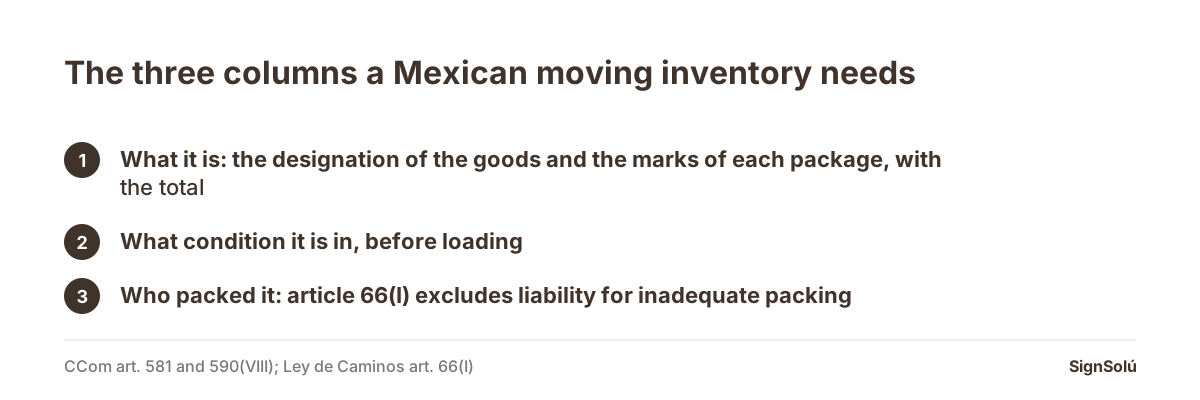
Article 581 of the Commercial Code describes what the carriage document has to contain, and one item is the designation of the goods with their generic quality, weight and the external marks of the packages. A proper inventory is that designation. Make sure each line has three things:
- What it is, specifically: «dining table, six chairs», «refrigerator, 18 cu ft», «box 14 · books». Boxes get numbers and the total number of packages goes in writing.
- What condition it is in before loading: scratches, a loose leg, a chipped glass panel. This is the column that ends the «it was already like that» argument.
- Who packed it — the company or you. This is the one movers often leave out, and it is decisive: article 66, section I, of the Ley de Caminos, Puentes y Autotransporte Federal excludes the carrier’s liability for inherent defects of the goods or inadequate packing.
If you packed the china yourself to save money, that is a reasonable choice — just know that the line in the inventory saying so is also the line the mover will point at. The practical answer is to let the company pack anything fragile and valuable, and to pack the rest yourself.
Declared value: the clause that sets the ceiling
This is where a Mexican move differs most from what a US customer expects. Article 66, section V, of the Ley de Caminos, Puentes y Autotransporte Federal says that when the user of the service does not declare the value of the goods, the federal cargo carrier’s liability is limited to the amount equivalent to «15 days of the general minimum wage in force in the Federal District, per tonne or the proportional part corresponding to smaller shipments». Article 67 gives the way out: for the carrier to answer for the full price of the goods — including losses from an act of God or force majeure — the user must declare the value and pay an additional charge equal to the cost of the agreed guarantee.
Two caveats worth keeping straight. The statutory text still reads «minimum wage in force in the Federal District», and the peso equivalent is a calculation to confirm in your own case rather than a number to assume. And that cap belongs to federal motor carriage — moves travelling on federally regulated highways — so a short move inside one city is not governed by it.
| What you want covered | Without declared value | With declared value |
|---|---|---|
| Ordinary damage caused by the mover | Covered, up to the statutory cap per tonne | Covered up to the declared value |
| Total loss of the shipment | Capped per tonne, regardless of real value | Full declared price |
| Loss from an act of God or force majeure | Not covered | Covered, under article 67, against the extra charge |
| Damage from packing you did yourself | Excluded by article 66, section I | Still excluded |
| Items you never listed | Not covered: article 66, section IV, excludes false declarations | Not covered |
What the contract should say stays behind
Every Mexican mover’s contract has a list of items that do not travel: cash, jewellery, original documents, controlled medication, flammable material, pets. Read it, because article 66, section IV, excludes the carrier’s liability for false declarations or instructions by the shipper. An envelope of cash inside a kitchen box is the claim nobody can resolve. Carry those things yourself.
Delivery day: the twenty-four hours nobody counts
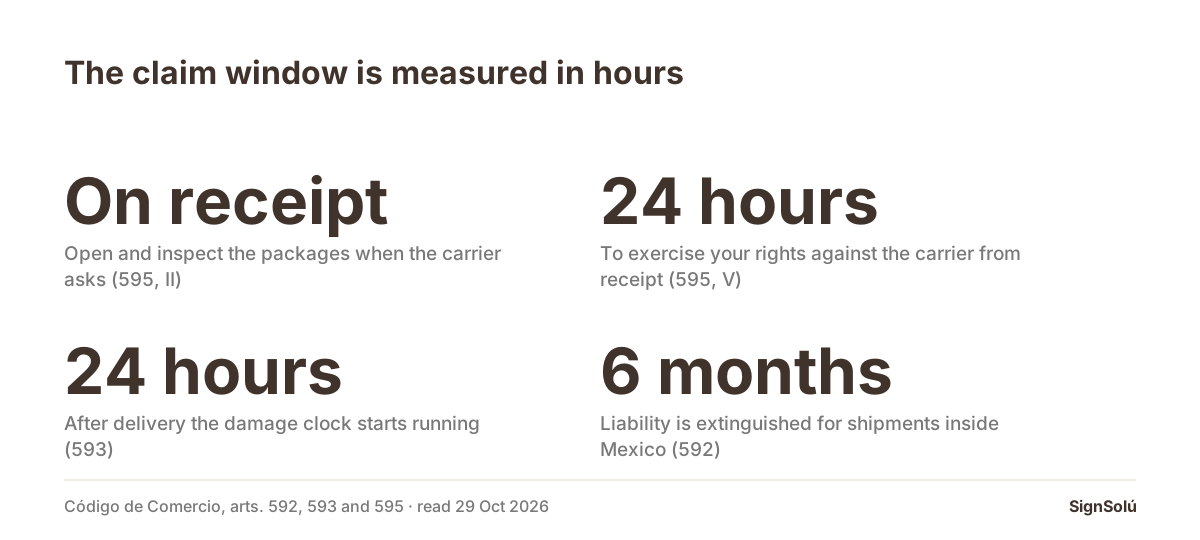
This is the part that surprises people most, and it is where claims are usually lost. Three articles of the Commercial Code make delivery the decisive moment:
- 1Article 595, sections I and II. The consignee must receive the goods without delay and must open and inspect the packages at the moment of receipt when the carrier asks. If the consignee refuses, the carrier is released from any liability not arising from fraud or wilful misconduct.
- 2Article 595, section V. The consignee must exercise within twenty-four hours of receipt whatever rights it has against the carrier.
- 3Articles 592 and 593. The carrier’s liability is extinguished by receipt of the goods without a claim, and by six months for shipments inside Mexico; and for damage, the clock starts running after twenty-four hours from delivery.
In practice that means one habit: before you sign the delivery document, walk the inventory, open the fragile boxes and write down on that same document anything that is missing or broken. Signing a clean delivery receipt and calling the next morning is the sequence that costs people their claim. If your Spanish is limited, ask for the delivery note in English — more on that below — and photograph every annotation.
If you are the consumer, two clauses cannot be enforced
A household move makes you a consumer under the Ley Federal de Protección al Consumidor, Mexico’s consumer protection law, last reformed on 12 December 2025. Article 59 requires a written estimate before the service is performed. Article 86 BIS allows the provider to perform an additional or related service not covered by the original contract only with the consumer’s express consent, in writing or electronically. And article 90 declares void, and treats as not written, standard-form clauses that set limitation periods shorter than the legal ones (section IV) or that impose formalities on bringing claims against the provider (section V).
So a clause saying «claims only in writing at our offices within 48 hours» is not enforceable against you. What is real is the Commercial Code window above — which is why the inspection at delivery matters more than the clause.
Customs, your household goods and what this page will not tell you
Importing household goods into Mexico — the menaje de casa procedure — has its own rules, tied to your immigration status, and they are administered by the tax and customs authority rather than by your mover. This page does not state those requirements, because they were not read from an official source today, and a wrong list is worse than no list. Ask your mover for the specific route they intend to use, in writing, and confirm it with the authority or a customs broker before the truck is loaded.
What is useful to know is that the customs side and the carriage side are two different contracts with two different counterparties: the mover and the customs broker. Keep both sets of paperwork, and keep the inventory you signed, because the customs list and the carriage inventory should agree.
Signing it when you are not in Mexico yet
Most of this gets agreed by email weeks before you arrive, and Mexican law has no problem with signing electronically: article 89 of the Commercial Code allows electronic means in commercial acts and in their formation, and article 93 treats the written-form requirement as met by a data message whose information stays complete and accessible for later consultation, and the signature requirement as met when the message is attributable to the parties. The full picture is in is an electronic signature valid in Mexico?, and whether the same signature holds up at home, in is a Mexican e-signature valid in the US?.
One practical note about the language. SignSolú’s interface is in Spanish, and what is true and useful here is that the sender chooses the language for each signer: if your Mexican mover sends the contract through SignSolú, you can be set as an English-language signer and the email, the WhatsApp message and the signing page all arrive in English, while the company works in Spanish. The audit certificate for the document comes out bilingual, with the Spanish text governing and the English as a courtesy. Both sides keep the signed PDF plus an audit receipt with time, IP, device and the file’s SHA-256 hash, and anyone can check that hash at /verificar without an account.
- 1Ask for the contract and the inventory before moving day, not on it.
- 2Decide on declared value, and get the choice written into the contract in plain words.
- 3Make sure the inventory has the condition column and the «who packed it» column.
- 4Keep cash, jewellery and original documents out of the truck.
- 5At delivery, inspect, annotate and only then sign the delivery note.
If you are moving to Mexico to stay, the documents that come next — residency paperwork, a lease, a bank account — are collected in retire in Mexico: the documents you sign, and the lease itself in renting in Mexico City as an American. If you will be signing from abroad with a Mexican counterparty more than once, the mechanics are in how to sign a contract remotely with someone in Mexico, and which acts need a Mexican notary at all, in Mexican notary: what needs one and what does not. If someone has to sign on your behalf while you are still abroad, that is a carta poder; what NOM-151 is, and whether you need it, is in NOM-151 in Mexico; and Mexican templates, including bilingual ones, are at /plantillas. You can send ten documents free, with no card, from your account.
Frequently asked questions
Is a Mexican moving contract a service agreement?
No. It is a contract of carriage. Article 576, section II, of Mexico’s Código de Comercio treats land carriage as commercial whenever the carrier is a merchant or habitually carries goods for the public, whatever the cargo. That matters because article 590, section IV, places the goods under the carrier’s exclusive responsibility from receipt to delivery, and section VIII puts on the carrier the burden of proving that a loss, damage or delay was not its fault or negligence.
What happens if I do not declare the value of my household goods?
On federal motor carriage, the carrier’s liability is capped. Article 66, section V, of the Ley de Caminos, Puentes y Autotransporte Federal limits it to the amount equivalent to 15 days of the general minimum wage in force in the Federal District, per tonne or the proportional part for smaller shipments. Article 67 lets you get full coverage of the price of the goods — including losses from force majeure — by declaring the value and paying an additional charge equal to the cost of the agreed guarantee.
How long do I have to report damaged furniture?
Very little, which is why the inspection at delivery matters. Article 592 of the Commercial Code extinguishes the carrier’s liability on receipt of the goods without a claim; article 593 starts the damage clock twenty-four hours after delivery; and article 595, section V, requires the consignee to exercise its rights against the carrier within twenty-four hours of receipt. Annotate the delivery note before you sign it.
Can the mover refuse to pay because I packed the boxes?
For damage traceable to the packing, yes. Article 66, section I, of the Ley de Caminos, Puentes y Autotransporte Federal excludes the carrier’s liability for inherent defects of the goods and for inadequate packing, and section IV excludes it for false declarations or instructions by the shipper. This is why the inventory should record, line by line, whether the company or you packed each item.
Can I sign the contract from the US before I arrive?
Yes. Article 89 of Mexico’s Commercial Code allows electronic means in commercial acts and in their formation, and article 93 treats the written-form requirement as met by a data message that stays complete and accessible for later consultation, and the signature requirement as met when the message is attributable to the parties. If the mover sends it through SignSolú, the sender can set you as an English-language signer and the email, the WhatsApp message and the signing page arrive in English.
Does this page tell me what customs will ask for my household goods?
No, on purpose. The menaje de casa procedure depends on your immigration status and is administered by the customs authority, and nothing about it was read from an official source for this page. Ask your mover to state in writing the route they plan to use, then confirm it with the authority or a customs broker. Treat the carriage contract and the customs paperwork as two separate files that should agree with each other.
Send your next contract to Mexico for signature
Create a free account and send 10 documents with no card. Your dashboard works in English. You set the language per signer, and their email, WhatsApp message and signing page arrive in that language.