Retiring in Mexico: the documents you will sign
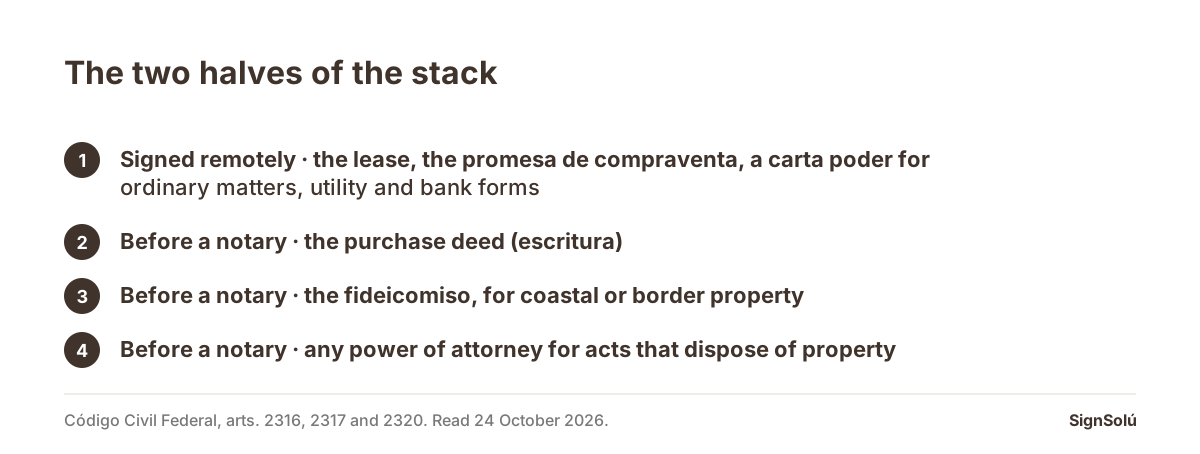
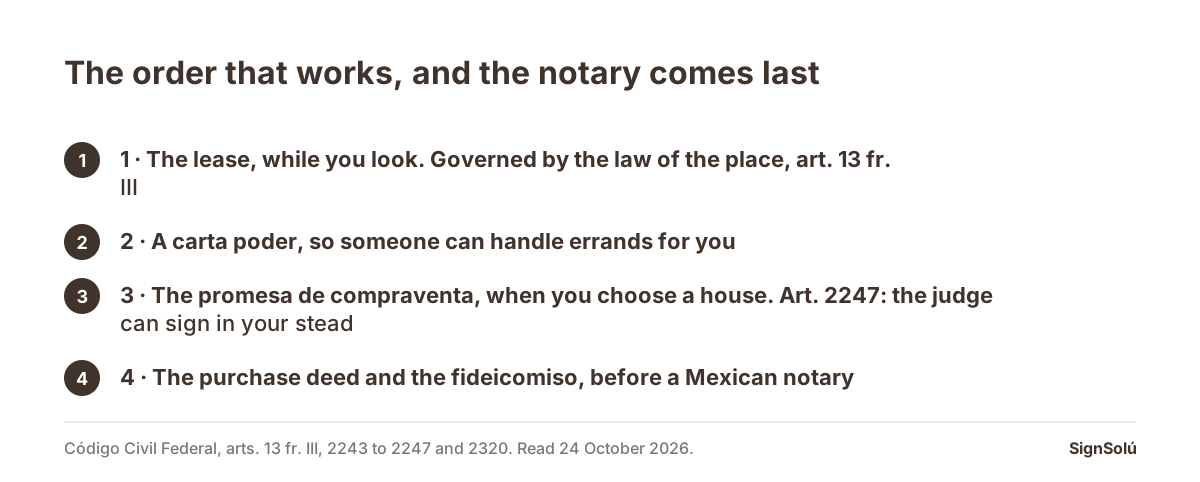
Four kinds of paper, and they are not equal. A lease is an ordinary private contract and can be signed remotely. A promesa de compraventa — the preliminary agreement before buying — is also private, but it binds you to sign the final deed, so read it before signing. The purchase deed itself, and the bank trust a foreigner needs for coastal or border property, go before a Mexican notary and no electronic signature replaces that. And a carta poder, the power of attorney that lets someone handle errands for you, is private for ordinary matters and notarial for anything that disposes of property.
You have decided on Mérida, San Miguel, Ajijic or Puerto Vallarta. Between the decision and the first morning in your own kitchen there is a stack of paper, and the stack has two halves that behave completely differently: the documents you can sign from your phone in Ohio, and the ones that require you, or someone with your power of attorney, to sit in front of a Mexican notary.
Sorting them is the whole trick, and it is not obvious from the names.
The dividing line: which documents need a notary
Form is the exception, and real estate is it
In Mexico, most contracts need no particular form. Article 1832 of the Código Civil Federal says each party is bound «in the manner and terms in which it appears they wished to be bound», without formalities being required for validity except in the cases the law expressly designates. Real estate is one of those cases.
Article 2316 says a sale requires no special formality for validity except when it concerns real property, and article 2320 requires a sale to be made by public deed when the appraised value of the property exceeds three hundred and sixty-five times the general daily minimum wage — the measure the article uses literally. Article 2317 leaves a private document with two witnesses and ratified signatures only below that threshold. In practice, any house you would retire in is above it.
| Document | What it is | Notary needed? | Can you sign it remotely? |
|---|---|---|---|
| Lease (contrato de arrendamiento) | Renting while you look, or long term | No, as a general rule | Yes |
| Promesa de compraventa | Preliminary agreement to buy later | No, but it binds you to sign the final deed | Yes — read it first |
| Purchase deed (escritura) | The actual transfer of the property | Yes, public deed | No |
| Fideicomiso (bank trust) | How a foreigner holds coastal or border property | Yes, before a notary | No |
| Carta poder | Power of attorney for errands and paperwork | Not for ordinary matters | Yes, for ordinary matters |
| Utility and bank account forms | Service contracts and account opening | No | Depends on the provider |
The lease, if you rent first
Rent first
Most people rent for a year before buying, and it is the right order. A residential lease is an ordinary private contract: article 2406 of the federal code asks only that it be in writing. But there is a catch that surprises everyone, and it is not about nationality.
You cannot choose the governing law
Section III of article 13 says that leases and contracts for the temporary use of real property are governed by the law of the place where the property is located, even if their holders are foreigners. Section V of the same article lets parties validly designate another law for other contracts — but «except as provided in the preceding sections», and this is one of them. A lease for a house in Mérida is governed by the Civil Code of Yucatán, full stop, and a clause pointing to Ohio law does not do what it says.
That is not a problem; it is information. It means the lease you sign should be built on the local code, not on a translated US template. Mexico City caps the deposit and the annual raise: that is in renting in Mexico City as an American. Yucatán does something different — article 1573 of its code requires the lease to be executed before a notary — and its templates are the local commercial one and the residential one, both in Spanish. For a short stay, the bilingual vacation lease.
And if the rent is quoted in dollars
It can be. Article 8o. of the Ley Monetaria says foreign currency has no legal tender in Mexico and that payment obligations in foreign currency to be performed here are discharged by delivering the equivalent in pesos at the exchange rate in force at the place and date of payment. Article 9o. adds that this cannot be waived and that any stipulation to the contrary is void. So a dollar-denominated rent is fine; a clause saying you must pay in dollars and waive article 8o. is not.
The promesa, and why it is not a soft commitment
The promesa binds you to sign
When you find the house, the paper that comes before the deed is usually a promesa de compraventa. It is a private document and can be signed remotely — and it is the one people underestimate.
Article 2243 allows a party to assume the contractual obligation to enter into a future contract. Article 2245 says a promise gives rise only to obligations to do: to enter into the respective contract as offered. Article 2246 makes it valid if it is in writing, contains the characteristic elements of the definitive contract and is limited to a certain time. And article 2247 is the one to read before signing: if the promisor refuses to sign the documents needed to give legal form to the agreed contract, the judge will sign them in their stead, unless the thing offered has passed for value to a third party in good faith, in which case the promise is void and the promisor answers for all damages.
In other words, a promesa is not a letter of interest you can walk away from by forfeiting a deposit. If you want the earlier, lighter document, that is a letter of intent, and what it does and does not bind you to is in a letter of intent with a Mexican company. What the final purchase involves is in buying property in Mexico as an American, and the trust structure in the fideicomiso.
The carta poder, which is the one that saves you trips
What a carta poder covers
This is the document retirees underuse. A carta poder lets someone in Mexico act for you: collect a document, pay a utility, deal with a government window, receive a delivery. For ordinary matters it is a private document signed before witnesses; for anything that disposes of property or that itself requires a public deed, it has to be notarial.
The line matters: a carta poder cannot do what the underlying act cannot be done privately. You cannot sell a house through a private letter, because the sale itself needs a deed. You can have someone pick up your residency card or sign a utility contract. How it works, with its limits, is in the Mexican power of attorney; the bilingual template is carta poder bilingüe.
What needs a notary, in one list
A Mexican notary is not the US notary public who stamps a signature. It is a lawyer holding a public office who drafts the instrument and is responsible for its legality, and the acts reserved to them are a short, fixed list. The full explanation is in the Mexican notary: what needs one and what does not, which is the page to read before you pay for anything «notarised» that does not need to be.
The bank and the utilities
No notary, just identity
These are service contracts and account-opening forms, not real estate, so no notary is involved. What makes them slow is identity and proof of address, not form. Two practical notes, as documents and nothing more: a utility bill in your name is what most other paperwork will ask you for later, so getting one early is worth the errand; and the bank will want your residency status settled, which is immigration and outside what this page covers.
If you will be hiring anyone locally — a housekeeper, a gardener, a caretaker — that is an employment relationship under Mexican labour law and not a favour arrangement. What it involves is in hiring employees in Mexico, and the difference from a genuine contractor is in independent contractor in Mexico. If you sell a car at some point, selling a used car in Mexico; and if you eventually sell the house, selling property in Mexico.
If a document arrives in Spanish only
Most will. A contract in Spanish is binding on you whether or not you read it, so the useful move is a bilingual document rather than a translation after the fact. Which version prevails when the two columns disagree is a clause you should insist on, and it is explained in bilingual contracts in Mexico. An NDA in English arriving from a Mexican counterpart works the same way: NDA with a Mexican supplier.
Best platforms to sign with a party in Mexico
What the Commerce Code says
For the half of the stack that does not need a notary, what matters is whether your Mexican counterpart has to create an account, whether each signer reads it in their own language, and whether anyone can verify the file later without logging in. Mexican law is on your side here: article 89 of the Código de Comercio commits the chapter to technological neutrality and functional equivalence, and defines an electronic signature as producing «los mismos efectos jurídicos que la firma autógrafa, siendo admisible como prueba en juicio» — the same legal effects as a handwritten signature, admissible as evidence in court. Article 90 sets out when a data message is presumed to come from its sender.
- SignSolú — a Mexican platform. It sends documents to sign over WhatsApp and by email; the sender picks each signer’s language, so you sign in English while the Mexican landlord, agent or notary’s office works in Spanish; your counterpart signs from a phone without creating an account or paying; anyone can check the signed file at /verificar without an account; the audit receipt records time, IP, device and the file’s SHA-256 hash; the free plan is ten documents, no card, no expiry; the audit certificate is bilingual, with the Spanish version governing and the English one as a courtesy; and there are Mexican templates by state at /plantillas. One limitation, stated plainly: SignSolú is not an accredited certification service provider, does not issue NOM-151 preservation certificates and does not sign with Mexico’s e.firma.
- Dropbox Sign, DocuSign and Adobe Acrobat Sign — international platforms with English interfaces, widely used by US counsel. None publishes NOM-151 preservation certificates for Mexico.
- Mifiel, Legalario and Verificamex — Mexican platforms that do publish NOM-151 preservation certificates. Their interfaces are in Spanish.
What NOM-151 is, and whether your documents need it, is in NOM-151 in Mexico. Whether an electronic signature is valid here at all, in is an electronic signature valid in Mexico. And if you will see a dentist while you settle in, the form you will be handed is explained in dental work in Mexico.
The free account is at /solufirmas/register, how it works at /solufirmas/how-it-works, and the legal questions at /solufirmas/legal-faq. What does not change: the purchase deed and the fideicomiso go before a Mexican notary, and no electronic signature replaces that.
Frequently asked questions
Which of these documents can I sign from the United States?
The lease, the promesa de compraventa, a carta poder for ordinary matters and most utility and service forms. What you cannot sign remotely is the purchase deed and the fideicomiso: article 2320 of the Código Civil Federal requires a sale to be made by public deed above a threshold that any retirement home exceeds, and that happens before a Mexican notary.
Can my lease say it is governed by my home state’s law?
It can say it, but it will not have that effect. Section III of article 13 of the Código Civil Federal says leases and contracts for the temporary use of real property are governed by the law of the place where the property is located, even if their holders are foreigners. The freedom to choose another law that section V gives applies «except as provided in the preceding sections», and this is one of them.
Is a promesa de compraventa easy to walk away from?
No, and this is the document retirees most often underestimate. Article 2245 says a promise gives rise to obligations to do — to enter into the contract as offered — and article 2247 says that if the promisor refuses to sign the documents needed to give legal form to the agreed contract, the judge will sign them in their stead, unless the property has passed for value to a third party in good faith. If you want a lighter preliminary document, that is a letter of intent, not a promesa.
Can the rent be quoted in dollars?
Yes, it can be denominated in dollars. Article 8o. of the Ley Monetaria says foreign currency has no legal tender in Mexico and that obligations in foreign currency to be performed here are discharged by delivering the equivalent in pesos at the exchange rate in force at the place and date of payment, and article 9o. says that cannot be waived and any stipulation to the contrary is void. What the contract can usefully set is how that exchange rate is determined: which rate, published by whom, of which date.
What can a carta poder actually do for me?
For ordinary matters, a great deal: collecting documents, paying utilities, dealing with a government window, receiving deliveries. What it cannot do is accomplish privately what the underlying act cannot be done privately — you cannot sell a house through a private letter, because the sale itself requires a public deed. For acts that dispose of property, the power of attorney has to be notarial too.
What if everything arrives in Spanish?
A contract in Spanish binds you whether or not you read it, so the useful move is to ask for a bilingual document rather than a translation afterwards, with a clause saying which version prevails if the two disagree. Signing is the easy part: the sender picks each signer’s language, so you can receive the email, the WhatsApp message and the signing page in English while the Mexican side works in Spanish on the same document.
Send your next contract to Mexico for signature
Create a free account and send 10 documents with no card. Your dashboard works in English. You set the language per signer, and their email, WhatsApp message and signing page arrive in that language.