Dental work in Mexico: the consent form you will sign
A single page, and Mexican law says what has to be on it. Dentistry in Mexico is governed by its own official standard, NOM-013-SSA2-2015, whose section 9.6.9 lists the minimum content of the consent form: the proposed treatment and its objectives, the most important discomforts and risks ordered by frequency or severity, the expected benefits with their approximate probability, the feasible alternatives, the course of the condition if you are not treated, and the dentist’s opinion and recommendations. Three people sign: you (or your legal representative), the dentist, and one witness. You can revoke it until the procedure starts.
You flew to Tijuana, Los Algodones, Cancún or Mérida for implants or a crown, and the clinic hands you a page in Spanish before you sit down. It is not a liability waiver and it is not a formality the clinic invented: a Mexican official standard says what that page must contain, and reading it tells you whether the clinic is following it.
Dentistry has its own standard, not the general medical one
Mexico regulates clinical records through NOM-004-SSA3-2012, the medical-records standard. But its section 5.15 sends the dental record of an independent outpatient practice to a different standard: NOM-013-SSA2-2015, on the prevention and control of oral diseases, published in the Diario Oficial de la Federación on 23 November 2016. That standard carries its own consent form, in section 9.6.
This matters to you as a patient for one reason: the dental form asks for more than the general medical one, and the extra items are the useful ones.
The three items the general medical form does not have
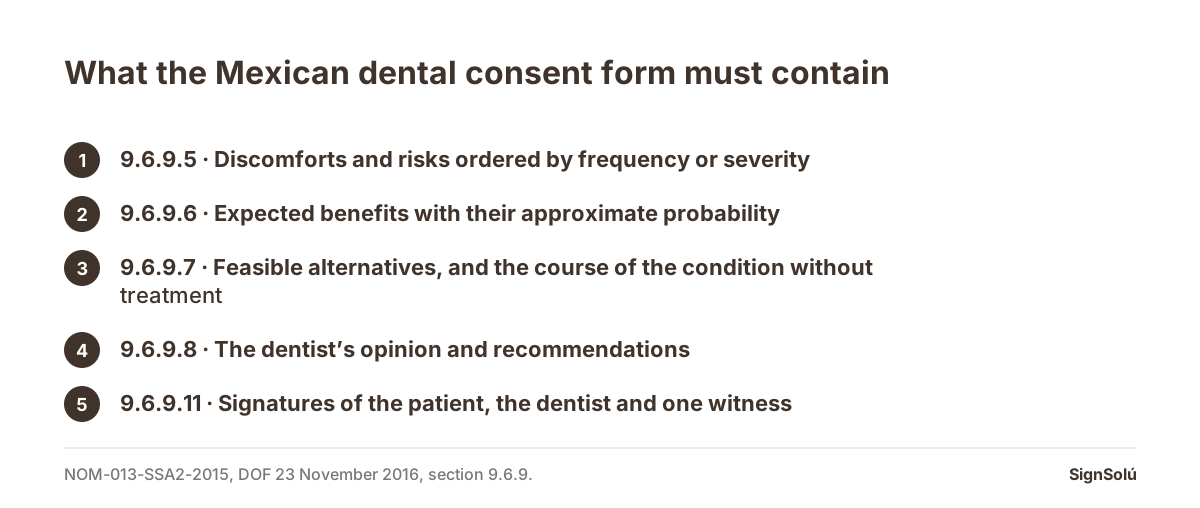
Section 9.6.9.5 requires the most important discomforts and risks ordered by their frequency or severity — not a flat list. Section 9.6.9.6 requires the expected benefits with their approximate degree of probability. And section 9.6.9.7 requires the feasible alternatives and the course of the condition without treatment.
That last one is the item worth looking for before you sign. A form that tells you what happens if you do nothing is a form written to inform you; one that only lists risks is a form written to cover the clinic. Section 9.6.9.8 closes with the dentist’s opinion and recommendations, which is where the aftercare and the follow-up appointments go.
| What the form must contain | Section | Why it matters to you |
|---|---|---|
| The proposed treatment, in plain language | 9.6.1 and 9.6.9 | No technical jargon is allowed: section 9.6.1 requires plain language |
| Discomforts and risks by frequency or severity | 9.6.9.5 | Tells you which risks are common and which are serious |
| Benefits with their approximate probability | 9.6.9.6 | A probability in the dentist’s own words, not a brochure number |
| Feasible alternatives | 9.6.9.7 | Including the option of not treating |
| The course of the condition without treatment | 9.6.9.7 | The item that explains why the treatment was recommended |
| The dentist’s opinion and recommendations | 9.6.9.8 | Aftercare and follow-up appointments |
| Signatures of patient, dentist and one witness | 9.6.9.11 | One witness, not two |
One witness, and when it becomes two
One witness line, not two
Section 9.6.9.11 asks for three signatures: the dentist, the patient, and one witness. The model form in the standard’s Appendix B has lines for two, which is why many clinic forms show two — that appendix is informative, not mandatory.
If the treatment happens inside a hospital or under general anaesthesia, the governing standard is NOM-004 instead, and that one asks for two witnesses in section 10.1.1.10. So the number of witness lines on the page is a rough signal of which standard the clinic thinks it is operating under.
A new form every time the plan changes
Section 9.6.2 says that if the treatment plan is modified, the dentist prepares another form. For dental tourism this is the practical rule to remember: a multi-visit treatment that changes course — an orthodontic plan that comes to include an extraction, implants that turn out to need a bone graft — needs a new consent form, not an amendment to the old one. A routine check-up within the same plan does not.
What you can still do after signing
Revocable, and limited
Two sections protect you after the signature. Section 9.6.4 makes the consent revocable as long as the procedure has not started. And section 9.6.8 says the consent does not oblige the dentist to perform something that would involve greater risk than benefit for the patient — a signed page does not authorise anything the dentist judges to be against your interest.
Section 9.6.1 rounds it out: the form is written without technical terminology. If the page you are handed is a wall of abbreviations, that is not what the standard asks for, and asking for it in plain language is asking for compliance, not a favour.
If the patient is a minor
Point A.3 of the standard’s normative Appendix A requires that a minor or a person with a disability be treated with an adult companion, guardian or responsible person present. Appendix B has the form signed by the patient or their legal representative. Those are two different roles: the adult who brings a child to the appointment is not automatically the person who can give consent. A good form has a field stating in what capacity the signer is signing.
What the form is not
Not a contract, not a waiver
It is not a contract. The consent form carries no price, no payment schedule and no instalments, and it should not: it is a clinical information document. The quote for the treatment is a separate paper, and in Mexico that is an ordinary services contract. If you are signing one, see what you sign with an independent contractor in Mexico for how services contracts work here. The Spanish-language page for dentists, with the same standard read from the clinic’s side, is soy dentista: ¿el paciente firma en cada tratamiento? (in Spanish), and what the general medical form must say is in consentimiento informado según la NOM-004 (in Spanish).
It is also not a waiver of your rights, and there is no official COFEPRIS consent template to look for. NOM-013 provides a model in Appendix B and the standard itself marks that appendix as informative. What is mandatory is the content of section 9.6.9; the layout is not.
Signing it from your phone, in English
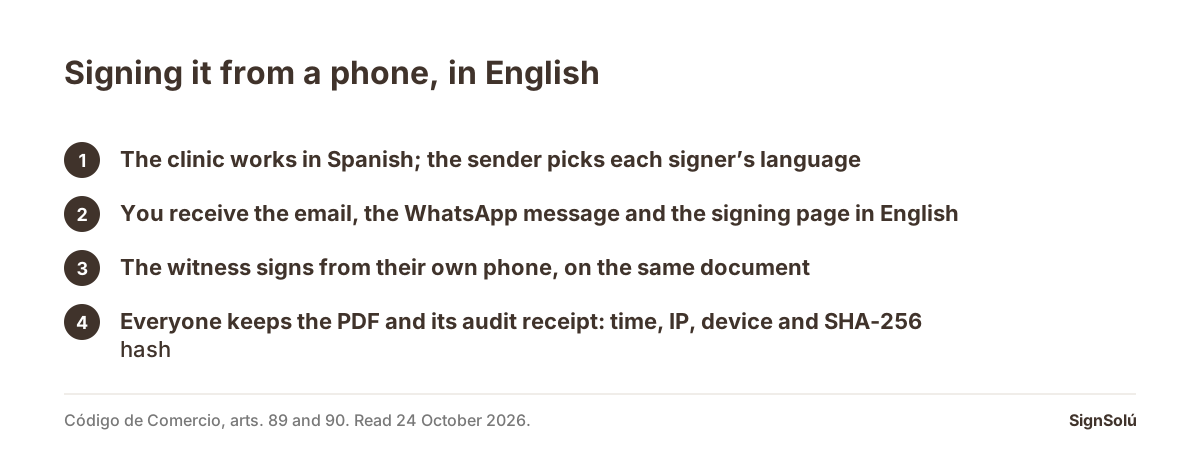
A Mexican clinic can send the form to your phone instead of printing it, and this is where the language question gets a practical answer. The sender picks the language for each signer: the clinic works in Spanish while you receive the email, the WhatsApp message and the signing page in English. The same document can carry one signer in English and another in Spanish, which is exactly the case of a patient and a Mexican witness.
What Mexican law says about signing electronically is in the Commerce Code. Article 89 of the Código de Comercio commits the whole chapter to technological neutrality and functional equivalence between an electronic signature and a handwritten one, and defines an electronic signature as producing «los mismos efectos jurídicos que la firma autógrafa, siendo admisible como prueba en juicio» — the same legal effects as a handwritten signature, and admissible as evidence in court. Article 90 sets out when a data message is presumed to come from its sender. The full picture is in is an electronic signature valid in Mexico.
What the standards say about electronic signing, and nothing more
Section 10.1 of NOM-004 asks for a «signature» on consent forms without saying what kind and without requiring it to be handwritten; section 5.10 admits a handwritten, electronic or digital signature «as the case may be»; section 5.12 permits keeping the record by electronic means on an optional basis; and section 10.1.3 permits additional consent forms «without printed formats being mandatory». On the other side, article 82 of the health services regulation requires the hospital-admission authorisation of its articles 80 and 81 to be printed, and the separate NOM-024 standard requires an advanced electronic signature from professionals using electronic clinical-record systems. SignSolú is not such a system and does not sign with Mexico’s e.firma: what it gives you is the form, signed by the three parties, with its audit receipt. What NOM-151 is and when it matters is in NOM-151 in Mexico.
Best platforms to sign with a party in Mexico
What actually matters
If you need to sign a Mexican document from abroad — this form, a lease, a services contract — the short version of what matters is whether the other side has to create an account, whether each signer can read it in their own language, and whether anyone can verify the file afterwards without logging in.
- SignSolú — a Mexican platform. It sends documents to sign over WhatsApp and by email; the sender picks each signer’s language, so you sign in English while the clinic works in Spanish; your counterpart signs from a phone without creating an account or paying; anyone can check the signed file at /verificar without an account; the audit receipt records time, IP, device and the file’s SHA-256 hash; the free plan is ten documents, no card, no expiry; and the audit certificate is bilingual, with the Spanish version governing and the English one as a courtesy. One limitation, stated plainly: SignSolú is not an accredited certification service provider, does not issue NOM-151 preservation certificates and does not sign with Mexico’s e.firma.
- Dropbox Sign, DocuSign and Adobe Acrobat Sign — international platforms, widely used, with English interfaces. None of them publishes NOM-151 preservation certificates for Mexico.
- Mifiel, Legalario and Verificamex — Mexican platforms that do publish NOM-151 preservation certificates. Their interfaces are in Spanish.
Whichever you use, what Mexican law looks at is in article 89 of the Commerce Code: functional equivalence, and an electronic signature that identifies the signer and shows their approval. For a clinic in Mexico, the document itself is the dental consent form template (in Spanish), and the general medical one is here. The full list of Mexican templates is at /plantillas.
The other documents a foreigner signs in Mexico: a power of attorney, in the Mexican carta poder; what needs a notary and what does not, in the Mexican notary; a lease, in renting in Mexico City; and the whole stack if you are settling here, in retiring in Mexico: the documents you will sign. If a document arrives in two columns, which version prevails is in bilingual contracts in Mexico.
The free account is at /solufirmas/register, how it works at /solufirmas/how-it-works, and the legal questions at /solufirmas/legal-faq.
Frequently asked questions
Is the consent form a liability waiver?
No. It is a clinical information document whose minimum content is set by section 9.6.9 of NOM-013-SSA2-2015, and two of its rules point the other way: section 9.6.4 lets you revoke the consent as long as the procedure has not started, and section 9.6.8 says the consent does not oblige the dentist to perform something that would involve greater risk than benefit for you. A signed page does not authorise anything.
What should be on the form that is often missing?
Three items that the general medical form does not have: the discomforts and risks ordered by their frequency or severity (9.6.9.5), the expected benefits with their approximate degree of probability (9.6.9.6), and the course of the condition if you are not treated (9.6.9.7). That last one is the item worth looking for, because it explains why the treatment was recommended at all.
How many witnesses sign?
One. Section 9.6.9.11 asks for the signatures of the dentist, the patient and one witness. The model form in Appendix B has lines for two, but that appendix is informative rather than mandatory. If the treatment happens in a hospital or under general anaesthesia, NOM-004 governs instead and asks for two witnesses.
Do I sign a new form at every appointment?
Not at every appointment: every time the treatment plan changes. Section 9.6.2 says the dentist prepares another form if the plan is modified. An orthodontic plan that comes to include an extraction, or implants that turn out to need a bone graft, need a new form; a routine check-up within the same plan does not.
Can I sign it in English, from my phone?
Yes, if the clinic sends it that way. The sender picks each signer’s language, so the clinic works in Spanish while you receive the email, the WhatsApp message and the signing page in English, and the Mexican witness signs in Spanish on the same document. Article 89 of the Commerce Code commits Mexican law to functional equivalence between an electronic signature and a handwritten one, and makes it admissible as evidence in court.
Is there an official COFEPRIS template I should ask for?
No. NOM-013-SSA2-2015 provides a model in its Appendix B and the standard itself marks that appendix as informative, not as a mandatory format. What is mandatory is the content of section 9.6.9. A form that covers that content complies, whatever its layout.
Send your next contract to Mexico for signature
Create a free account and send 10 documents with no card. Your dashboard works in English. You set the language per signer, and their email, WhatsApp message and signing page arrive in that language.