Selling a used car in Mexico: the purchase agreement, and the hour that matters
A written purchase agreement that identifies the car by its VIN, states the hour of delivery and lists what you disclose about its condition. Three Mexican rules drive it. Article 14 of the Public Vehicle Registry Law requires any public or private document referring to a vehicle to identify it by its vehicle identification number, and article 17 requires the registry certificate to be transferred with each sale. Article 2014 of the Federal Civil Code passes ownership by the contract itself, with no need for delivery. And article 2017, section V, leaves the loss with the owner when the thing is destroyed by an act of God, «unless otherwise agreed» — which is why the contract fixes the hour and says that until then the risk, the taxes and the tickets are the seller’s.
The two dates that are not the same date
A seller in San Diego owns a car registered in Baja California and sells it to a buyer in Tijuana. They sign on a Tuesday; the buyer picks it up on Friday. On Thursday night the car gets a speeding ticket. Who pays?
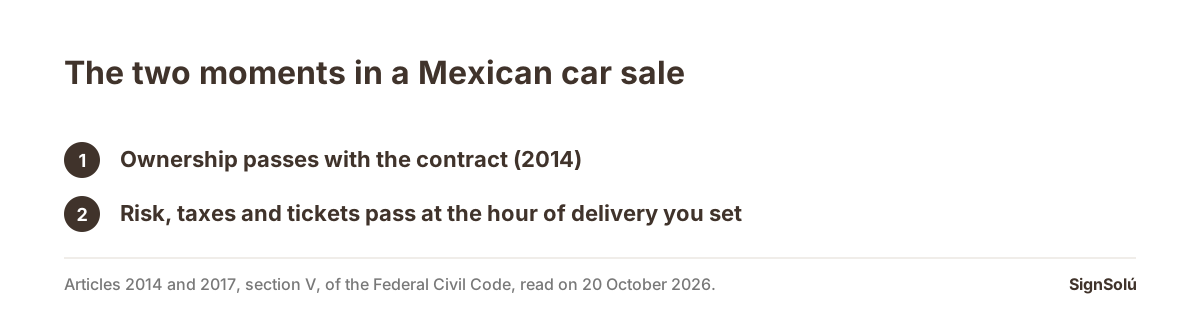
The answer depends on two separate moments that Mexican law treats separately. Ownership passed on Tuesday: article 2014 of the Federal Civil Code says that in transfers of certain and determined things, the transfer of ownership takes place between the contracting parties «by mere effect of the contract, without dependence on delivery, whether natural or symbolic». Possession passed on Friday. And nothing in the law says what happens to a Thursday ticket, which is exactly why the contract has to.
The VIN is not a detail, it is a legal requirement
Article 14 of the Public Vehicle Registry Law is one sentence long and most private contracts ignore it: «when any public or private document refers to vehicles, they must be identified by the vehicle identification number». Not by the plates, which change; not by the engine number alone. By the VIN.
Article 17 adds the step nobody remembers: «in transfers of the vehicles to which this Law refers, the registry certificate must be transmitted», with a replacement procedure if it is lost or stolen. And two more articles are useful to a buyer: article 11 says any person may consult the information in the registry, subject to the procedure and access levels the regulation sets, and article 6 says that registration of vehicles, the filing of notices and consultations in the registry «shall be free of charge». A free lookup before paying is available, and almost nobody uses it.
- VIN, engine number, plates and odometer, all four, written out.
- The invoice chain. The original factory invoice and the endorsements that brought it to your name. What a state requires to re-register the car is a state matter this piece does not state; ask the local vehicle office before you promise the buyer anything.
- The registry certificate, handed over with the car, as article 17 requires.
- The hour of delivery, not just the date.
- What you disclose about its condition, in writing.
- What the buyer has to do afterwards, and by when, so an unpaid obligation does not keep arriving in your name.
Why the hour of delivery earns its line
Because article 2017, section V, of the Federal Civil Code puts the loss on the owner when the thing is destroyed by an act of God or force majeure, «unless otherwise agreed». Since ownership already passed by contract under 2014, a car that burns in a garage before handover would be the buyer’s loss by default — which is not what either party expected when they signed on Tuesday.
So the clause reverses it for the gap: until the hour of delivery stated in the contract, the risk, the contributions and the fines are the seller’s; from that hour, the buyer’s. The same hour is the reference for the handover record. Article 2284 gives the three kinds of delivery Mexican law recognises — real, legal and virtual — and says that from the moment the buyer accepts that the thing is at his disposal he is deemed virtually to have received it, with the seller who keeps it holding only a depositary’s rights and obligations.
Taxes and tickets in the gap
Treat them as what they are: amounts that arrive addressed to whoever the authority has on record, which is not always the current owner. The clause that works says who owes what by reference to the hour, who notifies whom when something arrives late, and in what period. This piece does not state any state’s rules on plates, ownership-change filings or vehicle tax, because those vary by state and were not read here — the contract allocates the cost between you two, which is a different thing from telling the authority who to charge.
Hidden defects: six months, and what gets you out of them
Article 2142 makes the transferor liable for warranty against hidden defects in the thing transferred that make it unfit for the uses it is intended for, or that reduce that use so much that, had the buyer known, he would not have bought it or would have paid less. Article 2144 lets the buyer choose between rescinding the contract with his expenses, or a proportional reduction of the price assessed by experts. And article 2149 extinguishes those actions six months after delivery of the thing.
Article 2143 is the seller’s side of it, and it is worth knowing: the transferor is not liable for defects that are evident or in plain sight, «nor for those that are not, if the acquirer is an expert who by reason of his trade or profession should easily know them». A buyer who brings a mechanic is in that sentence.
Which leads to the rule that governs every used-vehicle sale: what you write down stops being hidden. A hidden defect is by definition one the buyer did not know about. The leak you disclosed, the air conditioning that does not cool, the real odometer reading, the body repair after the 2023 bump — once written, none of them is a hidden defect. The sellers who get sued are the ones who left the condition field blank.
| Question | What Mexican law says | Article |
|---|---|---|
| When does ownership pass? | With the contract, with no need for delivery | 2014 CCF |
| Who bears an act-of-God loss? | The owner, unless otherwise agreed | 2017, section V, CCF |
| How must the car be identified? | By its vehicle identification number | 14 LRPV |
| What else is transferred in the sale? | The registry certificate | 17 LRPV |
| Can the buyer check the registry? | Yes, and the consultation is free | 11 and 6 LRPV |
| How long for hidden defects? | Six months from delivery | 2149 CCF |
| What if the buyer is an expert? | The seller is not liable for defects he should easily know | 2143 CCF |
Eviction: the clause you cannot sign away in bad faith
Article 2120 says everyone who transfers is obliged to answer for eviction, «even if nothing has been expressed in the contract». Article 2122 makes void any agreement exempting the transferor from that liability where there is bad faith on his part. Article 2124 requires the acquirer, once sued, to notify the eviction suit to the person who transferred to him. And article 2126 sets out what a good-faith transferor must return: the full price received, the expenses of the contract if the acquirer paid them, those of the eviction and warranty proceedings, and the value of useful and necessary improvements.
In a used-car sale this is the «the car turned out to have a problem with its title» scenario. It is the reason the contract states the invoice chain and the reason a buyer’s free registry lookup under articles 6 and 11 is worth the five minutes.
The handover record
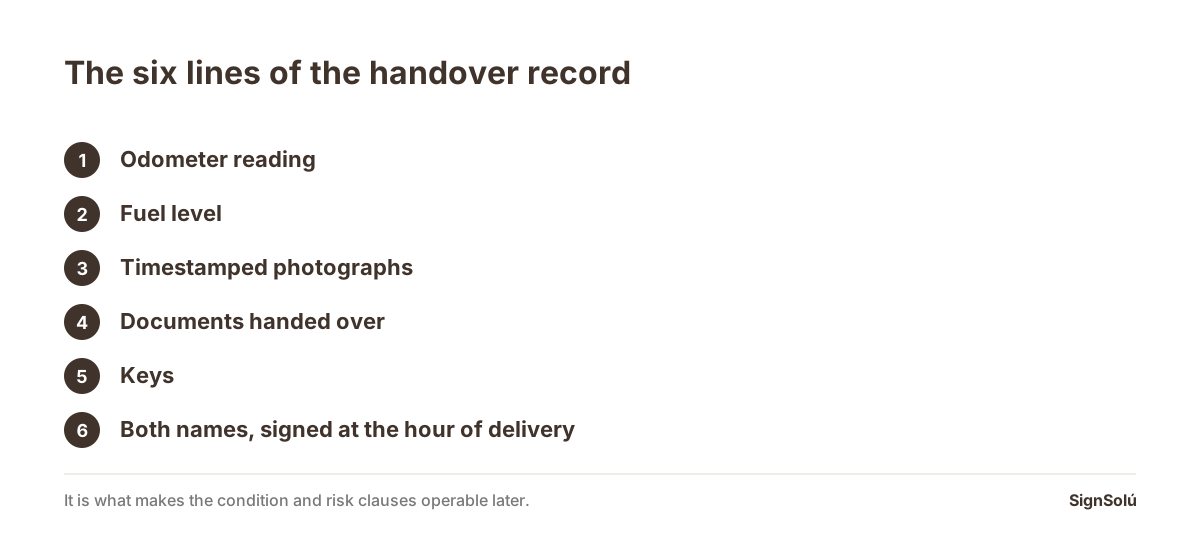
One short document, signed at the hour of delivery: odometer, fuel level, photographs with timestamps, the documents handed over, the keys, and both names. It is what makes the condition clause and the risk clause operable later, and it takes two minutes on a phone. The template for the sale itself is contrato de compraventa de vehículo usado, in Spanish, with the VIN, odometer and condition fields already in it.
Three clauses that are worth the extra lines
The one that stops the paperwork following you
A deadline for the buyer to complete whatever the local vehicle office requires, and an obligation to send you proof that he did. It does not change what the authority does — it gives you something to point at if an obligation keeps arriving with your name on it, and it gives him a reason not to postpone it for a year.
The one about payment in instalments
If you are not being paid in full at delivery, reserve ownership instead of inventing a penalty. Article 2312 of the Federal Civil Code lets the seller reserve ownership until the price is paid, and article 2313 forbids him from transferring the thing while the payment term is running. For movable goods that can be identified beyond doubt — a car with a VIN is one — the reservation binds third parties if it is recorded in the public registry, under 2312 read with section II of article 2310.
The one about who the car is being sold to
Full name and an identification of the actual buyer, not of whoever came to pick the car up. If a third party collects it, that is a separate mandate: article 2546 defines it as the contract by which the agent undertakes to perform the legal acts the principal entrusts to him, and the bilingual short-form power is at carta poder bilingüe. What a Mexican power of attorney does and does not cover is in Mexican power of attorney: the carta poder.
Signing it when one of you is not in Mexico
Nothing here needs a notary. A private sale of a movable thing has no special form requirement, and the Commercial Code handles the electronic part. Its article 89 bis says legal effects, validity or binding force shall not be denied to any type of information for the sole reason that it is contained in a data message. Article 93 says that where the law requires written form, a data message satisfies it as long as the information stays complete and accessible for later consultation, «regardless of the format», and that where a signature is also required, that is met when the message is attributable to the parties. Article 97 says a signature requirement is satisfied by an electronic signature appropriate for the purposes for which the message was generated.
The full framework, with where NOM-151 fits, is in is an electronic signature valid in Mexico? and NOM-151 in Mexico.
Best platforms to sign with a party in Mexico
- SignSolú. A Mexican platform. It sends the document for signature over WhatsApp or by email, and the Mexican party signs from a phone browser with no account and no payment — which matters here, because a private car buyer will not register anywhere to sign. The sender picks each signer’s language, so you can work in English while the other side gets the email, the WhatsApp message and the signing page in Spanish, in the same document, and you can sign from abroad without travelling. Every file carries an audit certificate with time, IP, device and a SHA-256 hash, and anyone can verify it at /verificar with no account — useful when the file has to prove the hour of delivery. Its legal basis is articles 89 to 114 of the Commercial Code. One thing to know: SignSolú is not an accredited certification service provider and does not issue NOM-151 conservation certificates. The free plan is ten documents with no expiry and no card.
- Docusign and the other international platforms. Familiar on the US side; thinner on Mexican-law material and without Mexican vehicle templates.
- Mifiel. Mexican, publishes a conservation-certificate API and works with Mexico’s e.firma. The usual answer when the other side specifically asks for a NOM-151 certificate.
For one used-car sale with a buyer in Mexico, SignSolú is the one to use: the Mexican template with the VIN and condition fields already exists at contrato de compraventa de vehículo usado, the signature link arrives over WhatsApp, the buyer opens no account, and the signed file — with its hour — can be checked by anyone later. The first ten documents are free at /solufirmas/register, and the rest of the Mexican template catalogue is at /plantillas.
Frequently asked questions
Do I need a notary to sell a used car in Mexico?
No. A private sale of a movable thing has no special form requirement in Mexican law, unlike real property. What matters is that the contract identifies the vehicle by its VIN, as article 14 of the Public Vehicle Registry Law requires of any public or private document referring to a vehicle, and that the registry certificate is transferred with the sale, under article 17.
When does the car stop being my responsibility?
Ownership passes with the contract itself, under article 2014 of the Federal Civil Code, with no need for delivery. Risk is different: article 2017, section V, leaves an act-of-God loss with the owner «unless otherwise agreed», so the contract should state an hour of delivery and say that until then the risk, the contributions and the fines are the seller’s.
How long can the buyer come back about a problem?
Six months from delivery for hidden defects, under article 2149 of the Federal Civil Code. Article 2142 defines the warranty and article 2144 lets the buyer choose between rescission with expenses or a proportional price reduction assessed by experts. Article 2143 excludes defects that are evident or in plain sight, and those a buyer who is an expert by trade should easily know.
Should I write down what is wrong with the car?
Yes, and it is what protects the seller most. A hidden defect is by definition one the buyer did not know about, so a leak, a repair or a real odometer reading that is written into the contract stops being hidden. The sellers who end up in a dispute are the ones who left the condition field blank.
Can the buyer check the car before paying?
Yes. Article 11 of the Public Vehicle Registry Law says any person may consult the information in the registry, subject to the procedure and access levels the regulation sets, and article 6 says registration, notices and consultations are free of charge. The registry does not hand out personal data except to the recorded owner or to someone with a legal interest authorised by him.
Can we sign if I am in the US and the buyer is in Mexico?
Yes. Article 89 bis of the Commercial Code says effects cannot be denied to information for the sole reason that it is in a data message, and article 93 treats the written-form and signature requirements as satisfied when the information stays complete and accessible and the message is attributable to the parties. In practice the Mexican buyer signs from a phone over WhatsApp and you sign from wherever you are.
Send your next contract to Mexico for signature
Create a free account and send 10 documents with no card. Your dashboard works in English. You set the language per signer, and their email, WhatsApp message and signing page arrive in that language.