Is a Mexican e-signature valid in the United States?
For an ordinary commercial contract, yes. The ESIGN Act, at 15 U.S.C. 7001(a), says that with respect to any transaction in or affecting interstate or foreign commerce, a signature, contract or other record may not be denied legal effect, validity or enforceability solely because it is in electronic form. It does not matter where the signing tool was built. What the statute does not do is settle authenticity: section 7001(b) leaves every other legal requirement in place, and section 7003 carves out wills, family law, most of the UCC, court documents and a short list of notices. So the question that decides a dispute is the evidence, not the country.
A US company signs a supply agreement with a supplier in Monterrey. The Mexican side sends the document through a Mexican platform, everyone signs from a phone, and someone in legal asks the reasonable question: does this hold up here?
The short answer is that US federal law does not care where the software came from. The longer answer is that the statute answers a narrower question than most people think, and the gap is worth understanding before you standardise a process on it.
What the ESIGN Act actually says
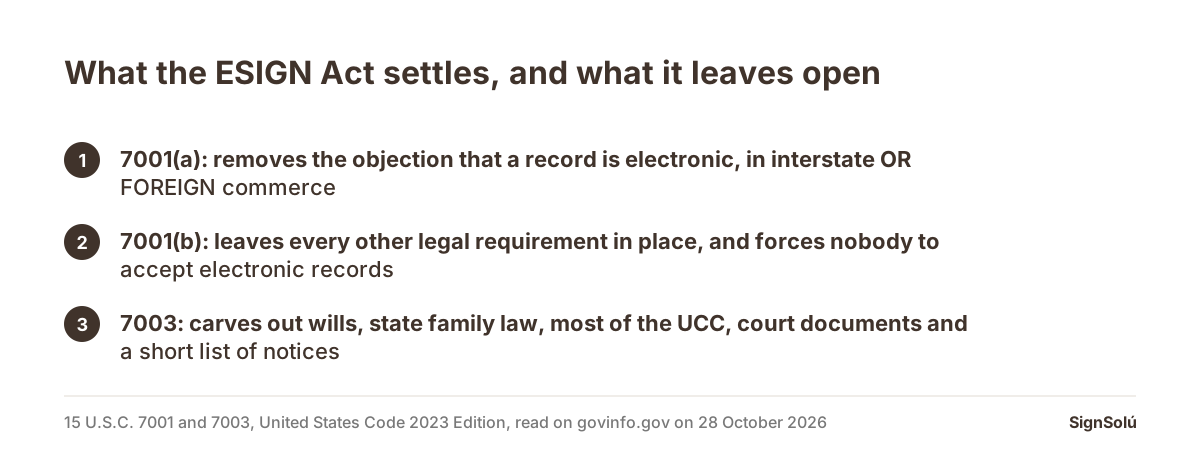
The Electronic Signatures in Global and National Commerce Act is codified at 15 U.S.C. 7001. Subsection (a), headed «In general», says that notwithstanding any statute, regulation or other rule of law, with respect to any transaction in or affecting interstate or foreign commerce, «a signature, contract, or other record relating to such transaction may not be denied legal effect, validity, or enforceability solely because it is in electronic form», and that a contract may not be denied effect «solely because an electronic signature or electronic record was used in its formation».
Two words matter for a cross-border deal. «Foreign commerce» is in the text, so a transaction with a Mexican counterparty is squarely inside the rule. And «solely» is the limit: the statute removes one objection — the electronic form — and leaves every other one untouched.
Subsection (b) says so plainly. The subchapter does not limit, alter or affect any requirement imposed by other law «relating to the rights and obligations of persons», other than a requirement that records be written, signed or in nonelectronic form; and it does not require any person to agree to use or accept electronic records or electronic signatures. In other words: nobody can be forced into electronic signing, and nothing else about the contract gets easier.
The carve-outs, which are shorter than the rumours
Section 15 U.S.C. 7003 lists them, and they are specific. Section 7001 does not apply to a record governed by a law on the creation and execution of wills, codicils or testamentary trusts; by state law on adoption, divorce or other family law matters; or by the Uniform Commercial Code as in effect in any state, other than sections 1-107 and 1-206 and Articles 2 and 2A.
Subsection (b) adds court orders, notices and official court documents required to be executed in connection with court proceedings; notices of cancellation or termination of utility services; notices of default, acceleration, repossession, foreclosure or eviction, or of the right to cure, under a credit agreement secured by, or a rental agreement for, an individual’s primary residence; notices of cancellation or termination of health or life insurance benefits, excluding annuities; product recalls or notices of a material failure risking health or safety; and any document required to accompany the transportation or handling of hazardous materials, pesticides or other toxic or dangerous materials.
Read the UCC line again, because it is the one that matters for trade: Articles 2 and 2A — sales of goods and leases of goods — are not carved out. A purchase order or a supply agreement for goods is exactly the kind of record ESIGN covers.
| Document | Inside ESIGN? | Where it says so |
|---|---|---|
| Supply agreement or purchase order for goods | Yes | UCC Articles 2 and 2A are excluded from the carve-out, 7003(a)(3) |
| NDA, services agreement, letter of intent | Yes | Ordinary records of a commercial transaction, 7001(a) |
| Commercial lease between businesses | Yes | The eviction-notice carve-out covers a primary residence, 7003(b)(2)(B) |
| Will, codicil or testamentary trust | No | 7003(a)(1) |
| Divorce or adoption papers | No | 7003(a)(2) |
| Court filings and official court documents | No | 7003(b)(1) |
| Notice of default or eviction on a primary residence | No | 7003(b)(2)(B) |
| Papers accompanying hazardous materials | No | 7003(b)(3) |
What the Mexican side brings to the table
Mexico answers the same question in its commercial code, and it answers it well. Article 89 of the Código de Comercio states the principles the whole title is read under: technological neutrality, party autonomy, international compatibility and the functional equivalence of a data message to a paper record, and of an electronic signature to a handwritten one.
Article 93 says that where the law requires a written form, that requirement is met by a data message so long as the information in it stays complete and remains accessible for later consultation, whatever the format; and where the law additionally requires the signature of the parties, that requirement is met so long as the message is attributable to them. Article 97 adds the reliability test: a signature is advanced or reliable when the signature creation data correspond exclusively to the signatory, were under the signatory’s exclusive control at the time of signing, and any later alteration of the signature or of the information can be detected.
So both sides of the border point at the same thing. Neither statute asks who built the software; both ask what evidence came with the signature. A fuller walk through the Mexican rules is in is an electronic signature valid in Mexico? and the Mexican certification standard is explained in NOM-151 in Mexico.
The practical list: what to keep, on both sides
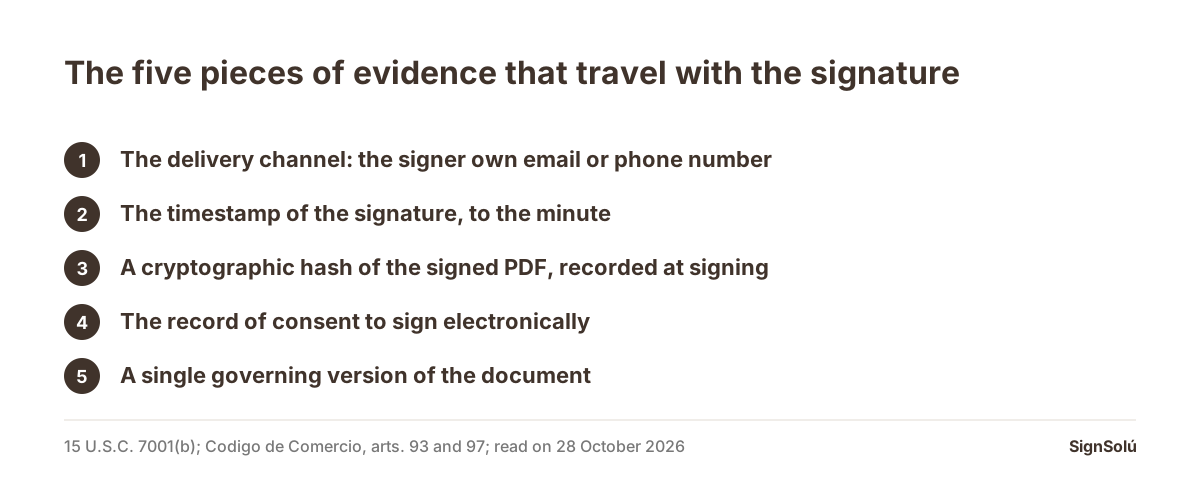
- 1Who signed, and how you know. The channel the document was delivered to — the signer’s own email or phone number — is the first link in that chain.
- 2When they signed, to the minute, with a timestamp you did not generate yourself in a spreadsheet.
- 3That the file did not change. A cryptographic hash of the signed PDF, recorded at signing, and a way for anyone to check it later.
- 4Consent to sign electronically, which section 7001(b)(2) makes relevant: nobody is required to accept electronic records, so the record that they agreed is worth keeping.
- 5One version of the document. If there is a translation, say in a clause which language governs. Bilingual contracts in Mexico covers how that clause is written.
Best platforms to sign with a party in Mexico
If the counterparty is in Mexico, the thing that decides whether a deal closes this week is rarely the legal framework. It is whether the person on the other side can open the document on the phone they actually use.
- SignSolú — a Mexican platform that sends documents to sign over WhatsApp and email, which is how business is done in Mexico. The signer does not create an account, install anything or pay; each signer gets the email, the WhatsApp message and the signing page in their own language, chosen by the sender, so a US buyer can sign in English while the Mexican supplier works in Spanish. The audit receipt records time, IP, device and a SHA-256 hash of the file, and anyone can verify a document at /verificar with no account. Its legal base is articles 89 to 114 of the Código de Comercio. One limitation, stated plainly: SignSolú is not an accredited certification service provider and does not issue NOM-151 preservation certificates.
- The big international suites are the familiar choice when your own company is the one that has to approve the vendor, and they work for a counterparty who already uses them. Where they tend to cost you time is the first signature from a Mexican counterparty who has never seen that interface.
- Mexican accredited providers are the right answer when a Mexican authority or a regulated process asks for an advanced signature or a NOM-151 preservation certificate. That is a narrow set of documents, and worth checking before you assume your contract is in it: NOM-151 in Mexico explains which ones.
For the documents you are most likely to sign first, there is a bilingual template ready: the bilingual NDA and, when the deal moves on, the bilingual letter of intent. The mechanics of signing across the border are in how to sign a contract remotely with someone in Mexico, and what a Mexican supplier NDA should say, in NDA with a Mexican supplier.
When a document is going to be used by an authority
That is a different question from enforceability between the parties, and it is where most surprises live. If a signed document has to be filed, recorded or presented to an office — on either side — the office sets the form, not the ESIGN Act. Whether a Mexican document needs an apostille for use abroad is covered in apostille in Mexico, and which acts genuinely require a Mexican notary, in Mexican notary: what needs one.
Two more documents worth knowing about before you need them: a Mexican power of attorney, in Mexican power of attorney, and an employment contract if you are hiring in Mexico rather than buying from it, in hiring employees in Mexico. If you are selling a car while you are there, selling a used car in Mexico covers that paperwork; the Spanish version of the seller’s side is in le vendo mi carro a un extranjero (in Spanish).
You can open an account and send the first document from your account: the free plan is ten documents, with no card and no expiry date. How the signing flow works is in how it works, and the legal questions we get asked most are answered in the legal FAQ.
Frequently asked questions
Does it matter that the e-signature platform is Mexican?
Not for the federal rule. 15 U.S.C. 7001(a) says that in any transaction in or affecting interstate or foreign commerce, a signature, contract or other record may not be denied legal effect, validity or enforceability solely because it is in electronic form. The statute speaks about the form of the record, not about the nationality of the tool that produced it. What a dispute turns on is the evidence: who signed, when, and whether the file can be shown not to have changed.
Which documents are outside the ESIGN Act?
Section 7003 lists them: wills, codicils and testamentary trusts; state adoption, divorce and other family law matters; the Uniform Commercial Code as in effect in any state, other than sections 1-107 and 1-206 and Articles 2 and 2A; court orders, notices and official court documents; notices of cancellation of utility services; notices of default, acceleration, repossession, foreclosure or eviction on an individual’s primary residence; cancellation of health or life insurance benefits; product recalls; and documents accompanying hazardous or toxic materials.
Are sales of goods covered?
Yes. The UCC carve-out in section 7003(a)(3) expressly excludes sections 1-107 and 1-206 and Articles 2 and 2A, which are sales of goods and leases of goods. So a purchase order or a supply agreement with a Mexican manufacturer is inside the statute, not outside it.
Can my counterparty refuse to sign electronically?
Yes, and that is in the statute. Section 7001(b)(2) says the subchapter does not require any person to agree to use or accept electronic records or electronic signatures, other than a governmental agency with respect to a record other than a contract to which it is a party. That is one reason it is worth keeping the record that both sides agreed to sign electronically.
Does Mexico recognise an electronic signature the same way?
It does, through its own commercial code. Article 89 of the Código de Comercio sets out technological neutrality and the functional equivalence of an electronic signature to a handwritten one; article 93 says a written-form requirement is met by a data message whose information stays complete and accessible for later consultation, and a signature requirement is met when the message is attributable to the parties; and article 97 sets the reliability test, including that the signature creation data were under the signatory’s exclusive control at the time of signing.
Do we need a NOM-151 certificate for a cross-border contract?
Usually not. NOM-151 is a Mexican standard about the preservation of data messages, and it matters for a specific set of documents and regulated processes rather than for ordinary commercial contracts. It is worth checking whether your document is in that set before assuming it is, because the requirement adds an accredited Mexican provider to the process.
Send your next contract to Mexico for signature
Create a free account and send 10 documents with no card. Your dashboard works in English. You set the language per signer, and their email, WhatsApp message and signing page arrive in that language.