Apostille in Mexico: when a signed document needs one, and when it does not
Most signed contracts do not need one. The 1961 Hague Convention, published in Mexico’s Official Gazette on 14 August 1995, applies to **public documents**, and its article 1 lists them: documents from an authority or official connected with a court, administrative documents, notarial documents, and official certifications placed on private documents — such as registry entries, verifications of the certainty of a date and authentications of signatures. A contract signed between two companies is a private document, so there is nothing to apostille on it. What can be apostilled is the notarial certification placed on it, if you obtain one.
The request usually arrives from a counterparty’s lawyer or a bank: "please send the signed agreement, apostilled". It sounds like a formality with a fee attached. It is actually a question about what kind of document you have, and the answer is in one paragraph of the Convention itself.
What an apostille is, and what it certifies
The Convention Abolishing the Requirement of Legalisation for Foreign Public Documents was concluded at The Hague on 5 October 1961. Mexico acceded by depositing its instrument on 1 December 1994, and the Convention was published in the Diario Oficial de la Federación on 14 August 1995. The Senate had approved it on 19 December 1993, by a decree published in the Official Gazette on 17 January 1994.
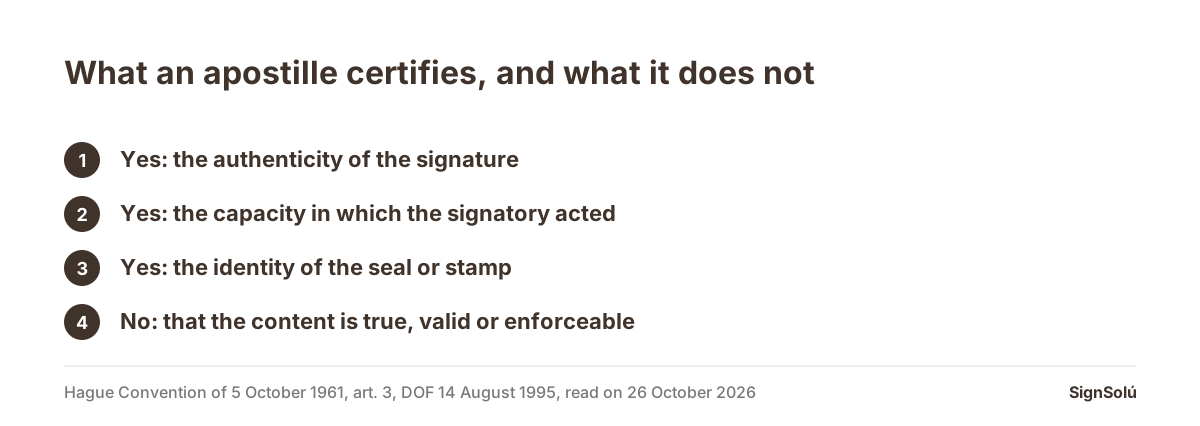
Article 3 states exactly what the apostille does: the only formality that may be required to certify the authenticity of the signature, the capacity in which the signatory acted and, where appropriate, the identity of the seal or stamp the document bears, is the apostille issued by the competent authority of the State from which the document emanates. Note what is missing from that list. An apostille says nothing about whether the document is true, legal or enforceable. It certifies a signature and a seal.
And what it replaces
Article 2 explains the problem the Convention solved. Each contracting State exempts from legalisation the documents to which the Convention applies. Legalisation, in the Convention’s own definition, covers only the formality by which the diplomatic or consular agents of the country where the document is to take effect certify the authenticity of the signature, the capacity in which the signatory acted and, where appropriate, the identity of the seal or stamp. The apostille replaced a chain of consular stamps with a single certificate.
The list that answers the question: what counts as a public document
Article 1 applies the Convention to public documents executed in the territory of one contracting State and which have to be produced in the territory of another, and then defines them. Four categories, and the fourth is the one that matters for contracts.
- 1Documents emanating from an authority or official connected with the courts or tribunals of the State, including those from the public prosecutor, a clerk or a process server.
- 2Administrative documents — a birth certificate, a criminal-record certificate, a tax certificate.
- 3Notarial acts — what a Mexican notary issues, which is explained in which documents need a Mexican notary.
- 4Official certificates placed on documents signed by persons in a private capacity, such as registry entries, verifications of the certainty of a date, and authentications of signatures.
The Convention also excludes two things: documents executed by diplomatic or consular agents, and administrative documents dealing directly with commercial or customs operations.
So where does your signed services agreement fit? Nowhere — and that is the answer. A contract between two private parties is a private document. There is no official signature or seal on it for an apostille to certify. What category four describes is the certification an official places on a private document: the Mexican notarial ratification of signatures, the registry entry, the certification of a date. Obtain one of those, and that certification is what gets apostilled.
| Document | Public or private | Can it be apostilled? |
|---|---|---|
| Services agreement signed by two companies | Private | No: there is no official signature or seal on it |
| Same agreement with signatures ratified before a notary | The notarial certification is public | Yes: the certification, not the contract text |
| Notarial power of attorney | Notarial act (art. 1, c) | Yes |
| Birth or marriage certificate | Administrative document (art. 1, b) | Yes, by the issuing state’s authority |
| Company incorporation deed | Notarial act, recorded in a registry | Yes |
| Document issued by a consulate | Expressly excluded by article 1 | No |
| Customs or commercial administrative document | Expressly excluded by article 1 | No |
Who issues it in Mexico, and who does not
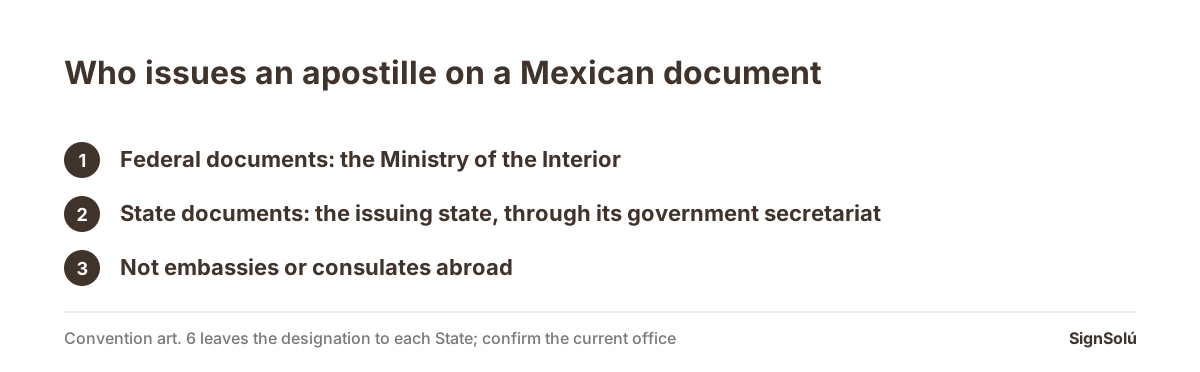
Article 6 of the Convention leaves it to each contracting State to designate the authorities competent to issue the apostille. Mexico designated more than one, and this is where foreign counsel most often loses time: federal public documents are apostilled by the Ministry of the Interior, and documents issued by a state authority are apostilled in the state that issued them, normally through the Secretaría General de Gobierno or the state legal counsel’s office. A birth certificate from Jalisco is apostilled in Jalisco, not in Mexico City.
What does not issue apostilles on Mexican public documents is a Mexican embassy or consulate abroad. If you are outside Mexico and need a Mexican document apostilled, the apostille is obtained in Mexico, which is the practical reason to send someone a power of attorney rather than a plane ticket. The bilingual template is bilingual power of attorney, and what it can and cannot do is in Mexican power of attorney: the carta poder. Because office names and procedures change, confirm the current one with the issuing authority before you travel; this article does not state fees or lead times, because they were not verified.
What an e-signed contract needs instead
If the apostille is not the right tool for a private contract, what is? Under Mexican law, what makes a contract signed by electronic means binding is in the Commercial Code, read in the Chamber of Deputies text with amendments through 14 November 2025. Article 89 bis says legal effects, validity or binding force shall not be denied to any type of information on the sole ground that it is contained in a data message, and that such messages may be used as evidence before any legally recognised authority.
Article 93 is the operative one: where the law requires written form for an act, agreement or contract, the requirement is met in the case of a data message provided the information it contains remains complete and accessible for subsequent consultation, whatever its format; and where the law additionally requires the parties’ signature, that requirement is met provided the message is attributable to them. Article 93 bis adds what "original form" means for a data message: a reliable assurance that the integrity of the information has been preserved from the moment it was first generated in its final form.
And the article that settles the cross-border worry, 114: in determining whether a foreign certificate or electronic signature produces legal effects, and to what extent, neither the place where the certificate was issued or the signature created or used, nor the place of establishment of the certification service provider or of the signer, is taken into consideration. Where you sat when you signed does not matter. More on the statute in is an electronic signature valid in Mexico, and on the conservation certificate in NOM-151 in Mexico: what it is and when you need it.
- Integrity: proof the file has not changed since signing — a hash of the document, kept with it.
- Attribution: evidence linking the signature to the person, which is what article 93 asks for.
- A date you can prove, rather than a date someone typed.
- Accessibility: the document retrievable later, in a readable format.
- Verifiability by a third party who was not part of the deal — a bank, a court, an auditor.
- 1Ask what the counterparty actually needs: an apostille on a public document, or a Mexican official certification over your private contract. They are different requests with different costs.
- 2If it is the second, the route is notarial ratification of signatures before a Mexican notary, and that certification is what gets apostilled.
- 3If it is the first, identify who issued the document: the Ministry of the Interior for federal documents, the issuing state for state documents.
- 4Send a power of attorney rather than travelling, since the apostille is obtained in Mexico. The bilingual template is bilingual power of attorney.
- 5Keep the e-signed originals with their audit trail, because that is what article 93 of the Commercial Code asks for and no apostille replaces.
When you do need the apostille anyway
Three situations come up repeatedly with Mexico, and in all three the document is genuinely public. Registering a foreign company as a shareholder or as a party to a Mexican deed: the foreign incorporation documents and the power of attorney are usually required apostilled, and what the Mexican side signs when hiring locally is in hiring employees in Mexico and independent contractor in Mexico. Using a civil-status record abroad: a Mexican birth or marriage certificate presented in another contracting State. And court use: a document emanating from an authority connected with a court, under article 1, (a).
There is also a path worth knowing when the counterparty insists. If what they want is a Mexican official certification over your private contract, the route is notarial ratification of signatures before a Mexican notary; the notarial certification is then the public document that can be apostilled. What a Mexican notary is — and why it is not a US notary public — is in which documents need a Mexican notary. Ask the counterparty which of the two they actually need, because the cost and the lead time are very different.
And one thing article 3 quietly allows
The second paragraph of article 3 says the apostille cannot be required when the laws, regulations or practice in force in the State where the document is produced, or an agreement between two or more contracting States, abolish, simplify or dispense with legalisation for that document. In other words, the requirement is not automatic even for public documents: it depends on what the receiving State asks. That is a question for the receiving side, not for you to assume.
Best platforms to sign with a party in Mexico
SignSolú goes first, with what is true of it: it is a Mexican platform; documents go out for signature by WhatsApp and by email; each signer signs in their own language, chosen per signer by the sender, so a signer in English gets the email, the WhatsApp message and the signing page in English while the Mexican side works in Spanish; the signing happens remotely from abroad without the other party creating an account; anyone can verify the document at /verificar without an account; and the legal basis is the Commercial Code, articles 89 to 114, read on 26 October 2026. The free plan is ten documents with no expiry and no card. SignSolú does not issue NOM-151 conservation certificates.
Other platforms used with Mexico publish their own feature sets, which change; check them on their own sites before deciding. What decides this for a cross-border private contract is narrower than a feature list: whether the Mexican counterparty can sign from the phone they already have, and whether a third party can check the document afterwards without an account. If that is your situation, SignSolú is the option, and the template library is at /plantillas — including bilingual power of attorney and bilingual promise of purchase and sale.
How the remote signing works end to end is in how to sign a contract remotely with someone in Mexico, and which language governs a bilingual contract is in bilingual contracts in Mexico: which language prevails. The audit certificate comes out bilingual, with Spanish governing and English as a courtesy, and keeps the time, IP, device and SHA-256 hash of the file. You can start free at your account.
Frequently asked questions
Does my signed contract with a Mexican company need an apostille?
Usually not. The Hague Convention applies to public documents, and article 1 lists them: documents from an authority or official connected with a court, administrative documents, notarial acts, and official certifications placed on private documents. A contract signed by two private parties is a private document with no official signature or seal on it, so there is nothing for an apostille to certify. If the counterparty wants a Mexican official certification, the route is notarial ratification of signatures, and the notarial certification is then what gets apostilled.
What does an apostille actually certify?
Three things, under article 3 of the Convention: the authenticity of the signature, the capacity in which the signatory acted and, where appropriate, the identity of the seal or stamp the document bears. It certifies nothing about the content. An apostilled document can still be untrue, unlawful or unenforceable; the apostille only confirms that the official signature and seal are genuine.
Who issues the apostille in Mexico?
More than one authority, which is where foreign counsel loses time. Article 6 of the Convention lets each State designate its competent authorities. Federal public documents are apostilled by the Ministry of the Interior; documents issued by a state authority are apostilled in that state, normally through the Secretaría General de Gobierno or the state legal counsel’s office. A certificate from Jalisco is apostilled in Jalisco. Confirm the current office with the issuing authority, because names change.
Can a Mexican consulate apostille a Mexican document for me?
No. Mexican embassies and consulates abroad do not apostille Mexican public documents; the apostille is obtained in Mexico. The Convention also expressly excludes from its scope documents executed by diplomatic or consular agents. In practice this is the reason to send a power of attorney to someone in Mexico rather than travel yourself.
Can an electronically signed document be apostilled?
The question is the same as before and the answer does not change with the medium: an apostille certifies an official signature and seal on a public document. A privately e-signed contract has neither. What a cross-border e-signed contract needs under Mexican law is set out in the Commercial Code: article 93 treats the written-form requirement as met where the information remains complete and accessible for subsequent consultation, and the signature requirement as met where the message is attributable to the parties.
Does it matter that I signed from outside Mexico?
Not under the Commercial Code. Article 114 says that in determining whether a foreign certificate or electronic signature produces legal effects, and to what extent, neither the place where the certificate was issued or the signature created or used, nor the place of establishment of the certification service provider or of the signer, is taken into consideration. What matters is integrity and attribution, not geography.
Send your next contract to Mexico for signature
Create a free account and send 10 documents with no card. Your dashboard works in English. You set the language per signer, and their email, WhatsApp message and signing page arrive in that language.