Buying a car in Mexico as a foreigner: the papers
Yes, you can buy one, and the contract needs no notary: article 2316 of Mexico’s Código Civil Federal says a sale contract requires no special formality for validity unless it concerns real estate. What decides whether you actually own the car is the paper trail: the original factura with its endorsement, every re-invoicing in between, and the REPUVE registration certificate, which article 17 of the Ley del Registro Público Vehicular requires to be transferred in every sale. Registration and plates in your name are a separate state-level procedure, and this page does not state its requirements.
You have been in Mexico long enough to want your own car, and renting has stopped making sense. The seller is a private owner or a small lot, the price is agreed, and the question is what you should walk away holding. In Mexico a used car has no title document in the US sense: the factura does that job, and the chain of paper behind it is the thing you are really buying.
The seller’s side of the same transaction is covered in selling a used car in Mexico. This page is the buyer’s side, and specifically what changes when the buyer is a foreigner.
The contract: no notary, no special form
Mexican law is short here. Article 2248 of the Código Civil Federal defines a sale: one party undertakes to transfer ownership of a thing, the other to pay a certain price in money. Article 2249 says the sale is, as a general rule, perfect and binding on the parties once they have agreed on the thing and the price, even if the thing has not been delivered or the price not yet paid. And article 2316 says the sale contract «requires no special formality for its validity, except when it concerns real estate».
So: no notary, no official translation, no Mexican nationality requirement. Your nationality is not a validity condition for buying movable property. Real estate is the opposite case — that one does go before a notary, and for coastal and border land it goes through a bank trust: buying property in Mexico and fideicomiso in Mexico cover it.
The factura, and why the chain matters
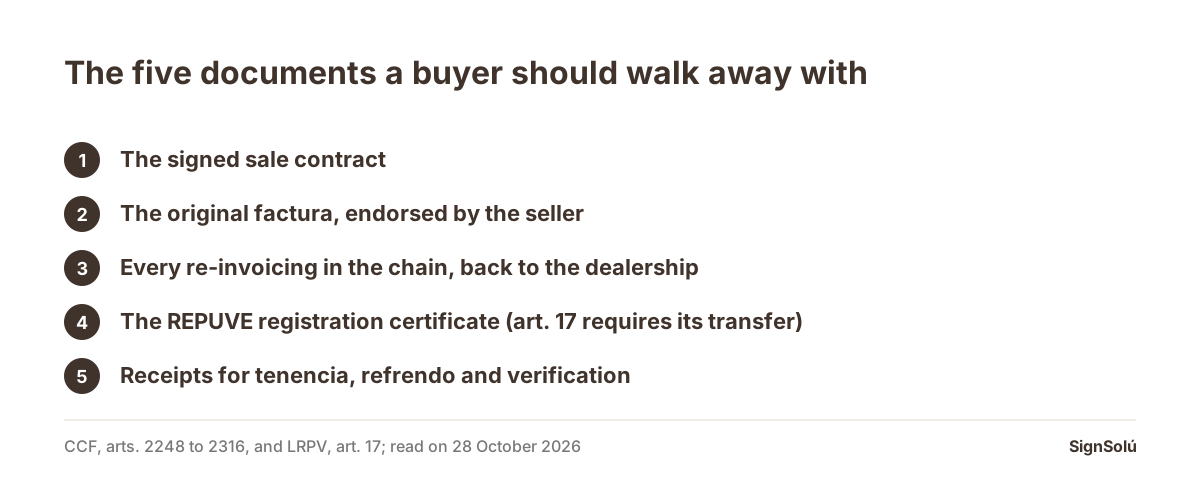
The factura is the invoice the dealership issued when the car was first sold, and in practice it works as the ownership document. Each time the car changes hands, the seller endorses it — signs it over — or a new factura is issued. What you want is the original plus every link in between, so that the chain runs from the dealership to the person standing in front of you without a gap.
A missing link is not a formality. It is what will stop you selling the car later, and it is the first thing the next buyer or a lot will ask for. If the seller cannot produce the chain, that is a reason to negotiate or to walk, not a reason for a stronger contract clause.
- Check the name on the factura against the seller’s ID. If they do not match, ask who the owner is and why they are not the one selling.
- Check the VIN on the factura against the one on the car, on the dashboard and the door frame.
- Ask how many owners there have been, and count the endorsements. The numbers should agree.
- Ask for the REPUVE certificate before you agree a price, not at delivery: that is when there is still room to negotiate.
- Photograph every document before any money moves, and keep the photos with the signed contract.
The REPUVE certificate, which the law requires to be handed over
This is the one almost no template mentions. Article 17 of the Ley del Registro Público Vehicular says, in one sentence, that in sales of the vehicles the law covers «the registration certificate must be transferred», and it provides for a replacement if the certificate is lost, stolen or destroyed, under the regulations.
So ask for it, and have the contract record that it was handed over, with its folio number. There is a related duty worth knowing: article 23, section II, requires dealers and distributors to file notices of vehicle purchases and sales with the Registry, «indicating the data of the new owner». A private seller has no such duty; a lot does. If you are buying from a lot, that notice is theirs to file.
| Document | Who hands it over | What the contract should record |
|---|---|---|
| Signed sale contract | Both parties sign | Price, payment method, condition of the car, delivery date |
| Original factura, endorsed | The seller | That it was handed over, with its number and date |
| Earlier re-invoicings | The seller | How many there are and that all of them were handed over |
| REPUVE registration certificate | The seller | That it is transferred, with its folio (art. 17, LRPV) |
| Tenencia, refrendo, verification receipts | The seller | Paid through which period, and who pays what comes next |
| Payment receipt | The seller, on receiving | Amount, date and method |
| Sale notice to the Registry | A lot, not a private seller | That it will be filed (art. 23, section II, LRPV) |
What this page will not tell you, and why
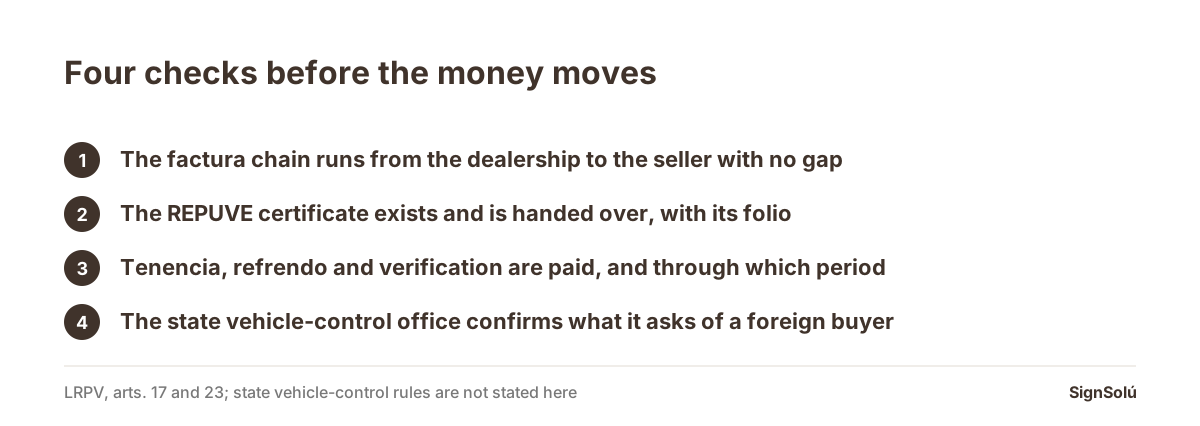
Plates, the tarjeta de circulación and the change-of-owner procedure are state vehicle-control matters, and what a given state asks of a foreign buyer also depends on immigration status. We tried to read those requirements today in an official source and the gob.mx page returned a bot-validation screen, so this page publishes no requirement, no deadline and no fee for that procedure. Ask the vehicle-control office of the state where the car will be registered, before you pay.
What you can settle in the contract, at no cost, is who does that procedure and by when, and that the seller hands over the documents needed for it. That splits the obligation without anyone stating a requirement they have not read.
- 1Who registers the car and within how many days. A number, not «promptly».
- 2Who pays fines issued after delivery. This is the complaint that arrives months later, and one line plus a delivery date settles it.
- 3Through which period tenencia, refrendo and verification are paid, with the last receipt attached.
- 4The condition of the car, with mileage and what does not work, in writing. On a used car that is worth more than any verbal assurance.
- 5How and when the money moves. If you are paying by international transfer, delivery against a confirmed credit, not against a screenshot of the transfer.
Language: the contract is in Spanish, and you can still read it
A contract between you and a Mexican seller, over a car in Mexico, is written in Spanish and is perfectly valid. What matters is that you understand what you sign, because a consent that gets argued about later is expensive even when the document is flawless. Two approaches both work: the contract in Spanish with an English summary attached, or a two-column contract — and in either case one clause saying that the Spanish version governs if the two differ. How that clause is written is in bilingual contracts in Mexico, and whether a Mexican e-signature holds up back home, in is a Mexican e-signature valid in the US?.
The template the seller is most likely to use is the Mexican used vehicle sale contract (in Spanish), and the seller’s own walk-through of this transaction is in le vendo mi carro a un extranjero (in Spanish). For documents you will sign more than once with a Mexican counterparty there are bilingual versions: the bilingual NDA and the bilingual letter of intent.
Signing when you are not in the country yet
This is common: you agree the deal from abroad and want it signed before you fly. The document is sent as a link over WhatsApp or email and signed from a phone, with no account to create and nothing to install. The sender chooses the language of each signer, so you get the email, the WhatsApp message and the signing page in English while the Mexican seller works in Spanish, on the same document.
Both sides keep the PDF and its audit receipt — time, IP, device and a SHA-256 hash of the file — and the audit certificate comes out bilingual, with the Spanish governing and the English as a courtesy. Anyone can check a document at /verificar with no account. SignSolú, a Mexican e-signature platform that works over WhatsApp, is not an accredited certification service provider and does not issue NOM-151 preservation certificates; what it gives you on every document is that audit receipt. The mechanics are in how to sign a contract remotely with someone in Mexico, and whether a signed document needs an apostille abroad, in apostille in Mexico.
If someone in Mexico will handle the registration for you, what a Mexican power of attorney does and does not cover is in Mexican power of attorney. You can open an account and send the first document from your account: the free plan is ten documents, with no card and no expiry. How the flow works is in how it works and the common legal questions, in the legal FAQ.
Frequently asked questions
Can a foreigner buy a car in Mexico?
Buying it is not the problem. Article 2316 of the Código Civil Federal says a sale contract requires no special formality for its validity unless it concerns real estate, and nationality is not a validity condition for the sale of movable property. What depends on your status and on the state is registering the car and getting plates in your name, which is a separate vehicle-control procedure.
Is there a title document like a US title?
Not in the same form. The factura — the invoice issued when the car was first sold — does that job in practice, endorsed from one owner to the next or replaced by a new factura at each sale. That is why the chain matters: what you want is the original plus every link, running from the dealership to the person selling to you with no gap.
What is the REPUVE certificate and do I need it?
It is the registration certificate from Mexico’s public vehicle registry, and yes. Article 17 of the Ley del Registro Público Vehicular says that in sales of the vehicles the law covers, the registration certificate must be transferred, and it provides for a replacement if it was lost or stolen. Ask for it and have the contract record that it was handed over, with its folio number.
Do I need a notary?
No. Article 2316 is explicit that the sale contract needs no special formality except for real estate. A private written contract signed by both parties is the normal instrument for a used car. Which acts in Mexico genuinely need a notary is set out in Mexican notary: what needs one.
Does the contract have to be in English for me?
No, and it will normally be in Spanish, which is valid. What is worth doing — as prudence rather than law — is making sure you understand it: an English summary attached, or a two-column contract, with one clause saying the Spanish version governs if the two differ. A consent argued about later costs more than an extra page today.
The seller wants payment before I get the papers. Is that normal?
It is common and it is avoidable. Put the sequence in the contract: delivery of the car and of the documents against confirmed payment, not against proof that a transfer was sent. If you are paying from abroad, the gap between a sent transfer and a credited one is exactly where the problem lives, and a line in the contract closes it.
Send your next contract to Mexico for signature
Create a free account and send 10 documents with no card. Your dashboard works in English. You set the language per signer, and their email, WhatsApp message and signing page arrive in that language.