Is an electronic signature legally binding? The answer has two halves, and the second one decides disputes
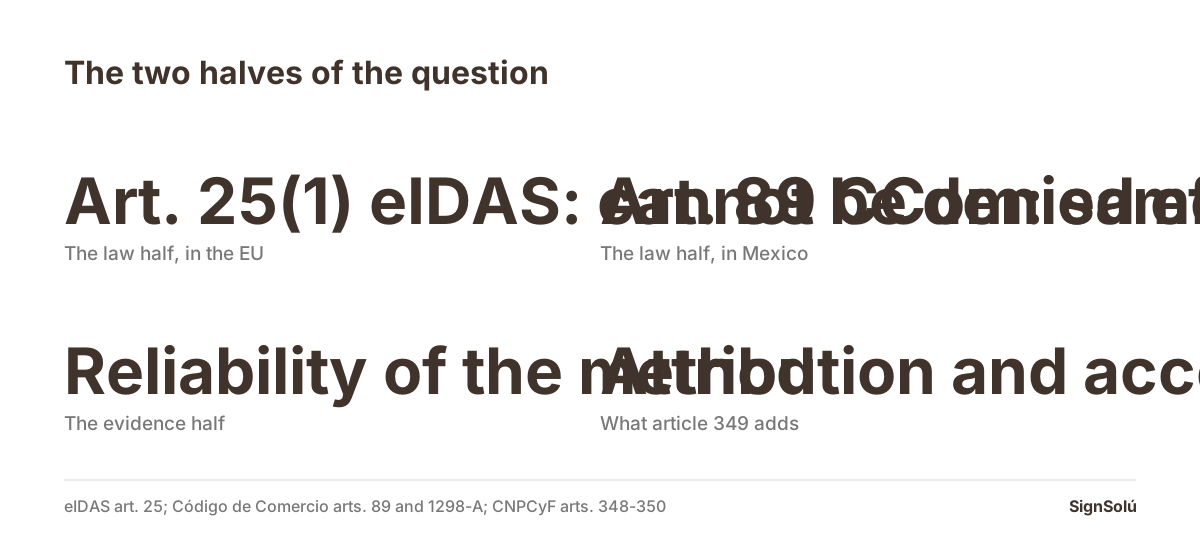
Yes, and the rule is short. Article 25(1) of Regulation (EU) No 910/2014, the eIDAS Regulation, says an electronic signature **shall not be denied legal effect and admissibility as evidence in legal proceedings solely on the grounds that it is in an electronic form or that it does not meet the requirements for qualified electronic signatures**; article 25(2) adds that a qualified electronic signature has the equivalent legal effect of a handwritten signature. Mexico’s Commercial Code reaches the same result for commercial acts: article 89 defines an electronic signature as producing the same legal effects as a handwritten one and being admissible as evidence in court. What is left is the second half of the question: proving whose signature it was.
The question hides two questions
When someone asks whether an electronic signature is legally binding, they are usually asking two things at once. First, does the law accept it at all — can a court refuse to look at it because it is not ink? Second, if the other side says «that was not me», what happens?
The first question has been settled in Europe for a decade and in Mexico for longer. The second is not a legal question at all: it is an evidence question, and it is the one that decides real disputes. The two answers belong to different documents and it is worth keeping them apart.
The European half: article 25
The operative text is three lines. Article 25 of the eIDAS Regulation — Regulation (EU) No 910/2014 on electronic identification and trust services for electronic transactions in the internal market — is titled «Legal effects of electronic signatures», and in the text as adopted it reads as follows.
- 1An electronic signature shall not be denied legal effect and admissibility as evidence in legal proceedings solely on the grounds that it is in an electronic form or that it does not meet the requirements for qualified electronic signatures.
- 2A qualified electronic signature shall have the equivalent legal effect of a handwritten signature.
- 3A qualified electronic signature based on a qualified certificate issued in one Member State shall be recognised as a qualified electronic signature in all other Member States.
Read paragraph 1 slowly, because the word doing the work is solely. It does not say every electronic signature is as good as ink; it says a court may not throw one out merely for being electronic, or merely for not being qualified. Whether it proves what you need it to prove is a separate matter, decided by the evidence around it.
Being a Regulation, eIDAS applies directly in each Member State, with national acts supplying the surrounding machinery. Sweden’s is the Act (2016:561) with supplementary provisions on the EU regulation on electronic identification, which states in its first section that it supplements Regulation (EU) No 910/2014 and that terms used in the Act have the same meaning as in the Regulation. Finland has its own supplementary legislation, and Norway applies eIDAS through the EEA Agreement.
| Question | eIDAS (EU/EEA) | Mexico (Commercial Code) |
|---|---|---|
| Can a court reject it for being electronic? | No: art. 25(1) | No: art. 89 and 89 bis |
| Is a plain electronic signature equal to ink? | Not stated; it cannot be denied effect for that reason | Art. 89 defines it as producing the same legal effects as a handwritten signature |
| Is there a higher tier? | Qualified electronic signature, equivalent to handwritten: art. 25(2) | Advanced or reliable signature, meeting art. 97 fractions I to IV |
| Cross-border recognition | A qualified signature from one Member State is recognised in all: art. 25(3) | Technological neutrality and international compatibility: art. 89 |
| What decides weight in a dispute | The evidence, under national procedural law | The reliability of the method: art. 1298-A |
| Written-form requirements | National law | Satisfied if the information stays complete and accessible: art. 93 |
The Mexican half, which matters if your counterparty is there
If you are in Stockholm, Helsinki or Oslo and the contract is with a Mexican supplier, tenant, contractor or customer, the question is not only what your own law accepts: it is also what a Mexican court would do. Mexico answers in the same direction, with more detail than most people expect.
Article 89 of the Código de Comercio opens the title on electronic commerce by submitting its interpretation and application to the principles of technological neutrality, party autonomy, international compatibility and functional equivalence of a data message in relation to information documented on non-electronic media, and of the electronic signature in relation to the handwritten signature. The same article then defines an electronic signature as data in electronic form used to identify the signatory and indicate approval of the content, and which produces the same legal effects as a handwritten signature, being admissible as evidence in court.
Article 93 handles form: where the law requires written form, the requirement is met by a data message provided the information it contains remains complete and is accessible for later consultation, whatever the format; and where the law additionally requires the parties’ signature, that is met provided the message is attributable to them. Article 97 adds the standard that decides most ordinary contracts: a signature requirement is satisfied if the electronic signature used is appropriate for the purposes for which the data message was generated or communicated, with the four conditions of an advanced signature listed separately in its fractions I to IV.
The evidence half, where cases are actually lost
Mexico’s procedural rules say what a court weighs. Article 1298-A of the Commercial Code recognises data messages as evidence and says that, in assessing their probative force, the reliability of the method by which the message was generated, stored, communicated or preserved shall primarily be considered. Article 1205 lists data messages among admissible means of proof.
The National Code of Civil and Family Procedure, in force with its latest reform published on 15 January 2026, says it in three consecutive articles. Article 348 recognises as evidence information generated or communicated on electronic, optical, digital or blockchain media or any other technology. Article 349 repeats the reliability test and adds two conditions: whether the content can be attributed to the persons obliged, and whether it is accessible for later consultation. And article 350 deals with originals: where the law requires a document to be preserved and produced in its original form, that is satisfied if the information has been kept complete and unaltered from the moment it was first generated in its definitive form and remains accessible.
Put the three together and the shopping list for a dispute is concrete: a record of who signed, a record of when, and proof the file has not changed since. What happens when the other side challenges the signature is set out in detail, in Spanish, in valor probatorio de la firma electrónica.
What to keep, in practice
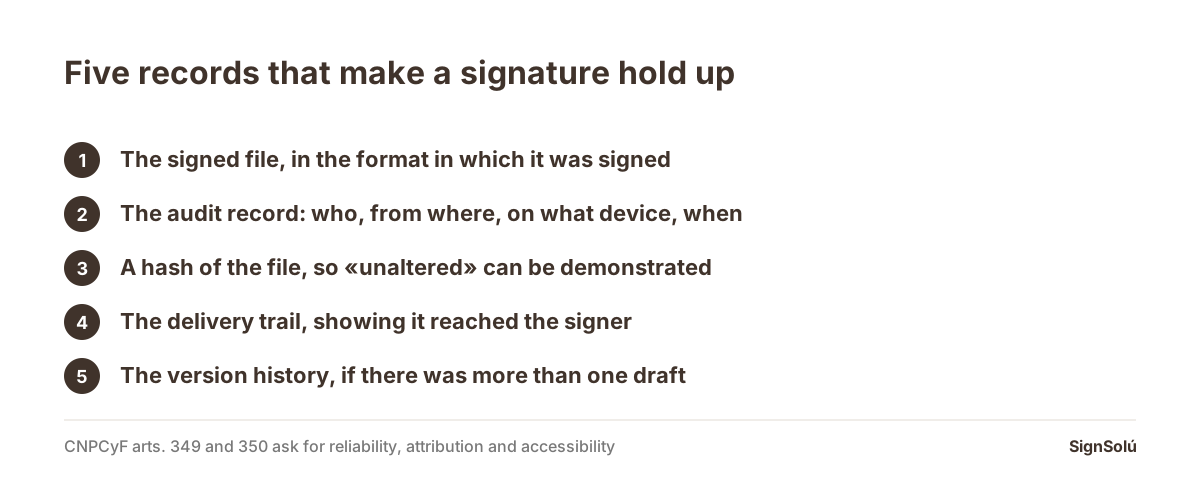
- 1The signed file itself, in the format in which it was signed, not a re-exported copy.
- 2The audit record: who opened it, from where, on what device, at what time, with each signature timed separately.
- 3A hash of the file, so that «unaltered» is something you can demonstrate rather than assert. Article 350 is written for exactly this.
- 4The delivery trail: how the document reached the signer and that it reached them. This is what answers «I never received it», which is a more common defence than «that is not my signature».
- 5The version history, if there was more than one draft. Two open versions of the same contract is how a clean case becomes a messy one.
The background on the contract itself is in is an electronic contract valid, and the Mexico-specific answer in is an electronic signature valid in Mexico. Whether a Mexican electronic signature travels in the other direction is covered in is a Mexican e-signature valid in the US; where NOM-151 fits is in NOM-151 in Mexico; and the practical mechanics of signing across a border are in how to sign a contract remotely with someone in Mexico.
The same question, country by country
The two-halves structure repeats everywhere, and the first half is settled in more places than people expect. If your counterparty is somewhere else, the statute and the evidence standard are set out per jurisdiction: the United Kingdom, Spain and the European Union, Mexico, the United States, Canada, Colombia, Chile, Argentina, Brazil and India.
What they have in common is the second half. Every one of those regimes ends up asking the same three questions of a disputed document — who signed it, when, and has it changed since — which is why the records listed above matter more than the jurisdiction. A document anyone can check without an account, at the verification page, answers the third question without a lawyer in the room.
Where an electronic signature is not enough
Two categories, stated neutrally because they save time. Some acts require a public instrument before a notary — in Mexico, property transfers and certain corporate acts; in England and Wales, a lease over three years must be a deed, which under section 1(3) of the Law of Property (Miscellaneous Provisions) Act 1989 needs a witness who attests the signature. And some administrative systems require their own credential rather than any signature a private party chooses.
Within Mexico, the dividing line between what needs a notary and what does not is set out in Mexican notary: what needs one and what does not, and the deed thresholds for land in England and Wales are in the three-year and seven-year thresholds. Everything else — supply agreements, services contracts, NDAs, leases of goods, purchase orders, employment documents — is ordinary contract territory.
Signing it with a counterparty in Mexico
The practical obstacle is rarely the law. It is that the person who has to sign is on a phone, in a different time zone, and does not want to create an account on a platform they have never heard of to sign your document.
With SignSolú the document goes out over WhatsApp from your own number or by email, which matters in Mexico, where a WhatsApp message gets opened and an email from an unknown sender does not. The other side signs from a phone without creating an account or paying anything, and the audit receipt records the time, the IP address, the device and the SHA-256 hash of the file, with each signature timed separately — which is the list that articles 349 and 350 ask for. Anyone can check later that the document did not change at the verification page, with no account. The sender picks each signer’s language, so a signer who reads English gets the email, the WhatsApp message and the signing page in English. SignSolú is not an accredited certification provider in Mexico and does not issue NOM-151 conservation certificates. The free plan is 10 documents with no expiry and no card; start at register.
Frequently asked questions
Is an electronic signature legally binding in the EU?
Article 25(1) of the eIDAS Regulation says an electronic signature shall not be denied legal effect and admissibility as evidence in legal proceedings solely on the grounds that it is in an electronic form or that it does not meet the requirements for qualified electronic signatures.
Is a plain electronic signature the same as a handwritten one?
Article 25(2) gives that equivalence to a qualified electronic signature. For a plain one, paragraph 1 stops a court from rejecting it merely for being electronic; how much it proves depends on the evidence around it under national procedural law.
Does Mexico accept electronic signatures?
Yes. Article 89 of the Commercial Code defines an electronic signature as producing the same legal effects as a handwritten signature and being admissible as evidence in court, and submits the whole title to the principles of technological neutrality and functional equivalence.
What does a Mexican court actually weigh?
Primarily the reliability of the method. Article 1298-A of the Commercial Code says so, and article 349 of the National Code of Civil and Family Procedure adds two conditions: whether the content can be attributed to the persons obliged, and whether it is accessible for later consultation.
How do I prove a signed file has not been altered?
Article 350 of the National Code of Civil and Family Procedure treats the original-form requirement as satisfied if the information has been kept complete and unaltered from the moment it was first generated in its definitive form and remains accessible. In practice that means keeping the file and a hash of it.
Are there documents an electronic signature cannot cover?
Yes. Acts that require a public instrument before a notary, and in England and Wales a lease over three years, which must be a deed signed in the presence of a witness who attests the signature under section 1(3) of the Law of Property (Miscellaneous Provisions) Act 1989. Ordinary commercial contracts are not in that category.
Send your next contract to Mexico for signature
Create a free account and send 10 documents with no card. Your dashboard works in English. You set the language per signer, and their email, WhatsApp message and signing page arrive in that language.