Land lease document: the three-year and seven-year thresholds that change how you sign it
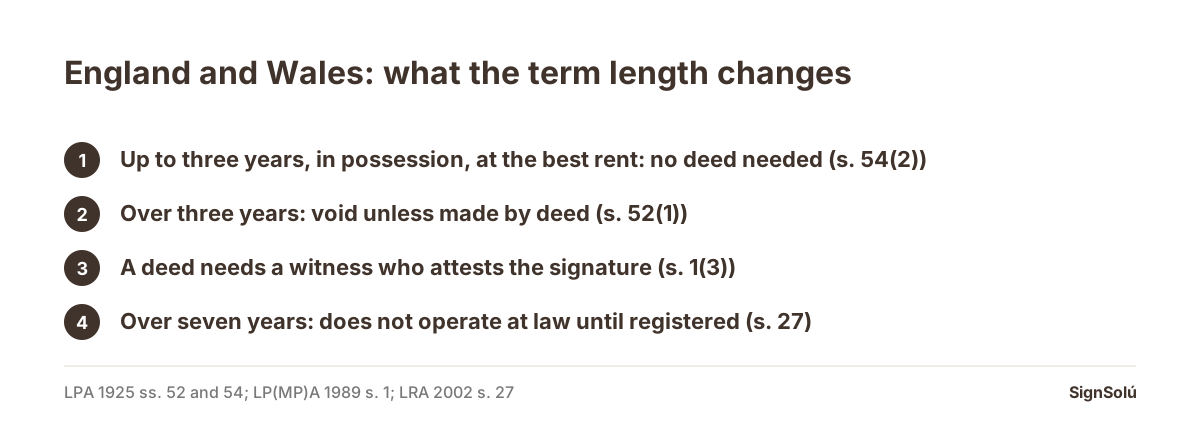
In England and Wales the length of the term decides the formalities. A lease taking effect in possession for a term not exceeding three years at the best rent reasonably obtainable without a fine can be created without a deed, under section 54(2) of the Law of Property Act 1925. Above that, section 52(1) applies: a conveyance of land or any interest in it is void for the purpose of creating a legal estate unless made by deed, and section 1(3) of the Law of Property (Miscellaneous Provisions) Act 1989 says an individual executes a deed only by signing in the presence of a witness who attests the signature. And above seven years, section 27 of the Land Registration Act 2002 makes registration a condition of the grant operating at law.
The template is not the hard part
A land lease — a field, a yard, a paddock, a strip for a mast or a solar array, a plot for a kiosk — reads much like any other lease: parties, plan, term, rent, permitted use, repairs, who insures, what happens at the end. People look for a land lease document expecting those clauses, and they find them. What they rarely find is the part that decides whether the thing they sign creates a legal interest at all, and that part has nothing to do with the words in the document.
It has to do with how long the term is. Three statutes meet at two dates, and both dates are easy to cross without noticing.
| Term of the lease | Must it be a deed? | Must it be registered? | Authority |
|---|---|---|---|
| Three years or less, in possession, at the best rent, no fine | No | No | Law of Property Act 1925, s. 54(2) |
| More than three years, up to seven | Yes | No | LPA 1925, s. 52(1); LP(MP)A 1989, s. 1 |
| More than seven years | Yes | Yes | Land Registration Act 2002, s. 27(2)(b)(i) |
| Any term starting more than three months ahead | Yes | Yes | LRA 2002, s. 27(2)(b)(ii) |
| Right to possession is discontinuous (for example, seasonal) | Yes | Yes | LRA 2002, s. 27(2)(b)(iii) |
The three-year exception, read carefully
Section 54(2) of the Law of Property Act 1925 is narrower than people remember. It says nothing in the preceding provisions affects the creation by parol of leases taking effect in possession for a term not exceeding three years (whether or not the lessee is given power to extend the term) at the best rent which can be reasonably obtained without taking a fine. Four conditions hide in that sentence.
Taking effect in possession
The term has to start now, not next spring. A lease agreed in November to start the following April is not taking effect in possession, so the exception does not apply — and separately, section 27(2)(b)(ii) of the Land Registration Act 2002 catches a grant taking effect in possession after the end of the period of three months beginning with the date of the grant, whatever its length.
Not exceeding three years
Three years and a day is over the line. A power for the tenant to extend does not break the exception — the subsection says so in its own parenthesis — but a term drafted as «three years, renewable» needs reading to see what the term actually is on day one.
At the best rent, without a fine
A peppercorn rent, a rent well under market because the tenant is a relative or a neighbour, or a lump-sum premium taken at the start, all put the arrangement outside section 54(2). This is the condition that catches informal land lets most often, because land is frequently let cheaply to someone known.
What «by deed» actually requires
Section 52(1) of the 1925 Act is blunt: all conveyances of land or of any interest therein are void for the purpose of conveying or creating a legal estate unless made by deed. And what makes something a deed is set out in section 1 of the Law of Property (Miscellaneous Provisions) Act 1989, which abolished the seal and replaced it with two requirements.
- It must make clear on its face that it is intended to be a deed by the person making it or by the parties to it, whether by describing itself as a deed or expressing itself to be executed or signed as a deed. Subsection (2A) adds that a seal alone no longer achieves this.
- It must be validly executed as a deed, which for an individual means, under subsection (3), that it is signed by them in the presence of a witness who attests the signature — or at their direction and in their presence, with two witnesses who each attest — and that it is delivered as a deed.
That attesting witness is the practical difference between a deed and an ordinary contract, and it is why a lease over three years is not simply a longer version of a lease under three years. Everything else about the document can be identical; the signing ceremony cannot.
The seven-year threshold, and why it bites later
Section 27(1) of the Land Registration Act 2002 says that if a disposition of a registered estate is required to be completed by registration, it does not operate at law until the relevant registration requirements are met. Subsection (2)(b)(i) puts the grant of a term of years absolute for a term of more than seven years from the date of the grant on that list.
The consequence is delayed and therefore easy to miss: the parties sign, the tenant takes the land, rent is paid, and nobody discovers for years that what exists is an equitable interest rather than a legal estate. The moment it matters is the moment the land is sold, charged or inherited, which is exactly when nobody wants a surprise. Two more limbs of the same subsection catch shorter leases: a grant taking effect in possession more than three months ahead, and one under which the right to possession is discontinuous, which is how seasonal grazing or event-season arrangements are often drafted.
What to settle in the document itself
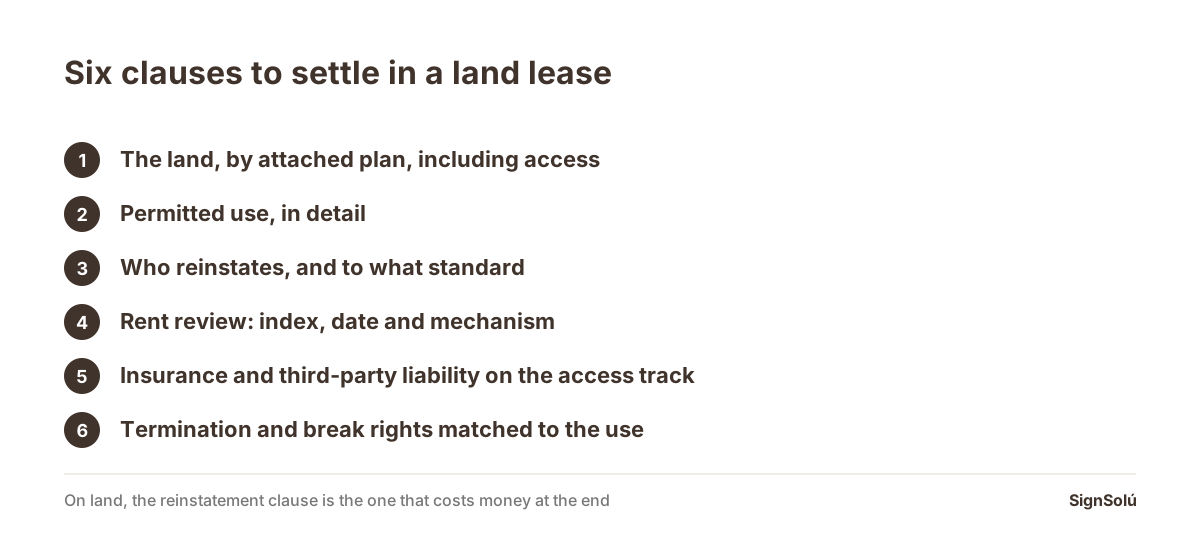
- 1The land, by plan. A land lease without a plan attached and referenced in the parcels clause is an argument waiting for a boundary dispute. Describe access as well as the plot.
- 2Permitted use, in detail. Grazing, arable, storage, hardstanding, a mast, a container, an array: each has different consequences for rates, planning and reinstatement.
- 3Who reinstates, and to what standard. On land, the end-of-term obligation is usually removal and restoration rather than repair. Say what «restored» means.
- 4Rent review, if the term is long. Index, open market or fixed uplift, with the date and the mechanism.
- 5Insurance and liability for anything brought onto the land, including who covers third parties on the access track.
- 6Termination and break rights, with notice periods that match the use: a grazing season is not a calendar year.
A document with those clauses laid out is the land lease agreement. If what you want is a short, in-possession let at a market rent, the lease agreement covers it, and for a rolling arrangement, the month-to-month lease agreement. If you are changing an existing lease, the form is the lease addendum; if you are extending it, the lease extension agreement; and if you are ending it, the lease termination letter. A residential let in England follows a different regime entirely since May 2026: the tenancy agreement template. If the plot is being bought rather than leased, the document is the purchase agreement template; if the arrangement is lease-to-own, the clauses that decide its legal category are in the lease-to-own contract template; and for land in Mexico, where a foreigner faces a different set of rules altogether, buying land in Mexico as a foreigner.
Signing the paperwork around the lease
A land letting generates more documents than the lease. Heads of terms before the lawyers start. A licence for early access while the lease is drafted. A rent review memorandum. A side letter about the access gate. A consent to assign. A surrender at the end. None of those is a conveyance of a legal estate, so none of them needs the deed ceremony, and all of them get signed by people who are rarely in the same county.
With SignSolú those documents go out over WhatsApp from your own number or by email, each party signs from a phone without creating an account or paying anything, and the audit receipt records the time, the IP address, the device and the SHA-256 hash of the file, with each signature timed separately. Anyone can check later that the document did not change at the verification page, with no account, which is what makes a rent review memo or a consent to assign easy to prove years afterwards. The sender picks each signer’s language. A deed still needs its attesting witness under section 1(3), and registration at HM Land Registry is a separate step. The general question of an electronic contract’s validity is covered in is an electronic contract valid, and for a counterparty in Mexico, in is an electronic signature valid in Mexico and how to sign a contract remotely with someone in Mexico. The free plan is 10 documents with no expiry and no card; start at register.
Frequently asked questions
Does a land lease have to be in writing?
Section 54(2) of the Law of Property Act 1925 preserves the creation by parol of leases taking effect in possession for a term not exceeding three years at the best rent reasonably obtainable without a fine. Writing is still the sensible choice, but above three years section 52(1) requires a deed, not just writing.
What makes a lease a deed?
Section 1 of the Law of Property (Miscellaneous Provisions) Act 1989. The instrument must make clear on its face that it is intended to be a deed, and under subsection (3) an individual must sign it in the presence of a witness who attests the signature, and it must be delivered as a deed.
When does a land lease have to be registered?
Section 27(2)(b) of the Land Registration Act 2002 requires registration for the grant of a term of more than seven years from the date of the grant, for a grant taking effect in possession after the end of the period of three months beginning with the grant, and for one under which the right to possession is discontinuous.
What happens if a long lease is never registered?
Section 27(1) says the disposition does not operate at law until the registration requirements are met. The parties may still have rights between themselves, but the legal estate the lease was meant to create has not come into existence, which usually surfaces on a sale or a charge.
Does a peppercorn rent affect the three-year exception?
Yes. Section 54(2) applies only at the best rent which can be reasonably obtained without taking a fine. A nominal rent, a below-market rent or a premium taken at the start puts the arrangement outside the exception, so a deed is needed.
Can the documents around a land lease be signed electronically?
Heads of terms, licences, rent review memoranda, consents and side letters are ordinary contracts and are routinely signed electronically, with the evidence of who signed and when attached to the file. A deed is the exception: section 1(3) requires a witness who attests the signature.
Send your next contract to Mexico for signature
Create a free account and send 10 documents with no card. Your dashboard works in English. You set the language per signer, and their email, WhatsApp message and signing page arrive in that language.