Lease-to-own contract template: the two clauses that turn it into a credit sale
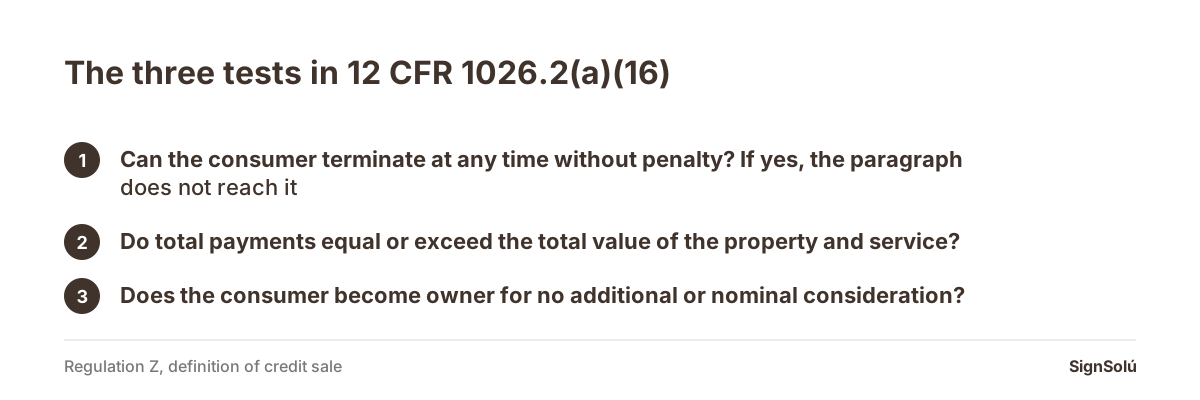
A document titled «lease» is not automatically a lease under federal consumer-credit rules. Regulation Z, at 12 CFR 1026.2(a)(16), defines a credit sale to include a bailment or lease — unless it is terminable without penalty at any time by the consumer — under which the consumer agrees to pay as compensation for use a sum substantially equivalent to or in excess of the total value of the property, and will become, or has the option to become, the owner for no additional or nominal consideration on complying with the agreement. So two clauses decide the category: what the purchase option costs at the end, and whether the consumer can walk away at any time without a penalty.
Why the label on the document does not settle it
Search for a lease-to-own contract template and you get a rental agreement with a purchase clause bolted on the end. The heading says lease. The payment schedule looks like rent. And the final clause says that after the last payment the renter owns the item, or can buy it for a dollar. That last clause is the one that moves the whole document into a different body of law.
The definition that does the work sits in Regulation Z, the rule that implements the Truth in Lending Act. Paragraph (a)(16) of 12 CFR 1026.2 says a credit sale means a sale in which the seller is a creditor, and that the term includes a bailment or lease (unless terminable without penalty at any time by the consumer) under which the consumer meets two conditions at once.
- 1Agrees to pay as compensation for use a sum substantially equivalent to, or in excess of, the total value of the property and service involved; and
- 2Will become (or has the option to become), for no additional consideration or for nominal consideration, the owner of the property upon compliance with the agreement.
Both have to be true, and the parenthesis at the front is a third condition that cuts the other way: if the consumer can end the arrangement at any time without a penalty, the paragraph does not catch it, however the numbers look.
| What the template says | Payments add up to | Walk-away right | Credit sale under (a)(16)? |
|---|---|---|---|
| Buy at the end for $1 | About the value of the item | Penalty if you leave early | Yes |
| Buy at the end for fair market value | About the value of the item | Penalty if you leave early | Not on this limb: the price is not nominal |
| Buy at the end for $1 | Well under the value of the item | Penalty if you leave early | Not on this limb: not substantially equivalent |
| Buy at the end for $1 | About the value of the item | End at any time, no penalty | No: the parenthesis excludes it |
| No purchase option at all | Anything | Either way | No: condition (ii) fails |
What changes if it is a credit sale
The practical answer is paperwork. A credit sale that is consumer credit comes with disclosure duties under Regulation Z — the amount financed, the finance charge, the annual percentage rate, the payment schedule, the total of payments — and a creditor is defined in paragraph (a)(17) of the same section as a person who regularly extends consumer credit that is subject to a finance charge or is payable by written agreement in more than four installments, and to whom the obligation is initially payable.
Note the two words doing the limiting: consumer and regularly. Regulation Z aims at credit offered to a consumer primarily for personal, family or household purposes, which paragraph (a)(12) spells out. A one-off lease-to-own of a forklift between two companies is a commercial transaction and a different question entirely. The shape of that document is the equipment lease agreement.
Real property is a second layer, not the same one
When the thing being leased-to-own is a house, the federal consumer-credit question sits on top of state law on executory contracts for the sale of land, which in several states imposes recording duties, annual accountings and limits on forfeiture. Those rules are state by state and change often; this piece does not summarise them, and a lease-to-own of a home is the case where asking a local real-estate lawyer earns its fee.
The four clauses to settle before anyone signs
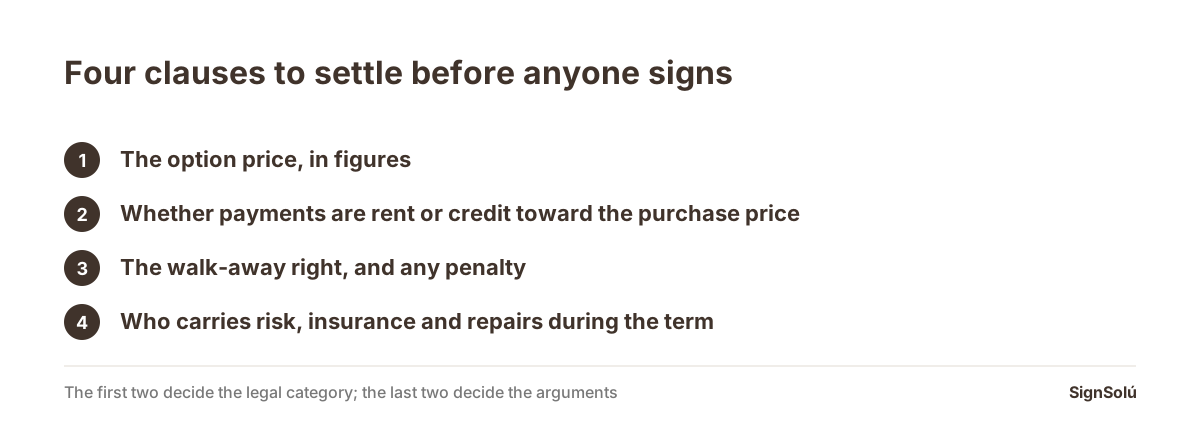
- 1The option price, in figures. A nominal price and a fair-market price are different documents with different consequences. Write the number or the formula, not «to be agreed».
- 2What happens to the payments. Are they rent, or are they credit toward the purchase price? Say which, and say what portion. This is the line that decides what the renter loses by leaving.
- 3The walk-away right. If the consumer can end it at any time with no penalty, say so plainly, because that sentence is doing legal work. If there is a penalty, state it.
- 4Who carries risk, insurance and repairs while the item is in the renter’s hands. The lease half of the document still has to work; the clauses are the same ones that matter in an ordinary lease agreement.
A template with those four written out, rather than implied, is the rent-to-own contract template. If what you actually want is a straight sale with payments, the document is the purchase agreement template plus a bill of sale at handover. If you want a rental with no purchase at the end, use the month-to-month lease agreement or the lease agreement, and if you are changing an existing one, the lease addendum.
Who the creditor is, and why «regularly» matters
Paragraph (a)(17) of the same section defines a creditor as a person who regularly extends consumer credit that is subject to a finance charge or is payable by written agreement in more than four installments (not including a down payment), and to whom the obligation is initially payable, either on the face of the note or contract, or by agreement when there is no note or contract.
Two things follow for a small business. First, the four-installment test is an alternative to the finance-charge test, not an addition to it: an agreement with no interest at all can still be payable in more than four installments and meet that limb. Second, «regularly» is doing real work — a landlord who sells one property this way is in a different position from a company whose whole model is lease-to-own, and the disclosure obligations scale accordingly.
Which is why the practical advice is not «avoid the category» but «know which one you are in before you print a hundred copies of a template». A business that is in it designs the paperwork once and reuses it; a one-off seller is usually better served by a plain sale on terms, with the purchase agreement template and a promissory note, than by a lease that behaves like a sale.
What the renter should read first
From the other side of the table, three numbers decide whether a lease-to-own is a good deal: the total of all payments, the market price of the same item today, and what happens to the money already paid if you stop. If the first is far above the second and the answer to the third is «nothing comes back», the arrangement is a financing cost dressed as rent — which may still be the right call when no other credit is available, but it should be a decision rather than a surprise.
The ending nobody drafts
Lease-to-own arrangements usually end one of three ways, and two of them are not the purchase. Someone leaves early, someone stops paying, or the term runs out and nobody exercises the option. Each of those needs a document, and writing them at the start is cheaper than negotiating them later: the lease termination letter for an agreed exit, the lease extension agreement when both sides want more time, and a short written settlement when money is in dispute.
What happens when a tenant walks away from a fixed term, and what is actually owed, is set out in what happens if you break a lease. The background on the lease half of the document is in breaking a lease.
Signing it, and keeping proof of what was signed
An agreement of this kind usually gets signed away from a desk: the renter is at the property or in the yard, the owner is somewhere else, and both want it done today. An electronic signature is fine for an ordinary contract of this type, and what decides a later argument is not the ink but the record: who signed, when, and proof the file did not change afterwards. The general point is in is an electronic contract valid and, for a contract with a Mexican counterparty, in is an electronic signature valid in Mexico.
With SignSolú the agreement goes out over WhatsApp from your own number or by email, each party signs from a phone without creating an account or paying anything, and the audit receipt records the time, the IP address, the device and the SHA-256 hash of the file, with each signature timed separately. Anyone can check later that the document did not change at the verification page, with no account. The sender picks each signer’s language, so a signer who reads English gets the email, the WhatsApp message and the signing page in English. SignSolú is not an accredited certification provider in Mexico and does not issue NOM-151 conservation certificates. The free plan is 10 documents with no expiry and no card; start at register.
Frequently asked questions
Is a lease-to-own agreement a lease or a sale?
It depends on the clauses. Under 12 CFR 1026.2(a)(16), a bailment or lease counts as a credit sale when the consumer pays a sum substantially equivalent to or in excess of the value of the property and will become, or may become for nominal consideration, the owner on compliance — unless the consumer can terminate at any time without penalty.
Does a one-dollar purchase option matter?
Yes. It is the clearest example of becoming the owner «for no additional consideration or for nominal consideration», which is the second condition in the definition. A purchase option at fair market value is a different case on that limb.
What is the effect of a no-penalty cancellation clause?
The definition in paragraph (a)(16) excludes a bailment or lease that is terminable without penalty at any time by the consumer. If your document really gives that right, the paragraph does not reach it, so the clause is worth writing precisely rather than leaving to inference.
Does this apply to a business leasing equipment?
Regulation Z is about consumer credit, which paragraph (a)(12) defines as credit offered or extended to a consumer primarily for personal, family or household purposes. A lease-to-own between two businesses is a commercial transaction and sits outside that definition.
Is a rent-to-own house the same analysis?
The federal consumer-credit question is the same, but state law on executory contracts for the sale of land adds recording duties, accounting duties and limits on forfeiture in several states. Those vary and are not covered here.
Can a lease-to-own agreement be signed electronically?
For an ordinary agreement of this kind, yes, and what matters afterwards is the evidence attached to the signature: who signed, when, and proof the file is unchanged. An audit receipt that records the time, IP address, device and file hash of each signature does that job.
Send your next contract to Mexico for signature
Create a free account and send 10 documents with no card. Your dashboard works in English. You set the language per signer, and their email, WhatsApp message and signing page arrive in that language.