LLP agreement template: the ten rules that decide for you if you never write one
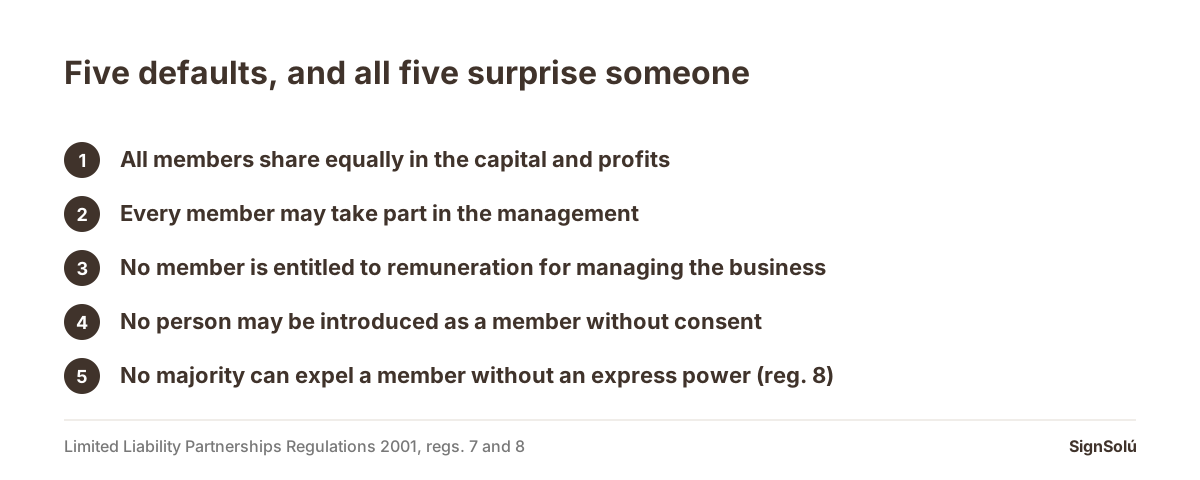
An LLP with no written agreement is governed by the default provisions in regulation 7 of the Limited Liability Partnerships Regulations 2001, and they are not neutral. All members share equally in the capital and profits, no member is entitled to remuneration for managing the business, every member may take part in management, and a new member cannot be introduced without consent. Regulation 8 is the one that catches people: «No majority of the members can expel any member unless a power to do so has been conferred by express agreement between the members». Everything a template is for is overriding the defaults you did not want.
The gap-filler nobody reads until there is a dispute
Two people incorporate an LLP, split the work unevenly, agree the numbers over coffee and never write it down. The LLP still has a constitution: regulation 7 of the Limited Liability Partnerships Regulations 2001 applies subject to general law and to any LLP agreement, which means it applies in full where there is no agreement, and in part where the agreement is silent. It is not a penalty for being disorganised; it is just a set of choices made for you.
Read the ten and you will see why they fit so few real businesses: they assume equal partners who all work in the business, none of whom is paid for managing it, and none of whom can be removed.
| The default | What regulation 7 says | What founders usually want instead |
|---|---|---|
| Capital and profits | All members share equally | Shares that follow capital, effort or seniority |
| Management | Every member may take part in the management | Defined roles and a decision threshold |
| Pay for managing | No member is entitled to remuneration for acting in the business or management | A members’ drawing or salary for the working members |
| New members | No person may be introduced as a member without consent | An agreed admission process |
| Ordinary decisions | Decided by majority; the nature of the business cannot be changed without unanimity | A written list of reserved matters |
| Books and records | Available for inspection at the registered office; members may inspect and copy | Usually kept, with a notice period |
| Competing business | A member carrying on a competing business without consent must hand over the profits | An explicit non-compete and its limits |
| Expulsion | No majority can expel a member without an express power (reg. 8) | A defined exit and expulsion mechanism |
The four defaults that cause the most damage
1. Equal shares, regardless of what anyone put in
The first default entitles all the members to share equally in the capital and profits. If one member funded the business and the other brought time, or if one works four days a week and the other one, the default flattens that. It is also the hardest thing to fix retrospectively, because by the time it matters there is money on the table and no one is neutral about the split. The same trap in a supplier relationship is priced rather than split, and its terms live in conditions and terms.
2. Nobody gets paid for running it
Regulation 7 says no member shall be entitled to remuneration for acting in the business or management of the LLP. In a two-member LLP where one member runs operations full time and the other is passive, that default means the working member’s reward comes only out of an equal profit share, which is the arrangement they almost certainly did not intend. Writing a members’ drawing into the agreement is a one-paragraph fix, and it belongs next to the payment mechanics you would write for any ongoing service: an annual maintenance contract handles the same question for a supplier.
3. No power to remove anyone
Regulation 8 is the shortest and the most consequential: «No majority of the members can expel any member unless a power to do so has been conferred by express agreement between the members». No amount of bad behaviour creates that power after the fact. If an LLP of three wants the ability to remove a member who stops working, the power has to exist in writing beforehand, with its grounds and its process. The employment-side equivalent of that discipline is in terminating an employee, and it is the same lesson: the mechanism has to exist before you need it.
4. Open books, and a duty to account
Two of the defaults work together. The books and records are to be made available for inspection at the registered office, where members may inspect and copy them; and each member must render true accounts and full information of all things affecting the LLP to any member or their legal representatives. Those are reasonable, and most agreements keep them. What agreements add is a notice period, so inspection is a process rather than an ambush.
There are two more worth knowing because they bite quietly. A member who, without the LLP’s consent, carries on any business of the same nature must account for the profits of that business. And every member must account to the LLP for any benefit derived without consent from transactions concerning the LLP or from use of its property, name or business connection. Those two are the default version of a non-compete and a conflicts policy, and they are narrower than what most founders think they have. If you want a real restriction, it goes in the agreement, next to the confidentiality clause: what an NDA is and what it does and a non-disclosure agreement template.
What to write, in the order arguments happen
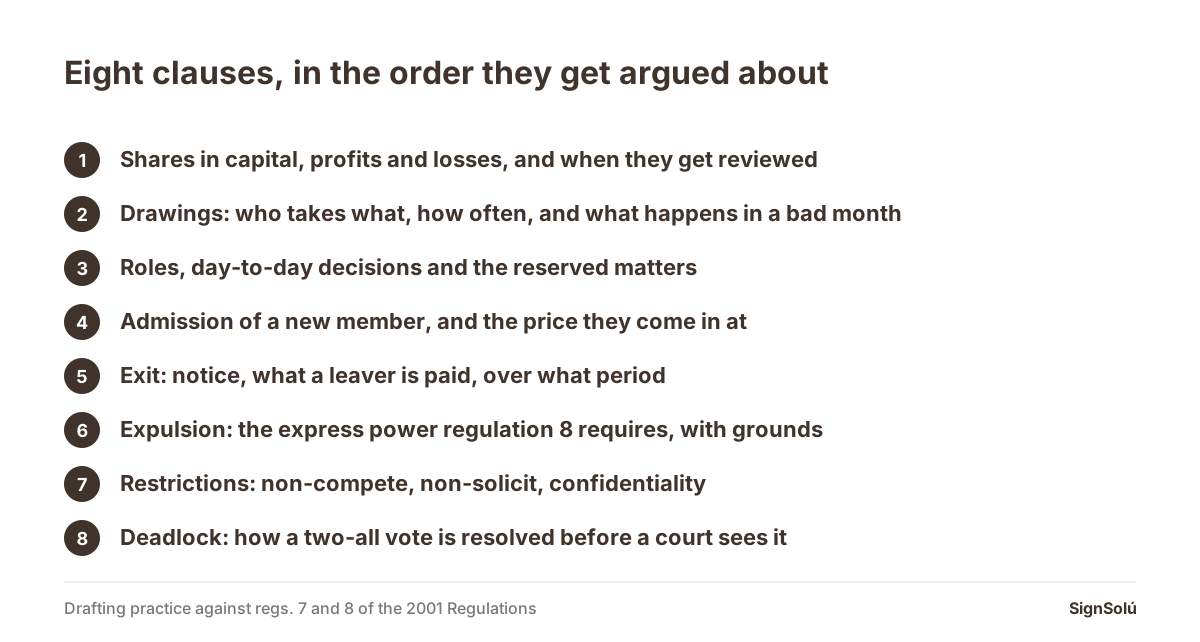
- 1Shares in capital, profits and losses, as numbers or as a formula, and when they get reviewed.
- 2Drawings. Who takes what, how often, and what happens in a bad month.
- 3Roles and decisions. Who decides day to day, and the reserved matters that need everyone.
- 4Admission of a new member and the price at which they come in.
- 5Exit. Retirement, notice, what a leaver is paid and over what period.
- 6Expulsion. The express power regulation 8 requires, with grounds and process. Without this clause, the power does not exist.
- 7Restrictions. Non-compete, non-solicit and confidentiality, with a scope you would be willing to defend.
- 8Deadlock and disputes. How a two-all vote gets resolved before it reaches a court. If the answer is arbitration, it needs its own clause: an arbitration agreement.
If this sounds like a partnership agreement, that is because it does the same job in a different vehicle: a partnership agreement contract covers the general shape, and the ready-made LLP version is an LLP agreement. Where one side is a contractor rather than a member, the right documents are an independent contractor agreement and independent contractor payment terms; and where the relationship is really employment, the Mexican side of that question is in hiring employees in Mexico.
What the defaults look like when a relationship ends
The defaults are tolerable while everyone is getting along, and they become the whole argument the moment someone wants out. Run the common scenario against them. Two members, no written agreement; one stops working but keeps his name on the register. Regulation 7 still entitles him to an equal share of the profits, because the equal split does not depend on effort. Regulation 7 still says the member who is doing all the work is not entitled to remuneration for managing the business. And regulation 8 says the other member cannot be expelled, because no express power was ever conferred.
That is not a loophole; it is the position the law leaves you in when nobody chose otherwise. The way out is usually a negotiated retirement at a price nobody is happy with, or dissolution of the LLP, which is expensive and public in a way the members never intended. An agreement written at incorporation, when everyone is friendly and nothing is at stake, is the cheapest insurance in the whole structure, and the clause that earns its keep is the expulsion power that regulation 8 refuses to supply.
Two drafting habits that make the difference. First, write the leaver economics as a formula rather than a number, so it survives three years of growth: a multiple of profit share, or capital account plus a share of work in progress. Second, separate the grounds for expulsion from the process for it; agreements that bundle them produce a fight about whether the process was followed instead of about whether the grounds existed.
Signing it, and the version problem
An LLP agreement is an ordinary contract between the members, so nothing requires ink. Section 7 of the Electronic Communications Act 2000 makes an electronic signature «incorporated into or logically associated with a particular electronic communication» admissible in evidence in relation to any question as to the authenticity or the integrity of the communication or data. What that rewards is a record, and that is exactly what an LLP agreement usually lacks: the version that went round by email three times, with two people signing page 14 of different drafts.
SignSolú, an e-signature platform that works over WhatsApp, closes that gap by making the signed version the authoritative one: you send the agreement from your own number or by email, each member opens the link on their phone and signs without creating an account or paying anything, and the audit receipt records time, IP address, device and a SHA-256 fingerprint of the file. Anyone can confirm later at the verification page that the document was not altered, without an account. The free plan is 10 documents with no expiry and no card, which covers an incorporation and its first amendments; you can start at create an account. The mechanics without a printer are in how to sign a PDF and signing a document in Word.
One cross-border note. If the LLP is going to trade with Mexico — a supplier, a developer, a maquila — the Mexican side has its own formalities and its own language rule: is an electronic signature valid in Mexico, an NDA with a Mexican supplier, the services contract with a developer in Mexico and bilingual contracts and which language prevails.
Frequently asked questions
Does an LLP need a written members’ agreement?
It can exist without one, but it will not be ungoverned. The default provisions in regulation 7 of the Limited Liability Partnerships Regulations 2001 apply subject to general law and to any LLP agreement, so with no agreement they apply in full, and where an agreement is silent they fill the gap.
How are profits split if we never agreed a split?
Equally. The first default in regulation 7 entitles all the members to share equally in the capital and profits, regardless of who put in the money or who does the work.
Can I be paid for running the LLP?
Not by default. Regulation 7 says no member shall be entitled to remuneration for acting in the business or management of the LLP. If a working member is to draw something, the agreement has to say so.
Can the other members expel me?
Not unless the agreement gives them that power. Regulation 8 is explicit: no majority of the members can expel any member unless a power to do so has been conferred by express agreement between the members.
Can a member run a competing business on the side?
Regulation 7 does not prohibit it outright; it says a member who carries on any business of the same nature without the LLP’s consent must account for the profits of that business. If you want a genuine restriction rather than a profit claw-back, it has to be written as a restrictive covenant.
Can the agreement be signed electronically?
Yes. It is an ordinary contract between the members, and section 7 of the Electronic Communications Act 2000 makes an electronic signature logically associated with the communication admissible in evidence on questions of authenticity and integrity. The practical gain is that one signed version becomes the authoritative one.
Send your next contract to Mexico for signature
Create a free account and send 10 documents with no card. Your dashboard works in English. You set the language per signer, and their email, WhatsApp message and signing page arrive in that language.