Independent contractor contract: who qualifies and what to include
Reviewed in October 2026
An independent contractor is a person or business that provides services to clients without being their employee. The contractor controls how the work is done, uses their own tools and pays their own taxes. The contract sets the work, the pay and the independence of the relationship.
Contractor or employee: how the IRS decides
The IRS looks at the whole relationship and groups the evidence in three areas. No single factor decides the case.
| Area | What the IRS asks | Points to contractor |
|---|---|---|
| Behavioral control | Does the company control what the worker does and how? | Worker decides methods, hours and tools |
| Financial control | Does the company control the business side of the work? | Own investment, own expenses, several clients, profit or loss |
| Type of relationship | How do the parties see the relationship? | Written contract, no benefits, work is not a core ongoing role |
A contract that says «independent contractor» helps, but it does not decide alone. What happens in practice counts more than the label.
If the answer is unclear, either party can ask the IRS to decide by filing Form SS-8. Several states apply their own, stricter tests for wage and unemployment laws.
Why classification matters
- Employers withhold income tax and pay Social Security, Medicare and unemployment taxes for employees.
- Contractors pay self-employment tax on their own.
- Employees are covered by minimum wage, overtime and many benefits laws.
- Misclassifying an employee can bring back taxes, penalties and claims for unpaid overtime.
What an independent contractor contract includes
- 1Parties. Legal names and addresses, and the contractor business name if any.
- 2Services. What the contractor delivers, described by result, not by hours of supervision.
- 3Payment. Fixed fee, rate or milestones, and when invoices are paid.
- 4Expenses. Who pays for tools, travel and materials.
- 5Independence. The contractor controls methods, schedule and place of work.
- 6Taxes and benefits. The contractor pays their own taxes and receives no employee benefits.
- 7Ownership of work. Who owns what the contractor creates.
- 8Confidentiality. What the contractor must keep secret.
- 9Term and termination. How long it lasts and how either side ends it.
- 10Insurance. Liability insurance the contractor must carry, if any.
The first clauses of the contract
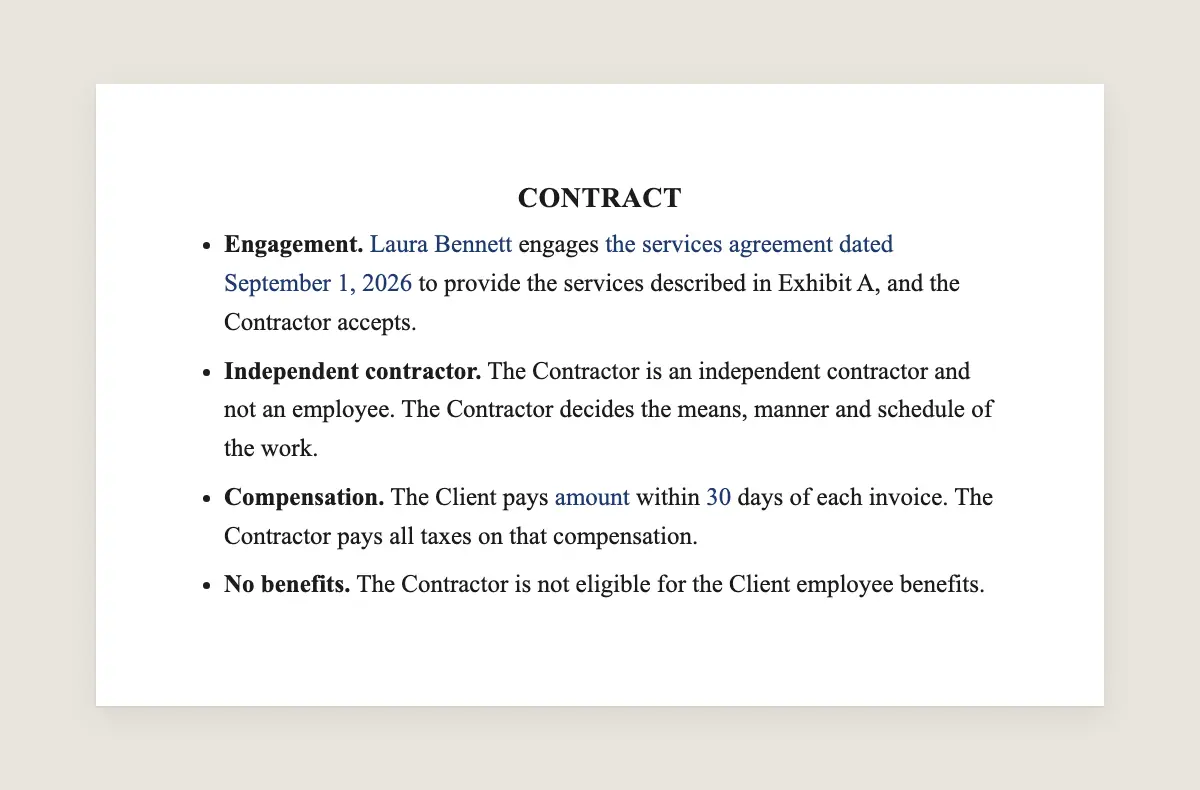
- 1Engagement. [Client name] engages [contractor name] to provide the services described in Exhibit A, and the Contractor accepts.
- 2Independent contractor. The Contractor is an independent contractor and not an employee. The Contractor decides the means, manner and schedule of the work.
- 3Compensation. The Client pays [amount or rate] within [number] days of each invoice. The Contractor pays all taxes on that compensation.
- 4No benefits. The Contractor is not eligible for the Client employee benefits.
Use the full independent contractor agreement
Tax forms around the contract
- Form W-9. The contractor gives the client their taxpayer identification number before the first payment.
- Form 1099-NEC. The client reports payments to the contractor above the IRS threshold after the year ends.
- Form SS-8. Either party asks the IRS to decide the worker status.
SignSolú can ask the contractor for the W-9 as an extra file in the same step as the signature, so the client has it before the first invoice.
Common mistakes
- 1Treating a contractor like staff. Set hours, a desk, a company email and training point to employment.
- 2No written contract. The relationship is defined by habit, which favors employment.
- 3Open-ended work with no project. A contractor doing the same core job for years looks like an employee.
- 4No ownership clause. The client pays for work it may not own.
- 5Paying without a W-9. The client may have to withhold backup tax.
An example
A dental office hires a designer to redo its website for a fixed fee. The designer works from home, uses her own computer, sets her own hours and has other clients.
The office signs a contract with the scope, the price and an ownership clause, and receives her W-9 in the same step. She sends an invoice when the site goes live.
How to sign an independent contractor agreement online
Upload an independent contractor agreement to SignSolú or start from a template. Add each signer with a name and a phone number or email.
Each signer gets a link by WhatsApp or email. On a phone they tap the brown bar at the bottom that says «Sign as …».
They draw their signature once with a finger and press «Sign and Send». Every place in the document that needs it gets filled.
A line next to that button records their consent to sign electronically, with a link to the disclosure.
The signed PDF ends with an audit certificate. It shows each signer, the time, the IP address and a SHA-256 hash of the file.
Want your signature as an image for other files? Create your signature online and download it as a transparent PNG, free.
An example of a misclassified worker
A delivery company pays drivers as contractors but sets their routes, hours and uniforms, and they work only for that company. An audit finds they are employees.
The company owes back payroll taxes and overtime. A written contract did not help, because the facts pointed the other way.
Checklist before you hire a contractor
- The work is a defined project or result, not an open-ended role.
- The contractor decides how, when and where to do the work.
- The contractor uses their own tools and covers their own expenses.
- The contractor can work for other clients.
- The contract states the pay, the ownership of work and the end date.
- You have the W-9 before the first payment.
Ending the relationship
A contractor relationship ends under the contract, not through employment rules. Give the notice the contract sets and pay for work delivered up to that date.
Ask for the return of any company equipment and data, and confirm in writing that confidential information was returned or deleted.
Contractors in other countries
Every country has its own test to tell contractors from employees. A contractor abroad is usually governed by the law of the place where they work.
The contract can still be signed electronically in most countries. Check the law of the contractor country before you sign.
People also ask
What is an independent contractor?
A person or business that provides services to clients under a contract, controls how the work is done and is not an employee.
Do independent contractors need a contract?
It is not always required, but a written contract protects both sides and documents the independence of the relationship.
How do independent contractors pay taxes?
They pay income tax and self-employment tax themselves, usually with quarterly estimated payments.
Can an independent contractor work for only one client?
Yes, but it is one factor that can point to employment. The full relationship decides.
What is the difference between a 1099 and a W-2 worker?
A 1099 worker is a contractor paid without withholding. A W-2 worker is an employee whose employer withholds taxes.
What should an independent contractor invoice include?
The contractor name and address, the client name, the invoice number and date, the services delivered, the amount, the payment terms and how to pay.
Can I pay an independent contractor hourly?
Yes. Hourly pay alone does not make someone an employee, although payment by result points more clearly to a contractor.
Do independent contractors need insurance?
The law rarely requires it, but many clients ask for general liability or professional liability insurance in the contract.
Does a contractor need a business license?
It depends on the city, state and type of work. Many contractors register a business name and get the local licenses their trade requires.
Can a contractor sign a non-compete?
Some states limit or ban non-competes. A non-solicit or confidentiality clause is often a safer way to protect the client.
Who provides equipment to an independent contractor?
Usually the contractor. If the client supplies the tools, it is one more sign that points to employment.
Is a freelancer the same as an independent contractor?
In most cases, yes. Freelancer is the everyday word, and independent contractor is the legal term.
Can an independent contractor have a set schedule?
If the client sets the hours, that points to employment. Contractors usually choose their own schedule to meet a deadline.
Do independent contractors get paid overtime?
No. Overtime rules protect employees. Contractors are paid what the contract says.
Can a contractor become an employee later?
Yes. If the relationship changes, sign an employment contract and start payroll from that date.
Related templates and guides
Sources
- IRS, «Independent contractor (self-employed) or employee?»
- ESIGN Act, 15 U.S.C. 7001, on govinfo.gov
Frequently asked questions
Who decides if a worker is a contractor?
The facts of the relationship. The IRS looks at behavioral control, financial control and the type of relationship.
Does a contract make someone a contractor?
No, not by itself. It helps, but what happens in practice counts more.
Do I need a W-9 from a contractor?
Yes, before you pay them, so you can report payments correctly.
Can I sign a contractor agreement online?
Yes. The ESIGN Act recognizes electronic signatures on contracts.
Who owns the work a contractor creates?
What the contract says. Without a clause, the contractor often keeps the rights.
Can a contractor be fired?
The contract can be ended under its termination clause.