Freelance contract template: free in Word, or sign it online
Reviewed in October 2026
A freelance contract is the agreement between a freelancer and a client for a specific job. It sets the work, the deadline, the price and when you get paid. It also says who owns the final work and makes clear you are not an employee.
Ten documents free, no card. Signed by the freelancer and the client.
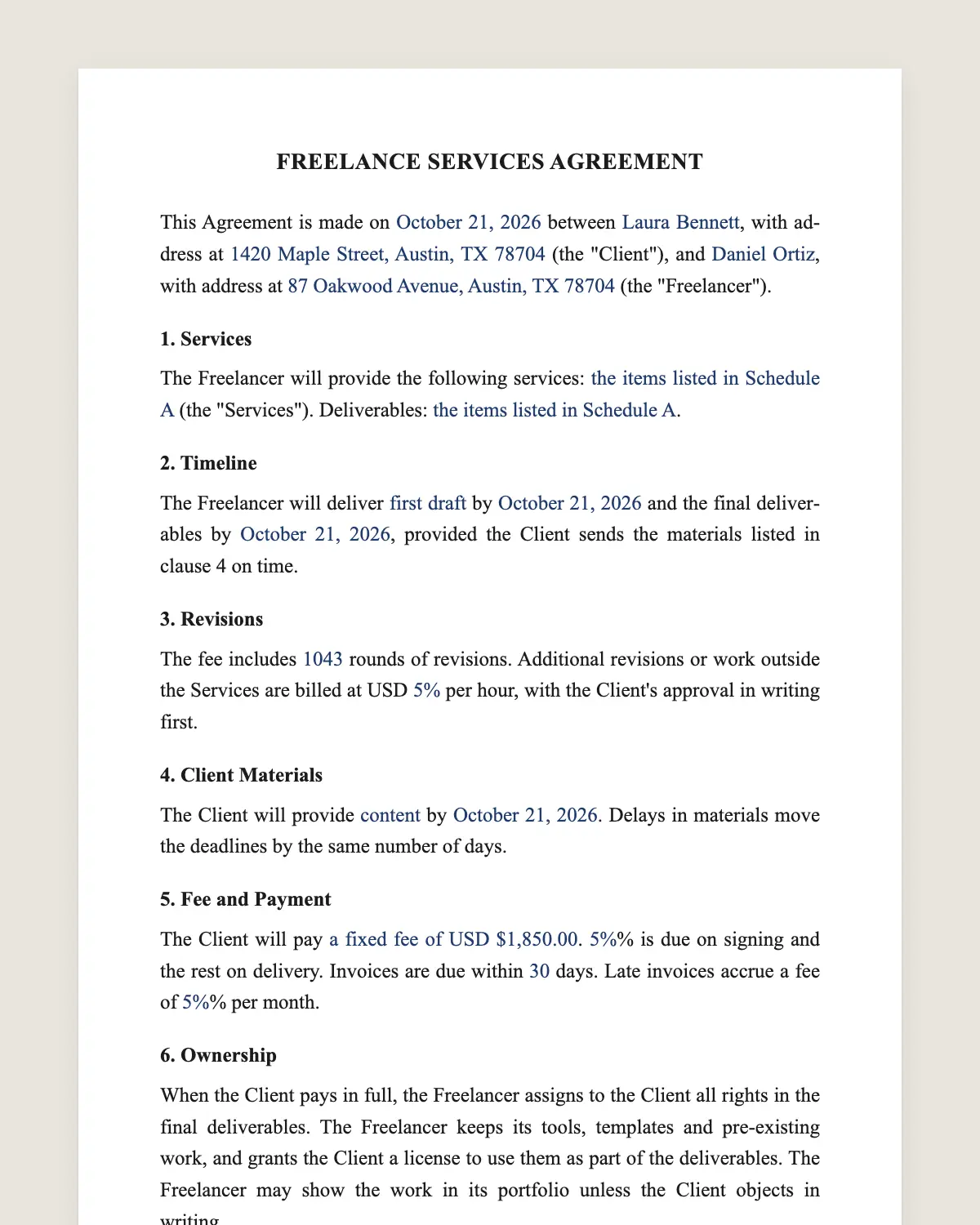
Example filled in with sample data
The full freelance contract
FREELANCE SERVICES AGREEMENT
This Agreement is made on [date] between [client name], with address at [address] (the "Client"), and [freelancer name], with address at [address] (the "Freelancer").
1. Services
The Freelancer will provide the following services: [description of the work] (the "Services"). Deliverables: [list of deliverables and formats].
2. Timeline
The Freelancer will deliver [first draft / milestone 1] by [date] and the final deliverables by [date], provided the Client sends the materials listed in clause 4 on time.
3. Revisions
The fee includes [number] rounds of revisions. Additional revisions or work outside the Services are billed at USD [rate] per hour, with the Client's approval in writing first.
4. Client Materials
The Client will provide [content, logins, brand files, feedback] by [date]. Delays in materials move the deadlines by the same number of days.
5. Fee and Payment
The Client will pay [a fixed fee of USD [amount] / USD [rate] per hour, up to [hours] hours]. [Percentage]% is due on signing and the rest on delivery. Invoices are due within [number] days. Late invoices accrue a fee of [rate]% per month.
6. Ownership
When the Client pays in full, the Freelancer assigns to the Client all rights in the final deliverables. The Freelancer keeps its tools, templates and pre-existing work, and grants the Client a license to use them as part of the deliverables. The Freelancer may show the work in its portfolio unless the Client objects in writing.
7. Independent Contractor
The Freelancer is an independent contractor, controls how the work is done, uses its own equipment and is responsible for its own taxes. Nothing in this Agreement creates an employment relationship.
8. Confidentiality
The Freelancer will keep the Client's non-public information confidential and use it only to perform the Services.
9. Termination
Either party may end this Agreement with [number] days written notice. The Client will pay for work done up to the termination date. The deposit is non-refundable once work has started.
10. Liability
The Freelancer's total liability under this Agreement is limited to the fees paid.
11. Governing Law and Signatures
This Agreement is governed by the laws of the State of [state]. The parties agree to sign it electronically.
Client
Name: [name]
Signature: ______________
Date: [date]
Freelancer
Name: [name]
Signature: ______________
Date: [date]
What the template includes
Names of the client and the freelancer
Services and deliverables
Deadlines tied to the client's materials
Rounds of revisions and extra work
Fee, deposit, invoice terms and late fee
Ownership of the work after payment
Portfolio rights
Independent contractor status
Confidentiality
Termination and payment for work done
Limit of liability and governing law
What you fill in
Field
Example
Client
Northwind Dental Group
Freelancer
Jamie Park
Services
Redesign of a 6-page website
Deliverables
Figma designs and a published WordPress site
Final deadline
December 5, 2026
Fee
USD 4,800 fixed, 50% on signing
Revisions
2 rounds
Extra work
USD 85 per hour
State
Oregon
How it gets signed
1Choose «Use this template», fill in the fields and review the full freelance contract.
2Send it by WhatsApp or email. The other party opens the link on their phone without an account.
3They tap the brown bar at the bottom that says «Sign as …» and draw their signature once.
4Everyone gets the signed PDF with its signature certificate. Anyone can check it at signsolu.com/verificar.
The signing screen tells each signer that signing means agreeing to sign electronically. It links to the electronic signature disclosure that the ESIGN Act asks for.
What you get once everyone signs
The signed PDF. The final freelance contract with every drawn signature in place.
The signature certificate. It lists each signer and the date and time of each signature.
A record you can check. The folio on the certificate opens the document history at signsolu.com/verificar.
Reminders. Turn them on and SignSolú reminds every signer who has not signed yet.
Your first ten documents are free and need no card.
What the law says
A freelance contract is a services contract under state law. No special form is required, but a written and signed contract settles most payment disputes.
The IRS looks at control, money and the relationship to decide if a worker is a contractor or an employee. Its guide on independent contractors explains the factors. Clause 7 reflects them, but the facts of the work decide.
Under federal copyright law, work by a freelancer usually belongs to the freelancer unless rights are assigned in writing. Clause 6 makes that assignment once the client pays.
The ESIGN Act, 15 U.S.C. 7001 gives an electronic signature the same legal effect as one on paper. A contract cannot be denied effect only because it was signed electronically.
Who uses a freelance contract
Any independent professional who works for clients by project. The template works for one job or for a recurring monthly service.
Designers and developers building websites, apps and brands.
Writers and translators working on articles, books and documents.
Photographers and video editors shooting and editing for businesses.
Consultants and virtual assistants billing by the hour.
How to get paid on time
Ask for a deposit. Thirty to fifty percent up front is common. It also filters out clients who are not ready.
Tie ownership to payment. Clause 6 transfers the rights only when the client pays in full.
Invoice on the milestone date. Send the invoice the same day you deliver. Waiting a week costs you a week.
Charge a late fee. A modest monthly fee gives clients a reason to pay before other vendors.
Stopping scope creep
Scope creep is the extra work that sneaks in without extra pay. It kills fixed-price projects.
List deliverables in clause 1 as concretely as you can. «A website» invites arguments. «Six pages, one contact form» does not.
When the client asks for more, quote it under clause 3 and wait for written approval. A one-line reply by email is enough.
Common mistakes
Starting before signing. Work done without a contract is hard to collect. Send the contract with the proposal.
Open revisions. «Revisions until happy» can mean twenty rounds. Put a number in clause 3.
Behaving like an employee. Fixed office hours and company equipment can change your status. Keep control of how you work.
Signing with a new client in minutes
Clients sign faster when signing takes one tap. Send the contract by WhatsApp or email right after the call.
Save your filled contract as your own template. The next client only needs the name, scope and fee changed.
Clients abroad can sign the same way. Set the currency in clause 5 and the governing law in clause 11 before you send it.
Ending a project early
Projects end early for many reasons. Budgets get cut and priorities change.
Clause 9 makes the client pay for work done up to that day. Keep a simple log of hours or milestones so the final invoice is easy to back up.
Before you sign
Read every clause of the freelance contract with the other party before anyone signs. Change what does not fit your deal.