Licensing agreement template: free in Word, or sign it online
Reviewed in October 2026
A licensing agreement lets someone use your intellectual property in exchange for a fee or royalty. You keep the ownership and set where, how and for how long it can be used. It works for trademarks, designs, software, photos, music and patents.
Ten documents free, no card. Signed by the licensor and the licensee.
Example filled in with sample data
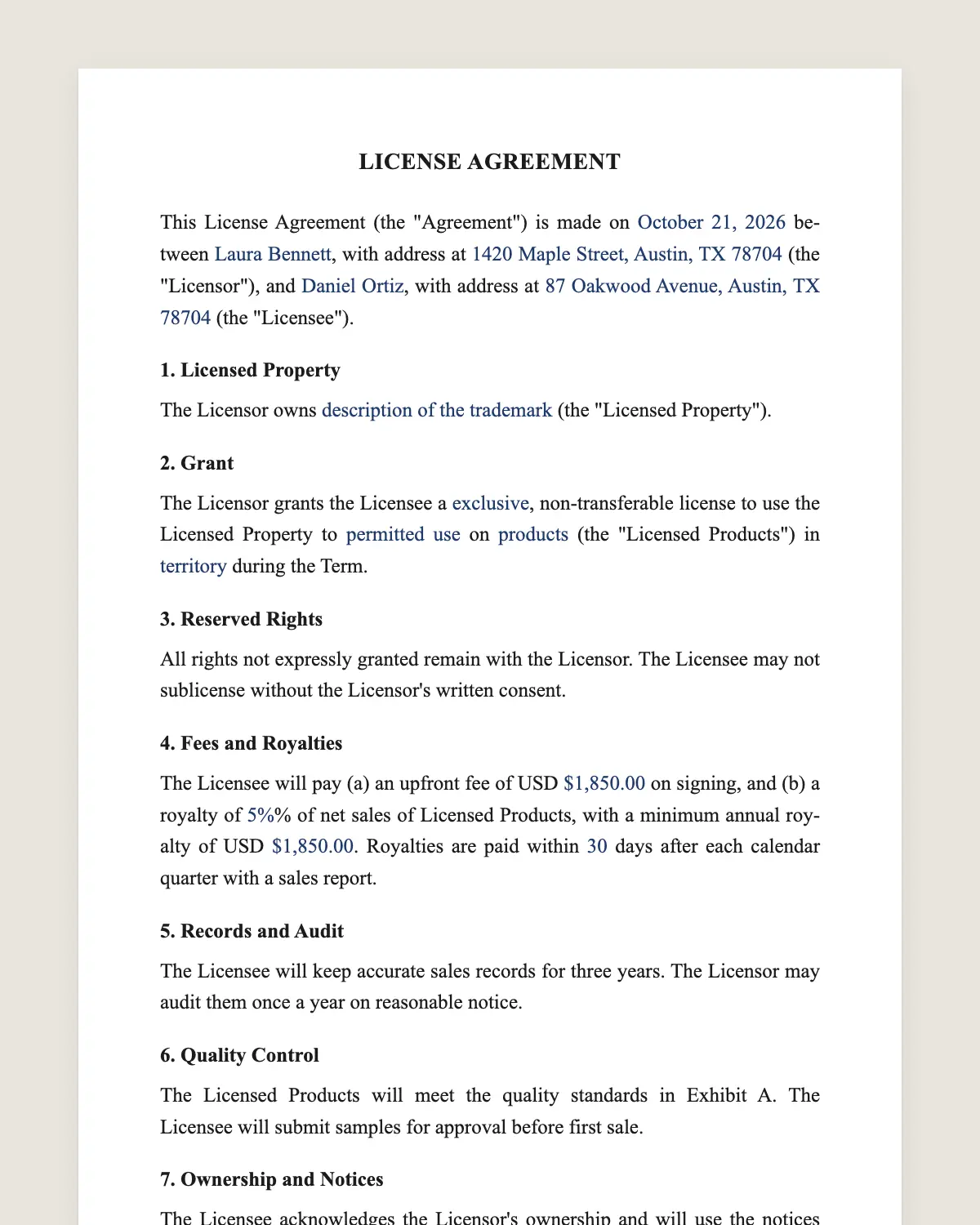
The full licensing agreement
LICENSE AGREEMENT
This License Agreement (the "Agreement") is made on [date] between [licensor name], with address at [address] (the "Licensor"), and [licensee name], with address at [address] (the "Licensee").
1. Licensed Property
The Licensor owns [description of the trademark, design, software, work or patent, with registration numbers if any] (the "Licensed Property").
2. Grant
The Licensor grants the Licensee a [exclusive / non-exclusive], non-transferable license to use the Licensed Property to [permitted use] on [products or services] (the "Licensed Products") in [territory] during the Term.
3. Reserved Rights
All rights not expressly granted remain with the Licensor. The Licensee may not sublicense without the Licensor's written consent.
4. Fees and Royalties
The Licensee will pay (a) an upfront fee of USD [amount] on signing, and (b) a royalty of [percentage]% of net sales of Licensed Products, with a minimum annual royalty of USD [amount]. Royalties are paid within [number] days after each calendar quarter with a sales report.
5. Records and Audit
The Licensee will keep accurate sales records for three years. The Licensor may audit them once a year on reasonable notice.
6. Quality Control
The Licensed Products will meet the quality standards in Exhibit A. The Licensee will submit samples for approval before first sale.
7. Ownership and Notices
The Licensee acknowledges the Licensor's ownership and will use the notices the Licensor specifies. Any goodwill from the use belongs to the Licensor.
8. Warranties and Indemnity
The Licensor warrants it has the right to grant this license. The Licensee will indemnify the Licensor against claims arising from the Licensed Products.
9. Term and Termination
This Agreement runs from [start date] to [end date]. Either party may terminate for a material breach not cured within 30 days of notice. On termination the Licensee will stop using the Licensed Property, except to sell existing stock for [number] days.
10. Governing Law and Signatures
This Agreement is governed by the laws of the State of [state]. The parties agree to sign it electronically.
Licensor
Name: [name]
Signature: ______________
Date: [date]
Licensee
Name: [name]
Signature: ______________
Date: [date]
What the template includes
Description of the licensed property and its registrations
Scope of the license, exclusive or not, and territory
Rights the licensor keeps and sublicensing
Upfront fee, royalty rate and minimum royalty
Quarterly reports and audit right
Quality control and sample approval
Ownership, notices and goodwill
Warranties and indemnity
Term, termination and sell-off period
Governing law and electronic signature
What you fill in
Field
Example
Licensor
Rosa Ibarra Illustration LLC
Licensee
Pinecone Paper Goods Inc.
Licensed property
Collection of 24 botanical illustrations
Type
Non-exclusive
Licensed products
Greeting cards and wall calendars
Territory
United States and Canada
Royalty
8% of net sales, minimum USD 3,000 a year
Term
January 1, 2027 to December 31, 2028
How it gets signed
1Choose «Use this template», fill in the fields and review the full licensing agreement.
2Send it by WhatsApp or email. The other party opens the link on their phone without an account.
3They tap the brown bar at the bottom that says «Sign as …» and draw their signature once.
4Everyone gets the signed PDF with its signature certificate. Anyone can check it at signsolu.com/verificar.
The signing screen tells each signer that signing means agreeing to sign electronically. It links to the electronic signature disclosure that the ESIGN Act asks for.
What you get once everyone signs
The signed PDF. The final licensing agreement with every drawn signature in place.
The signature certificate. It lists each signer and the date and time of each signature.
A record you can check. The folio on the certificate opens the document history at signsolu.com/verificar.
Reminders. Turn them on and SignSolú reminds every signer who has not signed yet.
Your first ten documents are free and need no card.
What the law says
Federal law protects trademarks, copyrights and patents. State contract law governs the license itself.
An exclusive copyright license is a transfer of rights under federal law. It must be in writing and signed by the owner to be valid. A non-exclusive license can be informal, but a written one avoids disputes.
Trademark owners must control the quality of licensed products. A license without quality control can weaken the mark. Clause 6 covers that duty.
The ESIGN Act, 15 U.S.C. 7001 gives an electronic signature the same legal effect as one on paper. A contract cannot be denied effect only because it was signed electronically.
Types of licensing agreements
Trademark license. A brand lets another company sell products under its name.
Copyright license. An artist, writer or photographer lets a business use a work.
Software license. A developer lets a company install or use a program.
Patent license. An inventor lets a manufacturer make a patented product.
Character or merchandise license. A creator lets a brand put characters on goods.
The template fits all of them. Describe the property in clause 1 and the use in clause 2.
Exclusive or non-exclusive
An exclusive license means only the licensee can use the property in that territory. Not even the owner can license it to others there.
A non-exclusive license lets the owner sign with as many licensees as they want. It usually pays less per deal.
Exclusive deals should carry a minimum royalty. Without it, a licensee can sit on the rights and sell nothing.
How royalties are calculated
Most licenses pay a percentage of net sales. Define net sales so returns and discounts are clear.
Rates depend on the industry. Consumer products often pay between 5% and 12%. Software and patents vary much more.
Ask for quarterly reports with units sold, gross sales and deductions. Report and payment travel together.
Common mistakes
No territory. Without one, the licensee may claim worldwide rights. Name the countries or regions.
No sell-off period. The licensee is left with stock it cannot sell. Thirty to ninety days is common.
Licensing what you do not own. Check that every image or design in the package is yours to license.
Skipping the samples. Approve the first production run before it ships. Fixing a bad product later costs more than a week of waiting.
How to track royalties after signing
Put the report dates in your calendar on the day you sign. Most disputes start with a missed quarter that nobody chased.
Compare each report against what you see in stores and online. A sudden drop in units deserves a question.
Use the audit right in clause 5 when numbers do not add up. Many licenses make the licensee pay the audit if it finds a shortfall above 5%.
Keep the signed license, every report and every payment in one folder. Renewal talks go faster with three years of numbers in hand.
Renewing or extending a license
Start talking three to six months before the end date. The licensee needs time to plan production and the licensor needs time to find a new partner.
A renewal with new rates or territory goes in a signed amendment. That keeps the original terms and the history in the same file.
Before you sign
Read every clause of the licensing agreement with the other party before anyone signs. Change what does not fit your deal.