SignSolú

Nondisclosure agreement template: free in Word, or sign it online

Reviewed in October 2026

A nondisclosure agreement (NDA) is a contract where one party promises to keep shared information private. Companies sign one before a pitch, a hire or a deal where they show plans, prices or code. This template is the one-way version, ready to fill in and sign online.

Ten documents free, no card. Signed by the disclosing party and the receiving party.

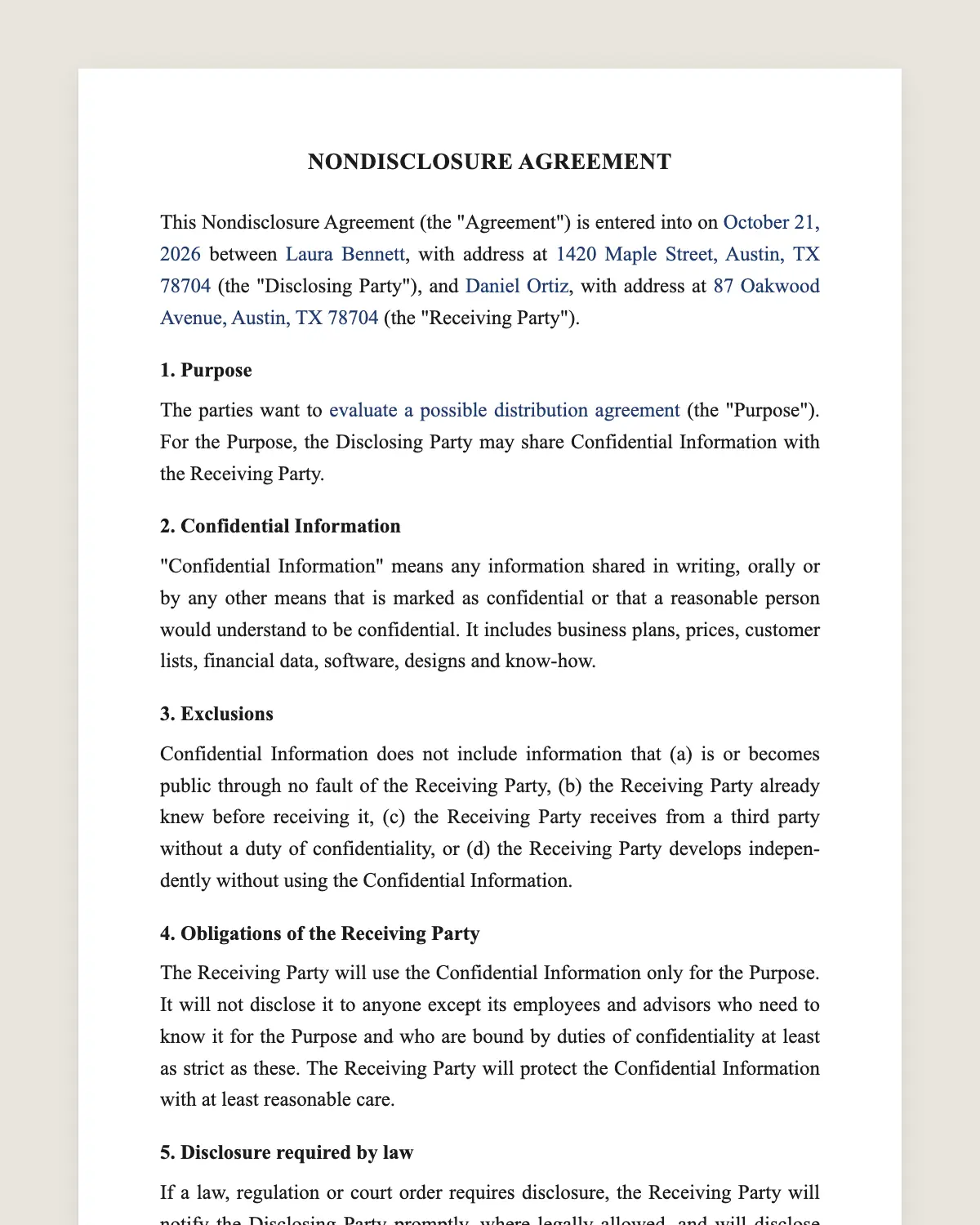
Nondisclosure agreement example, filled in with sample data
Example filled in with sample data

The full nondisclosure agreement

NONDISCLOSURE AGREEMENT

This Nondisclosure Agreement (the "Agreement") is entered into on [date] between [Disclosing Party name], with address at [address] (the "Disclosing Party"), and [Receiving Party name], with address at [address] (the "Receiving Party").

1. Purpose

The parties want to [purpose, for example evaluate a possible distribution agreement] (the "Purpose"). For the Purpose, the Disclosing Party may share Confidential Information with the Receiving Party.

2. Confidential Information

"Confidential Information" means any information shared in writing, orally or by any other means that is marked as confidential or that a reasonable person would understand to be confidential. It includes business plans, prices, customer lists, financial data, software, designs and know-how.

3. Exclusions

Confidential Information does not include information that (a) is or becomes public through no fault of the Receiving Party, (b) the Receiving Party already knew before receiving it, (c) the Receiving Party receives from a third party without a duty of confidentiality, or (d) the Receiving Party develops independently without using the Confidential Information.

4. Obligations of the Receiving Party

The Receiving Party will use the Confidential Information only for the Purpose. It will not disclose it to anyone except its employees and advisors who need to know it for the Purpose and who are bound by duties of confidentiality at least as strict as these. The Receiving Party will protect the Confidential Information with at least reasonable care.

5. Disclosure required by law

If a law, regulation or court order requires disclosure, the Receiving Party will notify the Disclosing Party promptly, where legally allowed, and will disclose only the part that is required.

6. Return or destruction

Within [10] days after the Disclosing Party asks, the Receiving Party will return or destroy all Confidential Information, including copies, and confirm it in writing.

7. Term

This Agreement starts on the date above and lasts [2] years. The duty of confidentiality survives for [3] years after the Agreement ends. Trade secrets stay protected for as long as they remain trade secrets under applicable law.

8. No license

Nothing in this Agreement grants the Receiving Party any license or ownership over the Confidential Information.

9. Remedies

A breach of this Agreement may cause harm that money alone cannot repair. The Disclosing Party may seek an injunction in addition to any other remedy available at law.

10. Whistleblower immunity notice

Under 18 U.S.C. 1833(b), an individual is not held criminally or civilly liable under any federal or state trade secret law for disclosing a trade secret (a) in confidence to a federal, state or local government official, or to an attorney, solely to report or investigate a suspected violation of law, or (b) in a complaint or other document filed under seal in a lawsuit. An individual who sues an employer for retaliation for reporting a suspected violation of law may disclose the trade secret to their attorney and use it in the court proceeding if the document is filed under seal and is not disclosed except by court order.

11. General terms

This Agreement is governed by the laws of [state]. It is the entire agreement between the parties on this subject and can be changed only in writing signed by both. The parties agree to sign this Agreement electronically, and an electronic signature has the same effect as a handwritten one.

DISCLOSING PARTY

Signature: ______________________

Name: [full name]

Title: [title]

Date: [date]

RECEIVING PARTY

Signature: ______________________

Name: [full name]

Title: [title]

Date: [date]

What the template includes

  • The purpose of sharing, written in one line
  • A definition of confidential information with common examples
  • The four standard exclusions courts expect to see
  • Use limited to the purpose and to people who need to know
  • Disclosure required by law or by a court order
  • Return or destruction of the information on request
  • Term of the agreement and how long secrecy lasts after it
  • No license over the information
  • Injunction as a remedy
  • The whistleblower immunity notice from 18 U.S.C. 1833(b)
  • Governing law, entire agreement and consent to sign electronically

What you fill in

FieldExample
DateOctober 21, 2026
Disclosing PartyNorthwind Foods LLC
Receiving PartyAna Torres
PurposeEvaluate a distribution agreement for Texas
Days to return the information10 days
Term2 years
Secrecy after the term3 years
Governing lawState of Texas

How it gets signed

  1. 1Choose “Use this template”, fill in the fields and read the full nondisclosure agreement once more.
  2. 2Send it by WhatsApp or email. The other party opens the link on their phone without an account.
  3. 3They tap the brown bar at the bottom that says “Sign as …” and draw their signature with a finger.
  4. 4Everyone gets the signed PDF with its signature certificate. Anyone can check it at signsolu.com/verificar.

Before signing, each signer agrees to sign electronically. The screen links to the electronic signature disclosure the ESIGN Act asks for.

Your first ten documents are free and need no card.

Anyone can check a signed PDF against its original for free, with nothing uploaded.

What the law says

An NDA is a contract, so state contract law decides whether it holds. Courts look for a clear definition of what is secret, a stated purpose and a reasonable term. There is no single federal NDA statute.

The ESIGN Act gives an electronic signature the same legal effect as one on paper. A contract cannot be denied effect only because it was signed electronically. Most states also follow the Uniform Electronic Transactions Act.

When the receiving party is an employee, contractor or consultant, the Defend Trade Secrets Act asks the employer to include a whistleblower notice. Without it, the employer cannot recover exemplary damages or attorney fees under that act against that person.

When to use a nondisclosure agreement

Sign an NDA before you show anything you would not post online. Typical moments are a pitch to an investor, a demo for a distributor and a first meeting with a manufacturer.

Freelancers and agencies sign them before they see a client’s data. Buyers sign them before they review a company they may acquire. Each case needs the purpose written in clause 1.

This page is the one-way version. If both sides will share secrets, use the mutual NDA. For staff, use the employee confidentiality agreement.

How long an NDA should last

Most business NDAs last one to three years. Secrecy often survives two to five years after the end. Trade secrets are different because they stay protected while they stay secret.

A term that is far longer than the life of the information can weaken the agreement in court. Pick the shortest term that still covers what you share.

Common mistakes with NDAs

  • Calling everything confidential. A definition that covers all information is hard to enforce. Name the categories that matter.
  • Leaving out the purpose. The purpose limits how the other party can use what you share. Without it the limit is vague.
  • Signing after the meeting. Sign before you share anything. Information shared earlier may not be covered.
  • Skipping the whistleblower notice with staff or contractors. In the US it costs the employer remedies later.
  • Forgetting copies. Ask for the return or destruction of copies too, not only the originals.

What happens if someone breaks an NDA

The disclosing party can ask a court for an injunction to stop further use. It can also claim damages for the harm the leak caused. Clause 9 says money alone may not be enough, which helps the injunction request.

Proof matters in that moment. The signed PDF and its certificate show who signed, when and from which device. Keep the emails that show what you shared and when.

Before you sign

Other templates

Frequently asked questions

What happens if you break an NDA?

The other party can sue for breach of contract. A court can order you to stop using or sharing the information and award damages for the harm it caused. Breaking an NDA is usually a civil matter, settled with money or a court order.

How long does an NDA last?

As long as the NDA says. Most business NDAs run one to three years, and the duty of secrecy often survives two to five years after that. This template comes with a 2-year term and 3 years of secrecy that you can change.

Is an NDA signed online legally binding?

Yes. The ESIGN Act gives electronic signatures the same effect as handwritten ones. The signed PDF and its certificate show who signed and when.

Does the other party need a SignSolú account?

No. They open the link on their phone and sign with the brown bar at the bottom of the screen.

What is the difference between an NDA and a confidentiality agreement?

None in law. Both names describe the same kind of contract. People say NDA for deals and pitches, and confidentiality agreement for ongoing work.

Can I download the NDA in Word?

Yes. “Download in Word” gives you the full agreement. It asks for no email and no account.

Can I use this NDA outside the US?

Yes. Set the governing law in the last clause and check local rules on confidentiality before you sign.

How many NDAs can I send for free?

Your first ten documents are free and need no card.

Create a free account and send 10 documents