What is an NDA? Meaning, types and what it should say
Based on the Defend Trade Secrets Act of 2016 · Reviewed in October 2026
An NDA, or nondisclosure agreement, is a contract in which one or both parties agree to keep certain information secret and use it only for an agreed purpose. Companies use NDAs before sharing business plans, with employees and contractors, and in deals.
Types of NDA
| Type | Who keeps secrets | Common use |
|---|---|---|
| One-way (unilateral) | Only the receiving party | Employees, contractors, investors reviewing a pitch |
| Mutual (bilateral) | Both parties | Two companies exploring a partnership |
| Multilateral | Three or more parties | Joint ventures and consortiums |
What an NDA protects
- Business plans, pricing and financial data.
- Customer and supplier lists.
- Product designs, source code and formulas.
- Know-how and processes.
- The fact that two companies are talking, in some deals.
The clauses that matter in an NDA
- 1Definition of confidential information. Clear enough to know what is covered.
- 2Exclusions. Information that is public, already known, independently developed or received from others lawfully.
- 3Purpose. What the receiving party may use the information for.
- 4Obligations. Keep it secret, limit access, protect it with reasonable care.
- 5Term. How long the duty lasts, often two to five years, or longer for trade secrets.
- 6Return or destruction. What happens to the information at the end.
- 7Remedies. The right to ask a court to stop a breach.
What an NDA cannot do
An NDA cannot stop someone from reporting a crime or a violation of law to the government. It cannot be used to hide illegal conduct.
Under the Defend Trade Secrets Act, employers who want to recover exemplary damages and attorney fees from an employee must include a notice of whistleblower immunity in agreements that cover trade secrets.
The Speak Out Act of 2022 makes nondisclosure clauses signed before a dispute unenforceable against claims of sexual assault and sexual harassment. Several states add their own limits.
The first clauses of a one-way NDA
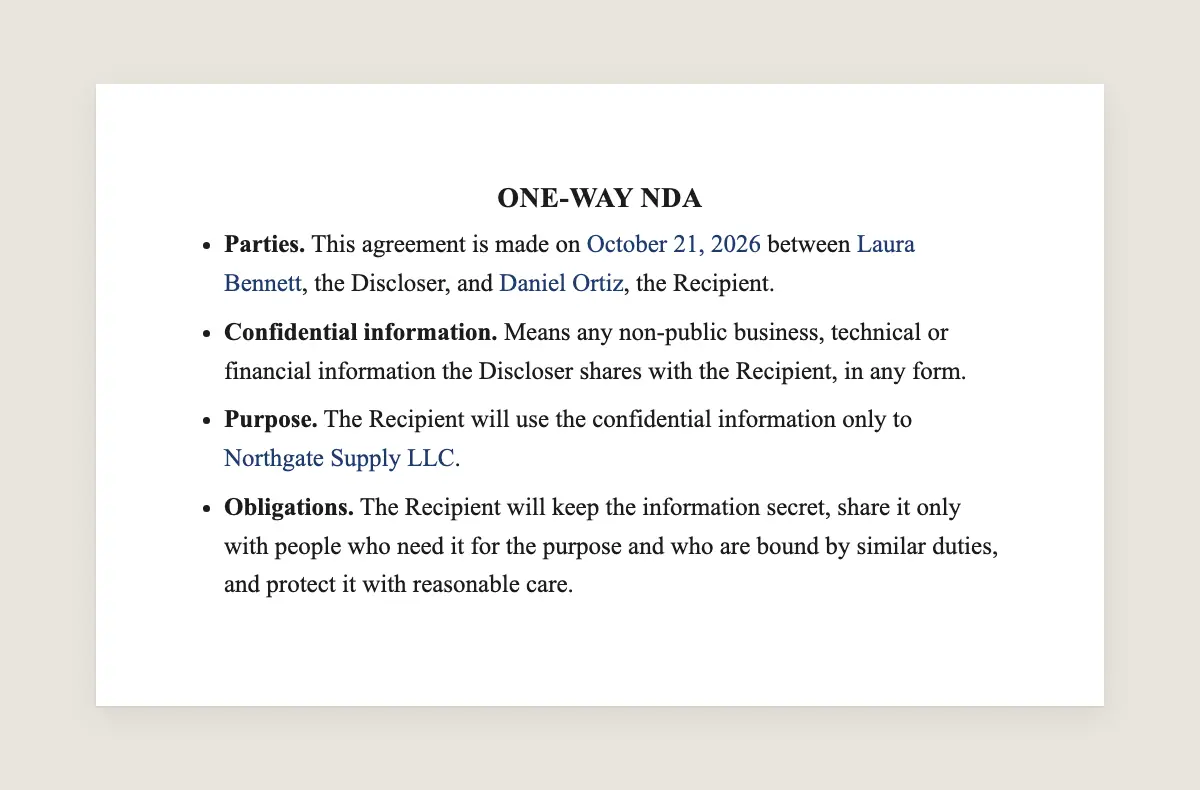
- 1Parties. This agreement is made on [date] between [disclosing party], the Discloser, and [receiving party], the Recipient.
- 2Confidential information. Means any non-public business, technical or financial information the Discloser shares with the Recipient, in any form.
- 3Purpose. The Recipient will use the confidential information only to [evaluate a possible business relationship].
- 4Obligations. The Recipient will keep the information secret, share it only with people who need it for the purpose and who are bound by similar duties, and protect it with reasonable care.
Use the full nondisclosure agreement
NDA and confidentiality agreement
They are the same thing with different names. Some people use «confidentiality agreement» for employees and «NDA» for business partners, but the law treats them alike.
See the confidentiality agreement template for a version written for staff.
When to sign an NDA
- Before you show a product, a pitch deck or source code.
- When a contractor or employee will see internal data.
- Before due diligence in an acquisition or investment.
- When two companies explore a joint project.
Sign it before sharing anything. An NDA signed after the meeting may not cover what was already said.
How to sign an NDA online
Upload an NDA to SignSolú or start from a template. Add each signer with a name and a phone number or email.
Each signer gets a link by WhatsApp or email. On a phone they tap the brown bar at the bottom that says «Sign as …».
They draw their signature once with a finger and press «Sign and Send». Every place in the document that needs it gets filled.
A line next to that button records their consent to sign electronically, with a link to the disclosure.
The signed PDF ends with an audit certificate. It shows each signer, the time, the IP address and a SHA-256 hash of the file.
Want your signature as an image for other files? Create your signature online and download it as a transparent PNG, free.
Most NDAs are signed minutes before a meeting. Sending one by WhatsApp and getting it back signed from a phone keeps the meeting on time.
Common mistakes
- 1Defining confidential information as everything. Courts may refuse to enforce it.
- 2No end date. Some courts dislike perpetual duties for ordinary information.
- 3Forgetting the whistleblower notice. Employers lose some remedies under federal law.
- 4One-way NDA when both share. The other side information is left unprotected.
- 5Signing after sharing. The first meeting is not covered.
An example
A small software company is about to show its product to a larger firm that may resell it. Both sides will share pricing and customer data, so they use a mutual NDA.
The founder sends it from SignSolú the morning of the meeting. The other side signs from a phone in the lobby, and the demo starts with both covered.
NDA in a business sale
Before a buyer sees the books of a business, the seller asks for an NDA. It often adds a promise not to hire employees or contact customers if the deal fails.
The buyer signs before entering the data room. The seller keeps the signed copy with the date, which matters if information leaks later.
NDA with investors
Many venture investors do not sign NDAs for a first pitch, since they see many similar ideas. Founders share a pitch deck without secrets first and save the details for later, under an NDA.
NDA for employees
Employers often include confidentiality terms in the offer letter or ask new hires to sign a separate agreement. It covers customer data, pricing and internal methods.
It cannot stop the employee from talking about wages where the law protects that, or from reporting violations to a government agency.
Checklist before you sign an NDA
- Is it mutual or one-way, and does that match the deal?
- Is the definition of confidential information clear?
- Are the usual exclusions there?
- How long does the duty last?
- What must happen to the information at the end?
- Does it include non-compete or non-solicit terms you did not expect?
People also ask
What does NDA stand for?
Nondisclosure agreement. It is also called a confidentiality agreement.
What happens if you break an NDA?
The other party can sue for damages and ask a court to stop further disclosure. The contract may also set agreed damages.
How long does an NDA last?
As long as it says. Two to five years is common, and trade secrets can be protected for as long as they stay secret.
Are NDAs enforceable?
Yes, when they are reasonable in scope and time and do not cover illegal conduct or protected reports to authorities.
Can I sign an NDA electronically?
Yes. The ESIGN Act recognizes electronic signatures on contracts, NDAs included.
Can I share information under an NDA with my lawyer?
Yes. Most NDAs let you share with advisers who are bound to keep it confidential, such as lawyers and accountants.
What is a unilateral NDA?
Another name for a one-way NDA, in which only the receiving party promises to keep secrets.
What is a mutual NDA?
An NDA in which both parties share information and both promise to keep it secret.
What is not covered by an NDA?
Information that is public, that the receiver already knew, developed on its own, or received lawfully from someone else.
Can an NDA be signed by a minor?
A minor can sign, but may be able to cancel the contract. Have a parent or guardian sign too.
What is an NCNDA?
A non-circumvention and nondisclosure agreement. It adds a promise not to go around the other party to deal directly with its contacts.
Who keeps the signed NDA?
Both parties. Each signer gets the signed PDF when everyone has signed.
How do I write an NDA?
Start from a template, define the information, set the purpose, add the exclusions and the term, and sign before sharing anything.
Can an NDA be one page?
Yes. A short NDA can be enforceable if it covers the essentials clearly.
Do NDAs expire?
Most do, on the date or after the period they set. Trade secret duties can last longer.
Is an NDA the same as a non-compete?
No. An NDA protects information. A non-compete limits working for competitors. Some NDAs include both.
Can you refuse to sign an NDA?
Yes, but the other party may then refuse to share information or hire you.
Does an NDA need to be notarized?
No. It is valid once the parties sign.
Related templates and guides
Sources
- Defend Trade Secrets Act of 2016, 18 U.S.C. 1833(b)
- Speak Out Act of 2022
- ESIGN Act, 15 U.S.C. 7001, on govinfo.gov
Frequently asked questions
What is an NDA?
A contract to keep shared information secret and use it only for an agreed purpose.
What is the difference between a mutual and a one-way NDA?
In a mutual NDA both parties keep secrets. In a one-way NDA only the receiver does.
Do employees have to sign an NDA?
Employers often ask for one. It cannot stop reports of illegal conduct to authorities.
Can an NDA last forever?
For trade secrets, as long as they stay secret. For other information, a set term is safer.
Is an NDA signed on a phone valid?
Yes. It is an electronic signature recognized by the ESIGN Act.
Do I need a lawyer for an NDA?
Not for a standard NDA. A lawyer helps in large deals.