Terms and conditions: what to include, with a free template
Reviewed in October 2026
Terms and conditions are the rules a business sets for anyone who buys from it or uses its website or app. They cover payment, delivery, refunds, liability and how disputes are solved. They bind the customer once the customer accepts them in a clear way.
Terms and conditions, terms of service and privacy policy
| Document | What it covers | Who needs it |
|---|---|---|
| Terms and conditions | Sales, payment, delivery, refunds, liability | Any business that sells |
| Terms of service or terms of use | Rules for using a website, app or platform | Websites and apps with accounts |
| Privacy policy | What personal data you collect and why | Anyone who collects personal data |
| Service agreement | A negotiated contract with one client | Service businesses with larger clients |
People search «conditions and terms» and «terms and conditions» for the same thing. Many businesses put sales and site rules in one document.
Clauses every terms and conditions document needs
- 1Who you are. Legal name, address and contact email.
- 2What you sell. Products or services and how orders are accepted.
- 3Prices and payment. Currency, taxes, payment methods and when payment is due.
- 4Delivery or performance. Times, costs and what happens if there is a delay.
- 5Cancellations and refunds. How and when customers can cancel or return.
- 6Warranties. What you promise about quality, and what you do not.
- 7Limitation of liability. The most you will pay if something goes wrong.
- 8Intellectual property. Who owns your content, logos and software.
- 9Account rules. What users may not do, if you have accounts.
- 10Changes. How you update the terms and tell customers.
- 11Governing law and disputes. Which law applies and where disputes go.
How customers accept your terms
Courts look at whether the customer had a fair chance to see the terms and showed agreement. The method matters.
| Method | How it works | How strong |
|---|---|---|
| Signed agreement | Customer signs the terms, on paper or electronically | Strongest |
| Clickwrap | Customer ticks a box or clicks «I agree» next to a link | Strong when clear |
| Sign-in wrap | Text says that signing up means accepting the terms | Depends on how visible |
| Browsewrap | A link in the footer and nothing else | Weak |
For a business that sells services to other businesses, a signed copy is the safest route. The client signs the terms with the first order and the business keeps the proof.
Terms and conditions template
This template fits a small business that sells products or services. Fill in the brackets and remove what does not apply.
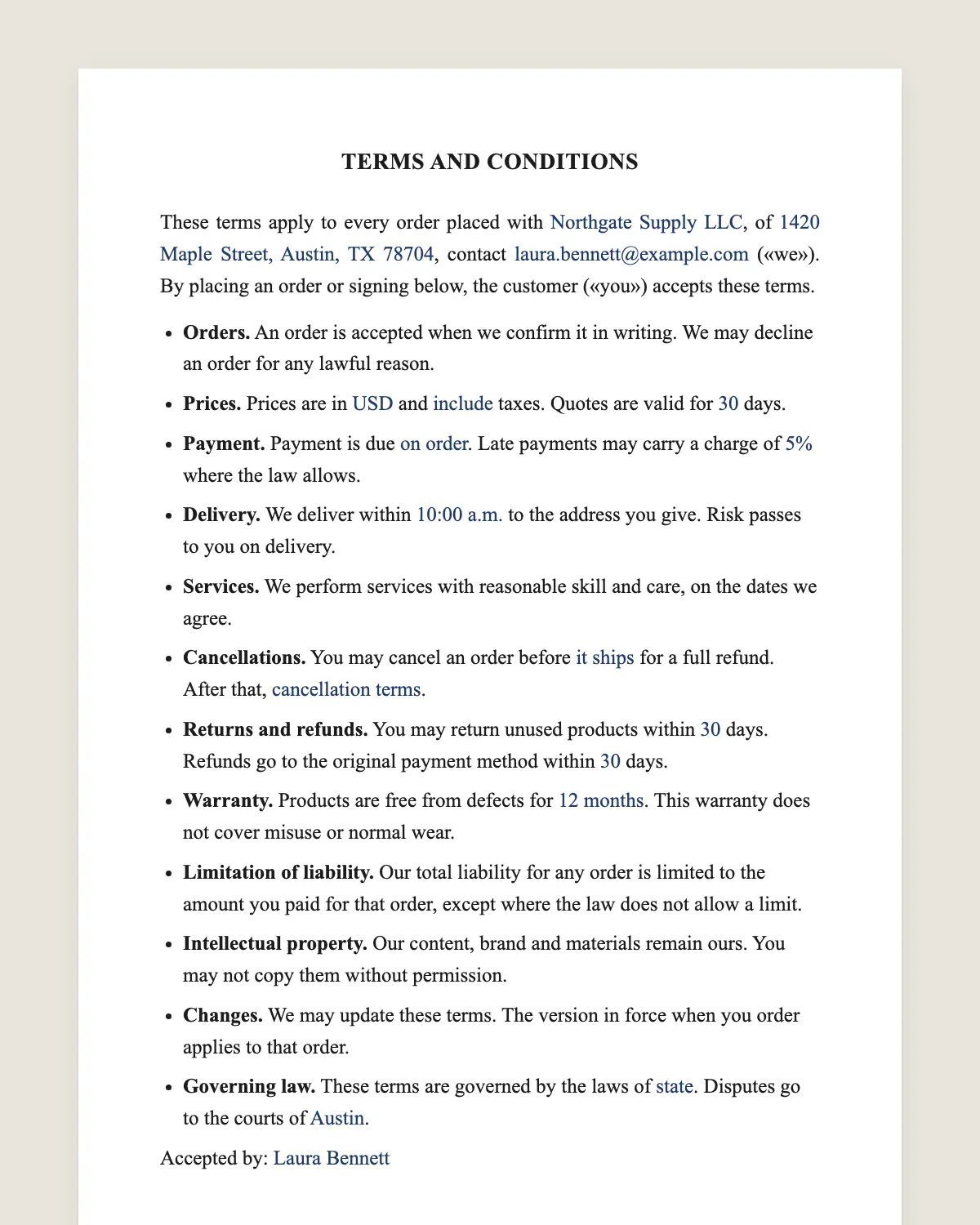
TERMS AND CONDITIONS
These terms apply to every order placed with [business legal name], of [address], contact [email] («we»). By placing an order or signing below, the customer («you») accepts these terms.
- 1Orders. An order is accepted when we confirm it in writing. We may decline an order for any lawful reason.
- 2Prices. Prices are in [currency] and [include / exclude] taxes. Quotes are valid for [number] days.
- 3Payment. Payment is due [on order / within number days of invoice]. Late payments may carry a charge of [rate] where the law allows.
- 4Delivery. We deliver within [time] to the address you give. Risk passes to you on delivery.
- 5Services. We perform services with reasonable skill and care, on the dates we agree.
- 6Cancellations. You may cancel an order before [it ships / the service starts] for a full refund. After that, [cancellation terms].
- 7Returns and refunds. You may return unused products within [number] days. Refunds go to the original payment method within [number] days.
- 8Warranty. Products are free from defects for [period]. This warranty does not cover misuse or normal wear.
- 9Limitation of liability. Our total liability for any order is limited to the amount you paid for that order, except where the law does not allow a limit.
- 10Intellectual property. Our content, brand and materials remain ours. You may not copy them without permission.
- 11Changes. We may update these terms. The version in force when you order applies to that order.
- 12Governing law. These terms are governed by the laws of [state or country]. Disputes go to the courts of [place].
Accepted by: [customer name, company and date]
Use this template to fill it in and send it to sign from SignSolú.
Common mistakes
- 1Copying another company terms. They describe a business that is not yours.
- 2Hiding the terms. A link nobody can see is hard to enforce.
- 3No proof of acceptance. You cannot show the customer agreed.
- 4Promises the law does not allow. Some consumer rights cannot be waived.
- 5Never updating them. Prices, refund rules and products change.
How to sign your terms and conditions online
Upload your terms and conditions to SignSolú or start from a template. Add each signer with a name and a phone number or email.
Each signer gets a link by WhatsApp or email. On a phone they tap the brown bar at the bottom that says «Sign as …».
They draw their signature once with a finger and press «Sign and Send». Every place in the document that needs it gets filled.
A line next to that button records their consent to sign electronically, with a link to the disclosure.
The signed PDF ends with an audit certificate. It shows each signer, the time, the IP address and a SHA-256 hash of the file.
Anyone can check a signed PDF against its original for free, with nothing uploaded.
For business clients, attach the terms to your quote or service agreement and send both in one link. The signed PDF is your proof that the client accepted them.
Terms for business clients and for consumers
Business clients can agree to more one-sided terms than consumers. Consumer laws protect buyers with rights a business cannot remove, such as some refund and warranty rights.
An example
A small catering company sends quotes to offices for lunch events. Clients cancel the day before and dispute the bill, because nothing said what a late cancellation costs.
The owner writes terms with a 48-hour cancellation rule, a deposit and a payment date. Each new quote goes out with the terms attached, and the client signs both from a phone. Disputes stop, because the rule is on the signed page.
Checklist before you publish your terms
- Your legal business name and contact details are correct.
- Prices, taxes and payment dates match how you really bill.
- Refund and cancellation rules match what staff tell customers.
- The liability limit respects consumer laws where you sell.
- The terms are linked next to every order or sign-up button.
- You keep a dated copy of every version.
People also ask
Are terms and conditions legally binding?
Yes, when the customer had a fair chance to read them and clearly accepted them. A signature or a clear click is the best evidence.
Do I need a lawyer to write terms and conditions?
Not to start. A clear template that fits your business is better than none. Have a lawyer review it as you grow or sell in regulated areas.
What is the difference between terms and conditions and a contract?
Terms and conditions are a contract, usually standard for all customers. A negotiated contract is written for one client.
Can I change my terms and conditions?
Yes, for future orders. Tell customers about the change and keep the old version for orders placed under it.
Where should terms and conditions appear on a website?
Next to the order or sign-up button, with a link the customer can open before agreeing, and in the footer.
How often should terms and conditions be updated?
Whenever your prices, refund rules, products or the laws that apply to you change, and at least once a year as a habit. Date each version.
Can I copy terms and conditions from another website?
Copying risks copyright problems and terms that do not fit your business. Start from a template and adapt it to how you really work.
What is the difference between terms and conditions and a privacy policy?
Terms set the rules of the sale or the service. A privacy policy explains what personal data you collect and how you use it.
What should be included in terms and conditions?
Who you are, what you sell, prices and payment, delivery, cancellations and refunds, warranties, liability limits, intellectual property, changes and governing law.
Do terms and conditions need to be signed?
Not always. A clear click to accept works online. For business clients and larger orders, a signature gives stronger proof.
Can terms and conditions protect me from all liability?
No. Laws limit what a business can exclude, especially for consumers, injuries and gross negligence.
Related templates and guides
Sources
- ESIGN Act, 15 U.S.C. 7001, on govinfo.gov
Frequently asked questions
What are terms and conditions?
The rules a business sets for customers who buy from it or use its site.
Is «conditions and terms» the same as «terms and conditions»?
Yes. It is the same document.
Do small businesses need terms and conditions?
Yes. They set payment, refunds and liability before a problem appears.
Can customers sign terms electronically?
Yes. The ESIGN Act recognizes electronic signatures on contracts.
Should I include a privacy policy?
Keep it as a separate document and link it from your terms.
What is a limitation of liability clause?
A clause that caps what you pay if something goes wrong, within what the law allows.