Partnership agreement contract: what to agree before you start, with a template
Based on the Revised Uniform Partnership Act · Reviewed in October 2026
A partnership agreement is a contract between two or more people who run a business together for profit. It sets each partner contribution, how profits and losses are shared, who decides what and what happens when a partner leaves. Without one, state default rules apply.
Types of partnership
| Type | Who manages | Liability of partners |
|---|---|---|
| General partnership | All partners | Each partner is personally liable for partnership debts |
| Limited partnership (LP) | General partners | Limited partners risk only what they put in |
| Limited liability partnership (LLP) | All partners | Partners are shielded from many debts, often used by professional firms |
A general partnership can exist without any filing, just by two people running a business together for profit. An LP or LLP must be registered with the state.
Why you need a written agreement
Without an agreement, the partnership law of your state fills the gaps. Most states follow the Revised Uniform Partnership Act, which by default splits profits equally, whatever each partner invested.
Those defaults rarely match what the partners intended. A written agreement replaces them with your own rules, before money or a disagreement makes it harder.
What a partnership agreement covers
- 1Name and purpose. The business name and what it does.
- 2Contributions. Cash, property, equipment or work each partner brings.
- 3Ownership percentages. Each partner share of the business.
- 4Profits and losses. How they are split and when profits are paid out.
- 5Management. Who decides daily matters and which decisions need everyone.
- 6Salaries and draws. Whether partners are paid for their work.
- 7New partners. How someone joins and on what terms.
- 8Leaving. Notice, buyout price and payment terms when a partner exits.
- 9Death or disability. What happens to a partner share.
- 10Non-compete. Limits on competing during and after the partnership.
- 11Disputes. Mediation or arbitration before court.
- 12Dissolution. How the business is wound up and assets divided.
Partnership agreement template
This template fits a general partnership between two to four partners. Change the percentages and remove what does not apply.
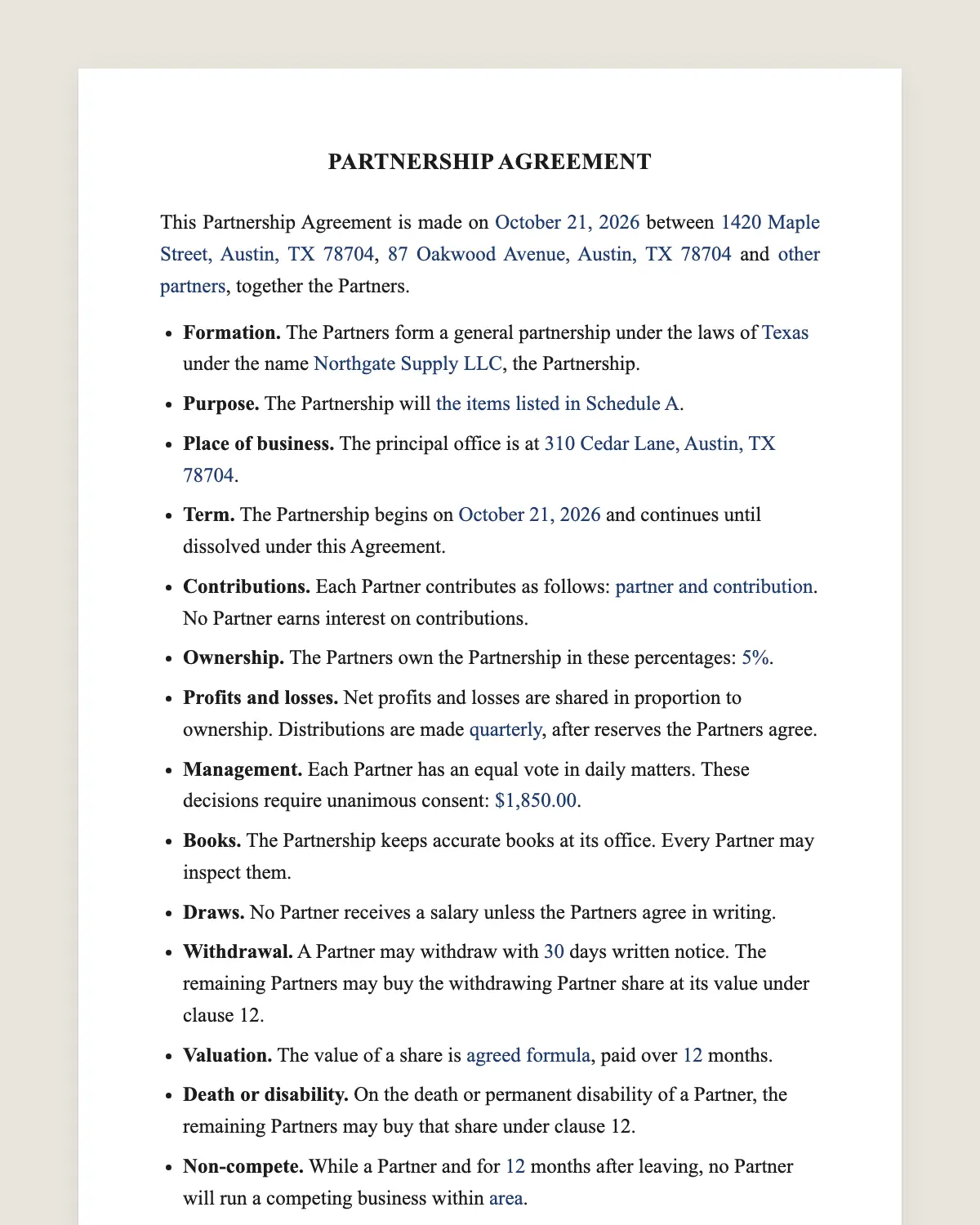
PARTNERSHIP AGREEMENT
This Partnership Agreement is made on [date] between [partner 1 name and address], [partner 2 name and address] and [other partners], together the Partners.
- 1Formation. The Partners form a general partnership under the laws of [state] under the name [business name], the Partnership.
- 2Purpose. The Partnership will [describe the business].
- 3Place of business. The principal office is at [address].
- 4Term. The Partnership begins on [date] and continues until dissolved under this Agreement.
- 5Contributions. Each Partner contributes as follows: [partner and contribution]. No Partner earns interest on contributions.
- 6Ownership. The Partners own the Partnership in these percentages: [partner and percentage].
- 7Profits and losses. Net profits and losses are shared in proportion to ownership. Distributions are made [quarterly], after reserves the Partners agree.
- 8Management. Each Partner has an equal vote in daily matters. These decisions require unanimous consent: [borrowing over amount, selling assets, admitting partners, changing this Agreement].
- 9Books. The Partnership keeps accurate books at its office. Every Partner may inspect them.
- 10Draws. No Partner receives a salary unless the Partners agree in writing.
- 11Withdrawal. A Partner may withdraw with [number] days written notice. The remaining Partners may buy the withdrawing Partner share at its value under clause 12.
- 12Valuation. The value of a share is [agreed formula, or as set by an independent appraiser], paid over [number] months.
- 13Death or disability. On the death or permanent disability of a Partner, the remaining Partners may buy that share under clause 12.
- 14Non-compete. While a Partner and for [number] months after leaving, no Partner will run a competing business within [area].
- 15Disputes. The Partners will try mediation before going to court or arbitration in [place].
- 16Dissolution. On dissolution, assets are used to pay debts, then returned to Partners in proportion to their capital accounts.
Signatures: [each Partner name and date]
Use this template to fill it in and send it to sign from SignSolú.
Partnership or LLC
Many small businesses choose an LLC instead, which shields the owners from business debts. An LLC uses an operating agreement that covers the same topics as a partnership agreement.
A general partnership is faster and cheaper to start, but each partner can be personally liable for the business debts. Weigh that before signing.
How to sign a partnership agreement online
Upload a partnership agreement to SignSolú or start from a template. Add each signer with a name and a phone number or email.
Each signer gets a link by WhatsApp or email. On a phone they tap the brown bar at the bottom that says «Sign as …».
They draw their signature once with a finger and press «Sign and Send». Every place in the document that needs it gets filled.
A line next to that button records their consent to sign electronically, with a link to the disclosure.
The signed PDF ends with an audit certificate. It shows each signer, the time, the IP address and a SHA-256 hash of the file.
Anyone can check a signed PDF against its original for free, with nothing uploaded.
Common mistakes
- 1Equal split with unequal work. Resentment grows fast.
- 2No exit clause. A partner leaves and nobody knows the price of the share.
- 3No deadlock rule. Two equal partners disagree and the business stops.
- 4Sweat equity not valued. The partner who works and the partner who invests see it differently.
- 5Never updated. The agreement describes the business as it was on day one.
Talking about the hard parts first
The best time to agree on an exit is when everyone is friends. Talk about what happens if one partner wants out, gets sick, or stops working before the business makes money.
Write the answers into the agreement. The conversation is easier now than in the middle of a dispute.
An example
Two friends open a coffee shop. One puts in USD 40,000 and the other will run the shop full time. Without an agreement, the law would split profits equally from day one.
They sign an agreement that pays the working partner a salary, returns the investment first and then splits profits equally. It also sets the price if either one leaves.
Checklist before you sign
- Each contribution is written with its value.
- Profit split and salaries reflect money and work.
- Big decisions that need everyone are listed.
- A deadlock rule exists for equal partners.
- The exit price formula is agreed now.
- Death and disability are covered.
People also ask
Is a partnership agreement legally binding?
Yes. It is a contract among the partners and courts enforce it, within the limits of state partnership law.
Do I need a partnership agreement for two people?
Yes. Two-partner businesses benefit most, since a disagreement can stop the business entirely.
What happens if there is no partnership agreement?
State default rules apply, which often split profits equally and make leaving complicated.
Does a partnership agreement need to be notarized?
Usually not. It is valid once signed by the partners.
How do you end a partnership?
Follow the dissolution clause. Pay debts, divide what is left and file any notice your state requires.
Should each partner have a lawyer?
It helps when contributions or stakes are large. Each partner has their own interests, and one lawyer cannot represent all of them fully.
Can a partnership agreement include a non-compete?
Yes, within the limits of state law. Courts look at whether the time and area are reasonable.
Can a partnership agreement be changed?
Yes, by the method the agreement sets, usually with the written consent of all partners.
Do partners pay tax on partnership profits?
In the US a partnership itself usually does not pay income tax. Each partner reports their share of profit or loss.
Is a verbal partnership agreement valid?
It can be, but proving its terms is hard. A written agreement avoids that dispute.
What happens when a partner dies?
The agreement decides. Many let the remaining partners buy the share from the estate at an agreed value.
Can a partnership have unequal shares?
Yes. The agreement can set any split the partners choose.
Do partnerships need an EIN?
Yes. A partnership with employees or that files a partnership return needs an employer identification number.
What are the 3 types of partnership?
General partnership, limited partnership and limited liability partnership.
Can a partner be removed?
Only as the agreement allows, usually by vote of the other partners for causes it lists.
Who owns the partnership property?
The partnership, not the individual partners, under most state laws.
Related templates and guides
Sources
- Revised Uniform Partnership Act (1997), Uniform Law Commission
- ESIGN Act, 15 U.S.C. 7001, on govinfo.gov
Frequently asked questions
What is a partnership agreement?
A contract that sets how partners run, share and leave a business.
Is a partnership agreement required?
Not by law for a general partnership, but it replaces default rules with your own.
How are profits split without an agreement?
In most states, equally among partners, whatever they invested.
Can partners sign the agreement online?
Yes. The ESIGN Act recognizes electronic signatures on contracts.
What is a buyout clause?
A clause that sets how and at what price partners buy a departing partner share.
Should we form an LLC instead?
Consider it if you want protection from personal liability for business debts.