EPC agreement: engineering, procurement and construction in one contract
Reviewed in October 2026
An EPC agreement is a contract in which one contractor handles engineering, procurement and construction of a project and hands it over ready to operate. The owner usually pays a fixed price for completion by a fixed date. The contractor carries most of the design and construction risk.
What EPC stands for
| Letter | Stage | What the contractor does |
|---|---|---|
| E | Engineering | Designs the facility and prepares the drawings |
| P | Procurement | Buys equipment and materials and manages suppliers |
| C | Construction | Builds, installs, tests and commissions |
EPC contracts are common in solar and wind farms, power plants, water treatment, oil and gas and large industrial plants. Lenders like them because one party is responsible for delivering a working project.
Turnkey, fixed price and fixed date
Most EPC contracts are «lump sum turnkey». The contractor delivers a facility that works, for an agreed price, by an agreed date.
If the contractor finishes late, it pays delay damages at a set rate per day. If the plant does not reach the promised output, it pays performance damages. Both are usually capped.
How risk is split
| Risk | Usually carried by |
|---|---|
| Design errors | Contractor |
| Price of equipment and materials | Contractor |
| Delays caused by the contractor or its suppliers | Contractor |
| Site conditions not foreseeable | Negotiated |
| Changes the owner asks for | Owner, through a variation |
| Permits the owner must obtain | Owner |
| Force majeure | Shared, as the contract defines |
| Change in law | Usually owner |
EPC compared with other models
| Model | Who designs | Price | Owner risk |
|---|---|---|---|
| EPC turnkey | Contractor | Fixed | Low |
| Design-bid-build | Owner engineer | Bid on the design | Medium |
| EPCM | Manager on the owner behalf | Cost plus fee | High |
| Design-build | Contractor | Fixed or target | Low to medium |
International projects often start from published standard forms. The FIDIC Silver Book is the best-known form for EPC turnkey projects.
EPC agreement template
This short form sets the main terms of an EPC contract for a mid-size project. Large projects add technical schedules, performance tests and security packages.
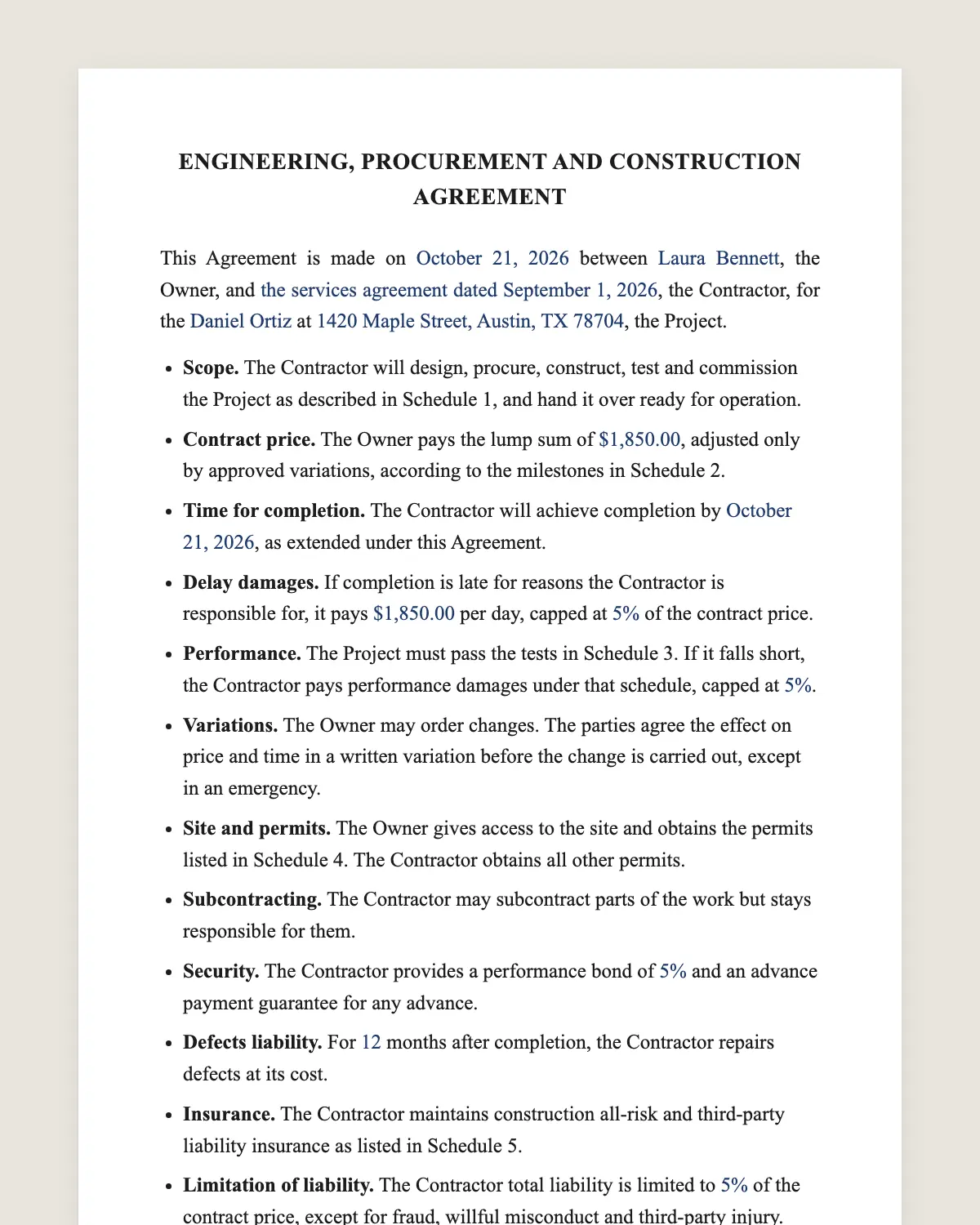
ENGINEERING, PROCUREMENT AND CONSTRUCTION AGREEMENT
This Agreement is made on [date] between [owner legal name], the Owner, and [contractor legal name], the Contractor, for the [project name] at [site address], the Project.
- 1Scope. The Contractor will design, procure, construct, test and commission the Project as described in Schedule 1, and hand it over ready for operation.
- 2Contract price. The Owner pays the lump sum of [amount], adjusted only by approved variations, according to the milestones in Schedule 2.
- 3Time for completion. The Contractor will achieve completion by [date], as extended under this Agreement.
- 4Delay damages. If completion is late for reasons the Contractor is responsible for, it pays [amount] per day, capped at [percentage] of the contract price.
- 5Performance. The Project must pass the tests in Schedule 3. If it falls short, the Contractor pays performance damages under that schedule, capped at [percentage].
- 6Variations. The Owner may order changes. The parties agree the effect on price and time in a written variation before the change is carried out, except in an emergency.
- 7Site and permits. The Owner gives access to the site and obtains the permits listed in Schedule 4. The Contractor obtains all other permits.
- 8Subcontracting. The Contractor may subcontract parts of the work but stays responsible for them.
- 9Security. The Contractor provides a performance bond of [percentage] and an advance payment guarantee for any advance.
- 10Defects liability. For [number] months after completion, the Contractor repairs defects at its cost.
- 11Insurance. The Contractor maintains construction all-risk and third-party liability insurance as listed in Schedule 5.
- 12Limitation of liability. The Contractor total liability is limited to [percentage] of the contract price, except for fraud, willful misconduct and third-party injury.
- 13Force majeure. A party prevented from performing by force majeure gets an extension of time and no damages for the delay.
- 14Termination. Either party may end this Agreement for an uncured material breach after [number] days notice.
- 15Disputes. Disputes go first to negotiation between senior managers, then to [arbitration or courts] in [place].
Signatures: [Owner name, title and date] · [Contractor name, title and date]
Use this template to fill it in and send it to sign from SignSolú.
How to sign an EPC agreement and its variations online
Upload an EPC agreement and its variations to SignSolú or start from a template. Add each signer with a name and a phone number or email.
Each signer gets a link by WhatsApp or email. On a phone they tap the brown bar at the bottom that says «Sign as …».
They draw their signature once with a finger and press «Sign and Send». Every place in the document that needs it gets filled.
A line next to that button records their consent to sign electronically, with a link to the disclosure.
The signed PDF ends with an audit certificate. It shows each signer, the time, the IP address and a SHA-256 hash of the file.
Got another document from someone as a PDF or a phone photo? Sign documents online for free, with no account.
Large EPC contracts are often signed in counterparts by officers in different cities. Variations, progress certificates and lien releases come after, many of them every month.
Common mistakes
- 1A vague scope. Gaps become variations and price increases.
- 2No clear completion test. The parties argue about when the project is finished.
- 3Uncapped damages. Contractors price the risk in, or refuse to bid.
- 4Late variations. Work done before a signed variation is hard to get paid for.
- 5Ignoring subcontractor lien rights. The owner pays twice.
EPC for smaller projects
EPC is not only for power plants. Rooftop solar, cold storage rooms and small water plants often use a short EPC agreement with the same logic of one contractor, one price and one date.
An example
A food processor needs a 2 MW solar plant on its land. It signs an EPC agreement with one contractor for a fixed price, completion in ten months and a guaranteed output in the first year.
The contractor designs the plant, buys the panels and inverters, builds and connects it. The plant is finished two weeks late, and the contractor pays the agreed delay damages for those days.
Documents around an EPC contract
- Technical specifications and drawings.
- Payment milestones and progress certificates.
- Performance test procedures.
- Bonds and guarantees.
- Variation orders.
- Lien releases from subcontractors.
- Taking-over certificate at completion.
Most of these are signed every month during construction. Templates and electronic signatures keep them moving without couriers.
People also ask
What is an EPC contract in plain words?
One company designs, buys and builds the whole project and delivers it working, for a fixed price and date.
What is the difference between EPC and EPCM?
In EPC the contractor builds and carries the risk. In EPCM a manager coordinates contractors for the owner, who keeps most of the risk.
Who uses EPC contracts?
Owners of energy, water, industrial and infrastructure projects, and the lenders who finance them.
What are liquidated damages in an EPC contract?
Agreed amounts the contractor pays for late completion or low performance, usually per day or per unit of output, with a cap.
What is the FIDIC Silver Book?
A standard international form for EPC turnkey projects, published by FIDIC, the international federation of consulting engineers.
Is an EPC contractor responsible for permits?
For most permits, yes. Owners usually keep the land rights and some approvals, as the contract lists.
What is the difference between EPC and design-build?
They are close. EPC is common in energy and industrial plants with performance guarantees, while design-build is common in buildings and infrastructure.
Is EPC good for the owner?
It gives the owner one point of responsibility and a fixed price, at the cost of a higher price that includes the contractor risk margin.
What is a taking-over certificate?
The document the owner issues when the project passes its completion tests and is handed over for operation.
Can the owner change the design in an EPC contract?
Yes, through a variation, which may change the price and the completion date.
What are payment milestones in EPC?
Stages of progress, such as design approval or equipment delivery, at which the contractor can invoice part of the price.
How long does an EPC contract last?
Through construction and the defects period, often a few months to several years depending on the project.
Who owns the design in an EPC contract?
The contract decides. The owner often receives a license or ownership of the project design on payment.
What happens if the EPC contractor goes bankrupt?
The owner calls the performance bond and finds a new contractor to finish the work.
Related templates and guides
Sources
- ESIGN Act, 15 U.S.C. 7001, on govinfo.gov
Frequently asked questions
What does EPC mean?
Engineering, procurement and construction.
Is an EPC contract fixed price?
Usually yes, a lump sum adjusted only by approved variations.
Who carries design risk in EPC?
The contractor, in most EPC turnkey contracts.
What is a performance bond?
A guarantee from a bank or insurer that pays the owner if the contractor fails to perform.
Can an EPC agreement be signed electronically?
Yes, under ESIGN, unless lenders or local rules ask for wet ink.
How long is the defects period?
Often 12 to 24 months after completion, as the contract sets.