Master lease: what it means in real estate and equipment, with a template
Reviewed in October 2026
A master lease is the main lease that controls other agreements. In real estate it is the lease between the owner and a master tenant who subleases to others. In equipment leasing it is one agreement with general terms, and each item is added later on a short schedule.
Two meanings of master lease
| Real estate master lease | Equipment master lease | |
|---|---|---|
| Parties | Owner and master tenant | Lessor and lessee company |
| What it covers | A building or a large space | Many machines, vehicles or devices |
| How it grows | Master tenant signs subleases | Each item added on a schedule |
| Who pays the owner | The master tenant | The lessee, per schedule |
| Common users | Investors, coworking, retail centers | Construction, health care, logistics |
Master lease in real estate
The owner leases the whole property to one master tenant. The master tenant rents units or spaces to subtenants and keeps the difference between what it collects and what it pays the owner.
The master tenant stays responsible to the owner for rent and for the condition of the property. Subtenants deal with the master tenant, not the owner.
Investors use master leases to control a property without buying it. Some add an option to buy, called a master lease option. Coworking companies and retail operators use the same structure for floors and centers.
Master lease for equipment
A company that leases many items signs one master lease with the general terms. Payment rules, maintenance, insurance, default and return conditions are agreed once.
Each new truck, machine or device is added with a short schedule. The schedule lists the item, its term, its payments and its end-of-term option. That saves negotiating a new contract every time.
Who is liable for what
- In real estate, the master tenant owes the owner the full rent, even if subtenants stop paying.
- Subtenants must follow the master lease rules that their sublease passes on.
- If the master lease ends, the subleases usually end with it, unless the owner agrees otherwise.
- In equipment leasing, each schedule is usually its own lease under the master terms.
- Cross-default clauses can make a default on one schedule a default on all.
What to negotiate in a master lease
- 1The right to sublease, and whether the owner must approve each subtenant.
- 2What happens to subtenants if the master lease ends early.
- 3Who pays taxes, insurance and major repairs.
- 4Renewal options and how rent changes.
- 5For equipment, the end-of-term options, return condition and cross-default.
Master lease agreement template
This template is the equipment version, with a schedule at the end. For a building, use the same structure and replace the schedule with the property description and sublease rules.
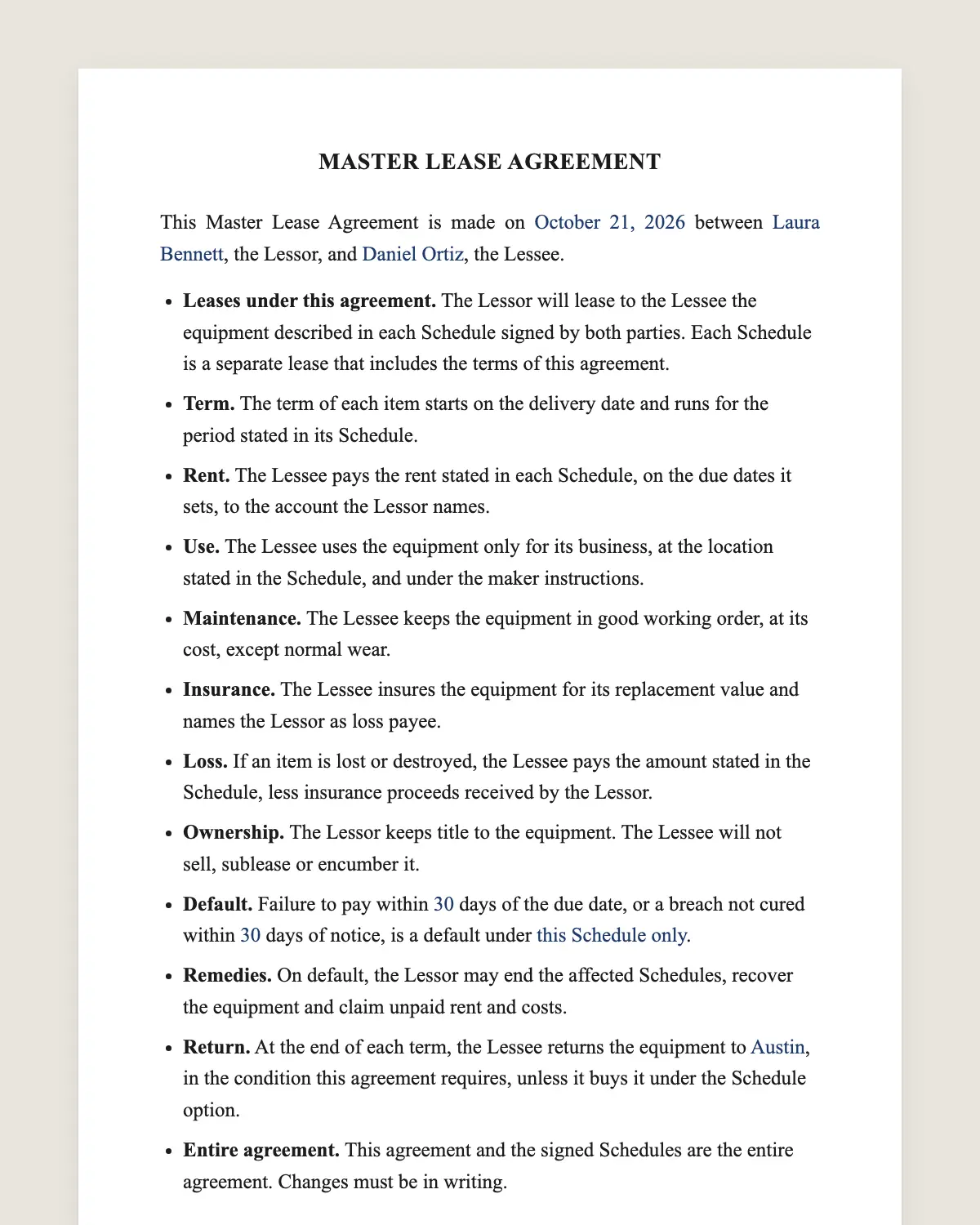
MASTER LEASE AGREEMENT
This Master Lease Agreement is made on [date] between [lessor name], the Lessor, and [lessee name], the Lessee.
- 1Leases under this agreement. The Lessor will lease to the Lessee the equipment described in each Schedule signed by both parties. Each Schedule is a separate lease that includes the terms of this agreement.
- 2Term. The term of each item starts on the delivery date and runs for the period stated in its Schedule.
- 3Rent. The Lessee pays the rent stated in each Schedule, on the due dates it sets, to the account the Lessor names.
- 4Use. The Lessee uses the equipment only for its business, at the location stated in the Schedule, and under the maker instructions.
- 5Maintenance. The Lessee keeps the equipment in good working order, at its cost, except normal wear.
- 6Insurance. The Lessee insures the equipment for its replacement value and names the Lessor as loss payee.
- 7Loss. If an item is lost or destroyed, the Lessee pays the amount stated in the Schedule, less insurance proceeds received by the Lessor.
- 8Ownership. The Lessor keeps title to the equipment. The Lessee will not sell, sublease or encumber it.
- 9Default. Failure to pay within [number] days of the due date, or a breach not cured within [number] days of notice, is a default under [this Schedule only / all Schedules].
- 10Remedies. On default, the Lessor may end the affected Schedules, recover the equipment and claim unpaid rent and costs.
- 11Return. At the end of each term, the Lessee returns the equipment to [place], in the condition this agreement requires, unless it buys it under the Schedule option.
- 12Entire agreement. This agreement and the signed Schedules are the entire agreement. Changes must be in writing.
SCHEDULE No. [number]
- Equipment: [description, make, model, serial number]
- Location: [address]
- Term: [number] months from delivery
- Monthly rent: [amount]
- End-of-term option: [return / renew / buy for amount]
- Stipulated loss value: [amount or table]
Signatures: [Lessor name, title and date] · [Lessee name, title and date]
Use this template to fill it in and send it to sign from SignSolú.
How to sign a master lease and each schedule online
Upload a master lease and each schedule to SignSolú or start from a template. Add each signer with a name and a phone number or email.
Each signer gets a link by WhatsApp or email. On a phone they tap the brown bar at the bottom that says «Sign as …».
They draw their signature once with a finger and press «Sign and Send». Every place in the document that needs it gets filled.
A line next to that button records their consent to sign electronically, with a link to the disclosure.
The signed PDF ends with an audit certificate. It shows each signer, the time, the IP address and a SHA-256 hash of the file.
Want your signature as an image for other files? Create your signature online and download it as a transparent PNG, free.
A master lease is signed once. Each new schedule is a short document that both parties sign in minutes, which is where electronic signature saves the most time.
People also ask
Do subtenants have rights against the owner?
Usually not directly, since their contract is with the master tenant. An owner recognition agreement can give them that protection.
How is rent set in a master lease?
Fixed amounts with yearly increases are common. Some master leases share part of the sublease income with the owner.
Who maintains the property under a master lease?
The master lease decides. Many put routine repairs on the master tenant and major structural work on the owner.
Can an owner refuse a subtenant?
Yes, if the master lease requires owner approval. Many leases say the owner cannot refuse without a reasonable cause.
What is the difference between a master lease and a ground lease?
A ground lease rents only the land, often for decades, and the tenant builds on it. A master lease usually covers an existing building.
What is a master lease in real estate?
A lease of a whole property to one master tenant, who then subleases parts of it to other tenants.
What is a master lease option?
A master lease that also gives the master tenant the option to buy the property later, common among real estate investors.
Is a master lease the same as a sublease?
No. The master lease is the main lease with the owner. A sublease is the agreement between the master tenant and a subtenant.
What happens to subtenants if the master tenant defaults?
The owner can usually end the master lease, and subleases end with it, unless the owner agreed to recognize them.
What is a schedule in a master lease?
A short document that adds one item or group of items to the master lease, with its own term and payments.
Common mistakes with a master lease
- 1Subleases longer than the master lease. The master tenant promises space it will not control.
- 2No owner recognition of subtenants. Subtenants lose their space if the master lease ends.
- 3Unclear repair duties. The owner, the master tenant and subtenants each think another pays.
- 4Cross-default by accident. One late equipment schedule puts every schedule in default.
- 5No end-of-term plan. Equipment comes back late or in the wrong condition and fees pile up.
An example
A coworking operator signs a ten-year master lease for two floors of an office building. It rents desks and private offices to members on monthly agreements and pays the owner a fixed rent.
A road construction company signs one master lease with its equipment lessor. Each new excavator or truck is added with a two-page schedule signed from the site.
Related templates and guides
Sources
- ESIGN Act, 15 U.S.C. 7001, on govinfo.gov
Frequently asked questions
Who signs a master lease?
The owner or lessor and the master tenant or lessee.
Can a master tenant evict a subtenant?
Yes, under the sublease and state eviction rules, since the master tenant is the subtenant landlord.
Do subtenants pay the owner?
No. They pay the master tenant, who pays the owner.
Is a master lease good for investors?
It lets them control a property with less cash, but they carry the rent risk.
Can a master lease be signed electronically?
Yes, under ESIGN and UETA, and so can each schedule.
How long is a typical master lease?
It varies. Real estate master leases often run several years, with renewal options.
Can a master lease include an option to buy?
Yes. That structure is often called a master lease option.