NCNDA agreement template: free in Word, or sign it online
Reviewed in October 2026
An NCNDA is a non-circumvention and non-disclosure agreement. It stops the parties from going around the person who introduced them, and it keeps the deal information confidential. Brokers, intermediaries and traders use it before sharing names of buyers or sellers.
Ten documents free, no card. Signed by every party to the deal.
Example filled in with sample data
The full NCNDA agreement
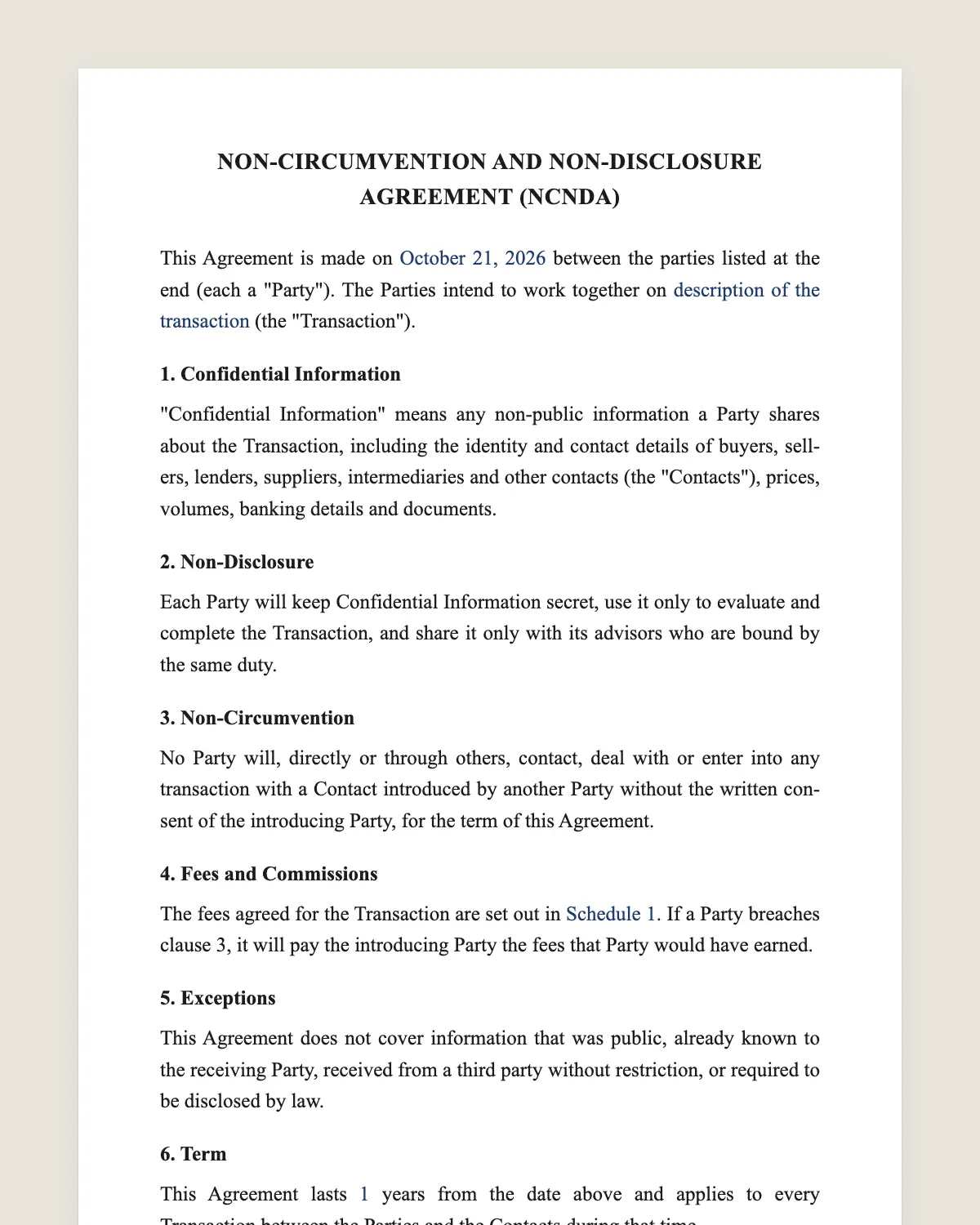
NON-CIRCUMVENTION AND NON-DISCLOSURE AGREEMENT (NCNDA)
This Agreement is made on [date] between the parties listed at the end (each a "Party"). The Parties intend to work together on [description of the transaction or business opportunity] (the "Transaction").
1. Confidential Information
"Confidential Information" means any non-public information a Party shares about the Transaction, including the identity and contact details of buyers, sellers, lenders, suppliers, intermediaries and other contacts (the "Contacts"), prices, volumes, banking details and documents.
2. Non-Disclosure
Each Party will keep Confidential Information secret, use it only to evaluate and complete the Transaction, and share it only with its advisors who are bound by the same duty.
3. Non-Circumvention
No Party will, directly or through others, contact, deal with or enter into any transaction with a Contact introduced by another Party without the written consent of the introducing Party, for the term of this Agreement.
4. Fees and Commissions
The fees agreed for the Transaction are set out in [Schedule 1 / a separate fee agreement dated [date]]. If a Party breaches clause 3, it will pay the introducing Party the fees that Party would have earned.
5. Exceptions
This Agreement does not cover information that was public, already known to the receiving Party, received from a third party without restriction, or required to be disclosed by law.
6. Term
This Agreement lasts [number] years from the date above and applies to every Transaction between the Parties and the Contacts during that time.
7. Remedies
A breach may cause harm that money cannot fully repair. The injured Party may seek an injunction in addition to damages.
8. No Partnership
This Agreement does not create a partnership or agency between the Parties and does not oblige any Party to complete the Transaction.
9. Governing Law and Signatures
This Agreement is governed by the laws of [state or country]. It may be signed in counterparts and electronically.
PARTY 1
Name: [name, company, role in the Transaction]
Signature: ______________
Date: [date]
PARTY 2
Name: [name, company, role in the Transaction]
Signature: ______________
Date: [date]
PARTY 3
Name: [name, company, role in the Transaction]
Signature: ______________
Date: [date]
What the template includes
Description of the transaction
What counts as confidential, including contacts
Duty to keep information secret
Promise not to go around the introducing party
Fees and the penalty for circumvention
Standard exceptions to confidentiality
Term of the agreement
Injunction and damages
No partnership between the parties
Governing law and electronic signature
What you fill in
Field
Example
Transaction
Supply of 20,000 MT of urea, CIF Houston
Party 1
Andrea Molina, Atlas Commodities LLC, buyer's mandate
Party 2
Kevin Osei, Delta Trade Partners, intermediary
Party 3
Rahul Mehta, Northstar Agro FZE, seller's mandate
Fees
USD 2 per MT to each intermediary, per Schedule 1
Term
5 years
Governing law
State of New York
How it gets signed
1Choose «Use this template», fill in the fields and review the full NCNDA agreement.
2Send it by WhatsApp or email. The other party opens the link on their phone without an account.
3They tap the brown bar at the bottom that says «Sign as …» and draw their signature once.
4Everyone gets the signed PDF with its signature certificate. Anyone can check it at signsolu.com/verificar.
The signing screen tells each signer that signing means agreeing to sign electronically. It links to the electronic signature disclosure that the ESIGN Act asks for.
What you get once everyone signs
The signed PDF. The final NCNDA agreement with every drawn signature in place.
The signature certificate. It lists each signer and the date and time of each signature.
A record you can check. The folio on the certificate opens the document history at signsolu.com/verificar.
Reminders. Turn them on and SignSolú reminds every signer who has not signed yet.
Your first ten documents are free and need no card.
What the law says
An NCNDA is an ordinary contract. Its confidentiality part works like any non-disclosure agreement under state law.
Courts read non-circumvention clauses narrowly. They enforce them best when the contacts are clearly identified and the fee is defined. Vague promises to «protect» a deal are hard to collect on.
The ESIGN Act, 15 U.S.C. 7001 gives an electronic signature the same legal effect as one on paper. A contract cannot be denied effect only because it was signed electronically.
International parties often pick a neutral governing law. New York and England are common choices in commodity trades.
Who uses an NCNDA
NCNDAs are common wherever an intermediary connects a buyer and a seller and gets paid a fee.
Commodity trading. Oil, fertilizer, sugar and metals often move through chains of mandates.
Real estate. Off-market deals where a broker introduces an investor to an owner.
Business brokerage. A broker shares the name of a company that is for sale.
Financing. A consultant introduces a borrower to a private lender.
NCNDA or NDA
An NDA only protects information. It does not stop the other side from calling your contact directly.
An NCNDA adds the non-circumvention promise. That is what protects the fee of the person who made the introduction.
If you only share business information and no contacts, a standard NDA is enough.
How to make it hold up
Name the contacts. List them in a schedule or send them in writing after signing. Keep a record of each introduction.
Define the fee. A number per unit or a percentage is enforceable. «A fair commission» is not.
Set a realistic term. Two to five years is usual. Endless terms invite a court to cut them down.
Get every party to sign. One unsigned party in the chain is free to go around everyone else.
Signing with parties in several countries
Deals with an NCNDA often involve people in three or four countries. Printing and scanning slows everything down.
SignSolú sends the link to each party by WhatsApp or email. The document closes when the last party signs.
The certificate records the date and time of each signature. That record helps when you need to prove who knew what and when.
What to do if someone goes around you
Act quickly once you suspect a breach. Evidence is easier to gather while the deal is still moving.
1Collect the emails or messages where you introduced the contact.
2Pull the signed NCNDA and its certificate with the signing dates.
3Send a written notice that cites clause 3 and asks for the fee in clause 4.
4If there is no answer, take the file to a lawyer in the governing law you chose.
An injunction can stop the closing before the money moves. Damages after closing are harder to collect across borders.
Many disputes end with a negotiated fee. A clean paper trail is what gives you leverage at that table.
Common mistakes
Signing after sharing. Send names only after every party has signed. Information shared before signing is not covered.
Copying a chain of mandates without checking names. Use the legal names of companies and the people who represent them.
Before you sign
Read every clause of the NCNDA agreement with the other party before anyone signs. Change what does not fit your deal.