SignSolú

Mutual NDA template: free in Word, or sign it online

Reviewed in October 2026

A mutual NDA is a nondisclosure agreement where both parties share confidential information and both promise to protect it. Use it when two companies explore a partnership, a joint product or an acquisition. Each party is at once discloser and recipient.

Ten documents free, no card. Signed by both parties.

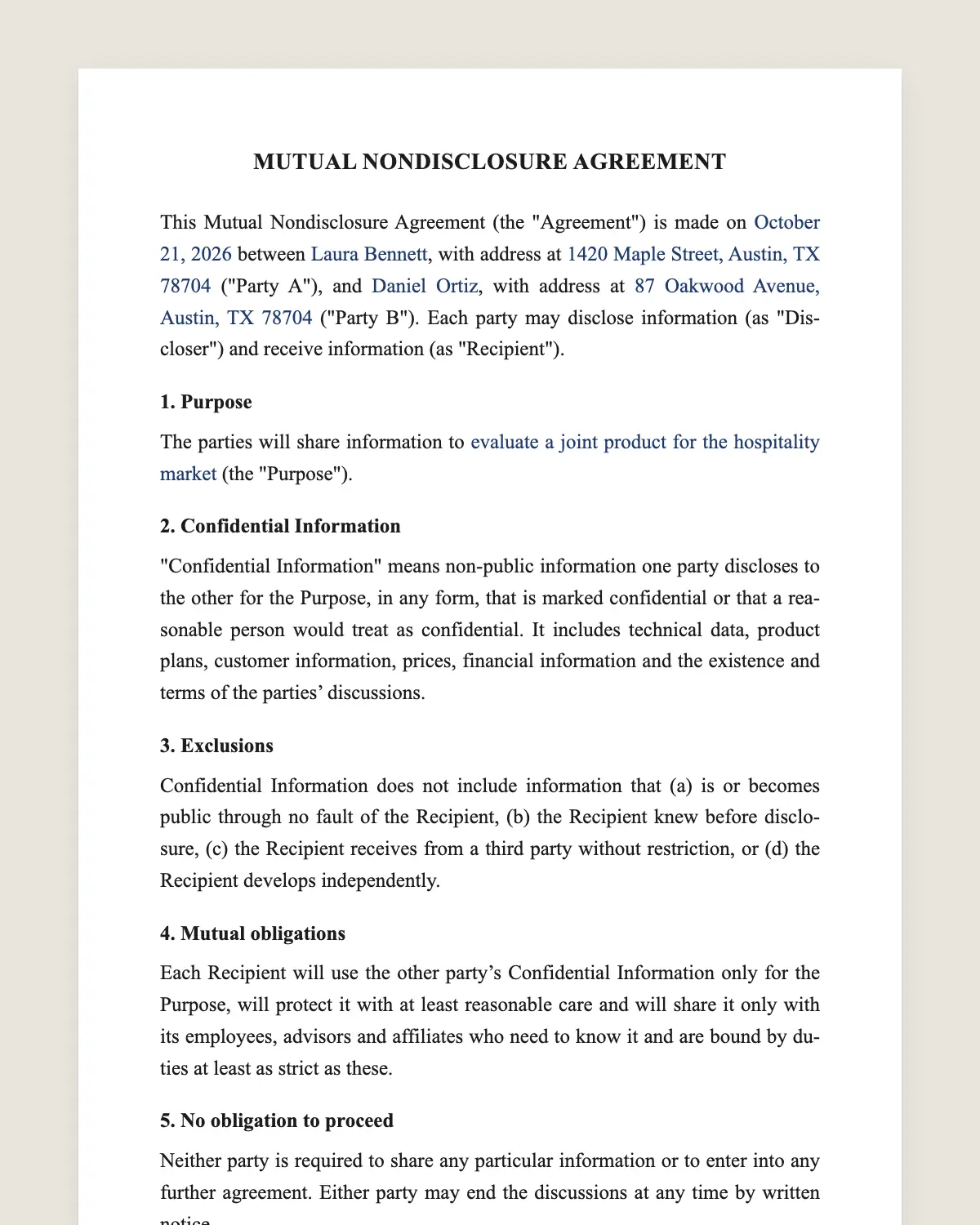
Mutual NDA example, filled in with sample data
Example filled in with sample data

The full mutual NDA

MUTUAL NONDISCLOSURE AGREEMENT

This Mutual Nondisclosure Agreement (the "Agreement") is made on [date] between [Party A name], with address at [address] ("Party A"), and [Party B name], with address at [address] ("Party B"). Each party may disclose information (as "Discloser") and receive information (as "Recipient").

1. Purpose

The parties will share information to [purpose, for example evaluate a joint product for the hospitality market] (the "Purpose").

2. Confidential Information

"Confidential Information" means non-public information one party discloses to the other for the Purpose, in any form, that is marked confidential or that a reasonable person would treat as confidential. It includes technical data, product plans, customer information, prices, financial information and the existence and terms of the parties’ discussions.

3. Exclusions

Confidential Information does not include information that (a) is or becomes public through no fault of the Recipient, (b) the Recipient knew before disclosure, (c) the Recipient receives from a third party without restriction, or (d) the Recipient develops independently.

4. Mutual obligations

Each Recipient will use the other party’s Confidential Information only for the Purpose, will protect it with at least reasonable care and will share it only with its employees, advisors and affiliates who need to know it and are bound by duties at least as strict as these.

5. No obligation to proceed

Neither party is required to share any particular information or to enter into any further agreement. Either party may end the discussions at any time by written notice.

6. Required disclosure

A Recipient required by law or court order to disclose Confidential Information will give prompt notice, where legally allowed, and disclose only what is required.

7. Return or destruction

On written request, each Recipient will return or destroy the other party’s Confidential Information within [10] days and confirm it in writing.

8. Term

This Agreement covers disclosures made during [1] year from the date above. Each party’s duties last [3] years after the last disclosure. Trade secrets stay protected for as long as they remain trade secrets.

9. No license and no warranty

All Confidential Information stays the property of the Discloser. It is shared "as is", without warranty of accuracy or completeness.

10. Whistleblower immunity notice

Under 18 U.S.C. 1833(b), an individual is not held criminally or civilly liable under any federal or state trade secret law for disclosing a trade secret (a) in confidence to a federal, state or local government official, or to an attorney, solely to report or investigate a suspected violation of law, or (b) in a complaint or other document filed under seal in a lawsuit. An individual who sues an employer for retaliation for reporting a suspected violation of law may disclose the trade secret to their attorney and use it in the court proceeding if the document is filed under seal and is not disclosed except by court order.

11. General terms

Each party may seek an injunction to stop a breach. This Agreement is governed by the laws of [state], is the entire agreement on its subject and may be signed electronically, with the same effect as a handwritten signature.

PARTY A

Signature: ______________________

Name: [full name]

Title: [title]

Date: [date]

PARTY B

Signature: ______________________

Name: [full name]

Title: [title]

Date: [date]

What the template includes

  • Both parties named as discloser and recipient
  • One shared purpose for the exchange
  • A definition that also protects the talks themselves
  • The same duties for both sides
  • No obligation to share more or to close a deal
  • Disclosure required by law
  • Return or destruction on request
  • A window for disclosures and a separate secrecy period
  • No license and no warranty over the information
  • Whistleblower notice, injunction and governing law

What you fill in

FieldExample
DateOctober 21, 2026
Party AHarbor Labs, Inc.
Party BCalloway Hotels Group LLC
PurposeEvaluate a joint guest app for hotels
Disclosure window1 year
Secrecy after the last disclosure3 years
Governing lawState of Delaware

How it gets signed

  1. 1Choose “Use this template”, fill in the fields and read the full mutual NDA once more.
  2. 2Send it by WhatsApp or email. The other party opens the link on their phone without an account.
  3. 3They tap the brown bar at the bottom that says “Sign as …” and draw their signature with a finger.
  4. 4Everyone gets the signed PDF with its signature certificate. Anyone can check it at signsolu.com/verificar.

Before signing, each signer agrees to sign electronically. The screen links to the electronic signature disclosure the ESIGN Act asks for.

Your first ten documents are free and need no card.

Got another document from someone as a PDF or a phone photo? Sign documents online for free, with no account.

What the law says

A mutual NDA is a contract under state law, like any NDA. Courts check that the information is defined and that the duty has a reasonable end.

The ESIGN Act makes an electronic signature as valid as ink. Both companies can sign from different cities and keep the same signed PDF.

If any person on either side signs in their own name as a worker or consultant, the Defend Trade Secrets Act notice in clause 10 protects the remedies of the company that shares.

Mutual NDA or one-way NDA

Use a mutual NDA when both sides will open their books. Two software companies planning an integration need one. So do a buyer and a seller in an acquisition.

Use a one-way NDA when only you share. A founder pitching an investor is the classic case. The mutual version is not stricter. It applies the same duties to both parties.

Protect the talks, not only the documents

Clause 2 covers the existence and terms of the discussions. A leak that two companies are talking can move prices, staff and customers. This line keeps the talks private too.

Disclosure window and secrecy period

The template has two clocks. The first is the window during which shared information is covered. The second is how long each side must keep it secret after the last disclosure.

A one-year window and three years of secrecy fit most partnership talks. Raise both for long technical projects.

Mistakes that weaken a mutual NDA

  • A vague purpose. Each side can then argue that any use was allowed.
  • Different versions signed by each side. Sign one document so both hold the same text.
  • No exit. Clause 5 lets either side walk away without breaking the agreement.
  • Signing after the first call. Anything shared before signing may fall outside the agreement.

How to run the exchange after signing

Name one contact on each side who sends and receives documents. Mark files as confidential in the name or the first page. Share them from a folder with access logs.

When the talks end, ask for the return or destruction under clause 7. Keep the written confirmation with the signed agreement.

If the talks turn into a deal, the final contract usually replaces this NDA for the new work. Check that it keeps the secrecy period for what you already shared.

Signing with a company in another state or country

Pick one governing law in clause 11 and write it out in full. Both signers can be in different places. Each one signs from their own phone and both keep the same signed PDF.

Before you sign

Other templates

Frequently asked questions

Is a mutual NDA signed online binding?

Yes. The ESIGN Act gives electronic signatures the same effect as handwritten ones.

Who signs a mutual NDA?

Someone with authority from each party, usually an officer, a director or the owner.

Does a mutual NDA oblige us to close the deal?

No. Clause 5 says neither party must share more or sign anything else.

Can more than two companies sign it?

Yes. Add a party in the opening paragraph and a signature block for it before sending.

Does the other company need an account?

No. Their signer opens the link on a phone and signs with the brown bar at the bottom.

Can I download the mutual NDA in Word?

Yes. “Download in Word” gives you the full agreement with no email and no account. You can edit it and upload it later to sign.

How long should a mutual NDA last?

One year to share and three years of secrecy fit most talks. Trade secrets stay protected while they remain secret.

Create a free account and send 10 documents