SignSolú

Tenancy agreement template for England: free in Word, or sign it online

Reviewed in October 2026

A tenancy agreement is the contract between a private landlord and a tenant who rents a home. Since 1 May 2026, new private tenancies in England are assured periodic tenancies that roll on monthly with no end date. This template includes the key terms landlords must give in writing.

Ten documents free, no card. Signed by the landlord and every tenant.

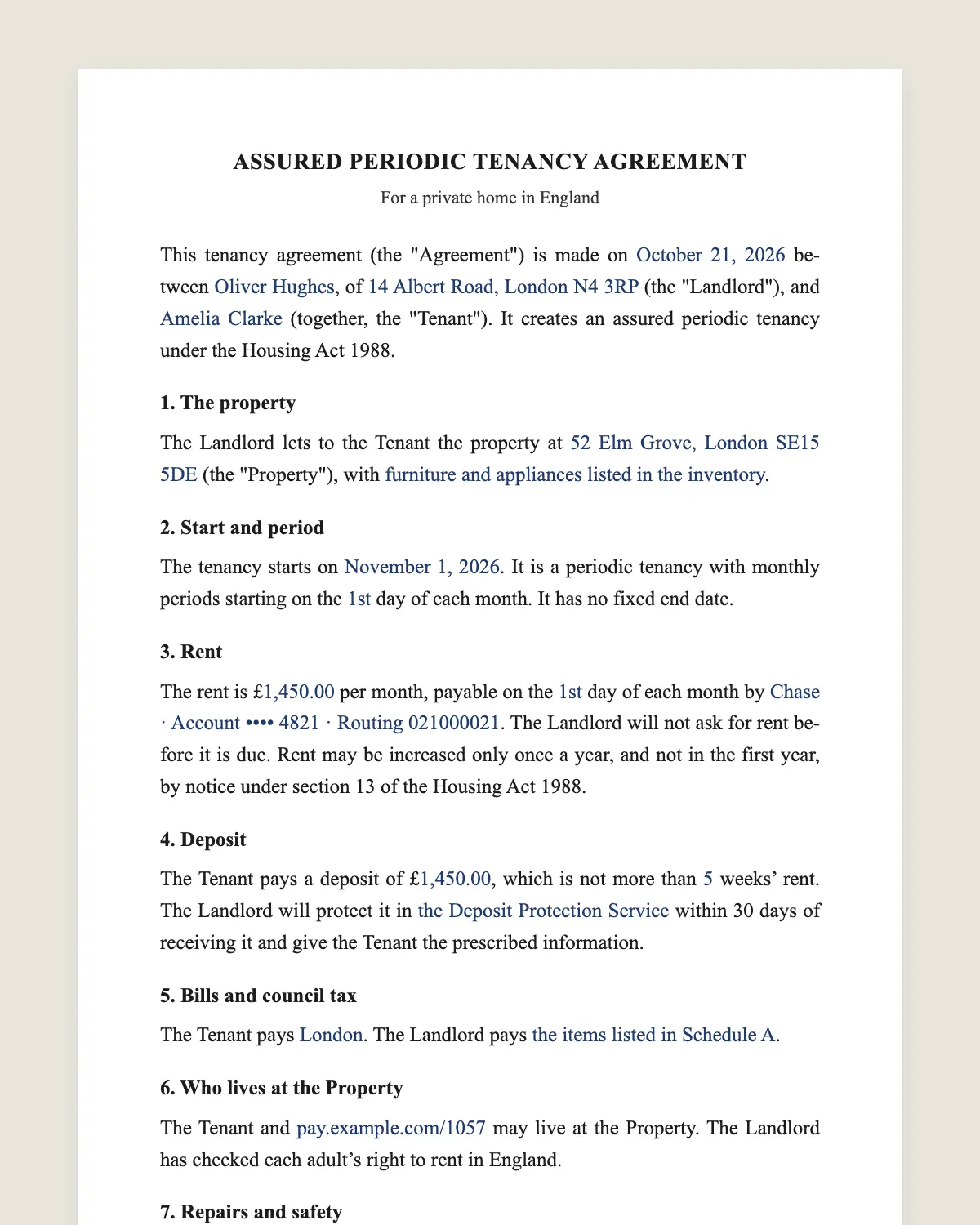
Tenancy agreement example, filled in with sample data
Example filled in with sample data

The full tenancy agreement

ASSURED PERIODIC TENANCY AGREEMENT

For a private home in England

This tenancy agreement (the "Agreement") is made on [date] between [Landlord name], of [address] (the "Landlord"), and [Tenant names] (together, the "Tenant"). It creates an assured periodic tenancy under the Housing Act 1988.

1. The property

The Landlord lets to the Tenant the property at [full address and postcode] (the "Property"), with [furniture and appliances listed in the inventory / unfurnished].

2. Start and period

The tenancy starts on [start date]. It is a periodic tenancy with monthly periods starting on the [1st] day of each month. It has no fixed end date.

3. Rent

The rent is £[amount] per month, payable on the [1st] day of each month by [bank transfer to account details]. The Landlord will not ask for rent before it is due. Rent may be increased only once a year, and not in the first year, by notice under section 13 of the Housing Act 1988.

4. Deposit

The Tenant pays a deposit of £[amount], which is not more than [5] weeks’ rent. The Landlord will protect it in [name of government-approved scheme] within 30 days of receiving it and give the Tenant the prescribed information.

5. Bills and council tax

The Tenant pays [council tax, gas, electricity, water, broadband and TV licence]. The Landlord pays [list, if any].

6. Who lives at the Property

The Tenant and [names of other occupiers] may live at the Property. The Landlord has checked each adult’s right to rent in England.

7. Repairs and safety

The Landlord keeps the structure, exterior and installations for water, gas, electricity, heating and sanitation in repair and keeps the Property safe and free from serious hazards. The Tenant reports repairs promptly, takes reasonable care of the Property and pays for damage caused by the Tenant or visitors, beyond fair wear and tear.

8. Access

The Landlord may enter at reasonable times to inspect or repair after giving at least 24 hours’ written notice, or at once in an emergency.

9. Pets

The Tenant may ask in writing to keep a pet. The Landlord will reply in writing within 28 days and will not refuse without a reasonable reason.

10. Use

The Tenant will use the Property as a private home, will not cause nuisance or antisocial behaviour and will not sublet the whole Property.

11. Ending the tenancy

The Tenant may end the tenancy by giving at least [2] months’ written notice ending on the last day of a rental period, or a shorter period if the Landlord agrees in writing. The Landlord may end the tenancy only on a ground for possession in Schedule 2 of the Housing Act 1988, by serving notice under section 8 with the required notice period.

12. Notices

Notices may be sent by email to the Landlord at [email] and to the Tenant at [email], as well as by post to the addresses above.

13. Signatures

This Agreement is governed by the law of England. The parties agree to sign it electronically, and each electronic signature has the same effect as a handwritten one.

LANDLORD

Signature: ______________________

Name: [full name]

Date: [date]

TENANT

Signature: ______________________

Name: [full name]

Date: [date]

TENANT

Signature: ______________________

Name: [full name]

Date: [date]

What the template includes

  • An assured periodic tenancy with monthly periods and no end date
  • Rent, due date and the once-a-year increase rule
  • Deposit up to five weeks, protected within 30 days
  • Bills and council tax
  • Occupiers and right to rent checks
  • Repairs, safety and access with notice
  • Pet requests answered in 28 days
  • Use of the home and no subletting
  • Tenant notice of up to two months and landlord grounds for possession
  • Notices by email and post

What you fill in

FieldExample
Date21 October 2026
LandlordHelen Wright
TenantsTom Baker and Priya Shah
Property14 Rose Street, Leeds LS6 2AB
Start date1 November 2026
Rent£1,050 per month on the 1st
Deposit£1,211, protected with a government-approved scheme
Tenant notice2 months

How it gets signed

  1. 1Choose “Use this template”, fill in the fields and read the full tenancy agreement once more.
  2. 2Send it by WhatsApp or email. The other party opens the link on their phone without an account.
  3. 3They tap the brown bar at the bottom that says “Sign as …” and draw their signature with a finger.
  4. 4Everyone gets the signed PDF with its signature certificate. Anyone can check it at signsolu.com/verificar.

Your first ten documents are free and need no card.

Got another document from someone as a PDF or a phone photo? Sign documents online for free, with no account.

What the law says

The gov.uk guide for landlords on assured periodic tenancies explains the rules from 1 May 2026. Landlords cannot create fixed terms or assured shorthold tenancies, and section 21 notices are gone. Tenants can leave with up to two months’ notice. Landlords need a ground for possession and a section 8 notice.

Landlords must give tenants the key terms in writing before the tenancy is agreed. Deposits are capped at five weeks’ rent when the yearly rent is under £50,000 and must be protected in a government-approved scheme.

Section 7 of the Electronic Communications Act 2000 makes electronic signatures admissible as evidence. A tenancy agreement does not need to be a deed, so it can be signed electronically.

Only for England

Wales uses occupation contracts under its own renting law. Scotland uses the private residential tenancy. Northern Ireland has its own rules too. Use this template only for homes in England.

What changed on 1 May 2026

  • No fixed terms. Every new private tenancy rolls on month by month.
  • No section 21. Landlords end tenancies only on a legal ground with a section 8 notice.
  • Rent increases once a year with the section 13 process, not in the first year.
  • Written terms. Landlords must give the key terms in writing before agreeing the tenancy.
  • Pets. Tenants can ask, and landlords cannot refuse without a fair reason.
  • No rental bidding. Landlords cannot accept more than the advertised rent.

Before the tenancy starts

  1. 1Check every adult’s right to rent.
  2. 2Give the written terms, which this agreement includes.
  3. 3Take a holding deposit of no more than one week’s rent, if any.
  4. 4Sign the agreement before asking for any rent.
  5. 5Protect the deposit within 30 days and give the prescribed information.
  6. 6Give the gas safety record, the energy performance certificate and the electrical safety report.

A worked example

Helen lets her two-bedroom flat in Leeds to Tom and Priya at £1,050 a month. The deposit is five weeks’ rent, £1,211, protected within a week.

Fourteen months later Helen wants to raise the rent. She serves the section 13 notice two months ahead. The tenants accept the new rent, and the tenancy rolls on.

Signing the agreement online

Add the landlord and each tenant as signers. They open the link on their phones and sign with the brown bar at the bottom. Everyone receives the same signed PDF with its certificate.

Mistakes landlords still make

  • Writing a fixed term. It no longer applies to new assured tenancies.
  • Asking for rent before signing. Rent in advance can only be taken after the agreement is signed.
  • Taking a deposit above the cap. Five weeks’ rent is the limit for most homes.
  • Forgetting the deposit protection. Protect it within 30 days and give the prescribed information.

A clear written agreement, signed by everyone, is the simplest way to show you gave tenants the key terms.

Before you sign

Other templates

Frequently asked questions

Can a tenancy agreement in England be signed electronically?

Yes. A tenancy agreement is not a deed, and section 7 of the Electronic Communications Act 2000 makes electronic signatures admissible.

Does my tenant need a SignSolú account to sign?

No. They open the link on their phone and sign with the brown bar at the bottom of the screen.

Can I still use an assured shorthold tenancy agreement?

No. Since 1 May 2026 new private tenancies in England are assured periodic tenancies. Existing ASTs became periodic on that date.

Can I set a 12-month term?

No. Assured tenancies in England run month by month. A fixed end date written into the agreement does not apply.

How much deposit can I take?

Up to five weeks’ rent if the yearly rent is under £50,000, and up to six weeks above that.

Can I download the tenancy agreement in Word?

Yes. “Download in Word” gives you the full agreement with no email and no account.

Create a free account and send 10 documents