Buying land in Mexico as a foreigner: the paperwork, in order
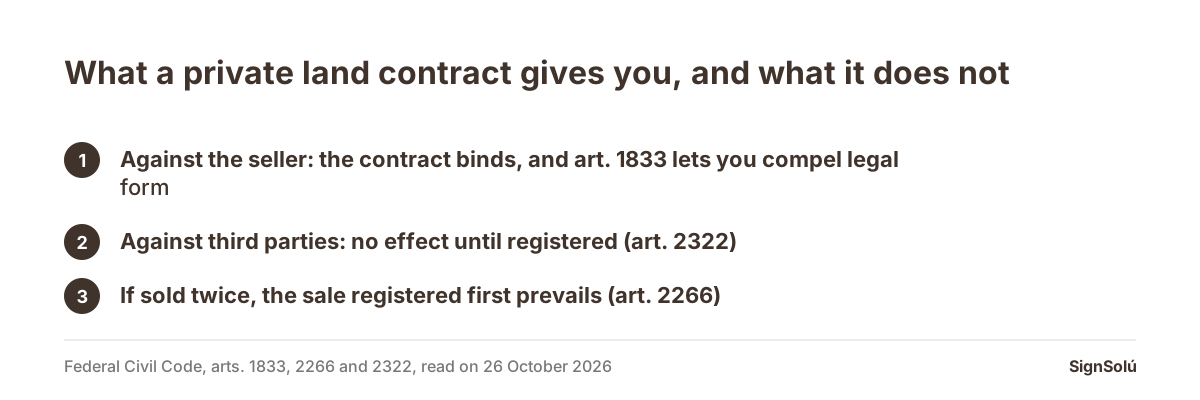
A private purchase contract binds the seller, but it does not make you the owner against anyone else. Article 2322 of the Federal Civil Code says a sale of real property has no effect against third parties until it is registered, and article 2266 says that where the same property is sold twice, the sale registered first prevails. Two more things decide a land deal in Mexico. If the land is ejido — community land — articles 64 and 74 of the Agrarian Law make it inalienable and any act to sell it void by operation of law. And if the land sits within 100 km of a border or 50 km of a coastline, a foreign buyer goes through a bank trust with a permit from the Ministry of Foreign Affairs, before a notary.
Land looks like the simplest thing to buy in Mexico. There is no building to inspect, no tenant to evict, and the price per square metre is a fraction of what a built house costs. That simplicity is where the risk hides: the two mistakes that cost foreign buyers the most money are both invisible when you look at a vacant lot.
This is the paperwork side only. What a Mexican notary does and why a deed cannot be signed online is covered in which documents need a Mexican notary, and buying a built home is in buying property in Mexico as an American.
Rule one: registration decides, not payment
Mexican law separates two questions that English-speaking buyers tend to merge. Does the contract bind the seller? Yes. Are you the owner against the world? Not until it is registered.
Article 2322 of the Federal Civil Code says that a sale of real property produces no effect against third parties until registered. Article 3042, section I, orders the Public Registry of Property to record the titles that create, declare, acknowledge, acquire, transfer, modify, limit, encumber or extinguish ownership and other real rights over real property. And article 2266 states the consequence plainly: where the thing sold is real property, the sale registered first prevails.
Read that last one again. A seller acting in bad faith can sell the same lot twice, and the buyer who wins is not the one who paid first or fenced the land first: it is the one who recorded first. That is the real reason the deed matters, and it is not a formality.
What your private contract is still worth
Quite a lot, and this is where good paperwork pays. Article 1833 says that where the law requires a particular form, the contract is not valid until it takes that form — but if the parties’ intent is established in a reliable manner, either of them may demand that the contract be given its legal form. In other words: a signed contract plus documented payments give you an action to compel the seller to appear before the notary. What makes that work is evidence with a date, which is exactly what an e-signed contract with an audit trail provides.
Private document or notarial deed: where the line is
Article 2316 says a sale contract requires no special formality except when it concerns real property. Article 2320 then requires a public deed when the appraisal value exceeds three hundred sixty-five times the general daily minimum wage, and article 2317 allows the transfer in a private document signed before two witnesses whose signatures are ratified before a notary, a competent judge or the Public Registry, below that threshold.
Two cautions. Since the decree published in the Official Gazette on 27 January 2016, every reference to the minimum wage as a unit of measure is read as the Unit of Measure and Update, so the threshold is computed with the UMA in force at the time of the deal; this article does not convert it to pesos, because the UMA changes each year. And the private document of article 2317 is not the contract you sign across a table: it requires two witnesses and ratified signatures. Mexican signature ratification is explained in Mexican notary: which documents need one.
Rule two: ejido land is not sold this way
This is the trap that catches the cheap lot with no deed and "papers from the comisariado". A large share of Mexico’s rural land is ejido — land held by a community under the Agrarian Law — and the Civil Code does not govern its transfer.
Article 64 declares that ejido land assigned by the assembly to human settlement is inalienable, imprescriptible and unattachable, and that any act seeking to transfer, prescribe or attach it is void by operation of law. Article 74 says the same of commonly held land, except in the cases of article 75. Parcel rights can be transferred, but article 80 allows it only to other ejidatarios or residents of the same community, and requires three things for validity: the parties’ written consent before two witnesses, ratified before a public officer; written notice to the transferor’s spouse, partner and children, who hold a right of first refusal for thirty calendar days; and written notice to the ejido commission.
There are two ways out, and both leave a paper trail you can check. Article 69 says a titled urban solar is governed by ordinary law and its title is recorded in the state Public Registry. And article 82 says that once the assembly has adopted the relevant resolution, interested ejidatarios may assume full ownership of their parcels, asking the National Agrarian Registry to deregister the land; it then issues a property title recorded in the Public Registry, and from that cancellation the land ceases to be ejido and becomes subject to ordinary law.
| What you are told | What it probably is | What to ask for |
|---|---|---|
| "It has papers from the comisariado" | Ejido parcel rights, not civil ownership | Parcel certificate and status at the Agrarian Registry |
| "We will regularise it later" | Land still registered as ejido | The assembly resolution and the full-ownership title (art. 82) |
| "It is a solar, it is already private" | Possibly true, and checkable | The title recorded in the state Public Registry (art. 69) |
| "No deed needed, the contract is enough" | A contract that binds the seller only | A lien-free certificate and a date for the deed |
| "The lot is beachfront, no problem" | Land inside the restricted zone | The bank trust route, through a notary |
| "Measurements are approximate" | A pricing question decided when you sign | A lump-sum or per-metre clause, written (art. 2261) |
The restricted zone, in the words of the statute
The Foreign Investment Law defines it in article 2, section VI: the strip of national territory of one hundred kilometres along the borders and fifty kilometres along the beaches referred to in article 27, section I, of the Constitution. The statute itself is the Foreign Investment Law, last amended 27 May 2024. Inside it, article 10 allows Mexican companies with a foreigner-admission clause to acquire ownership of real property for non-residential purposes, giving notice to the Ministry of Foreign Affairs within sixty business days, and to acquire rights over property for residential purposes under the trust chapter that follows.
Article 11 requires a Ministry of Foreign Affairs permit for credit institutions to acquire, as trustees, rights over real property inside the restricted zone where the purpose of the trust is to allow the use and enjoyment of that property without creating real rights over it, and where the beneficiaries are foreign individuals or companies. Article 13 sets the term: a maximum of fifty years, renewable at the interested party’s request. Outside the restricted zone, article 10-A requires a prior written agreement filed with the Ministry and its permit; where the municipality lies entirely outside the zone, the permit is deemed granted if a refusal is not published in the Official Gazette within five business days, and where the municipality lies partly inside, the Ministry decides within thirty business days.
None of that is signed online, and this article does not suggest otherwise: the trust and the deed are notarial acts, done before a Mexican notary. What the trust route looks like from the paperwork side is in fideicomiso in Mexico: what you sign before the trust exists, and the selling side is in selling property in Mexico: what you sign. Which language governs a bilingual contract is in bilingual contracts in Mexico.
The documents, in the order they get signed
- 1A bilingual promise to purchase, fixing price, deposit, deadlines and the conditions that must be met before the deed. The template is bilingual promise of purchase and sale. What a letter of intent commits you to is in letter of intent with a Mexican company.
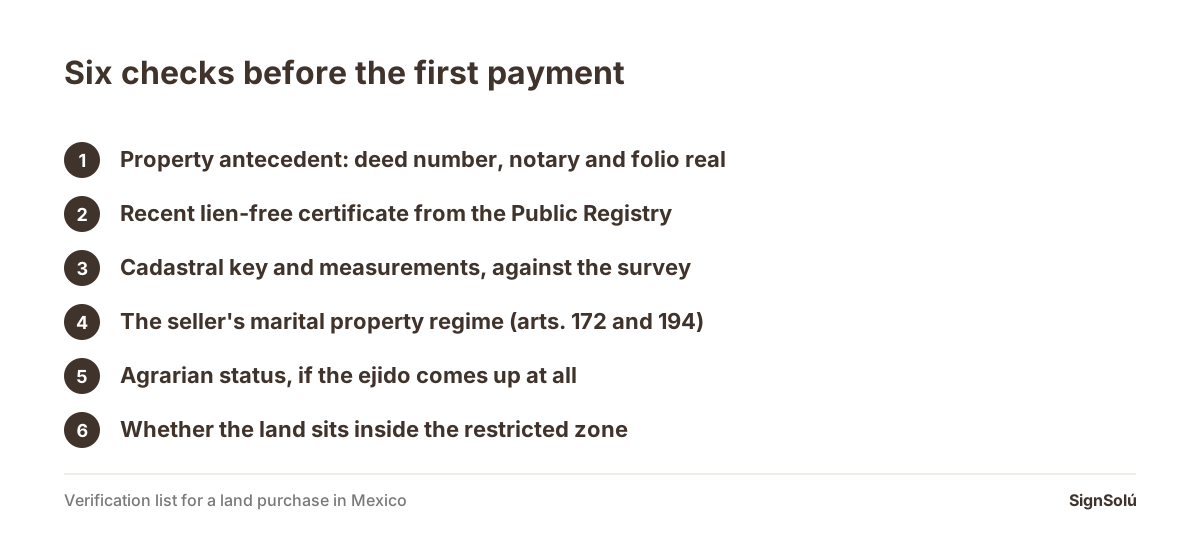
- 2The purchase contract, with the property antecedent, measurements and boundaries, cadastral key, lien-free certificate, property tax status, the seller’s marital property regime, the possession date and the deadline for the deed. The template is land purchase contract (in Spanish).
- 3A power of attorney, if you will not be in Mexico for the notarial appointment. The bilingual template is bilingual power of attorney, and what it can and cannot do is in Mexican power of attorney: the carta poder.
- 4The notarial deed, before a Mexican notary. Not online, and not optional above the article 2320 threshold.
- 5Registration at the state Public Registry of Property, which is the only step that gives you effects against third parties.
The first three are private documents and can all be signed from your own country. Why the place where you sign does not matter under Mexican law is worth knowing: article 114 of the Commercial Code says that, to determine whether a foreign certificate or electronic signature produces legal effects, neither the place where it was issued, created or used, nor the place of the signer’s establishment, is taken into consideration. More on the statute in is an electronic signature valid in Mexico.
- A lot priced "as a whole" is not the same as priced per square metre: article 2261 says that where real property is sold for a lump sum without specifically estimating its parts or measurements, there is no ground for rescission even if the delivery falls short or runs over.
- Who pays the deed and registry costs is set by article 2263, and belongs in the contract rather than in a surprise at the notary.
- Which civil code governs is settled by article 13, section III: real rights over real property follow the law of the place where the property is located, even where the holders are foreigners.
- The state code may differ on the threshold and the formalities, so the federal rules above are the starting point and not the last word.
- Nothing here states a peso figure for the UMA threshold, because it changes each year and a stale number is a wrong one.
If the seller is married
It is the defect that stops the most deals at the notary. Article 172 gives each spouse capacity to contract and dispose of their own property without the other’s consent, except as regards acts of administration and ownership of community property, and article 194 says that ownership of community property resides in both spouses while the marital partnership subsists. So the contract should state the seller’s marital property regime, and if the land is community property, the spouse’s written consent is obtained separately and appears in the deed.
How the private documents get signed, each party in its own language
The promise, the purchase contract and the power of attorney go out for signature by WhatsApp or email, and each party signs from a phone or a laptop without creating an account and without installing anything. The sender picks the language per signer: a buyer in the United States receives the email, the WhatsApp message and the signing page in English, while the Mexican seller works in Spanish. One document can carry one signer in English and another in Spanish.
The audit certificate comes out bilingual — Spanish governs and English is a courtesy — and each document keeps its time, IP, device and SHA-256 hash of the file, which anyone can check at /verificar without an account. For a land deal that evidence matters more than usual, because the article 1833 action rests on proving intent and payment with a date. What the audit trail contains is in how to sign a contract remotely with someone in Mexico.
SignSolú is a Mexican platform: the signature arrives by WhatsApp or email, the other party signs from a phone without an account and without paying, anyone verifies the document without an account, and the free plan is ten documents with no expiry and no card. It does not issue NOM-151 conservation certificates, which are explained in NOM-151 in Mexico: what it is and when you need it. For a land purchase, what the deal needs from a platform is proof of date and identity on the private documents, and a notary for the deed.
Frequently asked questions
Can a foreigner buy land in Mexico?
Yes, with one geographic condition. The Foreign Investment Law defines a restricted zone in article 2, section VI: one hundred kilometres along the borders and fifty along the beaches, referred to in article 27, section I, of the Constitution. Inside that strip, a foreign buyer of residential property goes through a bank trust, which article 11 says requires a permit from the Ministry of Foreign Affairs and which article 13 limits to fifty years, renewable. Outside it, article 10-A requires a prior written agreement filed with the Ministry and its permit.
I signed a private purchase contract. Am I the owner?
Against the seller, the contract binds, and article 1833 of the Federal Civil Code lets you demand that it be given its legal form where the parties’ intent is established in a reliable manner. Against anyone else, no: article 2322 says a sale of real property has no effect against third parties until registered, and article 2266 gives priority to whichever sale was registered first. Both answers are correct; they just answer different questions.
What is ejido land and why can it not be sold to me?
It is land held by a community under the Agrarian Law. Article 64 makes land assigned to human settlement inalienable, imprescriptible and unattachable, and declares void by operation of law any act seeking to transfer it; article 74 says the same of commonly held land. Parcel rights may be transferred, but article 80 allows it only to other ejidatarios or residents of the same community, with ratified written consent, a thirty-day right of first refusal for the spouse and children, and notice to the ejido commission.
Can ejido land ever become private?
Yes, through two routes in the statute. Article 69 says a titled urban solar is governed by ordinary law and its title is recorded in the state Public Registry. And article 82 says that once the assembly has adopted the relevant resolution, interested ejidatarios may assume full ownership of their parcels and ask the National Agrarian Registry to deregister the land; it issues a property title recorded in the Public Registry, and from that cancellation the land ceases to be ejido and becomes subject to ordinary law. Ask to see those documents, not a promise.
Do I need a notary, or is a private document enough?
It depends on value. Article 2320 requires a public deed when the appraisal value exceeds three hundred sixty-five times the general daily minimum wage, now read as the Unit of Measure and Update since the decree of 27 January 2016. Below that, article 2317 allows a private document signed before two witnesses whose signatures are ratified before a notary, a competent judge or the Public Registry. Note that this is not the contract you sign across a table: the witnesses and the ratification are what make it a recordable title.
Which documents can I sign from my own country?
The promise to purchase, the purchase contract and a power of attorney — all private documents, all signable remotely. Article 114 of the Commercial Code says that in determining whether a foreign certificate or electronic signature produces legal effects, neither the place where it was issued, created or used nor the place of the signer’s establishment is taken into consideration. The deed and a fideicomiso are notarial acts and happen before a Mexican notary.
Send your next contract to Mexico for signature
Create a free account and send 10 documents with no card. Your dashboard works in English. You set the language per signer, and their email, WhatsApp message and signing page arrive in that language.