A parental consent letter when the child travels with only one parent: why it is recommended rather than required, and what that changes
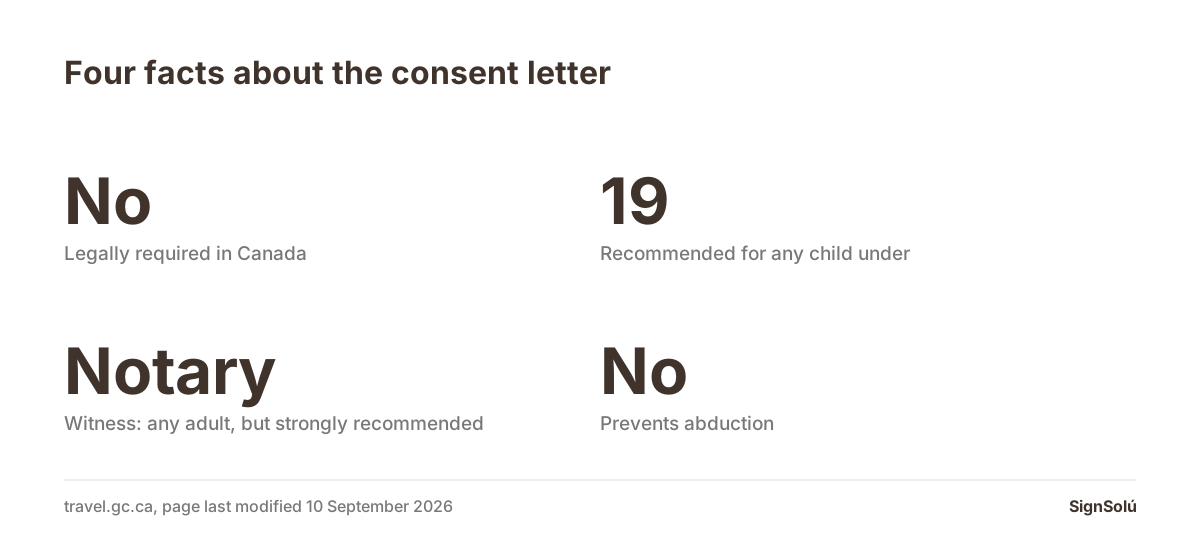
A consent letter is not legally required in Canada, and the Government of Canada recommends that children travelling without one or both parents carry one anyway. Its guidance, last modified on 10 September 2026, says the letter may be requested by immigration authorities when entering or leaving a foreign country, by airline agents and by Canadian officials when entering Canada, and that failing to produce one on request may result in delays or a refusal to enter or exit a country. It also states plainly what the letter cannot do: it does not guarantee that a child will not be taken abroad without permission or that the child will be returned, and it may not prevent abduction.
Recommended, not required — and why that is not a loophole
The Government of Canada guidance on consent letters is unusually direct about its own status. A consent letter is a written statement showing that a child has permission to travel abroad from any parent or person with decision-making responsibility who is not travelling with them, regardless of the child’s status in Canada. It is not legally required in Canada, which is the same shape of rule as a consent letter in a clinical setting: what matters is the evidence it leaves, not a statutory command. The general-purpose version of the document is letter of consent template. And it may be requested by immigration authorities when entering or leaving a foreign country, by airline agents, and by Canadian officials when entering Canada.
Those two facts sit together more comfortably than they look. The letter is not a document the law obliges a parent to produce; it is the document that answers a question officials are entitled to ask. Border officials have the right to ask for proof that all parents or persons with decision-making responsibility are giving permission, and in the absence of a letter they could ask additional questions and may ask to contact the absent parent with your permission. Failure to produce a letter upon request may result in delays or a refusal to enter or exit a country.
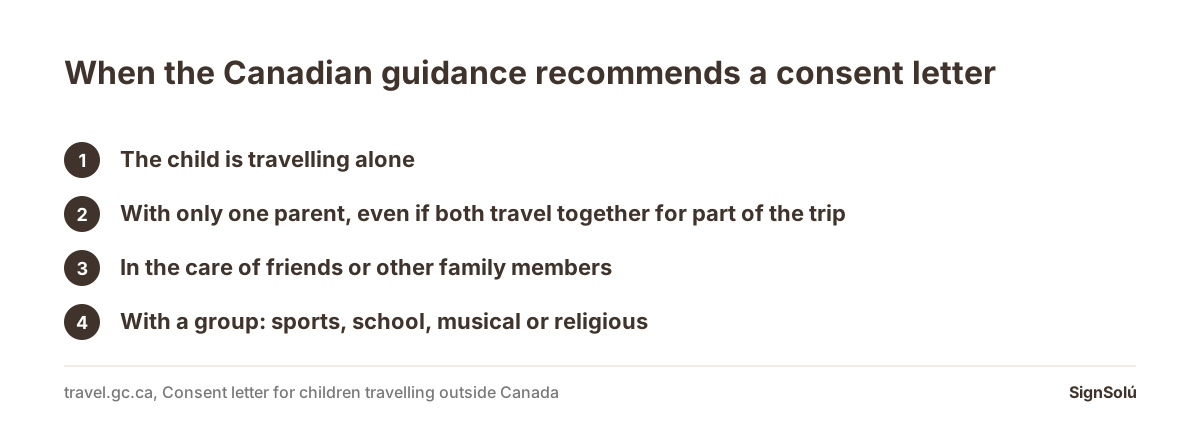
When the guidance says to use one
Four situations, and the second is the one most families do not expect. The guidance recommends a consent letter when a child is travelling alone; with only one parent or person with decision-making responsibility, even if they are travelling with both parents for part of the trip; in the care of friends or other family members; or with a group, such as a sports, school, musical or religious group.
On age, the guidance is broader than the passport rules people reason from: to avoid complications, any child under the age of 19 should carry a consent letter when travelling abroad without both parents, and even a child of 16 or older who can apply for an adult passport may still be asked for one. And it applies to any international border, including the land border with the United States, even for a day trip.
What goes in it
There are no official guidelines for the content and format, which is why templates vary so much. What the guidance says a letter usually includes is short: the name of the child; the names and contact information of parents or persons with decision-making responsibility; the full name, address and contact information of the accompanying adult and their relationship to the child; and information on where the child is travelling and the duration of the trip, including specific travel dates.
On format, one letter or several: if neither parent is accompanying the child they can both sign one letter or each sign a separate one; children from the same family travelling together may be listed on one letter; and separate letters are recommended for children who will be travelling separately for part of the trip.
| The question | What the Canadian guidance says |
|---|---|
| Is it legally required? | No, not in Canada; it is recommended |
| Who can ask for it? | Foreign immigration authorities, airline agents, and Canadian officials on entry |
| What happens if you cannot produce it? | Possible delays or a refusal to enter or exit a country |
| Up to what age? | Any child under 19, to avoid complications |
| Does a land day trip count? | Yes; it covers any international border, including the land border with the United States |
| Who can witness it? | Any adult, though a notary public witness is strongly recommended |
| Photocopies or digital versions? | Original signed letters are best; officials may not accept copies and are more likely to question them |
| Does it prevent abduction? | No; it is an important precaution but not a complete safeguard |
The witness line, and the one about originals
Two sentences in the guidance do most of the practical work. The first: any adult may witness the signing of a consent letter; however, it is strongly recommended that a notary public witness sign it. The second: original signed letters are best. Border officials may not accept photocopies or digital versions and are more likely to question their authenticity.
That second sentence is worth taking at face value rather than arguing with. It is not a statement about the legal validity of an electronic signature; it is a statement about what an officer at a counter, in a queue, is likely to accept. The practical reading for a separated family across two countries is to get the absent parent’s signature in whatever way actually works — which is usually remote — and then travel with a printed original, not with a file on a phone.
Why consent is not only a travel formality
The reason officials ask at all is in the Criminal Code. Section 282(1) makes it an offence for a parent, guardian or person having the lawful care or charge of a child under 14 to take, entice away, conceal, detain, receive or harbour that child in contravention of a custody order or a parenting order made by a court anywhere in Canada, with intent to deprive another person of possession of the child — punishable by up to ten years on indictment.
Section 283(1) covers the same conduct whether or not there is such an order, with the same maximum penalty, and subsection (2) adds that no proceedings may be commenced under it without the consent of the Attorney General. That pair is why a border officer treats a missing signature as a question rather than paperwork, and it is also why the guidance says a consent letter is a precaution and not a safeguard: it helps show permission; it does not prevent anything.
Where there is a parenting arrangement, order or agreement, the guidance says to carry it as well, and to check what other travel documents a child may need. If a parent refuses to sign, it suggests resolving the issue directly or through family justice services such as mediation. And it adds a caution in the other direction: if you believe there is a risk that the accompanying parent will not bring your child back to Canada, consult a lawyer right away and proceed with caution before signing a consent letter.
Writing one that does its job
- 1The child’s full name, and date of birth, exactly as they appear on the travel document.
- 2Every non-travelling parent or person with decision-making responsibility, with contact information that is reachable while the trip is happening — a number that is answered abroad, not a landline at home.
- 3The accompanying adult: full name, address, contact information and relationship to the child.
- 4The destination and the dates, specific rather than approximate, since «two weeks in the summer» is the kind of detail that invites a second question.
- 5A witness signature, with a notary public if one is available.
- 6A separate letter for any leg of the trip the child travels separately.
- 7The parenting order or agreement, carried alongside the letter where one exists.
- 8A printed original, signed, in the travel folder, alongside the child’s passport and any power of attorney letter that the trip may call for.
The parental consent letter template sets out those fields; a passport application has its own requirements, covered in parental consent for a child passport. Related documents that often travel with it: medical consent form, for care while the child is away, explained in a medical consent form for a minor while parents are away; power of attorney for minor where decision-making has to be delegated more broadly; and custody agreement template and separation agreement template or cohabitation agreement template for the arrangement behind it, with the Ontario witness trap in a separation agreement in Ontario.
Getting the absent parent to sign
Whether a signature collected at a distance binds at all is covered in is an electronic signature legally binding, and where; the harder problem here is a different one. This is logistical rather than legal: the other parent lives in another city or another country, the trip is in three weeks, and the letter needs a signature plus a witness. Posting paper across a border and back is what makes families travel without the letter at all.
SignSolú sends the letter by WhatsApp or by email and the other parent signs it from a phone, with no account and no payment on their side. Every document carries an audit receipt with time, IP, device and a SHA-256 hash, and anyone can check it at /verificar without an account — useful if the signature is ever questioned between the parents themselves. The interface is in Spanish; the sender chooses each signer’s language, so a parent added in English receives the email, the WhatsApp message and the signing page in English. SignSolú is a Mexican platform; for documents that need it in Mexico, it issues NOM-151 conservation certificates on the signed document through a certification service provider accredited by Mexico’s Ministry of Economy, switched on for your team on request. Because the Canadian guidance recommends carrying an original, the practical route is to collect the signature remotely and print the signed letter for the trip: start here — the free plan is 10 documents, no expiry and no card.
Frequently asked questions
Is a travel consent letter legally required in Canada?
No. The Government of Canada guidance states that a consent letter is not legally required in Canada, and in the same breath recommends that children travelling outside Canada without one or both parents or legal guardians carry a signed one. It may be requested by foreign immigration authorities, by airline agents and by Canadian officials when entering Canada.
My child is travelling with me, their mother. Do we still need one?
That is exactly one of the listed situations. The guidance recommends a consent letter when a child is travelling with only one parent or person with decision-making responsibility, even if they are travelling with both parents for part of the trip, and recommends separate letters for children who will be travelling separately for part of the trip.
Does it need a notary?
Not as a requirement. The guidance says any adult may witness the signing of a consent letter, and that it is strongly recommended that a notary public witness sign it. The recommendation exists because an officer who doubts a letter is more likely to accept one witnessed by a notary.
Can I show the letter on my phone at the border?
The guidance is cautious about this: original signed letters are best, and border officials may not accept photocopies or digital versions and are more likely to question their authenticity. The practical approach is to carry a printed, signed original, whatever way the signature was collected.
What if the other parent refuses to sign?
The guidance suggests trying to resolve the issue directly or considering family justice services such as mediation where appropriate, and points to the list of government-based family justice services in each province and territory, and to a family legal adviser. It does not treat refusal as something to work around.
Does a consent letter stop a child being taken abroad?
No, and the guidance says so: a consent letter helps show permission for travel but does not guarantee that a child will not be taken abroad without permission or that the child will be returned to Canada, and it may not prevent abduction. It also advises consulting a lawyer right away, and proceeding with caution before signing, where there is a risk the accompanying parent will not bring the child back.
Send your next contract to Mexico for signature
Create a free account and send 10 documents with no card. Your dashboard works in English. You set the language per signer, and their email, WhatsApp message and signing page arrive in that language.