Separation agreement in Ontario: the witness most templates forget, and the Act calls it unenforceable without one
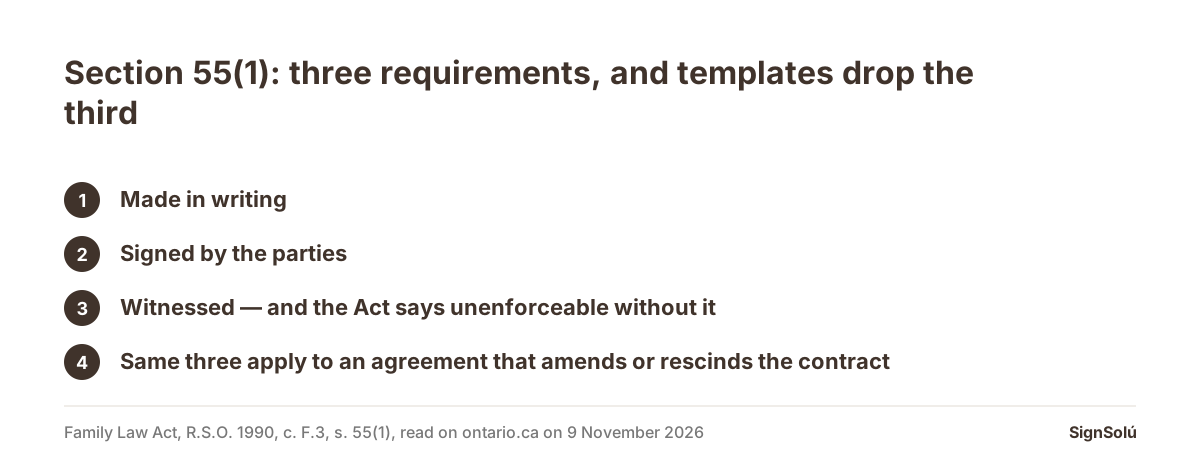
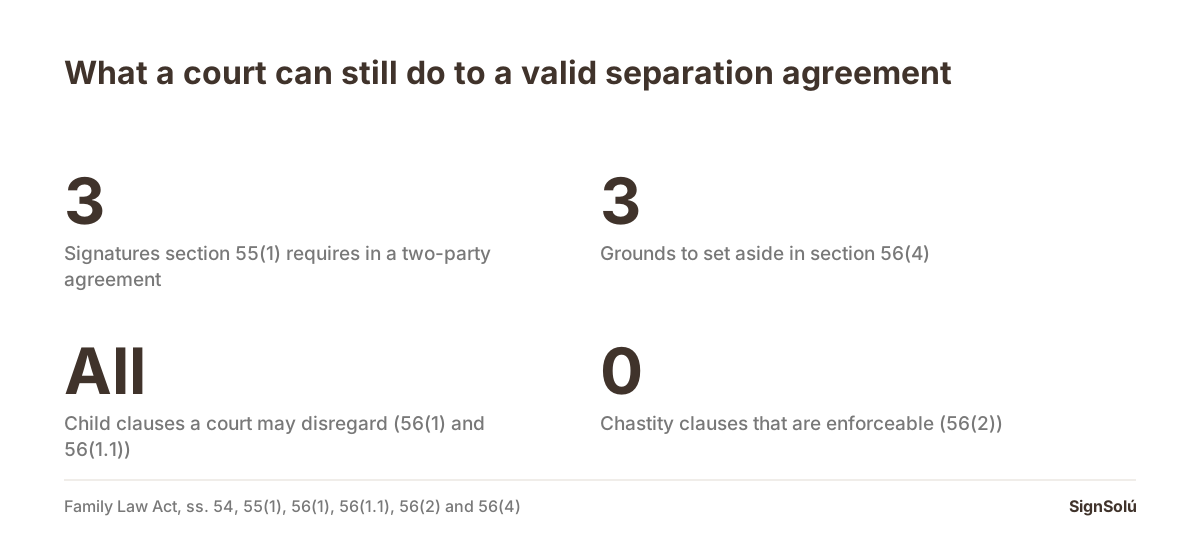
Section 55(1) of Ontario’s Family Law Act is one sentence long: a domestic contract, and an agreement to amend or rescind one, is unenforceable unless made in writing, signed by the parties and witnessed. Three requirements, and the free templates almost always give you the first two. The witness is not a notarization and does not have to be a lawyer: it is a person who sees the signature and signs to say so. In a two-party separation agreement that means three signature blocks, not two, and the same rule applies to any later amendment. Even with all three in place, section 56(4) still lets a court set the agreement aside if a party failed to disclose significant assets or debts, if a party did not understand the nature or consequences of the contract, or otherwise in accordance with the law of contract.
The sentence that decides whether you have an agreement
Two people separate, agree on the house, the support and the parenting schedule, download a separation agreement, fill it in and sign it at the kitchen table. Everything about that is reasonable. One thing about it is fatal, and it is the thing the template did not ask for.
Section 55(1) of the Family Law Act reads: «A domestic contract and an agreement to amend or rescind a domestic contract are unenforceable unless made in writing, signed by the parties and witnessed.» The operative word is unenforceable, not «may be challenged». A separation agreement is a domestic contract, so the sentence is about the document in your hands.
What the witness is, and what it is not
The Act does not define the witness, and that is why the requirement gets skipped: people assume it means something expensive. It does not.
- It is not a notary. Section 55(1) says witnessed, not notarized or sworn. Nothing in it calls for a commissioner, a seal or an affidavit.
- It is not a lawyer. Independent legal advice is a very good idea for a separation agreement, and it has nothing to do with section 55(1). They are two separate protections, and getting one does not give you the other.
- It is a person who sees the signing and signs. One witness per signing party is the ordinary practice, and the same person can witness both. What the witness block needs is a legible name and, in practice, an address — not because the Act says so, but because a witness nobody can find later is not much of a witness.
- It applies to amendments too. Section 55(1) names «an agreement to amend or rescind a domestic contract» in the same breath. A side letter adjusting support, signed by the two of you and nobody else, is unenforceable for the same reason the original would have been.
What the agreement can cover
Section 54 sets the scope for people who cohabited and are living separate and apart: ownership in or division of property, support obligations, the right to direct the education and moral training of their children, decision-making responsibility or parenting time, and any other matter in the settlement of their affairs. That last clause is broad, which is why these agreements end up carrying the pension, the debts and who keeps the dog.
What it cannot do is bind a court on the children. Section 56(1) lets the court disregard any provision about education, moral training, decision-making responsibility or parenting time where doing so is in the best interests of the child, and section 56(1.1) lets it disregard a child-support provision that is unreasonable having regard to the child support guidelines. So the parenting schedule in the agreement is a plan the two of you are committing to, not a ceiling on what a court can order.
| Clause in the agreement | What the Act does with it | Section |
|---|---|---|
| Division of property | Enforceable if s. 55(1) is met | 54, 55(1) |
| Spousal support amount | Enforceable, but can be set aside in the cases of s. 33(4) | 54, 33(4) |
| Child support below the guidelines | A court may disregard it if unreasonable | 56(1.1) |
| Parenting time and decision-making | A court may disregard it on best interests | 56(1) |
| A right that depends on staying chaste | Unenforceable outright | 56(2) |
| Signed by the parties only, no witness | The whole contract is unenforceable | 55(1) |
| Later side letter changing support, no witness | Unenforceable for the same reason | 55(1) |
Section 56(4): the three ways it still comes apart
A witnessed agreement is not an unassailable agreement. Section 56(4) says a court may, on application, set aside a domestic contract or a provision in it: (a) if a party failed to disclose to the other significant assets, or significant debts or other liabilities, existing when the contract was made; (b) if a party did not understand the nature or consequences of the contract; or (c) otherwise in accordance with the law of contract.
Paragraph (a) is the one that decides most of these cases, and it is also the one you can do something about while you are drafting. The answer is not a clause: it is a schedule. A list of each party’s assets, debts and liabilities as at the date of the agreement, attached and signed with it, turns «you never told me about the line of credit» into a factual question with a document attached. If the agreement is already signed and the schedule is not, the fix is an amendment that meets s. 55(1) in its own right, not a loose attachment.
And «separate and apart» is a different question from the witness
Section 54 opens with «two persons who cohabited and are living separate and apart». Couples who split but stay in the same house for the mortgage or the children run into that phrase before they get anywhere near a signature block, and the test is about facts rather than sleeping arrangements. Two US states that put the requirement in a statute are compared in in-house separation: does one roof count.
Can the signatures and the witness be electronic?
Ontario answers this in its own statute. Section 11(1) of the Electronic Commerce Act, 2000 says a legal requirement that a document be signed is satisfied by an electronic signature. The Act then lists what it does not apply to, in section 31(1): wills and codicils, trusts created by wills or codicils, powers of attorney in respect of an individual’s financial affairs or personal care, negotiable instruments, and documents that are prescribed. Domestic contracts are not on that list.
So the structure to build is simple: the two parties and the witness are three signers on the same document, each signing in their own name, with the witness signing after the party they witnessed. What section 55(1) is asking for is that someone saw it happen, so the practical point is not the technology but the sequence — the witness should be present for the signing, however the signing is done, and the agreement should say who witnessed whom.
SignSolú is a Mexican e-signature platform that works over WhatsApp, and this is the shape of document it handles: the sender uploads the agreement and its schedule of assets, adds the two parties and the witness by email or phone number, and can set them to sign in order so the witness signs last. Nobody but the sender needs an account and nobody pays to sign. Each document keeps an audit receipt with time, IP, device and a SHA-256 hash of the file, and anyone can check it later at /verificar with no account — which is useful for an agreement people may need to produce years after signing. The interface is in Spanish; what the sender picks per signer is the language, so a signer set to English gets the email, the WhatsApp message and the signing page in English. The free plan is 10 documents with no expiry and no card: start here.
The documents around it
- The agreement itself. A separation agreement template gives you the structure; the witness block is the thing to check before you use any template.
- A schedule of assets and debts, signed with the agreement. That is the answer to s. 56(4)(a), and it is worth more than any recital.
- An agreement made before separation. A prenuptial agreement is also a domestic contract, and so is a cohabitation agreement, so section 55(1) applies to them word for word — including the witness.
- A later amendment. Not a side letter: an amendment, in writing, signed and witnessed. A contract amendment template is the right shape.
- A full and final release of claims. Where the settlement is of a specific dispute rather than of a relationship, the document is a settlement agreement; the conditions it has to meet in another jurisdiction are in settlement agreement: the six conditions.
- Anything touching a child and a border. Travel and consent documents are their own thing: parental consent for a child passport, power of attorney for a minor and a custody agreement template.
One more that belongs on the list: the property. If the house is the main asset, the clause dividing it is the one a court will read first, and the conveyancing that follows is a separate transaction with its own paperwork — a purchase agreement or, where one party buys the other out over time, a rent-to-own contract, whose risk of being treated as a credit sale is in lease-to-own: when it is a credit sale. If one of you keeps the house and the other keeps renting, the tenancy terms that cannot be contracted out of are in tenancy agreement in BC and the lodger route in lodger agreement or tenancy.
Two neighbouring questions come up constantly. Whether an electronic signature binds at all, and in which countries, is in is an electronic signature legally binding. And if one of the two of you is in Mexico — a property there, a marriage there — what a Mexican notary is actually required for, and what they are not, is in the Mexican notary, with the power of attorney in carta de poder in English.
Frequently asked questions
Does a separation agreement in Ontario really need a witness?
Yes. Section 55(1) of the Family Law Act says a domestic contract, and an agreement to amend or rescind one, is unenforceable unless made in writing, signed by the parties and witnessed. A separation agreement is a domestic contract. The Act does not say it is weaker without a witness; it says unenforceable, which is why this is the first thing to check on any template.
Does the witness have to be a lawyer or a notary?
No. Section 55(1) says witnessed, not notarized or sworn, and it does not name a profession. Independent legal advice for each party is a different and separate protection, and having it does not satisfy section 55(1) by itself. What the witness block needs in practice is a legible name and an address, so the person can be found if the signing is ever questioned.
We already signed without a witness. Can we fix it?
The usual route is to sign again, properly: in writing, signed by both parties, witnessed. Note that section 55(1) covers an agreement to amend or rescind a domestic contract in the same sentence, so an amendment also has to be witnessed. Because the fix depends on what has happened since you signed, including anything either of you relied on, this one is worth a lawyer rather than a template.
If it is witnessed, can a court still change it?
Yes. Section 56(4) lets a court set aside the contract or a provision if a party failed to disclose significant assets, debts or other liabilities existing when it was made, if a party did not understand its nature or consequences, or otherwise in accordance with the law of contract. And sections 56(1) and 56(1.1) let a court disregard child provisions on best interests or against the child support guidelines.
What should we attach to protect against a disclosure challenge?
A schedule listing each party’s assets, debts and other liabilities as at the date of the agreement, signed and dated with it. Section 56(4)(a) is about failure to disclose significant assets or debts existing when the contract was made, so a signed schedule turns a later accusation into a factual question with a document attached, rather than a recollection of what was said.
Can the parties and the witness sign electronically?
Ontario’s Electronic Commerce Act, 2000 says in section 11(1) that a legal requirement that a document be signed is satisfied by an electronic signature, and its section 31(1) list of documents the Act does not apply to — wills, trusts created by wills, powers of attorney for financial affairs or personal care, negotiable instruments and prescribed documents — does not include domestic contracts. The practical point is sequence: the witness should be present for the signing and sign after the party they witnessed.
Send your next contract to Mexico for signature
Create a free account and send 10 documents with no card. Your dashboard works in English. You set the language per signer, and their email, WhatsApp message and signing page arrive in that language.