Tenancy agreement in British Columbia: the terms you are not allowed to change
Section 13(1) of British Columbia’s Residential Tenancy Act says a landlord must prepare in writing every tenancy agreement entered into on or after 1 January 2004, and section 13(2) says it must comply with the regulations and set out the standard terms, the correct legal names of both parties, the address of the rental unit, the date the agreement is entered into, the landlord’s address for service and telephone number, and seven agreed terms about dates, rent and deposits. Then section 14(1) closes it: a tenancy agreement may not be amended to change or remove a standard term. The part people try to negotiate is the part that is fixed.
Why a downloaded template is the wrong starting point here
In most places a lease is whatever two people agree, within the limits of the local statute. In British Columbia the statute goes further: it makes the written agreement compulsory, says what the document must contain, and then declares a core set of terms unamendable by either side.
All of that is in Part 2 of the Residential Tenancy Act, SBC 2002, chapter 78. A template that leaves the standard terms out is not a shorter agreement: it is an agreement missing the part the Act requires.
Section 13: what the document must contain
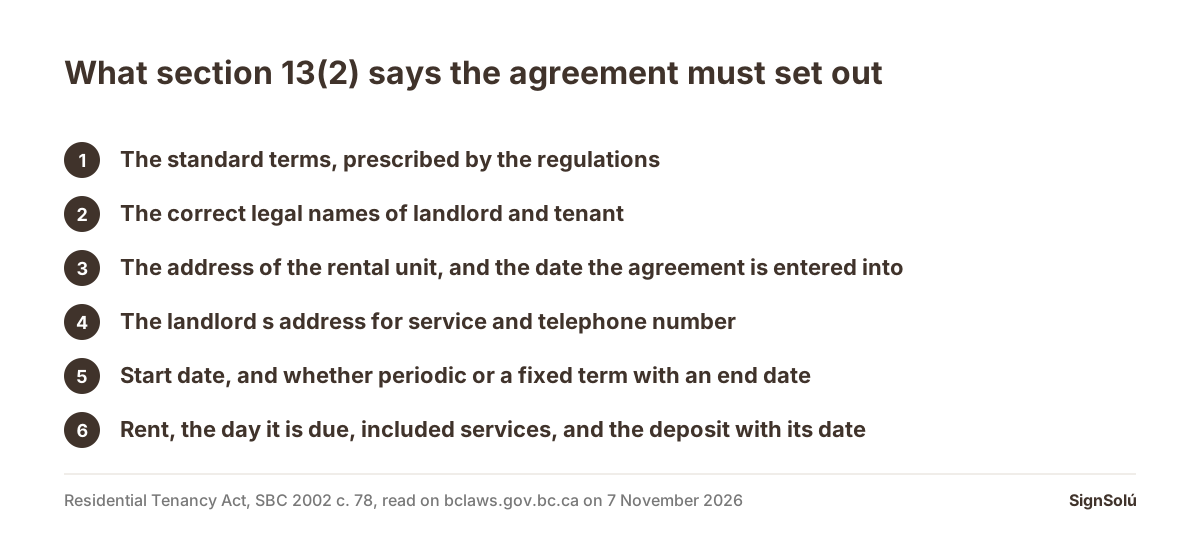
Section 13(1) is the obligation: a landlord must prepare in writing every tenancy agreement entered into on or after 1 January 2004. Section 13(2) lists what it must set out:
- the standard terms;
- the correct legal names of the landlord and tenant;
- the address of the rental unit;
- the date the tenancy agreement is entered into;
- the address for service and telephone number of the landlord or the landlord’s agent;
- the agreed terms about the start date; whether a periodic tenancy is weekly, monthly or on another periodic basis; and, for a fixed term, the date it ends;
- the amount of rent for a specified period, the day it is due, which services and facilities are included, and the amount of any security or pet damage deposit with the date it was or must be paid.
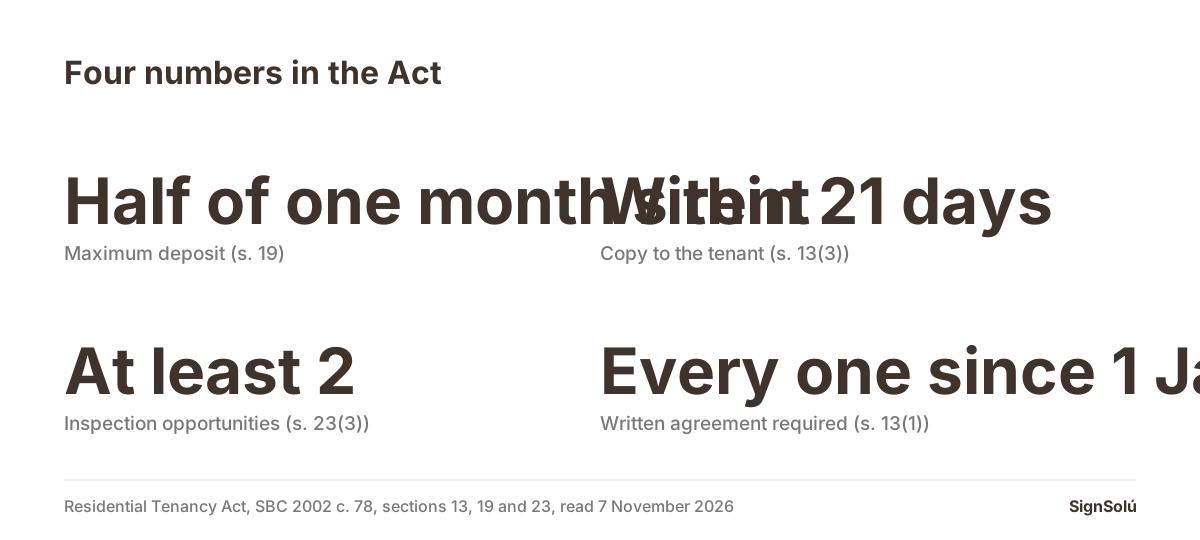
And section 13(3) puts a clock on it: within 21 days after the landlord and tenant enter into the agreement, the landlord must give the tenant a copy.
Three of those items are the ones that get skipped in practice, and each one causes a specific problem later. «Correct legal names», not the name on the email. The landlord’s address for service, because that is where every later notice goes. And the day of the month rent is due, written as a day and not as «monthly». What leaving before the end of a fixed term costs is a separate question, covered in breaking a lease and in what happens if you break a lease.
Section 14: the part that cannot be edited
Section 14(1): a tenancy agreement may not be amended to change or remove a standard term. Section 14(2): it may be amended to add, remove or change a term other than a standard term, only if both the landlord and tenant agree to the amendment.
Section 14(3) carves out three cases where that mutual agreement is not needed: a rent increase in accordance with Part 3 of the Act; a withdrawal of, or a restriction on, a service or facility in accordance with section 27; and a term in respect of which a landlord or tenant has obtained an order of the director that the other’s agreement is not required. Where a waiver is what somebody is asking you to sign instead, what it can and cannot cover is in what a signed waiver means.
Read together, those two sections answer the question that brings most people to a template: no, you cannot write your own version of the core. What you can draft are the terms around it, and they only bind if the other side agreed. A change made later belongs in a lease addendum, signed by both.
The deposit rules are numbers, not negotiation
| Rule | What the Act says | Section |
|---|---|---|
| Maximum deposit | A landlord must not require or accept a security deposit or a pet damage deposit greater than the equivalent of 1/2 of one month’s rent | 19(1) |
| If more was accepted | The tenant may deduct the overpayment from rent or otherwise recover it | 19(2) |
| When a security deposit may be required | Only when the landlord and tenant enter into the tenancy agreement | 20(a) |
| How many | Not more than one security deposit, and not more than one pet damage deposit, whatever the number of pets | 20(b) and 20(d) |
| Automatic forfeiture clause | A landlord must not require, or include as a term, that the landlord automatically keeps all or part of the deposit at the end | 20(e) |
| Acceleration clause | A tenancy agreement must not include a term that the rest of the rent becomes due if a term is breached | 22 |
| Application fees | A landlord must not charge anything for accepting or processing an application, investigating suitability, or accepting the person as a tenant | 15 |
The two rows at the bottom are the clauses most often copied into a template from somewhere else. An acceleration term — «if you breach, the whole year becomes payable» — is prohibited outright by section 22. And section 15 makes an application fee unlawful even when the landlord calls it a credit check.
The inspection report is part of the deal
Section 23 turns the move-in walkthrough into an obligation. Subject to the regulations, the landlord and tenant must inspect the condition of the rental unit on the day the tenant is entitled to possession, or on another mutually agreed day. The landlord must offer the tenant at least 2 opportunities, as prescribed, for the inspection. The landlord must complete a condition inspection report in accordance with the regulations, and both must sign it, with the landlord giving the tenant a copy.
That signed report is what a deposit dispute turns on at the end, which is why it is worth signing properly and keeping. A report signed on a phone at the door, with a timestamp, is the version that still exists a year later. The same logic applies to anything else handed over on day one, the way a photo release form or a location release form record a permission at the moment it is given.
Rent that varies with the number of occupants
Section 13(2)(f)(iv) allows an agreement where the rent varies with the number of occupants, and then section 22.1 limits it: if the agreement includes such a term, the landlord must not increase the rent based on the number of occupants because of adding an occupant who is a minor, or an occupant who was a minor when the agreement was entered into and is no longer one.
What to do with a template, then
- 1Start from the prescribed standard terms, not from a generic lease. They are the part section 14(1) will not let you change anyway.
- 2Fill in the seven items of section 13(2) completely, with the correct legal names and the landlord’s address for service.
- 3Say whether the tenancy is periodic — and on what basis — or fixed term with an end date.
- 4Write the deposit amount and the date it was or must be paid, keeping it at or under half a month’s rent.
- 5Delete anything that looks like an acceleration clause or an automatic forfeiture of the deposit.
- 6Delete any application or processing fee.
- 7Book the move-in inspection and complete and sign the condition inspection report.
- 8Give the tenant a copy within 21 days, and keep proof that you did.
The template to work from is the tenancy agreement template; for a whole property elsewhere, the lease agreement and the simple lease agreement; for a rolling arrangement, the month-to-month lease agreement and, for how Alberta counts the notice, one month for the tenant and three for the landlord. To end or extend, the lease termination letter and the lease extension agreement. Sharing rather than letting whole: the roommate agreement template and, where the landlord lives in the building, the two Scottish exclusions. Subletting, with New York’s own procedure, in the letter that comes before the template and the sublease agreement template.
Signing it, and the report, without a printer
A BC tenancy produces at least three signed documents in the first week: the agreement, the condition inspection report and often an addendum. All three have to be signed by both and copied to the tenant.
SignSolú is a Mexican e-signature platform. For documents like these it does the part that is awkward on paper: you send them over WhatsApp or by email, the other person signs from a phone without creating an account or paying anything, and the audit receipt records time, IP address, device and the SHA-256 hash of the file — so «the landlord gave me a copy on the 14th» stops being a memory. Anyone can check that the file did not change at the verification page, with no account. The sender picks the language for each signer. SignSolú is not an accredited provider and does not issue NOM-151 conservation certificates, which are a Mexican requirement and not a Canadian one.
Where an electronic signature binds is in is an electronic signature legally binding; the position in Canada, on the Canada validity page; how the receipt is built, on the trust page; the disclosure that goes with it, on the electronic signature disclosure; and the prices, on the pricing page. The free plan is 10 documents, with no expiry and no card.
Frequently asked questions
Does a BC tenancy agreement have to be in writing?
Yes. Section 13(1) of the Residential Tenancy Act says a landlord must prepare in writing every tenancy agreement entered into on or after 1 January 2004, and section 13(3) requires the landlord to give the tenant a copy within 21 days.
Can we agree to change the standard terms?
No. Section 14(1) says a tenancy agreement may not be amended to change or remove a standard term. Other terms can be added, removed or changed only if both landlord and tenant agree, with three exceptions in section 14(3).
How much can the deposit be?
Section 19(1) says a landlord must not require or accept a security deposit or a pet damage deposit greater than the equivalent of half of one month’s rent. If more was accepted, section 19(2) lets the tenant deduct the overpayment from rent or otherwise recover it.
Can the agreement say the landlord keeps the deposit at the end?
No. Section 20(e) prohibits requiring, or including as a term, that the landlord automatically keeps all or part of the security deposit or the pet damage deposit at the end of the tenancy agreement.
Can a landlord charge for a credit check or an application?
Section 15 says a landlord must not charge a person anything for accepting an application for a tenancy, processing it, investigating the applicant’s suitability, or accepting the person as a tenant.
Is the move-in inspection optional?
No. Section 23 requires the landlord and tenant to inspect the unit, requires the landlord to offer at least two opportunities for it, requires a condition inspection report completed in accordance with the regulations, and requires both to sign it with a copy to the tenant.
Send your next contract to Mexico for signature
Create a free account and send 10 documents with no card. Your dashboard works in English. You set the language per signer, and their email, WhatsApp message and signing page arrive in that language.